Canada Was Down to a Few Hundred Burrowing Owls What One Prairie Program Pulled Off Was Unbelievable
In the spring of 2024, inside a dusty field trailer in southeastern Alberta, Graham Dixon Macllum watched a green dot move across a laptop screen.
Outside, the prairie wind pushed through short brown grass and rolled toward a horizon with almost nothing to interrupt it.
The dot had been moving north for days. It crossed New Mexico, then Colorado, Wyoming, and Montana.
On a morning in late March, it crossed the border into Canada. The dot belonged to a burrowing owl called Green 48.
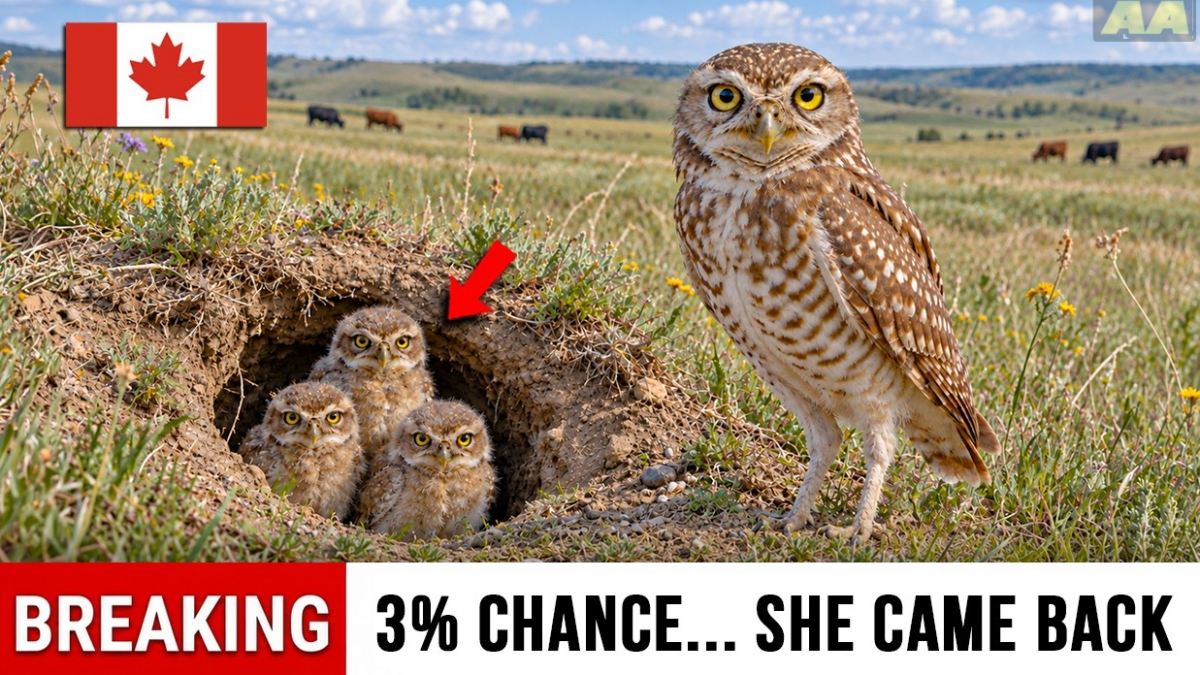
Two years earlier, she had been the smallest chick in her nest, the runt with a survival chance of only 3%.
She had been brought into human care, raised through a Canadian winter, and released in May 2023 into an artificial burrow on the Alberta prairie.
That autumn, she flew south to Mexico. Months later, she turned north again and traveled more than 2,500 kilometers toward the same grasslands where she had been released.
Then something happened that changed what the scientists thought was possible. Green 48 found a wild male.
She chose a nesting site 60 kilometers from her release location. A burrow scope revealed at least three nestlings beneath the prairie soil.
The bird that had barely been expected to survive her first year had crossed an international border, returned to Canada, found a mate, and begun raising a family.
But Green 48 was not supposed to be a miracle. She was supposed to be evidence of a desperate experiment.
So how did one of Canada’s most endangered prairie birds become the proof that a population could still find its way home?
To understand why Green 48 mattered, you have to go back to a time when the Canadian prairies looked nothing like they do today.
For roughly 10,000 years after the last glacial ice sheets retreated, grasslands stretched in a vast corridor from northern Mexico through the Great Plains and into southern Alberta, Saskatchewan, and Manitoba.
In Canada alone, prairie grasslands once covered approximately 141.5 million acres. This was not empty country.
It was one of the most productive ecosystems on the continent. Plains bison moved across the grasslands in enormous herds.
Their hooves disturbed the soil and created tiny patches of habitat that could support more plant diversity.
Their wallows created shallow depressions where water collected. Their dung supported beetles and microorganisms that helped keep the soil active.
And beneath the grass, another world was being built. Badgers excavated deep dens. Richardson’s ground squirrels created networks of tunnels beneath the soil.
Black tailed prairie dogs constructed underground towns with chambers and ventilation shafts. The prairie was full of holes.
And one small bird had learned how to use them. The burrowing owl, Atheni Kunicularia, was unlike most owls.
It was only about 20 centimeters tall. Its yellow eyes were enormous compared with its body.
Its legs were unusually long. It hunted during daylight rather than relying entirely on darkness.
And instead of building its own nest high in a tree or cliff, it lived underground.
But there was one problem. The owl could not dig the burrow itself. It depended on the work of other animals.
Badgers. Ground squirrels. Foxes. Coyotes. Prairie dogs. These animals created the underground homes, and the burrowing owl moved in afterward.
For thousands of years, that arrangement worked. Every spring, burrowing owls arrived from wintering areas in Mexico and the southern United States.
They found abandoned burrows. They lined them with dried vegetation and cow dung. Then they raised clutches that could contain six to ten chicks.
By late summer, young owls stood around burrow entrances, watching the prairie with enormous eyes and waiting for grasshoppers and other small prey to move within reach.
The landscape supplied almost everything they needed. Then the landscape began disappearing. The first enormous change was the removal of the plains bison.
By the late 1800s, the great herds that had once dominated the grasslands had been reduced to a few hundred animals in remote areas.
Without their grazing patterns, the structure of the prairie changed. Then the plow arrived. European settlement transformed the grasslands into one of the largest agricultural regions on Earth.
Native prairie was broken apart and planted with wheat, canola, barley, and lentils. By 1990, roughly 70% of Canada’s native grasslands had been converted to cropland, urban development, or industrial use.
Some provinces lost even more. Saskatchewan lost approximately 85% of its native grassland. Manitoba lost more than 75%.
Around 40% of prairie wetlands were drained. The changes moved through the food web. When grassland disappeared, so did many of the animals that maintained the burrows.
Badger numbers declined. Ground squirrel colonies contracted. Prairie dog towns were treated as pests and poisoned in some areas.
Fewer burrowing mammals meant fewer underground homes. Fewer underground homes meant fewer places for burrowing owls.
Then additional pressures appeared. Pesticides used against grasshoppers and rodents could accumulate in the prey eaten by owls.
Vehicles and wind turbines created hazards along migration routes. Energy development fragmented the remaining habitat.
The prairie was being altered from multiple directions at once. The population numbers became increasingly difficult to ignore.
From the early 1980s into the 2000s, Canada’s burrowing owl population fell by approximately 90%.
Saskatchewan held most of the country’s population, but even there the decline accelerated. The provincial population fell by 90% during the 1990s and another 76% between 2005 and 2015.
By 2006, estimates placed the national population between 800 and 600 birds. By 2017, the estimate had fallen to roughly 270 mature breeding individuals.
The federal recovery strategy under the Species at Risk Act had set a goal of 3,000 nesting pairs.
The actual population was less than one tenth of that target. In Manitoba, the bird had become almost absent.
The last confirmed wild nesting pair had been recorded in 2011. In British Columbia, the species had been declared extirpated as early as 1980.
The Committee on the Status of Endangered Wildlife in Canada had designated the burrowing owl as threatened in 1979.
It was upgraded to endangered in 1995. By 2003, the Species at Risk Act listed it as endangered and warned that it faced the possibility of disappearing from Canada entirely.
The prairie was still alive. But one of its most recognizable voices was becoming harder to hear.
The male burrowing owl’s low call at dusk had once been part of the grassland soundscape.
Now, in many places, it had vanished. But the story did not end with the decline.
It changed direction through a series of efforts led by people who refused to accept that the downward trend had to continue.
In Saskatchewan, one of the first organized efforts began in 1987. Nature Saskatchewan launched Operation Burrowing Owl.
The idea was simple. Instead of relying entirely on regulation, the program asked private landowners to voluntarily protect grassland habitat.
There were no binding legal agreements. No complicated restrictions on ranching. The central commitment was a handshake.
Keep the native grass intact. Report the owls nesting on the property. By the middle of the 1990s, more than 500 landowners had enrolled.
Together, they were protecting more than 148,000 acres of grassland. The program could not reverse the national decline by itself.
But it preserved something essential. Habitat. If the owls ever began returning, there would still be places for them to return to.
In British Columbia, another approach was taking shape. The wild population had already disappeared. So in 1990, the provincial ministry of environment began a captive breeding and reintroduction program.
Breeding facilities were established in Vancouver and Cam Loops. Twenty one wild caught founding birds from Washington State formed the starting population.
By 1992, captive raised owls were being released into artificial burrows across the Thompson, Nicola, and Okonogan valleys.
The program eventually became associated with the Burrowing Owl Conservation Society of British Columbia, chaired by Mike Mintosh.
The operation was never built around enormous budgets. Macintosh described it as a modest effort.
It did not have the massive facilities associated with some of the world’s most famous species recovery programs.
Instead, the funding came from unusual places. The Borrowing Owl Estate Winery in Oliver had been donating tasting fees to the effort since the early 1990s.
Since 2002, it had contributed more than $1 million. Community gaming grants also helped provide money for owl feed.
Between 1992 and 2024, the British Columbia program released 2,131 captive raised owls. Those birds produced 3,111 wild born chicks.
The numbers showed that reintroduction could create more than temporary populations. It could create birds that reproduced in the wild.
But Alberta was about to try something different. In 2016, Graham Dixon Macllum, a conservation research population ecologist with the Wilder Institute, launched a program built around a technique called headstarting.
The idea focused on the weakest point in the owl’s early life. Inside a burrowing owl nest, the last chick to hatch was usually the smalleSt.
It was weaker. It had fewer advantages over its older siblings. Its chance of surviving its first year was only around 3%.
That number changed the entire conservation question. Instead of raising every owl in captivity, why not intervene only with the chicks facing the lowest odds?
That became the headstarting strategy. Each summer, the team visited active burrowing owl nests. They identified the youngest owlet.
Then they carefully brought that bird into human care. The stronger siblings remained in the wild.
The collected owlet was transported to a conservation facility southeast of Strathmore, Alberta. There, veterinarians and animal care specialists took over.
The goal was not to turn the birds into tame animals. Quite the opposite. Caitlyn Slade, the animal care manager at the Archerald Biodiversity Center, described the approach as deliberately hands off.
Human contact was kept to a minimum. The birds lived in environments designed to resemble prairie conditions.
They had artificial burrows. They had open flight areas. Their diet included crickets, mealworms, and mice.
The birds were not handled unnecessarily. They were not treated like pets. They were not given the kind of constant human interaction that could make a wild animal dependent on people.
The objective was simple. Give the weakest chicks time. Time to grow. Time to develop flight muscles.
Time to develop a functioning immune system. Time to mature into birds capable of hunting and breeding.
The wild had almost no room for that process. The conservation facility could provide it.
When spring returned, the young owls were paired into male and female breeding groups. They were released onto Alberta prairie near the areas where they had originally hatched.
Artificial burrows were installed on working cattle ranches in southeastern Alberta. The release sites were carefully chosen.
Each pair entered an artificial burrow and remained inside a temporary netted enclosure during a short acclimation period.
Food supplements were provided. Once eggs were laid, the enclosure was removed. The owls were on their own.
Then the researchers watched. Every nest was monitored. Young birds were trapped and banded so they could later be identified.
Some adults received small solar powered satellite transmitters. The transmitters were worn like tiny backpacks.
They could send location information every minute for up to ten hours before recharging. For the first time, researchers could follow individual owls across thousands of kilometers.
They could watch a bird leave Alberta. They could follow it through the United States.
They could see when it reached Mexico. And then they could wait to see whether it came back.
The early results were deliberately cautious. The first groups were small. The scientists measured breeding success, fledgling survival, and return rates.
Nobody wanted to promise recovery before the evidence existed. Then the numbers began arriving. The breeding success rate among headstarted pairs reached 80%.
Four out of five released pairs successfully mated and produced young. Each successful pair produced around five or six owlets per clutch.
The results were better than expected. Much better. By 2023, the Wilder Institute had released 19 headstarted owls.
That spring, the 100th owl reached the prairie. The bird was a small sandy colored female.
The release took place at Canadian Forces Base Suffield within the Suffield National Wildlife Area.
The location was significant. It contained one of the last large areas of unplowed mixed grass prairie in Canada.
The area was roughly 260 kilometers southeast of Calgary. The military base was also unusual because it contained a federally designated conservation area within its boundaries.
It was not open to the public. Military training did not take place across the conservation area.
For the owls, it had become one of the country’s important release landscapes. But the most important evidence was not the number of birds released.
It was what happened afterward. The headstarted owls reproduced. Their offspring survived. And some of those offspring returned.
By 2022, the program had produced 152 fledglings from headstarted nests. Then came 2024. In that season, the team released 26 headstarted owls as 13 pairs.
Ten of those pairs successfully nested. Those ten nests produced 50 fledglings. Fifty new burrowing owls from one breeding season.
Then the return data began changing the story again. Nine owls from earlier cohorts returned to breed on the Alberta prairies.
One came from the 2022 cohort and made its third consecutive return from migration. Three others were offspring of headstarted parents from the 2023 and 2024 groups and returned for their second breeding season.
This was no longer simply a program releasing birds. It was beginning to create lineages.
Birds that had received help were producing offspring. Those offspring were migrating. Some were returning.
The process was beginning to reproduce itself. Graham Dixon Macllum described the results as a major success.
The birds were being cared for during winter, paired, released, and producing young. Then some were coming back from migration and nesting again.
For a scientist, that was important evidence. The headstarting approach was doing more than keeping individual owls alive.
It was helping establish another generation. And Green 48 became one of the clearest examples.
She had begun life as the smallest chick. The bird with a 3% chance. She spent a Canadian winter in human care.
She was released in May 2023. In October, she flew south to Mexico. Then, in March 2024, the satellite signal began moving north.
New Mexico. Colorado. Wyoming. Montana. Canada. More than 2,500 kilometers. The green dot moved toward Alberta.
Then it stopped. Green 48 had returned. She found a wild male. She nested at a site 60 kilometers from her release location.
The field team examined the burrow with a scope. At least three nestlings were inside.
The smallest chick had become a mother. And that changed the meaning of the entire experiment.
The goal had never been to create birds that could simply survive captivity. The goal was to create birds capable of becoming wild birds.
Green 48 had done exactly that. By then, the Wilder Institute had released 171 headstarted owls onto the Canadian prairies.
The cost per owl was far lower than many traditional captive breeding programs because the intervention was targeted.
The Archerald Biodiversity Center had opened in 2022 on 330 acres in Wheatland County. It supported multiple species recovery programs.
For the owl, the resources were focused on food, veterinary care, winter housing, field monitoring, and release.
But the owl could not be saved by indoor facilities alone. Its future depended on the grass.
And that created another problem. Less than 20% of native grasslands remained in Western Canada.
Those grasslands perform enormous ecological functions. They store carbon. They filter water. They reduce flooding.
They provide pollinator habitat. They support insects and small mammals. They also provide the burrows and hunting grounds that burrowing owls need.
A burrowing owl eats grasshoppers, beetles, mice, and other small prey. It helps regulate those populations without anyone needing to build a machine or operate a facility.
The owl simply lives on the prairie. But the prairie has an economic value to people too.
And that is where conservation becomes complicated. A cattle ranch can provide excellent burrowing owl habitat.
Cattle maintain shorter grass. Grazing can preserve the open structure the owls prefer. Ground squirrel colonies can remain in well managed pasture.
The relationship between ranching and burrowing owls is therefore not automatically a conflict. But grain crops can produce greater financial returns per acre.
Canola, wheat, and lentils can make the decision to retain pasture financially difficult. For a rancher facing those pressures, keeping native grassland may be good for wildlife while being harder on the household budget.
When grassland is plowed, the owls lose more than grass. Burrows collapse. Ground squirrel colonies can disappear.
The insects that once fed the owls are replaced by managed crops. Ian Cook, the grassland conservation manager at Birds Canada, described the dilemma clearly.
Burrowing owls can live in cattle pasture. They cannot make the same home in wheat, canola, or lentil fields.
So conservation programs have tried to create reasons for landowners to preserve grass. The Species at Risk Partnerships on Agricultural Lands program, run by Environment and Climate Change Canada, provides results based incentives to ranchers who protect habitat for species at risk.
Operation Burrowing Owl has continued its voluntary approach in Saskatchewan. More than 360 private landowners have enrolled, protecting nearly 150,000 acres.
But the remaining landscape is still under pressure. The energy industry creates another layer of conflict.
Within the Suffield National Wildlife Area, Cenovus proposed drilling 1,275 natural gas wells. Conservation groups including the Alberta Wilderness Association and Nature Canada formed a coalition opposing the development.
They argued that drilling would fragment habitat used by nearly 100 plant and animal species at risk.
The federal decision was delayed for years. The issue was not abstract. The same landscape being used to release endangered owls was also being considered for energy development.
Then there was the human relationship with the land. When Alex Froz began working with landowners in southwestern Manitoba, some people were reluctant to report burrowing owls.
They worried about what an endangered species designation might mean. Would government officials impose restrictions?
Would inspectors arrive? Would ranchers lose control over their own land? Froz did not solve that problem with a new regulation.
She spent time with people. She worked with landowners. She listened to their concerns. She built relationships.
She spent months living in the region and learning how ranchers understood their own land.
That trust became part of the recovery effort. In Manitoba, the work had started in 2013.
Froz founded the Manitoba Burrowing Owl Recovery Program after completing a master’s degree examining whether reintroduction was possible.
She installed more than 350 artificial nest burrows on private land. She released captive bred pairs.
And then something happened that had not been seen for years. Wild migrating burrowing owls began using those artificial burrows.
By 2022, wild owls had returned to Manitoba’s nesting sites for the third consecutive year.
Trail cameras captured males decorating their burrows with pieces of cow manure. They stood on the soil mounds.
They called for mates. The birds were not simply occupying artificial structures. They were behaving as if those structures belonged in their landscape.
Over the course of the program, 72 pairs had been released. Sixty four built nests.
One hundred sixty six owlets fledged. The target for Manitoba was modeSt. The goal was to restore between 23 and 25 breeding pairs.
For a species that had become nearly absent from the province, that number represented an enormous change.
British Columbia was experiencing its own version of the same recovery. The Upper Nicola Band, a Silix community in the Nicola Valley, had been operating a burrowing owl program since 2016.
The owl has deep cultural meaning within Silix culture. It is regarded as a guardian, guide, and messenger.
Loretta Holmes, an Upper Nicola member and senior resource technician, described the species as part of cultural identity.
The recovery program was therefore not simply about adding birds to an ecosystem. It was also about restoring a relationship between people and a species that had been disappearing from the land.
Artificial burrows were installed on the grasslands of the Douglas Lake Reserve. By 2026, the program had produced 125 wild born fledglings.
Both captive born and wild born owls were returning to breed. On Earth Day 2026, the Upper Nicola Band marked ten years of the effort by releasing six more owls into their traditional territory.
A nine year old boy named John Smithers held one of the small birds before releasing it.
The moment connected generations. A child held a species that had nearly vanished from the landscape.
Then he opened his hands. The owl returned to the grass. In 2023, another development brought these separate efforts closer together.
The Burrowing Owl Alliance was formalized as a national coordination body. Programs in British Columbia, Alberta, Saskatchewan, and Manitoba could now share data, coordinate releases, and align recovery strategies.
The owls did not recognize provincial borders. Their migration routes crossed them every year. The conservation effort was finally beginning to do the same.
But one enormous obstacle remained. Migration. Every autumn, burrowing owls from the Canadian prairies travel thousands of kilometers south.
Their winter range includes Mexico and the southern United States. The journey takes them through landscapes filled with roads, cities, agricultural chemicals, energy infrastructure, and wind farms.
The Canadian conservation teams cannot protect every bird along that entire route. A bird can leave Alberta in perfect condition and encounter danger thousands of kilometers away.
The migration journey remains one of the hardest parts of the species’ recovery. That is why the numbers must be viewed carefully.
The recovery goal of 3,000 nesting pairs remains far away. The national breeding population remains critically small.
The grasslands continue to face conversion pressure. Migration continues to expose the owls to hazards beyond Canada’s borders.
Funding remains uncertain. Programs can lose public support or face rising costs. The British Columbia program has dealt with increasing expenses, including frozen mice whose price has roughly doubled.
Mike Macintosh has described the entire operation as a low budget effort. That is not simply a statement about money.
It shows how much recovery can depend on people continuing to care. The programs are working, but they are working inside a landscape worth billions of dollars to agriculture and energy.
The owl needs a burrow. The rancher needs a viable ranch. The farmer needs a viable crop.
The energy company needs access to resources. The conservationist needs habitat. The Indigenous community needs its relationship with the species respected.
None of these realities can simply be erased. The recovery effort works when those interests find enough room to coexiSt.
That is what makes the return of Green 48 so meaningful. She did not return to a pristine prairie untouched by people.
She returned to a working landscape. She nested on land shaped by ranching. She used an artificial burrow.
She found a wild mate. She raised young. She migrated thousands of kilometers and came back.
Her story was not about recreating the past exactly as it had been. It was about giving an endangered species enough space to build a future.
Late in May, a biologist walks across the Alberta prairie. The grass is short. The wind moves across the open land.
There is almost nothing to block the horizon. She carries a burrow scope. She approaches a low mound of dirt and kneels.
Around the entrance is dried cow dung. A small head appears. Yellow eyes look back.
The biologist checks the green band. Green 48. The same owl that once had a 3% chance.
The same bird that was once the smallest chick in a neSt. The same bird that spent a winter under human care.
The same bird that flew to Mexico. The same bird that returned across more than 2,500 kilometers.
Now she is raising another generation. The prairie does not announce what happens next. It simply continues.
A grasshopper moves through the short grass. An owl watches. A rancher checks a fence.
A ground squirrel disappears into a burrow. A young owl waits beneath the soil. And somewhere far away, another person is deciding whether a patch of grass should remain grass or become something else.
That decision may seem small. But for an animal that depends on the prairie, small decisions accumulate.
One burrow matters. One nesting pair matters. One protected pasture matters. One migration matters. One returning bird matters.
Green 48 was once the weakest chick in a neSt. The prairie gave her almost no margin.
A team of people gave her more time. She used that time to become something the models could not guarantee.
A wild bird. A migrant. A mate. A mother. And now her chicks carry the story forward.
The burrowing owl recovery effort is not finished. The numbers are still low. The habitat is still under pressure.
The migration routes are still dangerous. The funding is still fragile. But the direction has changed.
Headstarting is producing breeding birds. Artificial burrows are being occupied. Wild migrants are returning to Manitoba.
Indigenous led programs are restoring both wildlife and cultural connections. Ranchers are protecting grassland. Scientists are following individual birds across continents.
And the prairies are answering in the only language they have. A bird returns. Then another.
Then another. A nest appears where there had been none. A burrow that was built by people becomes home.
A chick emerges from the darkness. It looks around at the grass. Its parents are nearby.
The wind moves over the prairie. And for the first time in a very long time, the future of the burrowing owl does not look like a straight line downward.
It looks like a path. A narrow one. A difficult one. But a path leading somewhere.
And perhaps that is what Green 48 was really showing the people who watched her green band move north across the map.
A recovery does not begin when a population becomes large. It begins when one individual survives long enough to return.
Then another returns. Then one of them raises young. And eventually, if enough of those small victories connect, the prairie begins to remember what it sounds like to have burrowing owls living on it again.
Disclaimer: This content may be created by Al for entertainment purposes. Any resemblance to real persons, events, or places is coincidental.








