“Can I Stay in Your Bed?” Asked the Alien Girl Who Only Cost a Sandwich a Week
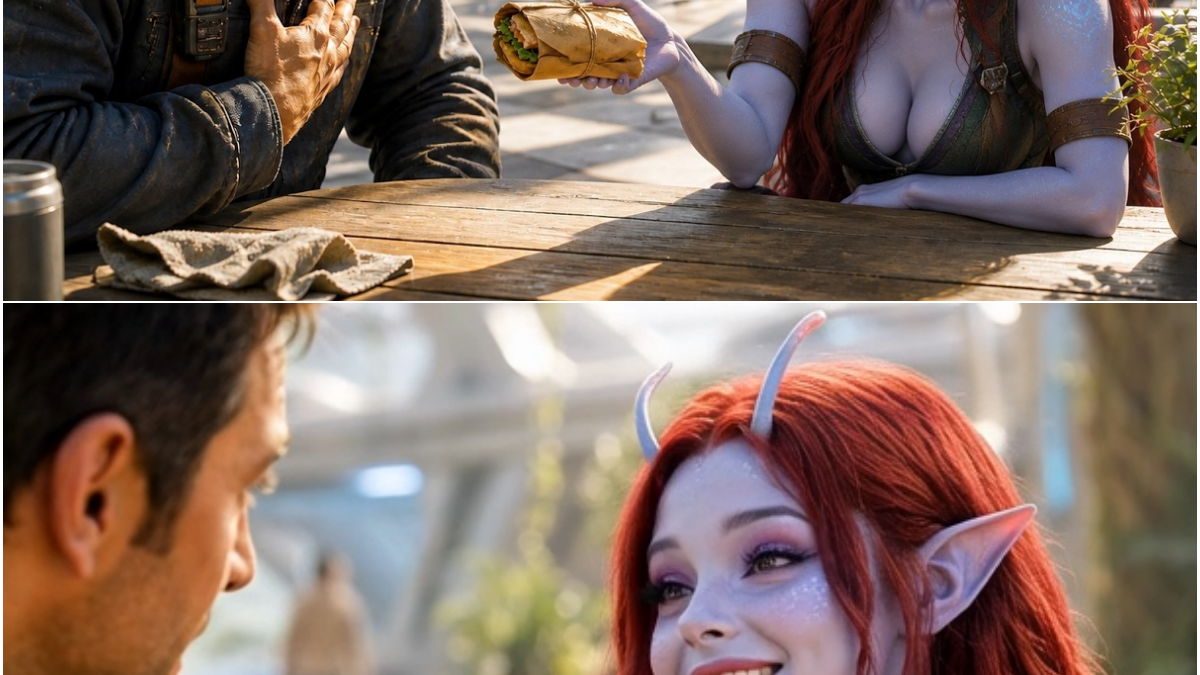
The little blue girl stood beneath the flickering streetlamp on Fenwick Street and watched Gareth Holloway lock his sandwich shop for the night.
She had been watching him for seven days, always from the same patch of pavement, always keeping enough distance between them to disappear if anyone looked too closely.
The settlement lights reflected in her enormous amber eyes, but she never seemed interested in the passing ships, the cargo haulers, or the bright signs that promised entertainment to travelers.
She watched the door of Gareth’s shop. That evening, Gareth noticed her. He stood with one hand on the lock, his coat pulled tightly around him against the evening chill.
For twenty two years, he had opened that little shop every morning and closed it every night.
For the last three years, he had done it without Mara, the woman who had once filled the place with laughter and conversation.
Now there was only Gareth, the empty upstairs rooms, and the quiet walk home. But the child across the street was still there.
She was tiny, blue skinned, thin, and wrapped in clothes far too worn for a child her size.
She looked at the darkened shop as though it had been the brightest place in the entire settlement.
Gareth wondered what she wanted. Then the girl stepped forward. She crossed the street slowly, stopped several paces away, and lifted her chin with the solemn courage of someone making the most important bargain of her young life.
“I don’t have money,” she said. Gareth waited. “But I can trade.” She swallowed. “I’ll be your family for one sandwich a week.”
Gareth stared at her. And for the first time in three years, the quiet inside him broke wide open.
What kind of life could teach a child to put a price on something as precious as belonging?
Gareth Holloway had run the little sandwich shop on Fenwick Street for twenty two years, and he had learned a great deal about people during that time.
He knew who liked their bread toasted until it was crisp around the edges. He knew which customers wanted extra sauce and which wanted none at all.
He knew that old Henrik always pretended he did not want vegetables, even though Mara had discovered years ago that he secretly liked them.
Mara had remembered everything. She remembered birthdays, favorite meals, difficult anniversaries, arguments between neighbors, good news from distant worlds, and which travelers were likely to need a quiet place to sit for an hour.
She had made the little shop feel larger than it was. After she was gone, Gareth kept the business open because closing it felt impossible.
The shop had been theirs. So he opened every morning. He prepared the bread. He sliced the vegetables.
He heated the grill. He served the regulars. Then, every evening, he locked the door and walked home alone.
The settlement of Ashworld was not a large place, but it was busy enough to make loneliness easy to hide.
Humans lived there alongside dozens of alien species. Traders arrived with cargo from distant systems.
Refugees passed through on their way toward safer worlds. Pilots slept in cheap boarding houses.
Mechanics, merchants, miners, travelers, and people simply looking for somewhere to begin again filled the streets.
Gareth served all of them. He never asked where someone came from before handing them a meal.
He never charged extra because someone looked strange. He had inherited that habit from Mara.
“Food first,” she used to say. “Questions later.” Gareth had followed the rule for years.
But after Mara was gone, the shop had become quieter. Then Pip appeared. At first, Gareth thought she was simply another child passing through.
She was so small that he assumed she was younger than eight, though he knew almost nothing about her species.
Her skin was a soft dusk blue, her eyes were enormous and amber colored, and two small ridges curved gently along the sides of her head.
Her clothing had once been respectable. Now it was patched, faded, and several sizes too large.
For nearly a week, she stood across the street. She watched the customers. She watched the tables.
She watched people laugh. Most of all, Gareth eventually realized, she watched people belong. She noticed Henrik saving food for the stray animals near the alley.
She noticed two elderly sisters holding hands beneath their table every Thursday. She noticed workers coming in exhausted and leaving with smiles.
She noticed families. Gareth understood what she was looking at because he knew that feeling.
He had spent three years watching other people live ordinary lives while standing outside his own.
The child was hungry, certainly. But hunger was not the only thing in her eyes.
She was hungry for a place. A person. A door that would open when she approached.
Gareth tried to ignore her. He told himself the frontier was full of children who needed help.
He told himself he had enough troubles. He told himself he was one man with a small shop and no experience raising children, especially not children from another species.
None of those thoughts lasted very long. On the fourth morning, he made an extra sandwich.
He wrapped it carefully. Then he crossed Fenwick Street. The child immediately stepped backward. Gareth stopped.
He remembered something Mara used to do with frightened children. She never crowded them. So he stayed several paces away and held out the sandwich.
“It’s just food,” he said. “You looked hungry.” Pip stared at the package. “No charge,” Gareth added.
“No catch.” She did not move. Gareth waited. Finally, she stepped forward and accepted it.
Her fingers were small. Very small. She unwrapped the sandwich carefully and took a bite.
Then another. She did not eat quickly. She ate like someone who had learned that food could disappear without warning.
Gareth watched without saying anything. When she finished, she folded the wrapper into a neat square.
“Thank you,” she whispered. “You’re welcome.” She looked at him. “I don’t have money.” “I figured.”
“But I can trade.” Gareth frowned. “For what?” She looked toward his shop. “For being family.”
Gareth said nothing. “I can be your family for one sandwich a week,” she continued.
“I’m good at it. I’m quiet. I don’t take much space. I can help clean.
I can learn things. I can be useful.” She looked directly into his eyes. “Is that a fair trade?”
Gareth could not answer. The child waited. Then she seemed to misunderstand his silence. “I can do more,” she said quickly.
“Two things. Maybe three. If one sandwich is not enough.” “It’s not a fair trade,” Gareth finally said.
Her shoulders dropped. “Oh.” She nodded as if she had expected rejection all along. “That’s all right.”
She took one step backward. “Thank you for the sandwich.” “It’s not a fair trade because you’re offering too much.”
She stopped. Gareth crouched slowly until they were closer to the same height. “Pip, is it?”
She nodded. “You’re offering to be somebody’s family for one sandwich.” “Yes.” “That’s worth a whole lot more than one sandwich.”
Pip looked confused. Gareth continued gently. “Come inside.” Her eyes widened. “Inside?” “You can eat properly.”
“I can pay.” “No.” “I can work.” “No.” “I can clean.” “Maybe later, if you want to help.
But not because you owe me.” Pip stared at him. “You don’t owe me anything,” Gareth said.
“You’re hungry. Hungry children get fed. That’s all there is to it.” “But everything costs something.”
“Not everything.” She shook her head. “That isn’t how the world works.” “Maybe the world taught you wrong.”
Gareth stood and opened the shop door. “Come on.” Pip remained on the sidewalk. “What do I have to give?”
“Nothing.” Her expression became even more uncertain. “Nothing?” “Nothing.” She followed him inside. The shop smelled of warm bread, grilled vegetables, roasted meat, and spices.
Pip stopped just inside the doorway. She looked around as though she had entered a palace.
Gareth pointed toward the corner table. “Sit.” She sat. He prepared a meal. Not a sandwich.
A real meal. He brought her soup, bread, vegetables, and a dish he had recently learned was safe for her species.
Pip looked at the food. Then at Gareth. “Really?” “Really.” She ate. Slowly at firSt.
Then with increasing confidence. Gareth stood behind the counter and watched. The little girl looked around between bites.
Nobody chased her away. Nobody demanded payment. Nobody asked what she could offer. When she finished, she sat quietly with both hands around the empty bowl.
Gareth noticed her eyes growing heavy. “You tired?” She nodded. “You got somewhere to sleep?”
She looked down. That was answer enough. Gareth closed the shop later than usual. Upstairs, he had a small sewing room that Mara had once used.
It had been empty for years. He cleaned it. He found fresh blankets. He placed a lamp beside the bed.
“You can sleep here tonight.” Pip stood in the doorway. “Just tonight?” “As long as you need.”
She stared at him. “For free?” “For free.” She looked as if the answer hurt.
Then she climbed onto the bed. Gareth closed the door halfway. He heard her breathing become uneven.
A few minutes later came the quiet sound of crying. He did not enter. He understood that sometimes a person needed privacy even when they were hurting.
That night, Pip slept safely under a roof. And Gareth discovered that the house did not feel empty anymore.
The truth about Pip came slowly. She had arrived on Ashworld months earlier aboard a refugee transport.
Her father had been gone before the journey began. Her mother had brought her across the stars with almost nothing.
They had expected to build a new life. Instead, the first months had been filled with sickness, shortages, and uncertainty.
Pip’s mother had become too weak to continue caring for her. Then Pip was alone.
She was eight by human reckoning. She knew almost nobody. She spoke trade standard well enough to survive, but not well enough to understand the complicated systems of the settlement.
She learned to survive by finding scraps, making tiny trades, and avoiding anyone who looked dangerous.
Eventually she discovered Gareth’s shop. She watched it because it was warm. But more than that, she watched it because people inside seemed to matter to one another.
Weeks later, she told Gareth why she had chosen him. “I picked your shop because you looked sad.”
Gareth nearly dropped a plate. “I looked sad?” “Yes.” “How could you tell?” “You looked like me.”
He stared at her. “You were lonely.” Gareth turned toward the grill. Pip continued. “I thought maybe a lonely person could help another lonely person.”
She smiled faintly. “I thought two lonely people could make one not lonely family.” Gareth swallowed.
“That was the idea?” “Yes.” He nodded slowly. “That was a good idea.” “It was?”
“Best one anybody ever had.” Pip smiled. After that, life changed. Not instantly. Pip still tried to earn everything.
She swept the floor before breakfaSt. She cleaned tables. She folded napkins. She tried to refuse new clothes unless she could offer something in return.
One morning Gareth found her standing on a chair, cleaning the windows. “You don’t have to do that.”
“I’m helping.” “You’re supposed to be eating breakfaSt.” “I can eat after.” “No.” She looked down.
“But I need to earn it.” Gareth set down the cup in his hand. “You don’t earn breakfaSt.”
“But I live here.” “Yes.” “So I should help.” “You can help because you want to.”
Pip frowned. “But if I don’t help, will I still get breakfast?” “Yes.” “If I make mistakes?”
“Yes.” “If I break something?” “Yes.” “If I’m difficult?” Gareth sighed. “Yes.” “If I’m not useful?”
He walked over and lifted her down from the chair. “You are not here because you’re useful.”
Pip looked at him. “You’re here because you’re Pip.” He placed the breakfast plate in front of her.
“This is your home.” She looked at the food. Then at him. “How long?” “As long as you want.”
“Really?” “Really.” She ate. Slowly, the girl changed. The constant tension in her shoulders began to fade.
She laughed more. She asked questions. She learned the names of customers. She began sitting at the counter instead of hiding in the corner.
She started helping Gareth prepare meals because she enjoyed it. She learned how to knead dough.
She learned which spices worked with which ingredients. She became fascinated by the grill. One afternoon she burned six sandwiches.
Gareth looked at the ruined food. Pip looked terrified. “I’m sorry.” Gareth studied the sandwiches.
Then he laughed. Pip stared. “You’re laughing?” “Yep.” “Why?” “Because I once burned twelve.” She laughed too.
It was the first time Gareth had heard her laugh without hesitation. The sound stayed with him all evening.
Elsie Mah came to the shop the following morning. She had been Mara’s closest friend.
She had known Gareth for decades. When she saw Pip, she stopped. Then she looked at Gareth.
Then back at Pip. “Oh,” Elsie whispered. “What?” “You finally have someone to look after.”
Gareth smiled. “I suppose I do.” Elsie crouched beside Pip. “What’s your name?” “Pip.” “Well, Pip, I’m Elsie.”
Pip shook her hand. Elsie smiled. “I think we’re going to get along.” They did.
Elsie became part of Pip’s life almost immediately. She brought clothes. She brought books. She brought small toys.
She brought stories about Mara. Pip wanted to hear every one. “What was she like?”
Elsie would smile. “Your father will tell you she was stubborn.” “She was.” Gareth would call from the kitchen.
“She was wonderful,” Elsie continued. “She was.” Gareth’s voice softened. Pip listened. Mara became part of the household even though she was no longer there.
Her recipes remained. Her favorite cups remained. Her photographs remained. Her friends remained. Pip learned that loving someone who had been part of Gareth’s past did not make her less important.
Instead, Mara became another thread in the family they were building. One evening Pip asked Gareth something she had been carrying for weeks.
“Can I miss my mother and still love you?” Gareth looked at her. “You don’t have to choose.”
“I thought maybe I should.” “No.” “I don’t want to forget her.” “You won’t.” “I don’t want loving you to mean I forgot her.”
“It doesn’t.” Gareth sat beside her. “I still miss Mara.” Pip leaned against him. “So you understand?”
“I understand.” They sat quietly. “Your heart isn’t a cupboard with one shelf,” Gareth said.
“It can hold more than one person.” Pip smiled. “That sounds like something Mara would say.”
“She probably would.” Another few months passed. Pip began school. It was difficult at firSt.
She was different. Children noticed. Some were curious. Some were kind. A few were cruel.
Gareth never pretended those things would never happen. Instead, he taught Pip how to stand firmly in the world without becoming hard because of it.
And the settlement slowly adopted her. Henrik brought her pastries. Elsie took her shopping. The sisters from the Thursday table taught her card games.
The mechanic next door taught her how engines worked. The schoolteacher learned enough about her species to make sure Pip was properly cared for.
Ashworld became home. Then came the visit from Cory Vance. Cory worked for the settlement welfare authority.
She was responsible for displaced children. She arrived at Gareth’s shop one afternoon with a folder under her arm.
“mr. Holloway?” “Yes?” “I need to speak with you about Pip.” Gareth went still. Pip was upstairs doing homework.
“What about her?” “There are questions concerning her guardianship.” Gareth’s jaw tightened. “She lives here.”
“I know.” “She is safe.” “I believe you.” “Then what’s the problem?” “The law requires formal authorization.”
Gareth stared at her. “What are you saying?” “I’m saying that taking in a displaced child informally is not enough.
There are procedures.” “You want to remove her?” “No.” Gareth did not believe the answer.
“No?” “I want the arrangement formally assessed.” Gareth leaned against the counter. “She stays here.”
“That is not entirely my decision.” “It is mine.” “mr. Holloway.” “I’ll complete every form.”
“Good.” “I’ll answer every question.” “Good.” “You can inspect the shop.” “Yes.” “My home.” “Yes.”
“You can speak to Pip.” “Yes.” “But she stays here while you do it.” Cory studied him.
“That may be possible.” “It needs to be.” Pip came downstairs. She saw Cory. Then she saw Gareth’s expression.
She understood immediately that something was wrong. “Who is she?” “This is Cory Vance.” Pip looked at the folder.
“Why is she here?” Cory softened. “To make sure you’re safe.” Pip looked at Gareth.
“I am safe.” “I know,” Cory said. Pip looked suspicious. “Then why are you checking?”
“Because that is my job.” Pip looked at Gareth again. He reached across the counter.
She took his hand. The assessment lasted several months. Cory inspected the shop. She inspected the apartment.
She spoke with Pip privately. She interviewed customers. She spoke with Elsie. She examined Gareth’s finances.
She reviewed his medical records. She checked the school’s reports. Everywhere she looked, she found the same thing.
Pip was thriving. One afternoon, Cory sat across from Pip in the small dining room.
“Do you want to stay with Gareth?” “Yes.” “Why?” Pip thought carefully. “He doesn’t make me earn anything.”
Cory looked at her. “What do you mean?” “I offered him a sandwich trade.” “A what?”
“One sandwich a week.” Pip explained everything. “He said family wasn’t something I could sell.”
Cory smiled faintly. “And what do you think now?” Pip looked toward the kitchen. “I think he was right.”
“Do you feel safe here?” “Yes.” “Do you feel loved?” Pip nodded. “Yes.” “Do you want to leave?”
Pip’s expression became serious. “No.” Cory closed the folder. “Then I think I have what I need.”
The paperwork took time. Gareth completed everything. He attended meetings. He answered questions. He signed forms.
Finally, the adoption became official. That evening, Gareth placed the papers on the table. “I have something for you.”
Pip looked at them. “What is it?” “Your name.” She read the document. “Pip Holloway.”
Gareth nodded. “If you want it.” She stared at the name. “Forever?” “Forever.” She touched the paper.
“I’m really your daughter?” “You’ve been my daughter for a long time.” “But now it’s official?”
“Yes.” Pip began crying. Gareth hugged her. “I thought I had nothing,” she whispered. “You had yourself.”
“I thought that wasn’t enough.” “It was always enough.” She held him tighter. “I offered you one sandwich a week.”
“I remember.” “And I got a whole father.” Gareth laughed through wet eyes. “You got a whole father.”
“And a home.” “And a home.” “And a name.” “And a name.” Pip smiled. “I made a good trade.”
Gareth shook his head. “No trade.” She looked at him. “No trade?” “No trade.” He touched her forehead gently.
“You gave me yourself because you thought you had to buy a family.” “Yes.” “And I got you because I wanted you.”
Pip smiled. “That sounds better.” “It is.” Her first birthday in the Holloway home was something she did not understand.
Gareth explained that birthdays were celebrations. “For what?” “For you.” “Just me?” “Just you.” “Why?”
“Because you were born.” Pip stared at him. “That deserves a party?” “Absolutely.” “How many people come?”
“As many as love you.” She became nervous. “How many is that?” Gareth smiled. “We’ll find out.”
Half the settlement arrived. Elsie brought a cake. Henrik brought a small wooden puzzle. The schoolchildren brought drawings.
The mechanic brought a tiny model engine. Cory brought a book. Pip stood in the center of the shop and stared at all of it.
“This is for me?” “Yes.” “All of it?” “Yes.” She began to cry. Elsie hugged her.
“You’re allowed to be happy.” “I know.” “You don’t look like you know.” Pip laughed through her tears.
“I’m learning.” Gareth watched her that evening. The little blue girl who had once stood across the street counting the customers in his shop was now running between tables while people called her name.
The transformation was almost impossible to believe. But Gareth understood something. Pip had not been changed by food alone.
She had been changed by certainty. By knowing that tomorrow had a place for her.
By knowing that breakfast would come. That the bed would still be hers. That Gareth would still be there.
That Elsie would knock on the door. That school would begin in the morning. That she did not have to earn any of it.
She was finally learning how to be a child. Years passed. Pip grew taller. Her clothes changed.
Her voice became stronger. She became an excellent cook. Eventually, she could run the shop better than Gareth.
“You’re taking my customers,” he complained one evening. “They like my sandwiches.” “They like mine.”
“They told me otherwise.” “Traitors.” Pip laughed. The little shop became famous across Ashworld. Not because it served the finest food.
Not because it was the largest restaurant. People came because they knew what the place meant.
If someone was hungry, they could eat. If someone was lonely, they could sit. If someone needed a quiet table, Gareth found one.
And Pip learned to notice the same things her father had once noticed. She saw the traveler sitting alone.
She saw the child lingering near the door. She saw the worker counting coins before ordering.
She saw the person pretending not to be afraid. And she remembered herself. So she fed them.
No questions. No payment. No trade. One afternoon, a young boy stood outside the shop.
He was small, nervous, and clearly trying to decide whether to enter. Pip walked outside with a sandwich.
The boy stepped backward. She stopped. “I won’t come closer.” He stared at her. She held out the sandwich.
“It’s free.” He shook his head. “I don’t have anything.” “I know.” “I can work.”
“You can eat firSt.” The boy hesitated. Pip smiled. “My father taught me that hungry children get fed.”
She held out the sandwich. “No trade.” The boy finally took it. Pip watched him eat.
And for a moment, she saw herself standing there years earlier. A tiny alien girl.
One sandwich. One offer. One chance. Gareth stood in the doorway watching. “You’ve become your old man,” he said.
Pip turned. “I learned from the beSt.” “I just made sandwiches.” “You made a home.”
Gareth smiled. “That too.” Pip walked back inside. “Dad?” “Yes?” “Do you ever think about that first sandwich?”
“Every day.” “I thought I was buying a family.” “You were trying.” “I didn’t understand.”
“No.” “But you did.” “I understood loneliness.” Pip looked at him. “And you understood me?”
“Eventually.” She smiled. “That’s enough.” Years continued. Gareth grew older. The shop eventually became Pip’s.
But he still came in every morning. He still complained about her coffee. He still insisted that the old grill worked better.
Pip still told him he was wrong. The shop remained warm. The tables remained full.
Mara’s recipes remained on the menu. Her memory lived in the little details. The spice blend.
The bread. The way the tables were arranged. The flowerpot beside the window. Pip knew she was part of a story that had begun before her.
She did not resent that. She loved it. She understood that family was not always about replacing one person with another.
Sometimes it was about making room. One evening, Gareth sat at the counter watching Pip close the shop.
She counted the tables. Checked the kitchen. Turned off the lights. Then she joined him.
“You tired?” “A little.” “You did good.” “I always do good.” He laughed. “Confident now.”
“You taught me.” “I taught you nothing of the sort.” “You taught me everything important.”
Gareth looked at her. Pip leaned against his shoulder. “I used to think family was something you bought.”
“I know.” “Now I think it’s something people give each other.” Gareth nodded. “That’s better.”
“And I think I understand why you said my offer wasn’t a fair trade.” “Why?”
“Because I was offering everything I had.” He looked at her. “And you were asking for one sandwich.”
Pip smiled. “I was worth more than that.” “You were worth everything.” She rested her head against him.
“So were you.” They sat quietly in the warm shop. Outside, Ashworld carried on. Ships came and went.
Lights moved across the night sky. People walked Fenwick Street. Some hurried. Some wandered. Some were searching for somewhere to belong.
Inside the little sandwich shop, Gareth Holloway and Pip Holloway sat together, father and daughter, exactly as they had become all those years ago.
There had been no grand ceremony at the beginning. No great promise. No complicated bargain.
Only a hungry child and a tired man. One sandwich. One open door. One simple refusal to put a price on belonging.
And that had been enough to change two lives. Pip eventually put a small sign above the counter.
Some things are free. Gareth read it and smiled. “What about the sandwiches?” “The sandwiches cost money.”
“I was worried for a moment.” Pip laughed. “But if someone truly needs one?” Gareth nodded.
“Then?” “No charge.” “Good.” She looked at the sign. “I think Mara would like it.”
Gareth looked toward the photograph behind the counter. “I think she would.” Pip smiled. “Then we’ll keep it.”
They did. And the little shop on Fenwick Street became known for more than food.
It became known as the place where nobody had to prove they deserved kindness. The place where a hungry child could sit down without fear.
The place where strangers became regulars. Where regulars became friends. Where friends became family. And whenever someone asked Pip why she had chosen that shop all those years ago, she always gave the same answer.
“I saw a lonely man.” Then she would smile. “And I thought he might need a family.”
People always laughed softly when she said it. But Pip never laughed at the memory.
Because she remembered standing across the street. She remembered being small. She remembered believing that everything had a price.
And she remembered the man who had looked at her and told her that some things were too important to trade.
Gareth had taught her that belonging was not something she had to purchase. It was not something she had to earn.
It was not something she had to make herself useful enough to deserve. It was simply something she could receive.
And once she understood that, she spent the rest of her life giving the same lesson away.
Free of charge. Just as Gareth had given it to her. One sandwich at a time.
Disclaimer: This content may be created by Al for entertainment purposes. Any resemblance to real persons, events, or places is coincidental.








