BRAZIL’S Swamp Got Invaded By Wild Pigs — What They Protected Stunned Scientists
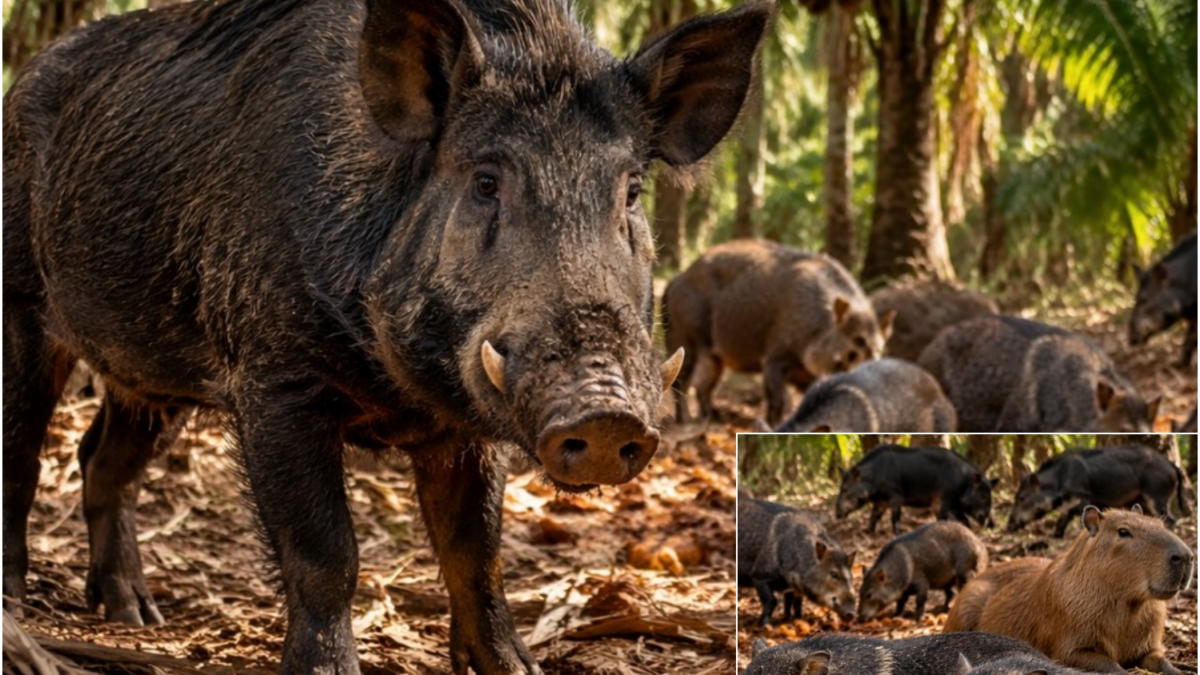
There were 255 skulls lying in the grass of Brazilian cattle ranches, collected one by one beneath the open sky.
When researchers finally counted what those skulls belonged to, the result seemed almost impossible. Nearly nine out of every ten were pigs.
The native peccaries, animals that had lived across the Pantanal long before ranches, roads, or fences, were barely represented.
If people had simply been taking whatever wild animal crossed their path, the bones should have told a completely different story.
Instead, the skulls revealed something stranger. An animal considered one of the world’s worst invasive species was absorbing most of the hunting pressure while native wildlife remained in the landscape.
The explanation did not begin with modern conservation plans or government programs. It began with a war in the 1860s, with ranchers living far from towns, with cooking oil that was difficult to obtain, and with a local tradition built around a wild pig.
For more than a century, people and animals had created an arrangement nobody had deliberately designed.
The pig was hunted, but it was also raised, protected, fattened, and released back into the floodplain.
It became food, fuel, and eventually something much stranger, a kind of shield between hunters and the native animals they might otherwise have pursued.
But then another set of skulls appeared decades later. Their measurements suggested that the pig itself was changing.
Not simply becoming a European wild boar, but moving toward a form that had never existed before.
How could an invasive animal become part of an ecosystem while simultaneously changing the very ecosystem that had allowed it to survive?
To understand the strange story of the Pantanal pig, you first have to forget the version of Brazil most people imagine.
There is no endless wall of jungle covering the landscape here. The Pantanal is a wetland, immense and constantly changing, stretching across roughly 140,000 square kilometers inside Brazil before continuing into Bolivia and Paraguay.
During the wet season, rivers spread across the plains until enormous areas become shallow inland water.
Then the dry season arrives, the flood retreats, and grasslands, lagoons, mudflats, and islands of forest appear again.
It is one of the richest wildlife regions in South America. Jaguars rest beside rivers.
Caiman gather in astonishing numbers. Capybara graze in family groups. Giant anteaters cross open country in daylight.
Herds of peccaries move through forest patches, searching for fruit and roots. Yet almost all of this landscape is working land.
Around 95% of the Brazilian Pantanal is private property. Families have raised cattle here for two centuries.
Ranches stretch across enormous areas, and many are separated from towns by long journeys through floodplain and foreSt.
That matters because people who live far from markets have always needed food that could be obtained locally.
They hunted peccaries. They hunted deer. They hunted tapirs and capybara. The practice was not necessarily driven by a desire to remove wildlife from the landscape.
It was part of life. Wild meat was food, and food had to come from somewhere.
Across tropical South America, ecologists have documented what can happen when hunting continues while forests remain standing.
The trees survive. The green canopy remains. The landscape still looks wild from a distance, yet many of its larger animals gradually disappear.
In the early 1990s, conservationist Kent Redford gave this phenomenon a memorable name, the empty foreSt.
The Pantanal seemed as though it should have followed the same path. Yet it did not.
Brazil had already introduced an important legal change. In 1967, commercial and recreational hunting of native wildlife was banned.
The pelt and skin trade that had once placed enormous pressure on caiman and big cats eventually declined.
But laws written far away could not completely replace the practical needs of people living days from the nearest town.
Something else had been happening on the ranches. To understand it, researchers had to go back more than a century.
The Paraguayan War began in the 1860s and became the bloodiest conflict in the history of South America.
Paraguay fought Brazil, Argentina, and Uruguay. During the opening months, Paraguayan forces pushed north into the Brazilian province of Mato Grosso and into the Pantanal.
Ranches were raided. Settlements were emptied. People fled. Among the animals left behind were pigs descended from Iberian breeds brought across the Atlantic centuries earlier by Portuguese and Spanish settlers.
They were dark, hardy animals accustomed to roaming. Some had probably entered the floodplain before the war, but researchers believe the upheaval of the 1860s was probably when many of the pigs became truly wild.
The historical record is incomplete. The outcome is not. When people eventually returned, the pigs remained.
They spread across the floodplain, feeding on fallen palm fruit and roots, moving through mud, surviving floods and dry seasons, and navigating a landscape where jaguars still prowled.
Their chances were also improved by an older human habit. Early settlers had spent generations shooting jaguars and pumas to protect cattle.
With fewer large predators in some areas, pigs had more opportunities to survive and reproduce.
Over generations, a local form emerged. It was smaller than a European wild boar, with adults averaging around 40 kilograms.
People called it porco montero, roughly meaning the pig of the bush. Eventually, the animal became part of everyday life across much of the Pantanal.
And then, in 2002, a researcher named Arnaud Debierre arrived. He was working with the Royal Zoological Society of Scotland and Embrapa Pantanal, the regional arm of Brazil’s agricultural research agency, while completing doctoral research through the Durrell Institute of Conservation and Ecology at the University of Kent.
Working alongside him was Alexine Keuroghlian of the Wildlife Conservation Society in Brazil. Keuroghlian had been studying peccaries in the Pantanal since 2000.
Few people knew these animals better. Their central question was surprisingly simple. Why was hunting not stripping the Pantanal of its large wildlife?
The researchers knew that simply asking hunters could produce incomplete answers. People might describe their habits differently when speaking to outsiders, especially researchers arriving with notebooks and scientific questions.
So the team approached the problem from several directions. Between April 2004 and November 2005, they conducted 97 interviews across 71 ranches in the central Pantanal.
Instead of relying entirely on written hunting records, they created a register based on drawings.
A ranch worker could identify an animal using pictures. Male or female. Fat or thin.
Pregnant or not. Taken with a gun or with a knife. The system was simple enough to work even when written records were difficult to maintain.
Then the researchers began collecting skulls. Around a research station called Numirim and on nearby ranches, skulls had been left in the grass after hunters removed the head and feet from pigs.
There was a practical reason for this. A hunter traveling on horseback did not want to carry unnecessary weight across a huge ranch.
The skulls remained behind beneath the sun. And eventually, scientists began reading them. The interviews produced an extraordinary pattern.
Every one of the 71 ranches reported hunting pigs. Only 18% of hunters said they had taken a white-lipped peccary during the previous five years.
Only 13% had taken a collared peccary. But 93% identified the feral pig as their preferred wild meat.
The skulls told an even clearer story. Teeth preserve a record of age. As an animal grows older, its teeth gradually wear down.
By examining that wear, researchers can estimate how long the animal had lived. The peccary skulls mostly belonged to older animals.
The pigs showed the opposite pattern. There were almost twice as many young adults as old animals.
That pattern resembled what researchers had observed in hunted white-lipped peccary populations in the Peruvian Amazon.
The bones were confirming what the people had told the researchers. The pig was absorbing the hunting pressure.
But the researchers discovered something even stranger. The ranch workers were not simply hunting the pigs.
They were managing them. A worker tending cattle might catch a young male pig, castrate it, mark it, and release it again.
The animal would then spend the next six to ten months moving freely through the ranch, feeding and gaining weight.
When it was eventually taken, it had become a capado. A fattened, castrated male. And the capado was the prize.
The hunting registers revealed just how systematic the practice had become. Of 102 males recorded as taken, 91 had been castrated.
Among 90 females, only four were pregnant. Hunters repeatedly described sparing pregnant females. Meanwhile, ranch workers were castrating more than seven times as many young males each month as the number of capados they eventually took.
The pattern was not random. People were managing the population without writing down a formal management plan.
They were directing the harvest toward males, protecting females that could reproduce, and allowing the remaining animals to continue supplying future hunts.
The pig had effectively become a self-restocking pantry. There was another reason the capado mattered.
It was not only the meat. It was the fat. A large capado could provide between 20 and 30 liters of fat.
That fat could be rendered and used as cooking oil. On more than half of the ranches surveyed, landowners did not provide cooking oil for workers.
Buying it required a trip to town and money that many workers did not have.
On ranches without electricity, rendered pig fat offered another advantage. Fried meat sealed in tins of fat could remain usable for months.
Cattle provided plenty of beef under normal conditions, but the wet season created problems. Meat could not easily be dried during prolonged rain.
The pig filled that gap. It became Sunday barbecue. It became festival food. It became something shared between neighbors who traveled across the ranches on horseback.
Hunting usually involved horses and dogs. In open floodplain, a pig might be caught with a lasso and finished with a knife.
In forest, hunters more often used firearms. A skilled hunter earned respect. And the meat was shared.
This was the strange center of the story. An animal introduced from another continent was becoming a replacement for native wildlife in the human diet.
Every pig brought home represented a peccary, deer, or tapir that had not been taken.
Debierre and his colleagues eventually described the feral pig as a replacement species. It supplied something that native wildlife had traditionally supplied.
It was abundant. It was familiar. It was accessible. And it cost nothing to obtain.
The researchers published their findings in Oryx in 2011. At first glance, the story seemed almost too neat.
An invasive animal was damaging the ecosystem, yet the same animal was protecting native wildlife by absorbing hunting pressure.
But the scientists refused to call the situation a victory. The pig was still changing the landscape.
The question was whether the protection it accidentally provided was greater than the damage it caused.
And that question became harder to answer as more research appeared. In 2015, a team led by Mauro Galetti placed camera traps beneath fruiting trees.
The cameras revealed substantial overlap between feral pigs and white-lipped peccaries. That mattered because white-lipped peccaries are not ordinary forest animals.
They can travel in herds numbering in the hundreds. They require enormous areas of habitat.
Across South America, they have disappeared from large portions of their former range and are listed as vulnerable.
The cameras showed another effect. Where pigs were present, collared peccaries changed the time of day when they approached food.
The invader was not merely sharing the foreSt. It was changing the schedule of the native animals.
Other research revealed a physical advantage. Studies of skull mechanics showed that the Pantanal pig could root much more powerfully than either peccary.
It could dig holes more than three times as deep. That ability mattered because pigs eat young acuri palm seedlings, and the acuri is one of the important fruit sources for wildlife in the region.
Pigs also take eggs from ground-nesting birds and caiman. They carry parasites, including one capable of causing illness in horses.
On roughly one ranch in ten, people reported that large males sometimes attacked newborn calves or lambs.
The shield had limits. The same hunting culture that spared peccaries and deer did not necessarily spare jaguars.
Big cats were generally shot when encountered. The pig could protect one part of the wildlife community while doing nothing for another.
So the Pantanal pig could not honestly be called either hero or villain. It was part of a trade.
And that trade appeared to work as long as the surrounding conditions remained stable. Then another animal entered the story.
Brazil had already been dealing with European wild boar. The species crossed from Uruguay into Rio Grande do Sul in 1989.
During the 1990s and into the 2000s, wild boar meat became fashionable in Brazilian restaurants.
Animals were imported from Uruguay, Argentina, and France. Farms began breeding them. Some were crossed with domestic pigs to create larger, faster-growing animals.
The hybrids became known as javaporco. At the end of the 1990s, Brazil tightened rules surrounding boar farming.
Some animals were released. Others escaped. The result was a spreading population of free-ranging wild boar and hybrids.
The invasion reached the Pantanal. In 2002, in the Pantanal subregion of Nhecolândia, a commercial operation began crossing European wild boar with the local porco monteiro.
The intended product was a more unusual meat. The resulting animal was given another name.
Javonteiro. It happened in the same broad part of the Pantanal where researchers had been gathering those sun-bleached skulls.
The market for boar meat eventually weakened. The animals remained. By 2013, Brazil had moved to stop new boar farms and authorize nationwide control of free-ranging wild boar and hybrids.
But by then, a much more difficult question had emerged. What had all that interbreeding done to the old porco monteiro?
Fernando Securo had already studied Pantanal pig skulls in the 1990s. As a young researcher, he had examined the jaws and neck mechanics of pigs and peccaries.
Decades later, working between the University of the State of Rio de Janeiro and the University of Aveiro in Portugal, he returned to the subject.
Among his colleagues was Luiz Flamarion de Oliveira of Brazil’s National Museum. Together, they assembled 76 adult skulls from museum and research collections.
Some came from Pantanal pigs collected in the 1990s. Others came from the 2000s. Others came from the 2010s.
The researchers also examined European wild boar from southern Brazil and Argentina, along with several known hybrids.
Then they measured the skulls. Again, the bones revealed something that was difficult to see in the living animals.
The Pantanal pig skull had become broader across the face. At the same time, the attachment areas for the powerful neck muscles used to lift the head and drive the snout into the soil had become progressively smaller.
The calculations suggested that newer pigs had less head-lifting force. Their rooting stroke may have become weaker.
Then came the detail that changed the entire interpretation. The newer Pantanal pigs did not simply resemble European wild boar.
Their skulls were not moving neatly toward the wild boar shape. They were becoming something else.
A new form. Something that had not previously existed in the Pantanal. The known hybrids from southern Brazil and Uruguay looked surprisingly similar to many of the pigs collected during the 2010s.
The researchers concluded that introduced wild boar had likely influenced the evolution of the Pantanal pig within only a few decades.
And nobody could yet say exactly what that would mean. A different skull can mean a different feeding strategy.
A different rooting ability can change how an animal disturbs soil. Changes in feeding can alter competition with peccaries.
Changes in behavior can affect how pigs respond when horses and dogs enter the foreSt.
The animal that had once become a strange buffer for native wildlife was changing again.
There was also a legal problem. The traditional porco monteiro occupied one category. European wild boar and hybrids occupied another.
Hunters were expected to distinguish them. But when animals are interbreeding, the boundary becomes harder to see.
Then came another disturbance. In 2020, the Pantanal experienced fires on a scale few people had witnessed before.
A later survey estimated that around 17 million vertebrates were directly affected by the fires.
The consequences for an ecosystem already under pressure could not be separated neatly from everything else.
Securo’s team pointed out that during difficult periods, when floods, fires, or droughts reduce available food, the competitive advantages of pigs may become more important.
A pig that can root deeply and search efficiently for food may cope differently from a peccary.
The balance between them can shift. And the human side of the old arrangement is changing too.
The system that protected native wildlife was never created by conservationists. It depended on people living a particular kind of life.
It depended on ranch workers traveling on horseback. It depended on dogs. It depended on knives.
It depended on the practice of castrating young males and allowing them to grow in the wild.
It depended on pregnant females being spared. It depended on rendered fat when cooking oil was difficult to obtain.
It depended on preserving meat in tins when electricity was unavailable. It depended on neighbors sharing what they brought home.
But ranch life does not remain frozen in time. Roads improve. Freezers become more common.
Supermarkets replace some of the need for local supplies. Cooking oil becomes easier to purchase.
Younger workers may grow up with different routines from their grandparents. Each change can improve daily life for people.
At the same time, each change can loosen one of the threads holding the old relationship together.
That is what makes the Pantanal story so difficult. If people hunt fewer pigs because modern food supplies are easier to access, the pig may receive less pressure.
If the pig receives less pressure, its influence on peccaries and other wildlife may increase.
If wild boar and hybrids continue spreading, the traditional porco monteiro may become harder to distinguish and harder to conserve.
If fire, flood, drought, or changing food availability alters competition, an animal that once filled a useful role may become more disruptive.
Nothing happens in isolation. The Pantanal has never behaved like a laboratory where one variable can be changed while everything else remains untouched.
The pig is connected to the rancher. The rancher is connected to the cattle. The cattle are connected to the jaguar.
The pig is connected to the peccary. The peccary is connected to the foreSt. The forest is connected to the flood.
And the flood is connected to the entire rhythm of the wetland. That is why the 255 skulls matter.
They were not simply bones left behind by hunters. They were records. The first collection showed a population being harvested in a completely different pattern from the native peccaries.
The age structure of the skulls showed that people were directing pressure toward pigs. The castration records explained why.
The interviews explained the cultural and economic reasons. The pigs were not merely surviving alongside people.
People had built a relationship with them. It was informal, practical, and passed from one generation to another.
Then the later skull collection told another story. The animal itself was changing. The broadening face.
The changing muscle attachments. The altered mechanical calculations. The resemblance to hybrids. The possibility that the porco monteiro was becoming something new.
Two collections of bones, separated by decades, had revealed two completely different secrets. The first secret was about people.
The second was about evolution. And neither secret offered a simple answer. For generations, the Pantanal pig had taken the pressure that might otherwise have fallen on native animals.
That does not erase the damage it caused. It does not make an invasive species native.
It does not make competition disappear. It does not explain what happens when wild boar genetics enter the population.
It simply shows that an animal’s role in an ecosystem cannot always be understood from its origin alone.
An introduced animal can become deeply embedded in human culture. A hunted animal can become a managed food source.
A species capable of damaging native wildlife can simultaneously reduce pressure on other species. And an animal that once filled one ecological role can change as its environment changes around it.
The Pantanal therefore offers no comfortable ending. There is no single button marked remove the invader.
There is no guarantee that taking away the pig would restore the landscape to an earlier condition.
There is no certainty that leaving the pig alone would preserve the balance that existed for more than a century.
There is only the evidence contained in bones, interviews, camera traps, ranch traditions, and the animals still moving through the foreSt.
At dawn, peccaries still travel through the forest islands. Jaguars still move along riverbanks. Caiman still gather where the water remains.
Pigs still cross the grasslands and feed beneath palms. The wetland remains full of life, despite everything that has happened there.
That may be the most important lesson hidden among the skulls. Nature does not always divide itself into simple categories.
Native and invasive. Good and bad. Protected and harmful. Instead, relationships accumulate over time. A war changes where animals live.
A ranching tradition changes what people hunt. A shortage of cooking oil gives value to animal fat.
A hunting preference changes which species absorb pressure. A new animal arrives from another country.
A hybrid appears. A skull changes shape. And suddenly, a system that seemed stable begins moving toward a future nobody can describe with confidence.
The old porco monteiro was shaped by history. The new pig may be shaped by another history now.
And somewhere in the grass of the Pantanal, another skull may already be waiting beneath the sun, carrying evidence of what happens when an animal, a landscape, and human tradition spend long enough changing one another.
The question is no longer simply whether the pig belongs there. The harder question is what the Pantanal itself will become if the relationship that held everything together for so long finally begins to change?
The answer may not be written in a law, a hunting register, or a scientific prediction.
It may already be waiting in the next set of bones.
Disclaimer: This content may be created by Al for entertainment purposes. Any resemblance to real persons, events, or places is coincidental.








