Australia Released 50 Dingoes Into a Reserve — 4 Years Later, the Ecosystem Was Unrecognizable
Imagine standing in the Australian outback where the horizon seems too wide for the human eye to hold.
Red earth stretches toward distant hills, dry salt pans shine beneath a white sky, and for miles there appears to be almost nothing moving through the scrub.
Yet beneath that silence, something has been changing for more than a century. The little animals that once tunneled through the soil have almost vanished from the open country.
The grasses have thinned. The ground has hardened beneath the sun. Foxes and feral cats have moved through the landscape with little resistance, while kangaroos have grazed enormous areas until the vegetation could barely recover.
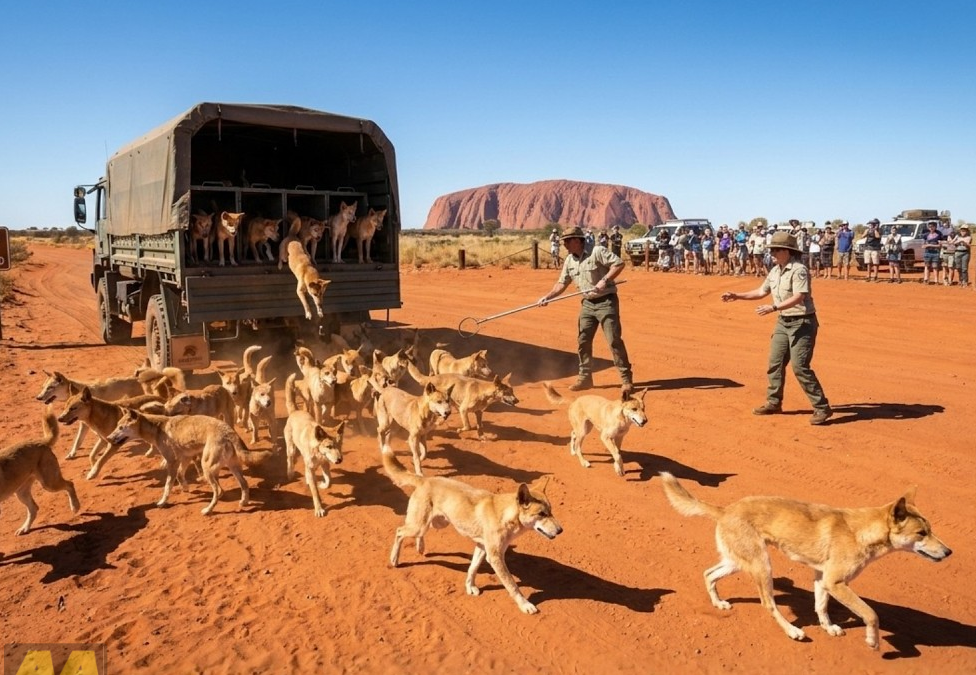
Then, in a decision that sounded reckless to many people watching from outside the project, ecologists loaded 50 dingoes into a trailer and drove them into a protected reserve covering more than a million acres.
They released them into country where ranchers expected the worSt. Four years later, the researchers returned with cameras, measurements, and years of observations.
What they found was not the landscape everyone expected. The grass had returned. Small digging mammals were appearing again.
The soil was changing. Water was remaining in the ground longer. And the most important work the dingoes had done was not simply the animals they hunted.
It was the animals they frightened, the movements they changed, and the space they gave the rest of the ecosystem to recover.
So how could 50 predators transform a million acres without needing to control every corner of it?
To understand what happened in that reserve, you first have to go back to the beginning of the ecological imbalance.
For generations, the dingo had occupied an unusual place in the Australian landscape. It was large, intelligent, adaptable, and capable of traveling enormous distances through some of the harshest country on the continent.
But when European settlers expanded into Australia, the relationship changed. Sheep and cattle were brought into country where dingoes already hunted.
To pastoralists, the animals became a threat to livestock. The response grew steadily more aggressive.
Bounties were offered. Poison baits were spread. Dingoes were shot. And eventually, an enormous fence was built across the continent.
The dingo fence extends for more than 5,600 kilometers through southeastern Australia. It became one of the longest human made structures anywhere, created largely to keep dingoes away from grazing country.
From a purely agricultural perspective, the idea seemed straightforward. Reduce the predator. Protect livestock. But ecosystems rarely respond to a single change in such a simple way.
The dingo was not merely another hunter moving through the bush. It occupied the upper part of a complicated food web.
Below it were smaller predators, including the red fox and the feral cat. Both had arrived with European settlement, and both were remarkably effective hunters.
When dingoes became scarce, foxes and cats gained more freedom. They could move through country with less pressure.
They could search more widely. They could spend more time in places where small native animals lived.
And the animals at the bottom of that chain had very few ways to compensate.
Australia experienced an extraordinary decline in its native mammal diversity following European settlement. More than 30 native mammal species disappeared from the continent during that period, an exceptionally severe pattern compared with other regions.
Many of those animals were small. They lived close to the ground. They dug burrows.
They searched for seeds, fungi, insects, roots, and other food beneath the soil. And they were exactly the kind of animals that foxes and feral cats could find.
The feral cat became especially difficult to control because of its ability to survive across enormous areas.
Estimates suggest that feral cats across Australia kill well over a billion native animals every year.
That number is almost too large to picture. But imagine instead a landscape where every night brings another hunt, another movement through grass and scrub, another small animal forced to remain hidden.
Now imagine removing the larger predator that once made those smaller hunters cautious. That was the problem the ecologists wanted to reverse.
They were not simply trying to add another animal to the reserve. They were trying to restore a missing relationship.
The reserve was located in the New South Wales outback and covered more than a million acres.
For decades, people had tried to protect its native wildlife. Fences were installed. Baits were used.
Predators were controlled. The landscape was managed carefully. Yet recovery remained limited. Foxes and cats continued to move through the country.
The remaining populations of native digging mammals survived only in scattered pockets. The question facing the researchers was uncomfortable.
What if the problem was not that the reserve needed more protection? What if it needed the old predator back?
The proposal sounded simple. Bring dingoes into the reserve. Track them. Watch what happened. Then allow the ecosystem time to respond.
Fifty dingoes were selected. They were fitted with GPS tracking collars so researchers could follow their movements.
The animals were transported to the reserve. The trailer moved deeper into the red country.
Inside were 50 predators that had been absent from much of that landscape for generations.
When the doors finally opened, the dingoes stepped onto the sand. Some moved immediately. Others paused.
Then they disappeared into the scrub. The researchers began watching. The ranchers who knew the country had serious concerns.
A dingo is a capable hunter. There were still vulnerable native animals in the reserve.
What if the newly released animals simply hunted everything they could find? What if the attempt to repair one problem created another?
The scientists had the same questions. That was why the GPS collars mattered. So did the camera traps.
They could not simply assume the project worked. They needed evidence. The first change was not dramatic.
There were no spectacular scenes. No sudden transformation of the landscape. Instead, something much quieter happened.
The foxes began changing their behavior. Camera traps that had regularly captured foxes moving across open country began recording fewer of them in the center of the reserve.
The animals had not necessarily vanished. They were changing where they went. They were avoiding places where dingoes were active.
That distinction turned out to be the key. Dingoes did not need to chase every fox.
They did not need to control every feral cat directly. Their presence alone altered the decisions those smaller predators made.
Ecologists call this the landscape of fear. The phrase sounds dramatic, but the mechanism is remarkably practical.
An animal survives by making choices. Where should it hunt? Where should it rest? How far should it travel?
When should it cross open ground? Where should it raise its young? A fox living without larger predators can take risks.
A fox sharing its territory with dingoes cannot take the same risks. Open ground becomes dangerous.
Long journeys become more costly. Certain hunting areas become too exposed. The fox begins staying closer to cover.
The feral cat faces similar pressure. The dingo does not need to appear every hour.
The scent is enough. A distant howl is enough. Tracks are enough. The possibility of an encounter is enough.
That possibility spreads farther than the animal itself. A pack of dingoes may occupy only a portion of a million acre reserve, but their presence can influence how other predators use much larger areas.
It is almost as though an invisible boundary has been drawn across the landscape. And once the foxes and cats changed their behavior, another group of animals gained something they had not possessed for generations.
Space. The first animals to benefit were the diggers. Bilbies. Betongs. Bandicoots. Small marsupials that spend much of their lives close to the soil.
They may not look impressive beside a kangaroo or a large predator, but their importance to the ecosystem is enormous.
These animals are engineers. They dig. They turn soil. They move organic material. They create small depressions where seeds and leaves collect.
They open the ground to rain. A single betong can turn over several tons of soil in a year.
That means one animal moving through the landscape at night can perform work that would require enormous human effort to reproduce.
Now imagine thousands of those small actions taking place across a recovering reserve. The ground begins to change.
A shallow excavation catches a seed. Another catches a fallen leaf. Another creates a pocket where water can enter instead of running across the hardened surface.
Organic material gathers. The soil becomes more active. Moisture remains longer. Roots have a better chance to establish.
The connection is easy to miss because it does not happen all at once. The dingoes do not dig the soil.
They do not plant seeds. They do not make grass grow. They simply create conditions under which the animals that perform those jobs can return.
That is what made the recovery so unusual. The dingoes were not rebuilding the reserve themselves.
They were changing the behavior of other animals. Those animals then changed the soil. The soil changed the plants.
The plants changed the habitat. And the habitat supported more animals. One relationship opened the door for another.
Then another. The chain continued. The green began returning. Country that had once looked bare and exhausted began holding more vegetation.
The grasses gained room to recover. The soil became less exposed. The small mammals had more places to forage.
The reserve was not simply becoming greener. It was becoming more complicated again. That mattered because a healthy ecosystem is not just a collection of species.
It is a network of interactions. Remove one important interaction and the consequences can travel much farther than anyone expects.
The dingoes were revealing that principle in real time. But there was another part of the story that was even less obvious.
Kangaroos. At first, bringing back a predator might sound like bad news for kangaroos. Dingoes do hunt kangaroos.
Yet researchers looking at the whole landscape saw another effect. Without a large predator, kangaroo populations can become concentrated in productive areas.
Once a mob finds good grazing, it can remain there. The animals feed. They return.
They feed again. Over time, the vegetation can struggle to recover. Grass becomes shorter. Cover disappears.
The soil becomes more exposed. Smaller animals lose shelter. Seeds have fewer places to establish.
The system begins moving toward a simpler and more fragile state. Dingoes change that behavior.
Their presence encourages kangaroos to remain alert and mobile. The animals do not necessarily need to be hunted constantly.
They simply cannot treat every rich patch of vegetation as completely safe. That keeps grazing more spread out.
It gives plants time to recover. The result is another indirect effect. The dingo sits at the top of two different chains.
One runs downward through foxes and cats. The other reaches toward large grazers such as kangaroos.
At first glance, 50 animals scattered across more than a million acres should barely matter.
But they do not need to physically occupy every acre. Their influence travels through the behavior of other animals.
That is the strange power of an apex predator. Its presence can reach much farther than its body.
Researchers studying the dingo fence had already seen evidence of this pattern. The fence provides an accidental experiment stretching for more than 5,600 kilometers.
On one side, dingoes remain more common. On the other, generations of control have reduced them.
The soil can look similar. The rainfall can be similar. The sky is the same.
The seeds are the same. But the animal communities can differ dramatically. Where dingoes remain, foxes and cats experience greater pressure.
Small mammals can have more room. Vegetation can be denser. Where dingoes have been heavily reduced, foxes and cats can move more freely.
Small mammals become harder to find. Vegetation can become thinner. In some parts of the desert, the boundary can appear almost like a seam.
One side looks healthier. The other looks more exposed. The difference is so striking that people traveling through the country have described the fence as a visible ecological line.
It was never designed as a scientific experiment. Yet it became one. A team of ecologists at the University of New South Wales, led by researcher Mike Lenik, spent years studying these differences.
They used surveys, remote observations, and drones to examine the landscape from above. What they found suggested that predator removal could eventually influence more than animals.
It could influence the physical structure of the land. Vegetation affects soil. Soil affects water movement.
Water affects plants. Plants affect erosion. And erosion affects the shape of the landscape itself.
That means removing a predator can eventually alter the ground. The effect is not immediate.
It takes years. That detail is essential. The viral version of rewilding stories often makes ecological recovery sound instantaneous.
Release the predator. The landscape changes. Everything returns. Nature is rarely that simple. The dingo story is much more interesting because the recovery took time.
The researchers watched. They measured. They waited. Four years passed. Four years is a long time for a human project.
For an ecosystem, it can be only the beginning. That is why the later observations mattered.
The grass was standing higher. Small mammals were returning. The soil was being disturbed by diggers.
Water was remaining in parts of the landscape longer. The reserve was beginning to behave differently.
But there was an important complication. Not every controlled experiment has produced the same result.
Some studies that removed dingoes for shorter periods did not find an immediate cascade. Fox numbers did not always explode.
Small mammal populations did not always change dramatically. Sometimes areas with and without dingoes looked surprisingly similar.
That does not necessarily mean the larger pattern is wrong. It means ecosystems have conditions.
A predator may need enough time and enough territory to influence another predator. The response may also depend on rainfall, vegetation, prey availability, and the particular region being studied.
In wetter and more productive country, the effect can be less obvious. In dry, low productivity landscapes, where every species is operating close to its limits, the effect can become stronger.
Time is part of the mechanism. That may be the most important lesson from the reserve.
Restoration is not a switch. You do not press a button and receive a finished ecosystem.
You create a condition. Then you allow thousands of relationships to respond. The dingoes changed fox behavior.
Fox behavior changed the opportunities for small mammals. Small mammals changed the soil. The soil changed water retention.
Water retention changed vegetation. Vegetation changed habitat. And habitat changed which animals could survive there.
The original 50 dingoes were only the beginning. Their presence allowed other processes to restart.
That is why the phrase landscape of fear is so useful. Fear sounds like a negative force.
In this context, it became a form of regulation. The dingo did not have to hunt every fox.
The possibility of encountering a dingo was enough to change where the fox hunted. The dingo did not have to remove every kangaroo.
The presence of a predator encouraged kangaroos to move. The dingo did not touch a blade of grass.
But its presence helped create conditions in which grass could return. The animal at the top of the food web was influencing the landscape without physically controlling most of it.
That is an extraordinary idea. And it helps explain why the disappearance of apex predators can produce effects far beyond the predators themselves.
The same broad principle has been observed in other parts of the world. The wolves of Yellowstone provide one famous example.
When wolves returned to Yellowstone in the 1990s, they changed the behavior of elk. The elk became more cautious in certain areas.
Their grazing patterns changed. Vegetation responded in some locations. Wolves also placed pressure on coyotes, another smaller predator.
The details of the Yellowstone story have often been simplified in popular retellings, and the idea that wolves literally redirected rivers is not supported as a simple explanation.
But the broader ecological principle remains important. Apex predators can alter ecosystems through behavior as well as direct hunting.
Australia’s dingoes demonstrate the same principle with an entirely different cast of animals. The deeper you look, the more the reserve becomes a story about connections rather than one species.
The bilby is connected to the soil. The soil is connected to water. The water is connected to grass.
The grass is connected to kangaroos. Kangaroos are connected to dingoes. Dingoes are connected to foxes and cats.
And foxes and cats are connected to the survival of the smallest animals. Remove one relationship and the entire network can begin shifting.
Restore one relationship and other pieces may begin moving back into place. That is what the ecologists were really testing.
They were not asking whether 50 dingoes could control a million acres. They were asking whether restoring one missing relationship could allow the landscape to regulate itself again.
The answer emerging from the reserve was complicated, but powerful. The dingoes did not need to dominate.
They needed to belong. Once they belonged, the rest of the ecosystem could respond to their presence.
There is also a deeper cultural history behind the animal itself. For tens of thousands of years, Aboriginal peoples across Australia developed relationships with dingoes that differed sharply from the view introduced by European pastoral expansion.
In many Aboriginal cultures, the dingo, or warle, has been understood as a companion, a protector, and an important part of the living country.
The animal was not simply viewed through the narrow question of whether it helped or harmed livestock.
It existed within a larger understanding of country. That perspective matters because modern ecological science is now arriving at questions that traditional knowledge has considered for a very long time.
What happens when one important part of a landscape is removed? What happens when the relationships between animals and country are interrupted?
And what happens when those relationships are restored? The answers are rarely simple. But the reserve offered one remarkable demonstration.
Bring back the predator. Then wait. Do not expect the predator to do every job.
Let the smaller animals return. Let them dig. Let the grass grow. Let the soil change.
Let water remain. Let the system rebuild its own connections. Four years after those 50 dingoes were released, the reserve no longer looked like the place the researchers had entered at the beginning.
The change was not caused by the teeth of the dingoes alone. It was caused by everything those teeth represented.
Pressure. Movement. Caution. Space. Balance. The fox became more careful. The cat became more cautious.
The kangaroo became more mobile. The bilby gained room. The betong began turning the soil.
The bandicoot moved through the recovering vegetation. Seeds found disturbed ground. Rain found new pathways into the soil.
Grass found moisture. And the landscape began holding itself together again. That is why the story of the 50 dingoes is so much stranger than a simple predator restoration story.
The animals did not rebuild the reserve by force. They changed the rules under which everyone else lived.
That was enough. And perhaps that is the most important lesson hidden in the red country.
An ecosystem does not always collapse because one species disappears from the landscape. Sometimes it collapses because the relationships disappear with it.
Remove the predator. The fox changes. The cat changes. The kangaroo changes. The small mammal changes.
The soil changes. The plants change. The water changes. Eventually, the landscape itself changes. But restore the missing relationship, and the process can begin moving in the opposite direction.
Not instantly. Not perfectly. Not everywhere in exactly the same way. But slowly. Patiently. One interaction at a time.
The 50 dingoes were not a magic solution. They were a beginning. Their greatest influence was not measured by how many animals they hunted.
It was measured by how many animals changed their behavior simply because the dingoes were there.
That invisible pressure traveled farther than any single pack could travel. It moved through scent.
Through tracks. Through distant howls. Through instinct. Through memory. And eventually through the vegetation itself.
The reserve became a demonstration of something easy to forget when looking at nature from a distance.
The wild is not built from isolated pieces. It is built from relationships. A predator can influence prey.
Prey can influence plants. Plants can influence soil. Soil can influence water. Water can influence everything.
And sometimes the smallest visible change begins with something almost impossible to see. A fox deciding not to cross an open flat.
A kangaroo moving before sunset. A betong returning to a patch of soil. A bilby digging beneath a recovering grassland.
A seed landing in a tiny depression. That is how a million acres can begin changing.
Not all at once. Not with a dramatic moment. But through thousands of quiet decisions made by animals that do not know they are rebuilding an ecosystem.
Four years after the release, the researchers could see the results. The grass stood higher.
The small mammals were returning. The soil was more active. The water remained longer. The reserve had begun to breathe differently.
And at the center of that transformation were 50 animals that many people had spent generations trying to keep away from livestock country.
The dingo had not returned as a conqueror. It had returned as part of the system.
That difference changed everything. So the next time you look across a seemingly empty stretch of Australian outback, remember that emptiness can be misleading.
A red plain may look silent while thousands of small decisions are taking place beneath the grass.
A fox may turn away from an open flat because it smells a dingo. A kangaroo may move before the vegetation is exhausted.
A betong may dig through the soil after sunset. A seed may settle into the small hollow left behind.
Rain may fall weeks later and enter the ground instead of running away. None of those events seems important by itself.
Together, they can reshape a landscape. And that may be the strangest thing the 50 dingoes revealed.
The force that restored the reserve was not simply hunting. It was presence. It was pressure.
It was the invisible knowledge spreading through the ecosystem that the old rules had returned.
The country had a predator again. And once the predator returned, everything beneath it began remembering how to live around it.
Fifty dingoes entered a million acres. Four years later, the land looked different. The creeks held water longer.
The grass had room to rise. The diggers were working the soil. The small mammals were finding space again.
And a landscape that had been moving in one direction for more than a century had begun moving another way.
Perhaps that is what restoration really means. Not rebuilding nature piece by piece. Not controlling every animal.
Not deciding exactly what every acre should become. Sometimes it means putting one missing piece back where it belongs, then stepping aside long enough to see what the rest of the living world can do for itself.
The 50 dingoes could not rebuild the outback alone. They did not need to. They only needed to remind the landscape that they were there.
And the landscape remembered.
Disclaimer: This content may be created by Al for entertainment purposes. Any resemblance to real persons, events, or places is coincidental.








