Australia Released 2 Poisoned Dingoes on an Island Full of Goats — What Happened Next Was Incredible
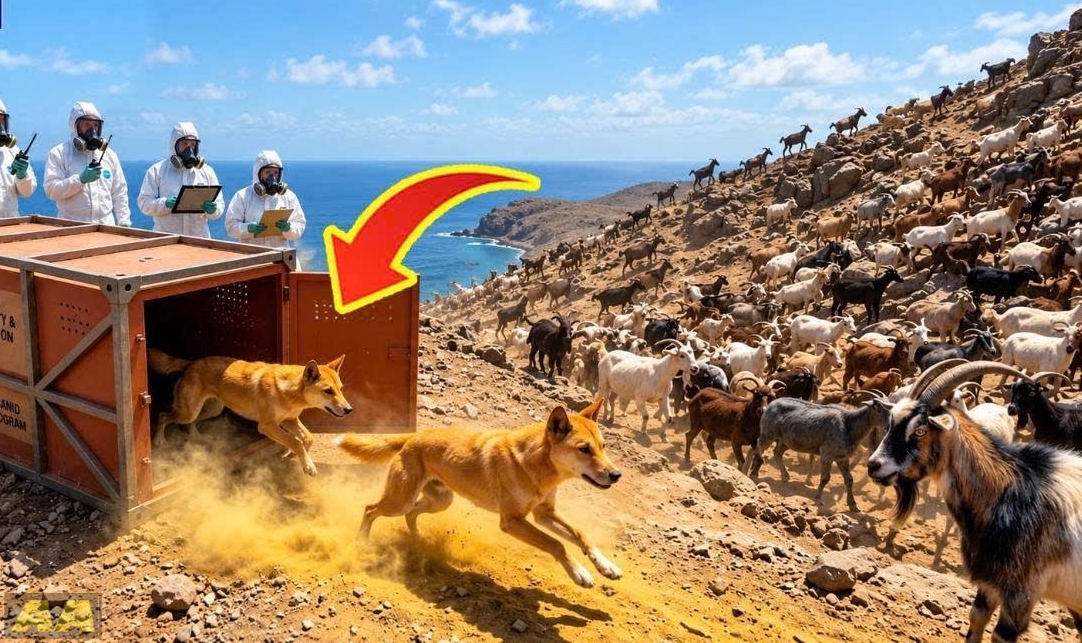
The island looked like the kind of place where nature should have been completely in control.
A thousand acres of steep green hills rising from the waters of the Great Barrier Reef, covered with coastal rainforest and surrounded by a vast ocean that seemed impossible to cross.
But beneath that beautiful surface, Pelorus Island was facing a quiet transformation. The trees that had protected the soil for generations were struggling.
The forest floor was becoming exposed, the land was losing its strength, and the cause was an animal that had no natural place there but had learned how to survive better than anyone expected.
By 2016, hundreds of feral goats had turned the island into a difficult challenge. They moved through the thick vegetation, feeding on young plants before they could grow and changing the balance of a fragile environment.
People had tried traditional solutions. Traps failed. Ground teams struggled through the terrain. Other methods were expensive and incomplete.
The problem remained. Then came an idea that sounded almost impossible. Instead of sending more machines, more hunters, or more people into the rainforest, scientists suggested bringing back an ancient force that ecosystems had relied on for thousands of years.
A predator. A dingo. But this was not simply a wildlife release. The plan involved carefully selected animals, tracking collars, and a strange safety measure hidden beneath their skin.
These dingoes were meant to restore balance and then disappear from the island. It was an experiment unlike anything before.
A predator was being asked to repair a damaged ecosystem, and when the work was finished, nature was expected to follow a schedule.
But what happens when nature refuses to follow the plan? Pelorus Island sits about 50 miles north of Townsville, one of the Palm Islands located inside the Great Barrier Reef Marine Park.
It is a place defined by isolation. The steep landscape, thick rainforest, and surrounding ocean make it difficult for humans to move through, but those same conditions create a unique environment where small changes can have enormous consequences.
The forests of Pelorus Island were not ordinary forests. They were coastal rainforests shaped by salt spray, tropical weather, and the constant movement of water.
These trees helped hold the island together, protecting the soil from being washed away during heavy rain.
For thousands of years, the island existed as a balanced system. Plants grew, animals moved through the forest, and natural forces maintained a rhythm that had developed over generations.
Then goats arrived. Nobody knows the exact moment they first reached the island. Across many islands in the Pacific region, goats were often introduced by people for food or left behind after visits by ships.
Over time, some populations escaped human control and established themselves in places where they had never naturally existed.
Pelorus Island became one of those places. The goats found exactly what they needed. There was food, there was space, and there were no major predators capable of controlling their numbers.
Their population grew until around 300 goats were moving across the island. At first, their presence might not have seemed like a crisis.
Goats are adaptable animals, and they can survive in harsh environments. But on a small island ecosystem, even a few hundred animals can create enormous pressure.
They ate young plants before those plants could mature. They reduced the vegetation beneath the trees.
They changed the structure of the forest itself. The problem was not only what the goats consumed.
It was what disappeared afterward. When young plants could no longer replace older ones, the forest slowly lost its ability to renew itself.
The exposed ground became vulnerable. Rainwater moving down the steep slopes carried soil toward the surrounding waters, affecting both the island and the nearby reef.
Ramon Jayo, the mayor of the local council, described the situation clearly. The island was losing its soil, and officials feared that if nothing changed, the landscape would continue to deteriorate.
The challenge was finding a solution that could actually work. Traditional methods had already been attempted.
Trapping animals across a steep, heavily forested island was extremely difficult. Ground shooting was limited by the dense vegetation and difficult terrain.
Even aerial shooting, a method sometimes used for invasive species removal on islands, was expensive and had not completely solved the problem.
The goats were cautious. They knew the landscape better than the people trying to remove them.
They could hide in areas where humans struggled to travel. The island had become a place where the usual methods were not enough.
That was when dr. Lee Allen and dr. Ben Allen began considering a different approach.
The two zoologists had spent years studying dingoes, one of Australia’s most debated animals. Dingoes have always created strong opinions.
Some people view them as a threat to livestock, while others see them as an important native predator that helps maintain ecological balance.
The disagreement surrounding dingoes was exactly what made Pelorus Island interesting. An island is different from the mainland.
It is a contained environment. Scientists can observe what happens when a predator is introduced without the same level of uncertainty found across a massive continent.
The Allens saw an opportunity to answer a difficult question. Could a native predator be used to solve an invasive species problem?
There was already an example that influenced their thinking. In 1993, 16 dingoes had been released on Townshend Island, another island farther south, where thousands of feral goats were causing problems.
The results were dramatic. The goats disappeared within a relatively short period. But there was a major issue.
The dingoes remained. Removing the predators afterward became a challenge that lasted more than a decade.
The animals had completed their task, but they had become the next management problem. That was the weakness the Allens wanted to solve.
What if the predator could do the work but could not create a permanent population?
The idea became a carefully designed experiment. Four young male dingoes were selected from a wild dog trapping program on the mainland.
The animals were chosen carefully, with preference given to those that already knew each other, including possible siblings.
They were desexed so they could not reproduce. They were vaccinated. They received GPS collars so researchers could follow their movements.
Then came the most unusual part. Each dingo received a surgical implant containing 1080 sodium fluoroacetate, a poison used in Australia for managing certain invasive animals.
The capsule was designed to release after roughly 18 to 24 months, with the idea that the dingoes would complete their work and then no longer remain on the island.
It was meant to be a built-in ending. A predator with a scheduled removal system.
The concept immediately attracted attention. In July 2016, two of the four selected dingoes were taken to Pelorus Island and released.
The news spread quickly. Around the world, people became fascinated by the idea. Headlines described them with dramatic names, focusing on the unusual combination of a living animal and a planned expiration date.
But the reaction was divided. Supporters argued that the plan was a practical way to restore an ecosystem.
They believed humans had already disrupted nature by allowing goats to dominate the island, and using a native predator was a way of restoring a lost balance.
The local council viewed it as an efficient solution. Instead of spending years fighting an impossible battle, they believed they were allowing natural behavior to solve the problem.
Animal welfare organizations saw the situation differently. Mark Townend, head of RSPCA Queensland, criticized the method and described concerns about the treatment of the dingoes.
The argument was not only about the goats. It was about the decision to introduce animals with the intention that they would later be removed through the implanted capsules.
The controversy grew quickly. A project designed to restore nature had suddenly become a debate about how humans should interfere with nature.
Then another concern entered the discussion. The beach stone curlew. The large shorebird is listed as vulnerable in Queensland.
It lives along coastal areas and has faced pressure from several threats, including predators such as dogs and foxes.
In August 2016, about a month after the dingoes arrived, Environment Minister Steven Miles issued an interim conservation order.
The order stopped any additional dingo releases. It also required the two dingoes already on Pelorus Island to be removed within 14 days.
The concern was that introducing predators into an area connected with vulnerable wildlife could create unexpected consequences.
However, there was uncertainty surrounding the bird’s connection to Pelorus Island. The last confirmed sighting of a beach stone curlew there was in 2002, when two birds were recorded during a survey.
The debate became complicated. One side argued that even the possibility of harming a vulnerable species required caution.
The other argued that the island’s environmental decline was already happening and that the dingoes represented a chance to restore balance.
Regardless of the disagreement, the government order was official. The council now had to remove the animals it had released.
The solution seemed simple on paper. The dingoes had GPS collars. Researchers knew where they were.
But Pelorus Island was not an easy place to search. The rainforest was thick. The landscape was steep.
Visibility could be limited to only a short distance. A dingo living there could move quietly through terrain where humans struggled to follow.
Professional shooters were hired. They searched the island. They returned. They searched again. But the dingoes remained.
By October 10, 2016, the council had spent 60,000 Australian dollars attempting to remove two animals and had failed.
The situation had reached an unexpected turning point. The same predator that people had feared would be difficult to control had proven difficult to catch.
The council eventually stopped the removal effort and returned to discussions with the environment department.
Instead of continuing a costly operation that was not succeeding, officials documented their attempts and explained the situation.
Months passed. The dingoes remained. Then, on September 11, 2017, the interim conservation order was lifted.
The department accepted the council’s explanation and decided no further action would be taken. The experiment that had nearly ended before it began continued.
The dingoes were still on the island. And now, without anyone intending it, scientists had the opportunity to observe what would happen when the predators were allowed to complete their original purpose.
Over the following months, researchers watched carefully. The question was no longer whether the dingoes would remain on Pelorus Island.
They had already survived longer than expected. The new question was what impact they would have on the environment around them.
The answer slowly became visible. The dingoes began doing what predators have done for thousands of years.
They hunted. The goats that had once moved freely across the island were suddenly facing a challenge they had not experienced before.
A predator was now sharing their environment, and unlike human hunters, the dingoes did not need equipment, vehicles, or schedules.
They simply followed their instincts. The results were recorded in a scientific paper published in 2020 in Australian Zoologist by Ben Allen, Lee Allen, and their colleagues.
The findings were remarkable. The experiment had worked. The two dingoes reduced the goat population to only one or possibly two male goats within about two years.
A herd of around 300 animals had been reduced to almost nothing by two predators.
The change affected much more than the number of goats. The disappearance of the goats allowed the island’s vegetation to recover.
Plants that had been repeatedly eaten before they could mature finally had the opportunity to grow.
Seedlings appeared. The forest floor began changing. The scientists described the process as a trophic cascade.
A trophic cascade happens when a change involving one part of a food chain creates effects throughout the entire ecosystem.
In this case, removing the pressure from the goats allowed plants to return, and those plants supported other forms of life.
The island began repairing itself. For decades, the goats had shaped the landscape by consuming vegetation faster than it could recover.
Once that pressure disappeared, nature started moving in another direction. The forest did not need to be planted again.
The soil did not need to be rebuilt by machines. The island simply needed the right conditions to begin recovering.
Pelorus Island became an unusual example because researchers had a rare opportunity. They knew approximately how many goats were present.
They knew how many predators were introduced. They knew the timeline. This was not just a theory about what might happen.
It was an actual observation of a predator influencing an ecosystem. For scientists studying dingoes, that made Pelorus Island especially valuable.
The project also raised questions about the way humans approach conservation. Across the world, invasive species removal from islands can require enormous amounts of time, money, and effort.
Many programs involve helicopters, teams of hunters, traps, and years of monitoring. Removing animals from isolated islands is often one of the most difficult challenges in conservation.
Pelorus Island was different. The largest expense was not removing the goats. It was the attempt to remove the dingoes.
The predators had completed the work that humans had struggled to accomplish. But there was still one major question hanging over the entire project.
What happened to the implanted capsules? The capsules were supposed to be the final part of the plan.
They were designed to release after roughly 600 days, which would have been around early 2018.
By that point, the goats had nearly disappeared. The timing seemed perfect. The dingoes had completed their role.
The safety mechanism was supposed to activate. But it did not happen. The capsules failed to work as expected.
A later academic review published in 2022 in Environment and Planning E noted that the 1080 implants did not kill the dingoes during the expected timeframe.
The reason remains unclear. Scientists have suggested several possible explanations. The capsules may have been affected by biological changes around the implant site.
The coating may have lasted longer than expected. The animals may have responded differently than anticipated.
Whatever the cause, the one part of the project designed to guarantee control over the situation did not perform as planned.
This created a strange contradiction. The project’s success came from the very thing that was supposed to disappear.
The dingoes were successful because they survived and continued hunting. But the survival of the dingoes also represented the exact uncertainty critics had warned about.
A predator introduced to an island cannot always be controlled according to a human timeline.
However, one important decision made before the release prevented the situation from becoming more complicated.
The dingoes had been desexed. They could not establish a breeding population. That meant the island did not face the same challenge that occurred after the Townshend Island experiment decades earlier.
The animals remained individuals rather than becoming a growing population. The scientists had built a second layer of protection into the plan.
The chemical solution had failed. The biological solution had worked. And that left everyone with a strange ending.
Nobody knew exactly what happened to the dingoes afterward. The tracking information was not publicly available in a way that could confirm their final status.
An animal welfare group claimed that only one of the two dingoes survived, but that claim was never officially confirmed by people with access to the full tracking records.
The final answer remained unknown. Somewhere on Pelorus Island, there may have been a dingo that was never supposed to still be there.
A predator brought to an island for a specific purpose. An animal that completed the task given to it.
An animal that survived beyond the schedule humans created. The story of Pelorus Island became more than a story about goats and dingoes.
It became a story about the difficulty of controlling nature after humans change it. For generations, people have altered ecosystems by moving animals into new environments, removing predators, and changing landscapes.
Then, when those changes create problems, people often search for technological solutions. But sometimes the answer is not creating something new.
Sometimes the answer is restoring something that was already there. Dingoes evolved as predators within Australia’s landscapes.
Their relationship with other animals developed over thousands of years. The Pelorus experiment showed what could happen when that relationship was placed back into a controlled environment.
It also showed the limits of human planning. The project was designed with a beginning, a middle, and an ending.
The dingoes would arrive. The goats would disappear. The capsules would activate. The predators would be removed.
But nature rarely follows a script. The goats vanished earlier than many expected. The dingoes remained longer than planned.
The safety system failed. And the final chapter was left unwritten. Pelorus Island itself continued changing.
Without the constant grazing pressure from the goats, vegetation recovered. The rainforest had room to strengthen.
The soil was better protected. The landscape that had been struggling began moving toward a healthier balance.
The island became an example of how powerful natural processes can be when given the opportunity to return.
The lesson was not that predators are always the answer. Every ecosystem is different. Every species introduction carries risks.
Every conservation decision requires careful consideration. But Pelorus Island demonstrated something important. Nature has its own methods of solving problems, and sometimes those methods are far older than the tools humans create.
A dingo does not understand conservation goals. It does not know about scientific papers, government policies, or public debates.
It simply behaves according to its instincts. And in this case, those instincts changed an entire island.
The experiment that began as a controversial idea became a rare example of a predator restoring balance in a damaged environment.
The people who designed the plan wanted a predator with a built-in ending. What they discovered was something much harder to predict.
They found an animal that completed the mission, ignored the schedule, and left behind a question that remains unanswered.
If a wild predator can repair an ecosystem in a way humans struggled to achieve, how should we think about the role these animals play in the landscapes around us?
Pelorus Island does not provide a simple answer. Instead, it leaves behind a challenge. A reminder that ecosystems are not machines.
They are living systems shaped by countless relationships, many of which existed long before people tried to manage them.
The story of the dingoes and goats on Pelorus Island continues to be studied because it represents a question facing conservation around the world.
When nature has been disrupted, should humans always try to control every step of recovery, or should we sometimes create the conditions and allow nature to rebuild itself?
The island may never provide a perfect answer. But the rainforest, the recovering vegetation, and the absence of the goats tell a story that is difficult to ignore.
A story about balance. A story about unexpected solutions. And a story about two dingoes that were sent to an island to finish a job, only to become part of one of the most unusual experiments in modern wildlife conservation.
Disclaimer: This content may be created by Al for entertainment purposes. Any resemblance to real persons, events, or places is coincidental.








