At 18, She Planted Seeds Nobody Wanted — When the Heatwave Hit, Farmers Begged to Know Her Secret
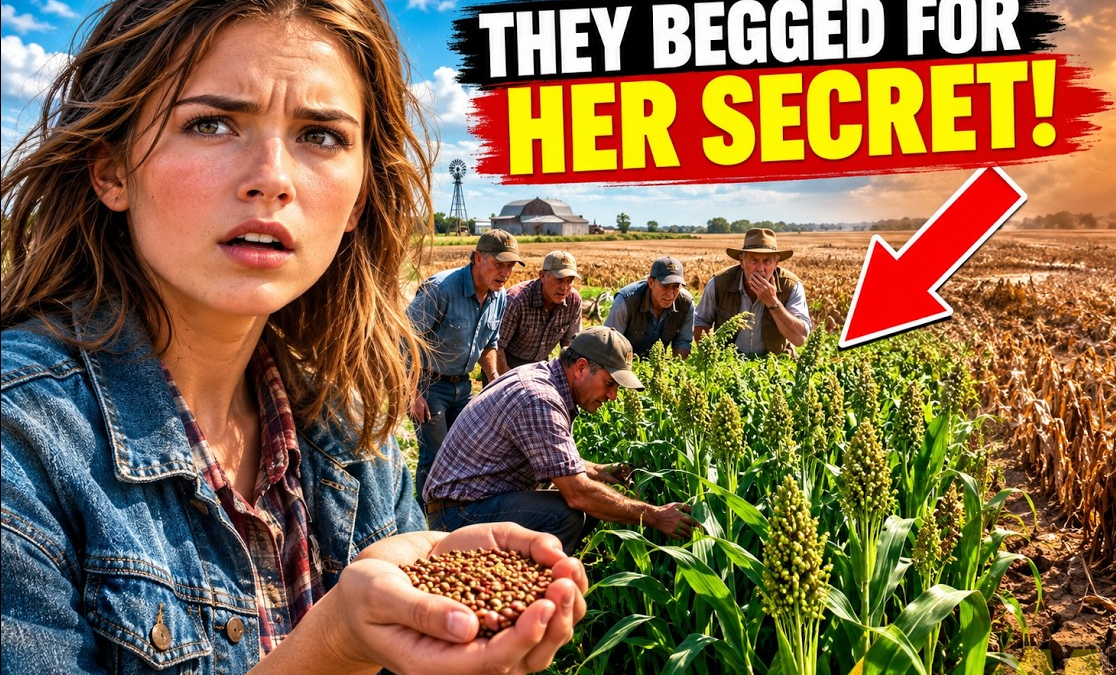
On a gray Tuesday morning in early spring, eighteen year old Hannah Voss stood alone in the back room of the Danville Co op, surrounded by seed bags that most farmers had forgotten existed.
Dust covered the shelves. Old labels had faded beneath years of neglect. Some bags had been sitting so long that the owner had stopped remembering exactly when they arrived.
Hannah did not seem bothered by any of it. She picked up another bag of heirloom sorghum and carried it toward the back door.
The owner watched her load the third bag into the bed of her truck before finally speaking.
“You know that stuff is basically obsolete?” Hannah rested one hand on the tailgate. “Nobody has planted it commercially in this county in twenty years,” he continued.
“The yields are lower than anything on the shelf.” “I know,” Hannah said. She closed the tailgate.
The owner shook his head as she climbed into the truck. He thought she was buying something nobody wanted.
Hannah thought she was buying something everyone had forgotten. She had spent years reading the old journals of her great grandfather, a farmer who had recorded every drought, every failed crop, every season when the rain came too late.
Buried among those pages was a name for a sorghum variety Hannah had never seen in a modern seed catalog.
Her great grandfather had described it in one sentence. Unremarkable when the weather is kind, nearly indestructible when it is not.
That sentence had stayed with her. And three months later, when temperatures climbed beyond 105 degrees and the fields around Danville began turning brown, Hannah finally had the chance to find out whether an old farmer’s notes had been worth believing.
But what would happen when the forgotten seed faced the worst summer the region had seen in decades?
Hannah Voss had grown up on sixty acres just outside Danville, on land that had belonged to her family for three generations.
The farm was not large enough to make anyone wealthy, and it had never been the kind of place where mistakes were easily absorbed.
Every acre mattered. Every harvest had to cover something. Seed, fuel, equipment, repairs, taxes, and the endless collection of smaller expenses that seemed to appear whenever a farmer thought the season was finally going well.
Her father understood that better than anyone. He worked the family farm while holding a full time job in town because farming alone had become too uncertain to support the household comfortably.
Most of their acreage went into corn and soybeans, using the same modern hybrid seed that most farmers in the county had adopted.
The reason was simple. The newer varieties promised higher yields. When rainfall was dependable and temperatures stayed within the range the crops preferred, the difference could be substantial.
Modern breeding had produced crops that could put on impressive growth and deliver impressive numbers at harveSt.
For Hannah’s father, that mattered. A farmer could not pay bills with an interesting theory about what might happen during a difficult season.
He needed grain. He needed reliable production. He needed the farm to make enough money in an ordinary year.
The trouble was that Hannah had begun wondering whether ordinary years were becoming less ordinary.
Summers seemed hotter. Rainfall seemed harder to predict. There would be long stretches when the soil dried faster than expected, followed by storms that arrived too late to repair the damage.
Hannah did not have a degree in agriculture. She was not an agronomiSt. She was not an experienced farmer with decades behind a tractor wheel.
She was simply an eighteen year old who had become fascinated by something sitting in an old wooden crate in her grandmother’s attic.
The crate had belonged to Hannah’s great grandfather. Inside were seed packets, notebooks, handwritten observations, receipts, weather records, and farming journals whose pages had yellowed with age.
Most people would have looked at the material and seen little more than old family papers.
Hannah read every page. She noticed that her great grandfather did not write like someone recording a family history.
He wrote like someone trying to leave instructions for a future farmer who might need them.
He recorded rainfall. He recorded planting dates. He recorded soil conditions. He recorded which crops performed well and which ones struggled.
More importantly, he recorded what happened when the weather turned against him. One crop appeared repeatedly in the journals.
An old sorghum variety that Hannah had never heard discussed by a modern farmer. Her great grandfather did not praise it for producing enormous harvests.
In fact, he admitted that its yields were ordinary during favorable seasons. But whenever the weather became brutally hot and dry, the old variety behaved differently.
It slowed down. It conserved itself. Its roots reached deep. It stayed productive when other crops began struggling.
Her great grandfather described it as nearly indestructible during the worst seasons. Hannah became obsessed with finding it.
She searched through modern seed catalogs firSt. Nothing. She asked farmers. Most had never heard of it.
She contacted people who handled older varieties. Eventually, she learned that some bags were still sitting in the back room of the Danville Co op.
They had been there for years. Nobody wanted them. The owner had practically forgotten they existed.
When Hannah arrived that Tuesday morning, she found exactly what she had been searching for.
Three dusty bags. Old seed. Old variety. Old reputation. The owner tried to explain why it had been abandoned.
Lower yield. Outdated genetics. Little commercial demand. Modern hybrids could outperform it during a normal season.
Hannah listened. Then she bought all three bags. She carried them outside while the owner watched.
“You really planning to plant that?” He asked. “Yes.” “All of it?” “Not all of it.”
She climbed into the truck. “Ten acres.” The owner looked toward the bags. “You know you’re giving up yield?”
“I know.” He shook his head. Hannah drove home. Convincing her father proved considerably harder than buying the seed.
He did not laugh at her. That would have been easier. Instead, he asked practical questions.
What was the expected yield? What would the seed cost? What would they lose if the experiment failed?
How much of their limited acreage would be taken away from the primary crop? What if the weather turned out to be completely normal?
Hannah had answers for some of those questions. For others, she had none. Her father eventually agreed to let her use ten acres.
That was the compromise. The main fields would remain planted with the modern hybrid. Hannah would have her experiment.
Ten acres was small enough that a poor result would not threaten the farm, but large enough to tell her something useful.
That was all she wanted. The planting went ahead. For the first several weeks, Hannah’s experiment looked like exactly what everyone expected.
The modern hybrid fields rose quickly. Rows were thick and uniform. The plants looked vigorous.
Hannah’s sorghum was different. It grew slowly. Some sections appeared uneven. The plants were shorter.
The field did not have the polished appearance of the modern varieties. Standing between the two fields made the comparison almost embarrassing.
Farmers noticed. So did people at the diner. The story spread. The eighteen year old girl had found some ancient seed and decided she knew something everyone else had missed.
Some laughed. Others simply smiled and changed the subject. At the Danville Co op, the owner occasionally asked whether Hannah had changed her mind.
She never had. An extension agent listened when Hannah showed him her great grandfather’s journals.
He was polite. He was also skeptical. Modern breeding had improved crop performance dramatically. Old varieties could have valuable characteristics, but historical observations were not the same as controlled research.
The agent suggested that Hannah keep records. That advice pleased her. She had already planned to.
She kept a notebook beside her bed. She recorded soil moisture. She recorded rainfall. She recorded growth.
She recorded temperatures. She wrote down what she saw rather than what she hoped to see.
By late June, the results were still unimpressive. One entry became especially important later. Everyone keeps asking if I regret it yet.
I don’t know. Ask me again in AuguSt. Hannah closed the notebook. Then she waited.
The heat arrived in July. It did not arrive gently. Temperatures climbed past 105 degrees.
One day became several. Several became nearly two weeks. The region had experienced hot summers before, but this was different.
Records began falling. Rainfall had already been below normal. Then the rain stopped. The soil dried.
Streams dropped. Irrigation systems worked constantly as farmers tried to keep their crops alive. Fields that had looked almost perfect only weeks earlier began changing.
Leaves curled. Color faded. Plants that had grown quickly in June could no longer maintain that growth.
The modern hybrids were under enormous stress. Hannah’s father’s fields suffered too. He watched them every morning.
He adjusted irrigation. He checked the soil. He searched for any sign that conditions might improve.
But there was only so much water available. There was only so much a farmer could do when the weather refused to cooperate.
Across the county, farmers were facing the same problem. The fields were drying. Yield estimates were falling.
The plants that had looked strongest in June were suddenly struggling. Then someone driving down the county road noticed something strange.
A small green field. Ten acres. Still standing. Still green. Still growing. The driver slowed.
Then stopped. He looked at the surrounding fields. Brown. Wilted. Stressed. Then he looked back at Hannah’s sorghum.
The story reached the diner. Then the co op. Then neighboring farms. People who had laughed at Hannah’s experiment began driving past the Voss farm just to look.
At first, nobody said much. They simply stood along the edge of the field. Hannah watched them.
One farmer walked down between the rows. Another crouched and examined the soil. Someone asked how often she had irrigated.
Hannah answered honestly. Someone else asked what seed she had used. She told them. The questions became more serious.
Nobody was laughing anymore. The old sorghum was not magically immune to heat. It was not producing enormous yields while ignoring the weather.
It was doing something more useful. It was surviving. The variety had characteristics that Hannah’s great grandfather had recognized decades earlier.
Its roots were extensive. They reached deeper into the soil than many of the modern crops surrounding it.
As the upper soil dried under the extreme heat, the sorghum could continue drawing moisture from below.
The plants also responded differently to stress. Instead of continuing aggressive growth until the heat overwhelmed them, they could slow their development and conserve resources.
That difference had been almost invisible during a mild spring. Under extreme heat, it became impossible to miss.
Hannah’s father noticed it before anyone else in the family. One evening he walked out to the edge of the field.
He stood there for several minutes. Then he looked across the road at one of his own fields.
The difference was obvious. He turned back toward Hannah. “I suppose your great grandfather knew something,” he said.
Hannah smiled. “He wrote it down.” Her father nodded. “That he did.” The heat continued.
The old field continued standing. The surrounding crops continued struggling. Within days, more farmers arrived.
Some came alone. Some brought family members. Some brought notebooks. The same people who had once called the seed junk were now asking Hannah where she had found it.
The co op owner received calls too. He went into the back room and looked at the remaining space where the old seed had once sat.
There was almost nothing left. Demand had appeared suddenly. For decades, nobody had wanted the variety.
Now everyone wanted it. The irony was not lost on him. Hannah’s great grandfather had understood something that the modern market had gradually forgotten.
A seed did not have to be the highest yielding variety under perfect conditions to have value.
Sometimes survival itself was valuable. The county extension agent returned to the Voss farm. This time he brought equipment.
He wanted measurements. He wanted soil information. He wanted to document the field. He asked Hannah questions.
She answered them. He examined the plants. He compared them with neighboring fields. He asked about the journals.
Hannah brought out the wooden crate. The old notebooks were still inside. The agent turned through the pages carefully.
He found the references to the sorghum. He read the observations Hannah’s great grandfather had written decades earlier.
Then he looked at Hannah. “You kept all of this?” “Yes.” “Why?” “Because I thought it might matter someday.”
The agent looked back at the notebook. “It does now.” The summer changed Hannah’s position in the community.
She had not expected that. She had only wanted to test a seed. She had not expected farmers twice her age to ask for advice.
She had not expected people to call the house asking where they could obtain the same variety.
She had not expected the Danville Co op owner to start asking her how much seed she planned to need next year.
Most of all, she had not expected her father to begin thinking about the farm differently.
The experiment had not proved that modern hybrids were worthless. Hannah never claimed that. Modern varieties still had advantages.
They could produce excellent yields in favorable conditions. They could offer characteristics that old varieties lacked.
The lesson was more complicated. A farm did not have to choose between the past and the future.
Sometimes the past contained traits that the future would need. The extreme heat had revealed one of those traits.
The following season, Hannah expanded the sorghum planting. She did not replace every modern crop.
She did not believe one seed could solve every agricultural problem. Instead, she increased the portion of land devoted to the variety that had proven itself when conditions became difficult.
Other farmers did the same. Some planted small test plots. Some ordered enough seed for larger acreage.
Others began searching through their own family records for varieties that had once been common and had later disappeared.
The conversation around seed changed. Farmers began talking about more than maximum yield. They discussed heat tolerance.
They discussed drought resilience. They discussed how crops responded to stress. They began asking whether a variety that produced less during a perfect year might still be valuable if it could produce something during a terrible one.
Hannah kept taking notes. She did not stop recording rainfall. She did not stop checking soil moisture.
She did not stop comparing fields. She did not stop reading her great grandfather’s journals.
The wooden crate remained in the farmhouse. The papers inside grew more worn. The pages became softer around the edges from repeated handling.
Hannah added her own notebooks to the collection. Soon the crate contained records from two generations.
Her great grandfather had written about droughts from another era. Hannah was recording the conditions of her own.
The difference was that now other people were paying attention. The Danville Co op began looking for additional seed sources.
The extension office discussed older varieties with farmers who had previously dismissed them. People who had never considered heirloom seed worth planting began asking whether other forgotten varieties might possess useful characteristics.
Hannah did not claim to have discovered something new. That distinction mattered to her. Whenever someone praised her for seeing what others had missed, she corrected them.
“I didn’t discover it,” she said. “He already knew.” She meant her great grandfather. He had written the observations down because he had lived through difficult seasons.
He had watched crops struggle. He had noticed which plants continued growing when others could not.
Then he had recorded what he saw. For decades, nobody needed those notes. That was why they ended up in an attic.
Agriculture changed. Seed companies developed new varieties. Farmers adopted them. Old seed disappeared from fields.
The journals became family history. Then the weather changed enough to make an old observation useful again.
Hannah understood that now. She also understood something else. Being underestimated was not the same as being right.
And being right was not the same as being proven right. Her experiment had looked foolish for months.
The plants had been shorter. The rows had been less impressive. The yield potential had been lower.
If the summer had remained mild, nobody might have cared. The old sorghum might have produced less grain than the modern hybrid, and the entire experiment might have ended as a small family story about an eighteen year old who tried something unusual.
Instead, the weather created a test nobody had planned. The seed Hannah had chosen was suddenly operating under the exact conditions her great grandfather had written about.
That was when the old description stopped looking like nostalgia. It became evidence. By the end of the season, farmers around Danville were asking Hannah questions she had never imagined answering.
Which seed source had she used? How much had she planted? How had she prepared the ground?
How deep had the roots gone? How often had she irrigated? What had the plants looked like before the heat arrived?
Hannah answered what she knew. When she did not know, she said so. She kept learning.
She kept testing. She kept comparing. The family farm also began changing. Her father expanded the old sorghum gradually.
He did not abandon the modern hybrids. He simply refused to depend entirely on one approach anymore.
The farm had become a collection of different possibilities. Some fields were planted for maximum production under favorable conditions.
Others were planted with varieties selected for resilience. The strategy was no longer about choosing one side.
It was about refusing to assume that the next season would look like the last one.
Hannah’s reputation changed too. At the diner, the jokes disappeared. At the co op, people stopped calling the seed obsolete.
At church, older farmers sometimes asked Hannah what she thought about an unusual variety they had found in an old family bin.
She always asked to see it. Sometimes the seed was unusable. Sometimes it had lost its quality.
Sometimes the old claims could not be verified. But sometimes, hidden among forgotten materials, there were characteristics worth investigating.
Hannah became especially interested in those cases. She understood how easily valuable information could disappear.
Not because someone deliberately destroyed it. Simply because nobody needed it for a while. That was what had happened to her great grandfather’s sorghum.
For decades, higher yields had made the old variety seem unnecessary. Then one summer changed the question.
The issue was no longer which seed could produce the most under ideal conditions. The question had become which seed could still produce when ideal conditions disappeared.
Hannah never forgot the morning she bought the three bags. She remembered the duSt. She remembered the old shelves.
She remembered the owner’s expression. Most of all, she remembered the word he had used.
Obsolete. At the time, she had not argued. She did not have enough evidence. She simply believed the word might be premature.
Years later, when farmers asked her why she had bought those bags, she gave them the simplest answer she could.
“I had read what my great grandfather wrote.” Sometimes that was all there was to it.
She had not known exactly what the future would bring. She had not known whether the summer would be hot.
She had not known whether the old seed would perform as the journals suggested. She had only known that conditions change, and that a trait that looks unnecessary under one set of conditions can become essential under another.
The wooden crate still sits in Hannah’s farmhouse. The yellow journals are more worn now.
Some pages are nearly too fragile to handle. But Hannah still opens them every spring.
She reads the old handwriting. She checks her own records. Then she walks outside and looks across the fields.
The farmers around Danville still plant modern varieties. They still care about yield. They still compare harvest numbers.
But now some of them plant the old sorghum too. The seed once left untouched in a dusty back room has found its way back into the soil.
Not because Hannah proved that the past was better. She did not. She proved something more useful.
The future does not always need entirely new answers. Sometimes it needs people willing to look again at the answers that were forgotten.
And every spring, when the planting season begins, there are a few farmers who stop by Hannah’s place and ask about the old journals.
Sometimes they ask about the sorghum. Sometimes they ask about another forgotten variety they have discovered in a family barn or an old storage room.
But sooner or later, they usually ask the same question. “What else is in that box?”
Hannah never laughs. She simply opens the lid and begins looking through the pages. Because after one forgotten seed survived the kind of summer that nearly everyone had underestimated, nobody in Danville was quite as certain anymore that an old idea was worthless simply because nobody had needed it lately.
Disclaimer: This content may be created by Al for entertainment purposes. Any resemblance to real persons, events, or places is coincidental.








