Apache Chief: “Marry My Ugly Daughter or Leave!” The Cowboy Said Yes… Then Everything Changed.
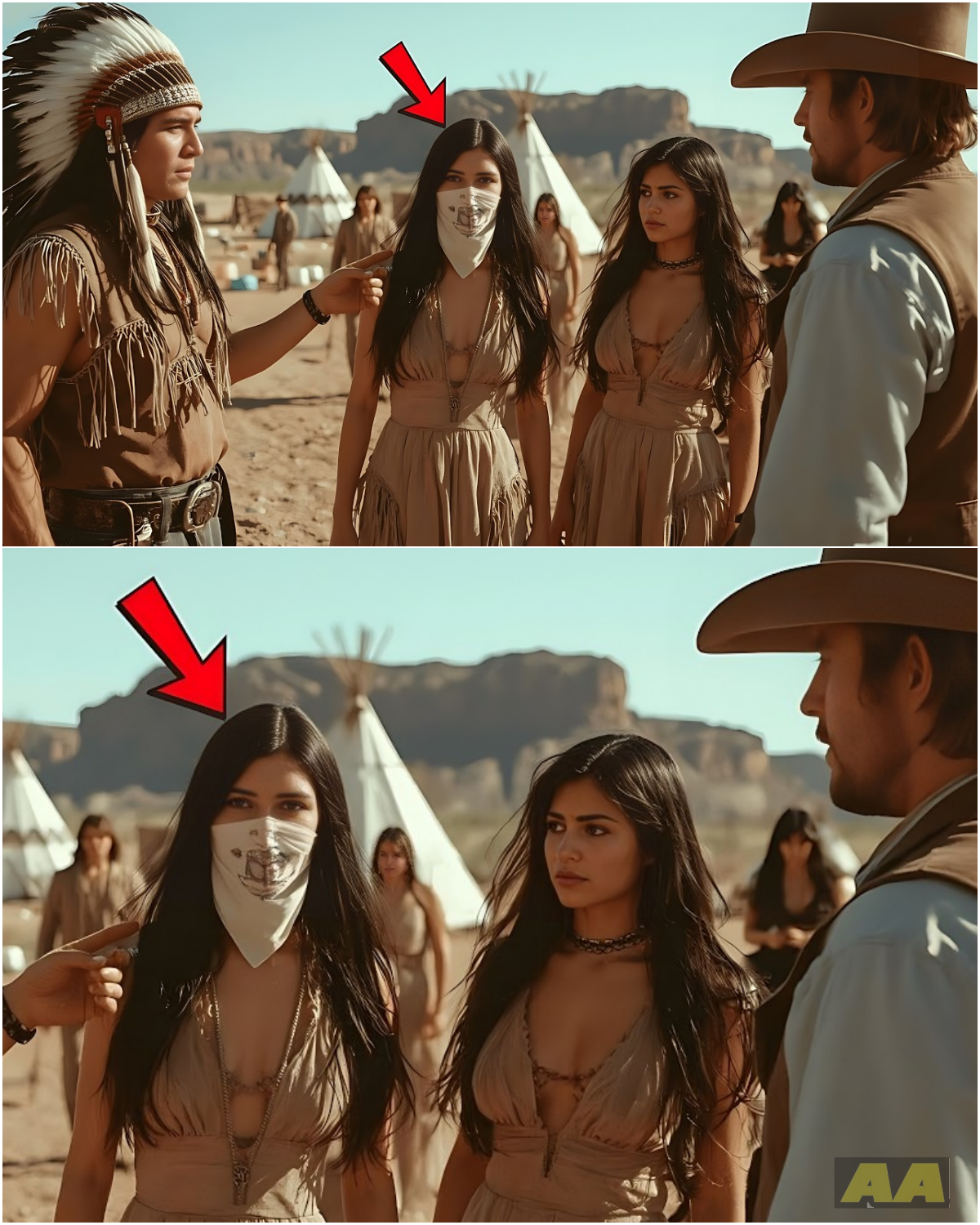
Maverick had ridden for three days through the desert, carrying his savings in a leather pouch and a dream he had chased for five long years.
He wanted nothing more than a piece of land beside a river, somewhere he could build a home, raise horses, and finally stop wandering from one ranch to another.
He had imagined the moment many times. He would meet the owner, agree on a fair price, shake hands, and begin the life he had worked so hard to earn.
But when he arrived at the Apache camp, the man waiting to negotiate was not a landowner willing to discuss money.
He was Chief Black Wolf, a proud leader with silver braided hair, a weathered face, and eyes that seemed to recognize truths other people tried to hide.
Black Wolf offered Maverick the land he wanted, but attached a condition so unexpected that the cowboy wondered whether he had misunderstood.
He must marry the chief’s daughter, Silver Bird, a young woman who had spent five years concealed beneath a white veil.
The chief claimed she was the ugliest woman in the tribe, and everyone seemed determined to convince Maverick that accepting her would ruin his future.
Yet the more they warned him, the more he wondered why nobody spoke about what Silver Bird wanted, what she feared, or what kind of person she might be beneath that veil.
Would Maverick risk the only chance he had ever been given, and could he offer kindness to a woman he had never even seen?
Montana Territory, 1884. The afternoon sun stood high over the desert when Maverick first entered the Apache camp.
Dust clung to his boots, and the long ride had left his shoulders stiff. He had crossed dry valleys, rocky passes, and stretches of open country where the only company was the sound of his horse’s hooves.
For five years, he had worked wherever he could find honest employment, sleeping in bunkhouses, borrowed rooms, and beneath the stars.
He had saved carefully, refusing to waste his wages on things that would not help him establish a home.
The land near the river had become his greatest hope. He had heard about its clean water, open grazing ground, and sheltering hills from a traveler who had passed through the region.
The description had stayed in his mind until he could think of little else. In town, however, people had warned him not to approach Apache territory.
“Those lands belong to the Apaches,” one man had told him. “You would be wise to look somewhere else.”
Another had simply shaken his head and said that strangers who rode into the camp rarely returned with the plans they had brought.
Maverick had listened, thanked them for their concern, and continued riding. He had not come looking for trouble.
He had come to speak honestly and discover whether an agreement was possible. If the land could not be purchased, he would accept that answer and continue searching.
But when he reached the camp, he discovered that Black Wolf had a very different proposal in mind.
The chief stood before a large tipi, his silver hair braided neatly and his arms crossed over his cheSt. Several warriors waited nearby, watching the stranger with guarded expressions.
Children moved between the tipis, while women prepared food and carried bundles of supplies. Smoke rose from cooking fires, and the sound of conversation filled the warm air.
Black Wolf studied Maverick for a long moment. “Will you marry my daughter, or will you leave here forever?”
Maverick removed his hat slowly. “I’m sorry, Chief, but I came to do business. I’m looking for land, not a wife.”
“The land is not for sale to strangers,” Black Wolf replied. “But if you become part of my family, the land beside the river will be yours.”
Maverick stared at him. He had expected a difficult negotiation, perhaps a refusal, or even a demand for a price beyond what he could afford.
He had not expected marriage to be placed before him like a contract. “Your daughter,” he said carefully, “may I meet her first?”
Black Wolf’s expression did not change. “She does not speak to strangers. She wears a veil and keeps her face covered.”
“Why?” The chief held his gaze. “Because people have called her the ugliest woman in the tribe.”
A few warriors lowered their eyes. Nearby, two women exchanged quiet words before returning to their work.
Maverick felt uncomfortable. He had never considered himself a man who judged people by their appearance, but he could not pretend that marrying a woman he had never met was a simple decision.
He had come seeking a place to settle, and now he was being asked to bind his future to someone whose wishes and personality he knew nothing about.
“With respect,” he said, “I cannot promise to marry someone without knowing her.” “Then leave.”
Black Wolf’s voice was firm, and the warriors around him shifted their positions. Maverick looked at the men carrying spears.
He was alone in unfamiliar territory, and it was clear that the chief had no intention of changing the terms.
“Why are you making this offer to me?” Maverick asked. “You have known me for barely an hour.”
For the first time, something in Black Wolf’s expression softened. The hard lines around his eyes seemed to deepen with weariness.
“My daughter deserves a chance,” he said. “She has lived five years hidden from the world.
People have called her names without knowing her heart. They have decided what she is worth before speaking to her.”
He paused. “And you arrived here without threats. You did not come with a group of men demanding that we surrender our land.
You came to ask. That tells me something about you.” Maverick looked toward the river valley beyond the camp.
He imagined the house he might build, the horses he could raise, and the life he had spent years trying to create.
Then he thought about the daughter Black Wolf had described, a woman apparently rejected by her own community and hidden behind a veil.
He wondered whether the chief was asking him to accept a responsibility he did not understand.
“When would the ceremony take place?” He asked at laSt. “Three days from now,” Black Wolf replied.
“At sunset.” Maverick took a long breath. “Then I accept.” A murmur traveled through the camp.
The warriors exchanged surprised looks, and one elder slowly shook his head as though he could not decide whether the cowboy had shown courage or poor judgment.
Black Wolf watched Maverick carefully. “You understand that your word matters here?” “I do.” “Then you will remain in the camp for three days.
You will have a place to sleep and food to eat. Prepare yourself.” A young warrior led Maverick toward a small tipi near the edge of the camp.
As they walked, Maverick tried to make sense of what had just happened. He had come to purchase land with the money he had saved.
Instead, he had agreed to marry a woman whose face he had never seen. Then he noticed her.
Near a distant tipi stood a solitary figure dressed in white. A veil fell from her head almost to the ground, concealing her face, her hands, and nearly every detail of her appearance.
She did not move as Maverick passed. Yet he felt certain she was watching him.
The young warrior followed his gaze. “That is Silver Bird,” he said. Maverick stopped. “Does she know about the arrangement?”
“She knows what her father has decided.” “That is not what I asked.” The warrior looked at him, apparently surprised by the question.
“She knows you are here.” Maverick glanced toward the veiled figure again. He wanted to greet her, but he did not want to approach without knowing whether she welcomed it.
Before he could decide, the warrior gently urged him onward. “Your tipi is this way.”
Maverick continued walking, but the image of the white veil remained in his thoughts. He had three days to discover what kind of life he was agreeing to enter.
More importantly, he needed to find out whether Silver Bird wanted the same future that her father was offering him.
That evening, he sat inside his assigned tipi with his hat beside him and the leather pouch of coins resting near his belt.
The camp’s sounds drifted through the walls. People talked, children laughed, and the distant crackle of fires mingled with the soft movement of the wind.
He thought about his years of wandering and the loneliness that had followed him from one ranch to another.
He had wanted a home for so long that the offer of land had seemed almost impossible to refuse.
But he could not ignore the woman at the edge of the camp. Whatever lay beneath her veil, she was a person, not a condition attached to a piece of property.
And if he was going to marry her, he would have to learn to treat her as someone whose choices mattered as much as his own.
The following morning, Maverick asked a young warrior whether he could speak with Silver Bird.
The request was carried to Black Wolf, who eventually allowed him to approach her, provided he respected her space.
Maverick found her standing beside a tipi, still covered in white. Several women were working nearby, but they gave the pair room when they noticed him coming.
He stopped several paces away. “Good morning,” he said. Silver Bird did not answer. “I’m Maverick.
I suppose you already know that.” The veil shifted slightly. “I wanted to tell you something before the ceremony.
I know this arrangement began with your father’s offer. But I don’t want you to think I expect you to accept me simply because he has agreed to give me land.”
For a moment, she remained still. Then her voice came quietly from beneath the veil.
“What do you expect?” Maverick was surprised to hear her speak. “Honestly? I don’t know yet.
I came here looking for land. I agreed because your father said you deserved a chance.
But I would rather learn who you are than pretend I understand you already.” “People usually decide who I am before they speak to me.”
“I’ve noticed.” “Then perhaps you should be careful.” “About what?” “About believing you can change everything simply by being kind.”
Maverick considered her words. “I don’t believe kindness can solve every problem. But I know it can make a difference in how a person is treated.”
She said nothing. He continued. “I promise I won’t force you to talk to me, and I won’t demand that you show your face before you’re ready.
If we are going to share a home, I want us to begin with respect.”
The veil moved with the breeze. After a long pause, Silver Bird gave a small nod.
It was not much, but Maverick felt that it mattered. He returned to his tipi with a strange mixture of relief and uncertainty.
He had spoken to her, even if only briefly. Her voice had been gentle but guarded, and he could not help wondering how many times she had been disappointed by people who claimed to understand her.
Later that day, Maverick rode back to town to purchase supplies. He needed clean clothes for the ceremony, a few provisions for the journey to the river land, and perhaps a gift for his future wife.
The moment he dismounted outside the general store, he noticed the looks. The storekeeper, a broad man named Thomas, stared at him from behind the counter.
“Is it true?” Thomas asked. “You’re marrying Black Wolf’s daughter?” “It’s true.” Thomas whistled. “You must have lost your senses.”
Maverick examined a stack of shirts. “Why do you say that?” “Because nobody has seen her face in years.
They say she’s horribly ugly. That’s why she hides beneath that veil.” Maverick placed a shirt on the counter.
“Have you ever spoken to her?” Thomas frowned. “No.” “Then how do you know what she’s like?”
The storekeeper had no answer. Maverick paid for the shirt and gathered the rest of his purchases.
Outside, several men had gathered near the hitching rail. Among them was Sam, a cowboy Maverick had worked with the previous year at a ranch near the border.
Sam was holding a bottle and wearing the red-faced expression of a man who had spent too much time in the sun and too little time thinking.
“Maverick!” He called. “Come here, friend.” Maverick approached. “Sam. I didn’t know you were in town.”
“Been working at Morrison Ranch for a month. Heard some news about you.” “I imagine you have.”
Sam grabbed his arm. “Tell me it’s a lie. You’re not really going to marry that woman, are you?”
Maverick gently freed himself. “I gave my word.” Sam shook his head. “Have you heard what people say about her?”
“I’ve heard plenty.” “They say every man who gets close to her ends up with bad luck.
A merchant tried doing business with the Apaches three years ago. He spoke to her near the river, and a week later his wagon overturned.
Lost half his goods.” “Wagons overturn,” Maverick replied. “It happens.” “And a hunter saw her once and broke his leg the next day.”
“That doesn’t mean she caused it.” Another man stepped closer. “You’re ignoring what everyone knows.”
Maverick looked at the group. “What everyone knows seems to be a collection of stories nobody can prove.”
Sam lowered his voice. “Listen, I know you. You’re a good man, and you deserve a decent chance at a good life.
Why tie yourself to a woman you’ve never even seen?” “Because the land is good,” Maverick said, “and because I believe people deserve to be treated with respect.”
“That’s not enough reason to marry someone.” “Maybe it isn’t. But I’ve already agreed, and I intend to find out who she is before deciding what our life will become.”
Sam sighed. “There are other opportunities. We could look for work together. There are ranches farther west that need experienced hands.”
For a moment, Maverick considered the offer. Sam was not a bad man, and the suggestion was practical.
He could leave the Apache camp, find another job, and continue saving until he could purchase land elsewhere.
But he remembered the woman in white standing silently near the tipi. He remembered the way she had asked what he expected and warned him against believing he could change everything.
He also remembered Black Wolf’s expression when he spoke about his daughter. Maverick had no desire to abandon a person simply because other people had decided she was not worth knowing.
“I’m staying,” he said. Sam studied him. “So there’s nothing I can say?” “No.” The other men began drifting away, muttering among themselves.
Sam remained for a moment, his expression becoming more serious. “Then at least remember this.
The Apaches have their own traditions. Don’t assume you understand them just because you’ve agreed to marry into the family.”
“I won’t.” “And whether she’s as ugly as they say or not, treat her well.
Nobody deserves to spend their life being mocked.” Maverick was surprised by the sincerity in his friend’s voice.
“I will.” Sam patted his shoulder. “Good luck, then. You’ll need it.” Maverick mounted his horse and started back toward the camp.
The sun was lowering, and the long shadows of the mountains stretched across the road.
As he rode, he thought about the stories he had heard. The supposed curse, the strange accidents, the warnings about the veiled woman.
None of them told him anything about Silver Bird herself. Nobody had asked whether she was happy.
Nobody had wondered what it felt like to live hidden from the world or to hear people discuss her as though she were a misfortune.
They spoke about her appearance, but not her hopes. They spoke about her supposed bad luck, but not her kindness or intelligence.
Maverick began to understand that the mystery surrounding Silver Bird might have less to do with her face than with the way people had chosen to treat her.
When he reached the camp, the cooking fires were already burning. The smell of food drifted through the evening air, and children played between the tipis.
Silver Bird stood near the same place where he had first seen her. Maverick dismounted and approached slowly.
“Hello again,” he said. She turned toward him. “I went into town,” he continued. “People had plenty to say about you.”
“I imagine they did.” “They told me you bring bad luck.” She was silent. “I don’t believe them.”
“Why not?” “Because they have no proof. And because I don’t think a person should be blamed for things that happen around them.”
Silver Bird tilted her head slightly. “People often prefer a story that explains their fear.”
“That may be true.” He hesitated before speaking again. “I also bought something.” He reached into his saddlebag and removed a small silver comb.
It was simple, with a few engraved lines along its handle. “I don’t know whether you would like it.
I thought it might be useful.” Silver Bird did not take it immediately. “Why would you give me a gift?”
“Because we are going to be married, and I wanted to offer you something. Not as payment.
Not because I expect anything in return.” After a moment, she accepted it. “Thank you.”
“You’re welcome.” She held the comb carefully beneath the veil. Maverick stepped back, giving her room.
“I’ll see you tomorrow.” “Yes,” she answered. It was only one word, but this time her voice seemed a little less distant.
The night before the ceremony, the camp became busy with preparations. Women prepared special food, elders gathered supplies, and men checked the drums that would accompany the celebration.
Children ran between the tipis, excited by the unusual activity. Maverick tried to rest, but sleep would not come.
He had spent the day thinking about the ceremony and the promise he had made.
Tomorrow, he would become Silver Bird’s husband. Yet he still knew very little about her.
He wanted to ask more questions, but he did not want to make her feel as though she were being examined.
Eventually, he rose and stepped outside. The desert night was cold and clear. Stars filled the sky, and the campfires had burned down to glowing embers.
He walked toward the corral, where the horses stood quietly behind the fence. His own horse had settled comfortably among the tribe’s animals.
Maverick smiled at the sight. The animal seemed to have adapted to its new surroundings more quickly than its owner.
Then he heard a soft sound. A faint scrape came from the far side of the corral.
Maverick stopped. He listened again. Another scrape. He moved toward the shadows, keeping close to the fence.
His years as a cowboy had taught him to recognize the difference between the ordinary noises of animals and the careful movements of someone trying not to be heard.
At the back of the corral, he saw three figures crouched beside the fence. They were cutting the ropes that held the gate secure.
Maverick’s expression hardened. Thieves. He looked toward the camp. The nearest tipis were quiet, and most of the people were asleep.
If he shouted immediately, the thieves might escape before anyone reached the corral. He needed to distract them long enough for the camp to wake.
He crouched and picked up several small stones from the ground. Then he moved in a wide arc until he was positioned behind the men.
“Good evening, gentlemen.” The thieves spun around. One of them reached for a weapon. “Who are you?”
“Someone who doesn’t appreciate thieves.” The largest man stepped forward. “Get out of here, cowboy.
This isn’t your business.” Maverick glanced toward the horses. “Those animals belong to the people who have welcomed me into their camp.
That makes it my business.” The large man laughed. “You’re the fellow marrying the veiled girl, aren’t you?”
“I am.” “Then you’re even more foolish than we heard.” Maverick kept his expression calm.
“Maybe. But I’m not foolish enough to let you walk away with those horses.” The man lunged.
Maverick stepped aside and threw one of the stones. It struck the attacker’s forehead, startling him and giving Maverick enough time to move away.
The second thief rushed forward. Maverick turned and struck him hard in the stomach with his elbow.
The man doubled over, stumbling against the fence. The third thief stayed back, watching for an opening.
“Two against one,” he said. “You don’t like those odds?” Maverick did not answer. The large man recovered and charged again.
Maverick waited until the last moment, then stepped aside. The man collided with his companion, and both stumbled to the ground.
Maverick shouted toward the camp. “Guards! Thieves in the corral!” Lights appeared inside nearby tipis.
Voices rose, and several warriors came running toward the fence with spears in their hands.
The thieves tried to escape, but the warriors reached them before they could get through the opening.
Within moments, the three men were surrounded and forced to drop their weapons. Black Wolf arrived shortly afterward, wearing a blanket over his shoulders.
He surveyed the broken ropes, the frightened horses, and the men being held by the warriors.
“What happened?” Maverick pointed toward the gate. “They were cutting the ropes. I caught them before they could take the horses.”
A young warrior inspected the fence. “He speaks the truth, Chief. The ropes are cut, and these men were trying to open the gate.”
Black Wolf turned toward Maverick. “You stopped them alone?” “Yes.” “Why?” Maverick looked at him, puzzled.
“Because they were stealing.” The chief studied him for a long moment. “Many men would have shouted for help and stayed away.”
“I was going to call for help. I just needed to keep them here long enough.”
Black Wolf placed a hand on Maverick’s shoulder. “You protected our horses. You protected our camp.”
“I did what seemed right.” The warriors murmured among themselves. Some nodded with approval, while others looked at Maverick with new respect.
An elderly man approached. His face was deeply lined, and his eyes seemed to hold the patience of someone who had watched many seasons pass.
Black Wolf listened as the elder spoke in Apache. Then he turned toward Maverick. “Wise Eagle says you have shown courage and respect.
He believes you are worthy of joining our family.” Maverick lowered his head slightly. “I’m honored.”
Across the camp, he noticed a familiar figure standing near the firelight. Silver Bird. She was still covered in white, but her posture had changed.
She no longer seemed as distant as she had when he first arrived. She watched him with an attention that felt different from simple curiosity.
Maverick wanted to speak to her, but the warriors were already escorting the thieves away.
The men would be removed from Apache territory and warned never to return. As the camp gradually settled, people began greeting Maverick with nods and quiet words of approval.
Children looked at him with open curiosity, and several women smiled as they passed. He was no longer simply the stranger who had agreed to marry the chief’s daughter.
He was someone who had taken a risk to protect the camp. Yet the greatest moment still waited for the following evening.
Tomorrow, the veil would be lifted. The next day, the sun descended slowly toward the mountains, painting the desert in shades of orange, red, and purple.
The entire camp gathered around the ceremonial fire. Maverick stood near the center, wearing the clean shirt he had purchased in town.
He had brushed the dust from his boots and combed his hair, but none of those efforts could settle the nervous beating of his heart.
Black Wolf stood before him, dressed in ceremonial clothing. Eagle feathers adorned his hair, and carefully applied paint marked his face.
The chief raised his hands. “Today, a stranger becomes family. An outsider becomes a brother.
Maverick has shown courage and honor. He has protected our horses and respected our daughter.
He is welcome among us.” The warriors struck their spears against the ground. Then the music began.
Drums sounded in a steady rhythm, and the women sang as the ceremony moved forward.
Their voices rose above the fire, carrying through the camp and into the open desert.
Maverick watched the gathering, trying to remember every detail. The warm glow of the flames, the faces of the elders, the children standing close to their families, and the proud expression on Black Wolf’s face all seemed to belong to a moment he would carry with him for the rest of his life.
Then Silver Bird appeared. Two elderly women escorted her between the tipis. The white veil covered her from head to toe, falling in soft folds around her body.
She walked slowly, and Maverick could sense her nervousness in the careful way she moved.
The camp gradually fell silent. Silver Bird stopped in front of him. For the first time, they stood close enough that he could hear her breathing beneath the veil.
Black Wolf raised his hands again. “The sun is witness. The earth is witness. May this union bring blessings to both.”
An elder approached with a bowl of fragrant herbs. The smoke was passed around Maverick, then around Silver Bird.
Another elder tied a red cord around Maverick’s wrist and then around Silver Bird’s, connecting them in a symbolic gesture of their promise.
Maverick looked at her concealed face. He wondered whether she was afraid of him. He wondered whether she regretted the agreement.
He wondered whether he would be able to give her the life she wanted. Then Black Wolf stepped forward.
“The time has come.” The drums stopped. The chief looked at his daughter, and the expression on his face was unlike anything Maverick had seen before.
The sternness that usually defined him had softened into something deeply personal. He reached toward the edges of the veil.
Maverick held his breath. The cloth began to rise. First, he saw her feet, delicate and steady beneath the hem of her decorated buckskin dress.
Then her hands appeared, small and graceful, followed by the line of her neck and chin.
The veil continued upward. At last, Black Wolf lifted it completely away. Maverick forgot the crowd around him.
Silver Bird was beautiful. Her features were delicate, her cheekbones high, and her lips shaped in a gentle curve.
Her long black hair framed her face, and her expression held both uncertainty and quiet strength.
But what captured Maverick’s attention most were her eyes. One was deep brown, warm and rich like the earth after rain.
The other was a clear, pale blue, bright as the summer sky. They were different colors, striking and unusual.
Maverick had never seen anything like them. Silver Bird looked directly at him, but her expression was not one of pride.
It was fear. She was searching his face for the first sign of disgust, the smallest hint that he might turn away now that he had finally seen her.
He understood then that the veil had not merely hidden her from the world. It had become the place where she had learned to expect rejection.
Maverick stepped closer and gently took her hand. “You are beautiful,” he whispered. Silver Bird’s eyes widened.
For a moment, she seemed unable to believe him. “Your eyes,” he continued softly, “are like sunrise and sunset together.
I have never seen anything so extraordinary.” A tear slipped down her cheek. Then another.
But this time, they were not tears of sadness. The crowd murmured, surprised by the unexpected revelation.
Some people stared at her eyes, while others exchanged uncertain looks. Black Wolf raised his voice.
“My daughter was born with two different colored eyes. Some believed it was a curse.
They said the spirits had made a mistake, that she would bring misfortune to anyone who stood beside her.”
He paused, looking across the gathering. “I allowed those words to shape her life. I called her ugly, and I hid her behind a veil.
But I did not do so because she was ugly. I did it because I feared what men from outside our camp might do when they saw her.”
His voice grew quieter. “Some came when she was young and offered horses or gold for the chance to take her away.
They did not ask about her hopes or her character. They saw only her appearance and believed she could be treated like an object.”
Maverick felt a heaviness settle in his cheSt. He looked at Silver Bird, who was still holding his hand.
Black Wolf continued. “I wanted her to have a chance to be loved for who she was.
I needed someone who would agree to join our family without knowing whether her face pleased him.
Someone who would show honor before receiving anything in return.” He looked directly at Maverick.
“I believed you might be that man.” Maverick finally understood the strange bargain, the warnings, and the chief’s insistence that he make a choice before meeting his daughter.
It had been a test, but not a test of whether Maverick could accept an unattractive woman.
It was a test of whether he could offer respect when he believed there was nothing to gain from it.
Yet he also understood that Black Wolf’s plan had placed an enormous burden on Silver Bird.
She had spent five years hidden, listening to people repeat a lie about her appearance until the lie had begun to shape the way she saw herself.
Maverick turned toward the chief. “I’m honored that you trusted me,” he said. “But Silver Bird deserves to make her own choices too.”
Black Wolf nodded slowly. “She does.” Maverick looked back at his bride. “Do you want this marriage?”
Silver Bird stared at him. For a moment, the whole camp seemed to disappear around them.
Then she answered. “Yes.” Her voice was soft, but there was certainty in it. “I want to be with someone who sees me as a person.
Someone who does not ask me to hide.” Maverick smiled. “Then I want the same thing.”
Silver Bird’s expression changed. The fear in her eyes did not vanish completely, but it gave way to a fragile happiness.
The drums began again, this time with a joyful rhythm. The women sang, the children cheered, and the camp erupted into celebration.
Black Wolf announced that the ceremony was complete. Maverick and Silver Bird were now husband and wife.
The celebration continued late into the night. Food was shared, stories were told, and people gathered around the fire.
The warriors who had once watched Maverick with suspicion now greeted him warmly. Some joked about his courage in agreeing to marry without seeing his bride, while others praised the way he had protected the horses.
Maverick accepted their words with humility. But his attention kept returning to Silver Bird. She sat beside him without her veil for the first time.
Her long black hair fell freely over her shoulders, and the firelight reflected in her unusual eyes.
Every time someone passed nearby, she instinctively lowered her gaze. The habit had been part of her life for five years, and one ceremony could not erase it.
“You don’t have to hide anymore,” Maverick said quietly. She looked at him. “It is difficult,” she admitted.
“For five years, the veil was my protection. It was the only way I knew how to move through the world without hearing what people thought of me.”
“Why did it begin five years ago?” “When I turned fifteen, strangers started coming to the camp.
Merchants, hunters, and travelers. They looked at me differently from the way they looked at other girls.
Some offered gifts. Others made offers to my father.” “What kind of offers?” “Twenty horses.
Gold. Promises of things they believed my father would want.” Her voice became firmer. “They did not ask whether I wanted to leave.
They did not care what I thought. They only wanted to possess something they considered beautiful.”
Maverick frowned. “So your father spread the story that you were ugly.” “Yes. He believed it would make those men leave me alone.”
“Did it?” “At first, yes. They stopped coming. They stopped asking about me. But then the people of our own camp began repeating the story.
Children whispered. Some women avoided me. Even people who had known me since I was little began looking at me differently.”
Silver Bird touched her cheek. “After a while, I began to wonder whether something really was wrong with me.
I knew my eyes were different, and I heard people say they were a bad sign.
Sometimes I thought that perhaps the world would be easier if I had been born looking like everyone else.”
Maverick gently covered her hand with his. “There is nothing wrong with you.” She looked at him, searching his expression.
“My mother used to say the same thing,” she whispered. “She said my eyes were a gift.
She told me that I should never let anyone convince me that being different made me less worthy.”
“Your mother sounds wise.” “She was.” Silver Bird looked toward the fire. “She told me that one eye carried the color of the earth and the other carried the color of the sky.
She said I should learn to stand between both without being afraid.” Maverick listened quietly.
“She believed I could see things other people missed,” Silver Bird continued. “Not because my eyes were magical, but because I had learned to pay attention.
She said people reveal themselves through what they do, not only through what they say.”
Maverick smiled. “Then she must have been paying attention when she raised you.” Silver Bird gave a small laugh.
For the first time, he saw how easily her face could brighten when she felt safe.
An elderly woman approached them. Her hair was silver, and her face held the calm expression of someone who had spent many years caring for others.
“I would like to speak with you,” she said in Spanish. Maverick and Silver Bird turned toward her.
“My name is Moon Flower,” she introduced herself. “I am a healer and a keeper of our stories.”
“It is an honor,” Maverick replied. Moon Flower settled beside them and looked at Silver Bird with affection.
“This young woman has always been special. When she was born with eyes of different colors, some people were frightened.
They believed the difference must mean something bad.” Silver Bird looked at her. “You never told me what you believed.”
Moon Flower smiled gently. “Because your father asked me to keep my thoughts quiet while you were growing up.
He feared that if people believed you had a special gift, others would try to use you.”
Maverick glanced toward Black Wolf, who was speaking with several elders near the fire. “What kind of gift?”
He asked. Moon Flower considered her answer. “Our stories speak of people who see the world from more than one direction.
Some understand the past because they remember carefully. Others can imagine the future because they recognize the choices people are making in the present.
Silver Bird has always possessed an unusual ability to notice what others overlook.” Silver Bird listened with surprise.
“You mean my eyes do not make me different because of some curse?” Moon Flower shook her head.
“No. They make you visibly different, but your worth does not come from the color of your eyes.
It comes from your heart, your patience, and the choices you make.” The elder turned toward Maverick.
“And you, cowboy, showed us something important. You accepted the chance to join this family without demanding to see her face.
You protected our horses without asking for a reward. You treated her as a person before you knew whether the world would call her beautiful.”
Maverick lowered his head. “I only tried to do what was right.” “That is often how character is shown,” Moon Flower replied.
“Not through grand speeches, but through ordinary decisions made when nobody is certain what will happen next.”
She looked toward the stars. “Your paths have crossed at a time when both of you needed a new beginning.
What you make of that beginning is now your responsibility.” With those words, Moon Flower rose and returned to the gathering.
Maverick and Silver Bird sat quietly for a while, listening to the celebration around them.
Then Silver Bird asked a question. “Are you afraid of being married to someone different?”
Maverick thought carefully. “I have spent most of my life feeling different myself. I never had a place that truly belonged to me.
I worked on other people’s ranches and watched them build families while I kept moving.
So I don’t think your differences frighten me.” She studied him. “What do you want from our life?”
“A home. Honest work. A place where we can be ourselves. And someone to share the good days and the difficult ones.”
“Would you want to live beside the river, even if I sometimes need to return to the camp?”
“Of course.” “I do not want to leave my people behind.” “You shouldn’t have to.”
Silver Bird’s shoulders relaxed. “I want to live somewhere I can be myself without a veil.
But I also want to remain part of my family.” “Then we will build a home that makes room for both.”
She smiled. “That sounds like something I could believe in.” At that moment, Black Wolf approached.
His expression was warmer than Maverick had seen it before. “Maverick,” he said, “I owe you my thanks.”
“For what?” “For giving my daughter something I could not give her during these five years.
The chance to choose her own future.” Silver Bird rose and embraced her father. “You were trying to protect me,” she said.
Black Wolf placed a hand on her back. “I was. But sometimes protection can become another kind of prison.
I thought the veil would keep you safe, and I did not see how much it was taking from you.”
She held him tightly. “I know you love me.” “I do.” He stepped back and looked at Maverick.
“Tomorrow I will show you the land beside the river. It is good ground, with water nearby and hills that offer shelter from the wind.
It will be yours, as I promised.” Maverick nodded. “Thank you, Chief.” Black Wolf’s expression became serious again, but his voice remained gentle.
“Do not think the land is the only thing I am giving you. You are joining a family.
That means you will have responsibilities, and it means you will have people who will expect you to treat them with respect.”
“I understand.” “Good.” The chief looked at his daughter. “And you must remember that you are free to speak your mind.
A marriage should not become another veil.” Silver Bird smiled. “I will remember.” Black Wolf returned to the celebration, leaving the newly married couple together.
Maverick looked up at the night sky. The stars seemed brighter than they had when he first entered the camp.
He thought about the years he had spent searching for land, believing that a place of his own would solve the loneliness he carried.
Now he understood that the land was only part of what he had been seeking.
He had found a family that welcomed him, a woman who trusted him, and a home that could become something more than a building beside a river.
Silver Bird rested her head on his shoulder. “What are you thinking about?” She asked.
Maverick smiled. “I came here looking for land. I thought that was the treasure I needed.”
“And now?” “Now I think I found something worth more.” She lifted her head and looked into his eyes.
“What is that?” “You.” Silver Bird’s cheeks warmed, and she smiled in a way that made her look younger and more carefree than he had seen her before.
“Then we found the same treasure.” The following morning, Black Wolf led Maverick and Silver Bird toward the river valley.
The land stretched beneath the clear sky, with broad grazing ground and a line of trees following the water.
The hills rose in the distance, offering protection from the strongest winds. Maverick dismounted and walked through the grass, studying the soil and the riverbank.
He could already imagine where the house might stand, where the stable should be built, and which part of the pasture would be best for the horses.
Silver Bird walked beside him, pointing out places where the ground stayed firm after rain and where the trees offered shade during the hottest months.
She knew the land well. Maverick listened as she explained how the river changed with the seasons and where wildlife often crossed the valley.
He realized that she could teach him as much about the property as he could teach her about building and ranching.
“This is a good place,” he said. “It is,” Silver Bird answered. “But it will take work.”
“I’ve never been afraid of work.” She looked at him with a playful expression. “Then you will have plenty of it.”
They laughed together. Black Wolf watched them from a short distance away. He had spent years worrying that his daughter might never find a place where she could live without hiding.
Now he saw her walking beside a man who listened when she spoke and respected what she knew.
He did not believe every difficulty in their lives had been solved. The world beyond the camp would still hold prejudice, and the work of building a home would require patience.
But for the first time in a long while, he felt that his daughter could face the future without being alone.
In the days that followed, Maverick began planning the house. He measured the ground, considered the direction of the wind, and marked where the stable and storage shed should stand.
Silver Bird helped him choose the location and organize the work. She insisted that the house should have a wide porch facing the river, where they could sit in the evenings and watch the light fade over the water.
Maverick agreed. They worked alongside members of the tribe, exchanging labor and knowledge. Some helped with the heavy construction, while others gathered materials and prepared the ground.
Maverick shared what he knew about building sturdy fences and maintaining livestock. Silver Bird helped coordinate the work and made sure the plans respected the land and the needs of the people who used it.
Their home began to take shape. As the walls rose and the roof was completed, Maverick realized that he had never felt so certain about where he belonged.
The work was demanding, but every board and stone seemed to carry the promise of a shared future.
One evening, after a long day, he found Silver Bird standing beside the river. The breeze moved through her hair, and the fading light reflected in her different colored eyes.
“Do you ever miss the veil?” He asked. She considered the question. “Sometimes I miss the feeling of being hidden.
It was familiar. I knew what to expect when people could not see my face.”
“And now?” “Now I am learning that being seen does not always mean being judged.”
Maverick stepped beside her. “You should never have had to hide to deserve respect.” “I know that now.”
She took his hand. “But I also know that my father was trying to protect me.
He made a choice out of fear, and that choice hurt me, even though he loved me.”
Maverick nodded. “People can make mistakes while trying to do the right thing.” Silver Bird looked toward the river.
“I want our home to be different. I want people to be welcome here. I want children to learn that being different is not something to be ashamed of.”
“Then that is what we’ll build.” She smiled. “And if someone comes here with a strange eye color?”
“We’ll offer them a seat and something to eat.” “And if they have two different colored eyes?”
“Then I suppose they’ll have something in common with my wife.” Silver Bird laughed, and the sound carried across the water.
By the time the first warm days of the next season arrived, their house stood complete.
It was not grand, but it was strong, comfortable, and filled with the things they had chosen together.
The porch faced the river. The stable stood nearby, and the pasture stretched toward the hills.
The wooden eagle Maverick had seen in the camp now rested on a shelf inside the house, where sunlight touched its carved wings each morning.
Silver Bird no longer wore the white veil. At first, she still lowered her gaze when strangers approached.
Sometimes she grew quiet when she noticed someone staring at her eyes. But Maverick never rushed her or told her how she should feel.
He simply remained beside her, offering the same steady respect he had shown from the beginning.
Gradually, she began to speak more freely with visitors. She welcomed neighbors who came to trade supplies, shared stories with women from the camp, and helped younger members of her community learn the skills her mother had taught her.
Some people continued to whisper about her appearance. Others still believed the old rumors about bad luck.
But Silver Bird no longer allowed those stories to decide how she lived. She had discovered that she could be seen without surrendering her dignity.
And Maverick had learned that the land he had spent five years searching for was not the only thing that could make a man feel rich.
Their days were filled with ordinary work and quiet happiness. They cared for the horses, tended the property, and visited the camp regularly.
Black Wolf came often, sometimes bringing supplies and sometimes simply sitting on the porch to talk with his daughter.
The chief grew more comfortable with the life she had chosen. He still worried about her, as fathers often do, but he no longer tried to protect her by keeping her hidden.
One evening, as the sun slipped behind the mountains, Black Wolf sat beside Maverick near the river.
“You have given her a good home,” he said. Maverick shook his head. “She has helped build it as much as I have.”
Black Wolf smiled. “That is how it should be.” They watched Silver Bird speaking with two women near the house.
Her laughter rose above the sound of the water, and the chief’s expression softened. “I wanted her to find someone who would see her heart,” he said.
“I thought I had to hide everything else to make that possible.” Maverick looked toward him.
“She deserved to be known, not hidden.” “Yes,” Black Wolf replied. “I understand that now.”
The chief rested his hands on his knees. “Thank you for asking whether she wanted the marriage.
You reminded me that she must have a voice in her own life.” Maverick nodded.
“I want her to choose me every day. Not because someone has decided she must, and not because she has nowhere else to go.”
Black Wolf looked at him for a long moment. “Then you have understood more than I expected when you first arrived.”
The sun disappeared behind the hills, and the first stars appeared over the river. Maverick returned to the house, where Silver Bird was waiting on the porch.
She reached for his hand as he sat beside her. “Were you and my father talking about me?”
She asked. “We were.” “Should I be worried?” “Not at all. He was thanking me.”
“For what?” “For choosing you.” Silver Bird looked at him, her expression thoughtful. “And what would you choose now, if you had to make the decision again?”
Maverick glanced toward the river, then back at her. “I would still come here looking for land.
I would still meet your father. But this time, I would hope to find you sooner.”
She smiled. “And would you still agree to marry me without seeing my face?” He considered the question.
“I would agree to meet you. I would agree to listen. I would agree to discover who you are.
And if you wanted the same future I wanted, I would choose you.” Silver Bird leaned against him.
“That is a better answer.” He laughed softly. “I’m learning.” She rested her head on his shoulder, and they watched the stars appear one by one.
The white veil was folded away, no longer needed as a shield against the world.
The rumors had not vanished entirely, but they no longer ruled Silver Bird’s life. The land beside the river had become theirs to care for, and the home they built was founded not on a bargain alone, but on trust, patience, and the freedom to choose.
Maverick had arrived believing that the greatest thing he could own was a piece of land.
He had discovered instead that a home was made by the people who shared it, and that the most meaningful promises were not the ones demanded by fear or tradition, but the ones given freely.
Silver Bird had spent five years hidden behind a veil, believing that the world would never see her as anything other than a strange face and a source of rumors.
Now she had a place where she could be herself, a husband who listened to her, and a future that belonged to her as much as it belonged to him.
And when the wind moved through the trees and the river carried the last light of evening toward the distant plains, the wooden eagle watched over their home with its wings spread wide.
It seemed to remind them both of the lesson they had learned: a person could travel far from where they began, but the place they truly belonged was wherever they were free to live honestly, love openly, and be accepted for who they were.
Disclaimer: This content may be created by Al for entertainment purposes. Any resemblance to real persons, events, or places is coincidental.








