Apache Chief Growled “Marry My Rejected Daughter or Leave” — The Cowboy Went Silent in Shock
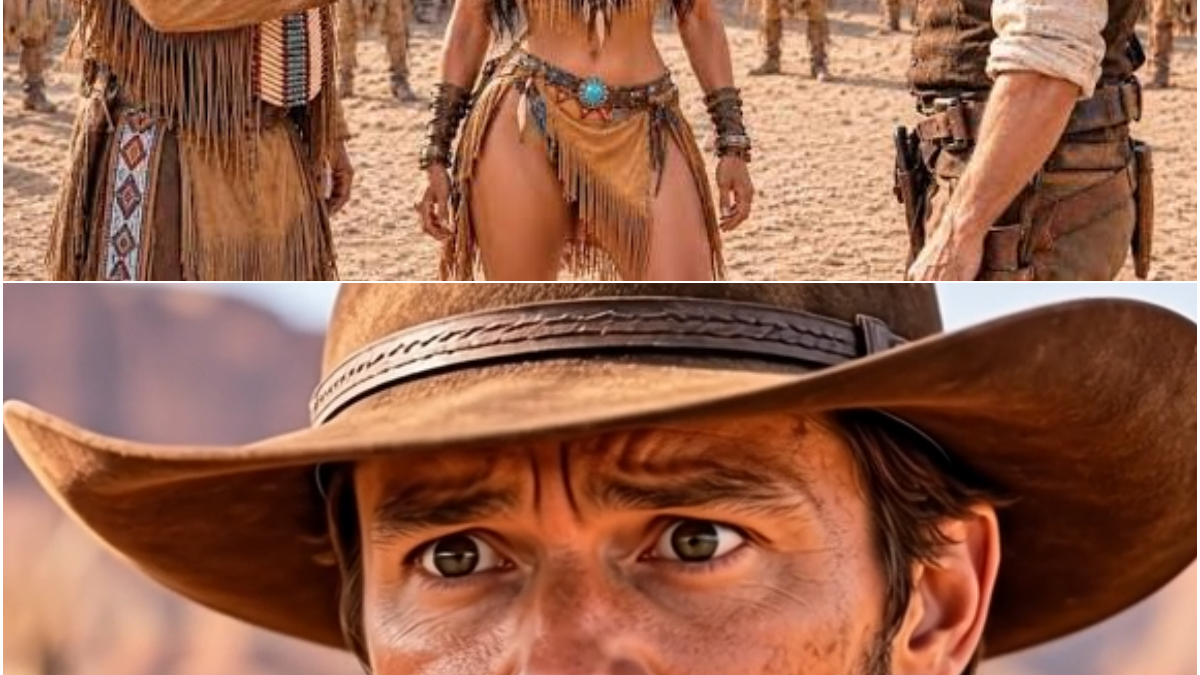
A rifle cracked across the empty canyon, and the sound raced between the red cliffs like thunder trapped beneath the afternoon sky.
A flock of hawks burst from the rocks as a chestnut horse reared on the narrow trail, its rider pulling hard on the reins.
Nathaniel Brooks had spent nine years learning when to trust his instincts, and every instinct he possessed was telling him that the canyon had become a trap.
Then the mountainside moved. Boulders thundered down the slope, striking the trail one after another until the path behind him disappeared beneath a wall of stone and duSt. Nathaniel reached for his rifle, but before his fingers could close around it, figures appeared along the cliffs.
Dozens of Apache warriors stood above him. Bows were drawn. Rifles were raised. Horses waited behind the rocks.
Painted faces watched him without a word. At the center stood an aging chief with long black hair streaked with gray and eyes that seemed to measure every choice a man had ever made.
Nathaniel had faced outlaws, bounty hunters, blizzards, and deserts that could strip a man’s strength away in a single afternoon.
Yet none of those things had prepared him for what the chief said next. “Marry my rejected daughter, or leave this land forever.”
Nathaniel stared at him, certain he had misunderstood. Behind the chief stood a young Apache woman in a carefully beaded buckskin dress.
Her dark eyes met his for only a moment before lowering toward the ground. Why would a proud woman like her allow a stranger to decide her future, and why had fate brought Nathaniel Brooks into this canyon at precisely that moment?
Nathaniel Brooks had never intended to become part of anyone’s family. At twenty nine years old, he was accustomed to moving alone.
His chestnut horse carried him from one territory to another, while his weathered gray hat had traveled farther than most stagecoaches.
His leather coat had collected dust from Arizona, New Mexico, Colorado, and Texas, and every crease in the worn material seemed to hold a story he had never bothered telling.
He preferred the road because the road asked very little of him. It did not demand explanations.
It did not ask where he planned to settle. It did not care whether he had a family waiting somewhere.
Nathaniel liked that arrangement. Three days earlier, he had been escorting a merchant caravan through rough desert country when the journey took an unexpected turn.
The traders had intended to reach a frontier settlement before sunset, but the trail ahead had become strangely quiet.
No wagons appeared in the distance. No voices carried through the open country. The horses sensed something before the men did, growing restless whenever Nathaniel examined the tracks leading away from the road.
He eventually found the wagon trail abandoned. The Black Buzzards had been there. The notorious outlaw gang had taken everything they could carry and scattered the remaining wagons across the desert.
Nathaniel recognized their trail because he had heard their name in several frontier towns. He also recognized the tracks of their leader.
Victor Slade. For Nathaniel, that name carried a history he had spent two years trying to put behind him.
Slade had once worn a deputy’s badge. He had been trusted by people who believed a badge meant something permanent.
Then he had turned against those who depended upon him and disappeared into the criminal world.
Nathaniel had been tracking him ever since a stagecoach robbery outside Santa Fe had changed his life forever.
Now, without realizing it, Nathaniel had followed Slade’s trail directly into Apache territory. That was the mistake that brought him to the canyon.
The Apache people had endured years of broken agreements, dishonest traders, land speculators, and soldiers who arrived promising one thing before doing another.
Strangers entering their territory were therefore treated with caution. Nathaniel could not blame them. Still, he had expected a confrontation over the trail.
He had never expected a marriage proposal delivered like a challenge. The aging chief stepped forward.
“My name is Tecumseh,” he said. Nathaniel slowly lowered his hand away from his rifle.
“I know your name.” Tecumseh studied him. “Then you know I do not speak without reason.”
Nathaniel looked past him toward the young woman standing several steps behind the chief. She was Ayanna.
Her buckskin dress was decorated with intricate beadwork, each pattern carefully placed by hand. She stood with her shoulders straight, yet Nathaniel noticed something that seemed out of place.
People avoided her. Several young women kept their distance. A few warriors looked toward the ground whenever she passed.
It was not fear. It was something more complicated. Sadness. Tecumseh noticed Nathaniel watching her.
“My daughter has been made to carry a burden that was never hers.” Ayanna remained silent.
Tecumseh explained that years earlier she had been promised to the son of another respected Apache leader.
The agreement had been intended to strengthen peace between neighboring groups. But the young warrior had abandoned the arrangement.
He had believed that marriage would interfere with his ambitions. Instead of accepting responsibility for his decision, he allowed rumors to spread around Ayanna.
People began saying she brought misfortune. The rumor traveled from family to family until it became a story repeated by people who had never even spoken to her.
Nathaniel listened without interrupting. “That was not her fault,” he finally said. Tecumseh’s expression softened slightly.
“No.” Ayanna finally raised her eyes. Nathaniel saw no weakness there. He saw embarrassment, anger, and something stronger beneath both.
Pride. “I am not looking for a wife,” Nathaniel said. “I know.” “Then why ask me?”
Tecumseh pointed toward the canyon walls. “Because this land is changing.” Nathaniel looked around. Mining camps were spreading farther into the territory.
Railroad surveyors were moving through remote country. Ranchers wanted new grazing ground. Outlaws wanted horses and supplies.
Every month brought more strangers. Tecumseh believed that survival would require people who could understand more than one world.
Nathaniel had already demonstrated that ability without realizing it. Weeks earlier, an Apache child had been caught in a sudden flash flood.
Nathaniel had pulled the child from the rushing water and carried the frightened youngster to safety.
He had not asked for payment. He had not waited for anyone to praise him.
He had simply ridden away. But the child had carried Nathaniel’s old silver pocket watch back to the settlement.
Tecumseh had remembered. “You helped my people when you had nothing to gain,” the chief said.
Nathaniel glanced toward Ayanna. “And now you want me to marry your daughter because of that?”
“No,” Tecumseh answered. Nathaniel frowned. “Then what do you want?” “I wanted to know whether you would listen before you judged.”
Nathaniel was quiet. The chief’s first demand had sounded absolute. But now something had changed.
Tecumseh continued. “I cannot choose Ayanna’s husband. She must choose for herself. Neither can I choose your future.
You must choose that yourself.” Nathaniel looked toward Ayanna again. She seemed almost surprised by her father’s words.
Before Nathaniel could answer, a distant rifle shot cracked through the canyon. Every Apache warrior turned.
Another shot followed. Then another. A rider came racing across the far ridge. He shouted something in Apache.
Tecumseh’s expression changed instantly. The Black Buzzards had found the settlement. They were coming for horses, food, supplies, and captives.
The peaceful canyon transformed within moments. Women gathered children. Elders moved toward the hidden caves.
Warriors mounted horses and collected weapons. Nathaniel could have left. His horse stood only a few yards away.
The trail ahead was blocked, but another narrow path remained open along the southern ridge.
He could have taken it. Instead, he looked toward Ayanna. She was helping frightened children toward shelter.
There was no hesitation in her movements. No panic. Only purpose. Nathaniel suddenly understood something.
The woman everyone had called unlucky was the person everyone depended upon when trouble arrived.
He turned toward Tecumseh. “Where do you need me?” The chief studied him for a moment.
“Wherever your courage takes you.” Nathaniel picked up an old Winchester offered by a wounded warrior and followed the others.
The first riders of the Black Buzzards appeared through a cloud of duSt. Nathaniel recognized Victor Slade immediately.
The outlaw sat high in the saddle wearing a dark coat and a wide black hat.
His face carried the same cold confidence Nathaniel remembered from the old days. Slade recognized him too.
“Well, Brooks,” Slade called across the valley. “Still chasing me?” Nathaniel steadied the Winchester. “Seems we keep meeting.”
Slade laughed. “This isn’t your fight.” Nathaniel looked toward the Apache families moving into shelter.
“It is now.” The fighting spread through the canyon. Horses moved between boulders while Apache riders used the cliffs to their advantage.
Their knowledge of the land allowed them to appear and disappear between the rocks before the outlaws could organize themselves.
Nathaniel fired only when necessary. He aimed for weapons and horses, trying to force the attackers away without making the situation worse.
One rider lost control of his horse and surrendered. Another threw down his rifle after finding himself surrounded.
Nathaniel kept moving. He saw Ayanna near the edge of the settlement. She was helping children reach a sheltered cave while an elderly woman struggled near a damaged wagon.
Without hesitation, Ayanna ran back. She lifted one side of the wagon enough for the woman to crawl free.
Then she helped her toward safety. Nathaniel watched for only a second before continuing. By late afternoon, the Black Buzzards were losing ground.
Several surrendered. Others fled toward the southern canyon. Victor Slade remained. He had been waiting for Nathaniel.
The two men finally met beside a dry riverbed surrounded by sandstone cliffs. Slade dismounted.
Nathaniel did the same. Neither man spoke for several seconds. “You should have kept riding,” Slade said.
“You should have stayed a deputy.” Slade’s expression hardened. Then he charged. They collided beside the riverbed.
The struggle was fierce and exhausting. Nathaniel slipped in the loose sand, recovered, and drove Slade backward.
Slade struck him across the shoulder. Nathaniel answered with a blow that sent the outlaw stumbling against a boulder.
For years Nathaniel had imagined this moment. He had imagined confronting the man responsible for changing his family forever.
But now, standing beneath the desert sun, he discovered that revenge was not what he wanted.
He wanted the man stopped. That was different. Slade reached for his revolver. Nathaniel moved toward him.
Then Ayanna appeared. She carried a hunting spear. With remarkable precision, she struck Slade’s arm before he could raise the weapon.
The revolver fell into the sand. Nathaniel seized the opportunity and forced Slade down. Within moments, Apache warriors surrounded them.
Nathaniel rose slowly. He looked at Ayanna. She lowered the spear. “You saved me,” he said.
“You saved me first,” she answered. “I don’t remember doing that.” “You did not.” Nathaniel almost smiled.
“You are difficult to understand.” Ayanna’s expression softened. “So are you.” Slade was secured and taken beneath the cottonwood trees.
Nathaniel expected Tecumseh to order immediate punishment. Instead, the chief demanded that the outlaw be treated fairly and kept safely until the frontier authorities arrived.
Nathaniel understood the decision. Justice was not the same as revenge. When the fighting ended, the settlement began rebuilding.
Nathaniel expected the Apache families to remain suspicious of him. Instead, people gradually began treating him as a gueSt.
Children watched him repair a saddle. Young warriors asked about his horse. Elders invited him to sit beneath the cottonwoods.
He began seeing a world that was completely different from the stories told in frontier saloons.
Families laughed together while repairing damaged homes. Children practiced riding ponies across open meadows. Artisans worked patiently on bows, blankets, leather goods, and jewelry.
Older men and women shared stories beneath the trees. Nathaniel realized how much he had misunderstood.
Ayanna became his guide to that world. She spoke fluent English, learned through years of contact with missionaries and settlers, but she had never abandoned her own language or traditions.
She told Nathaniel about her dream of opening a trading poSt. “A place where people can trade without being cheated,” she explained.
Nathaniel looked at her. “That sounds ambitious.” “It is.” “You think settlers and Apache families would trust each other?”
“Not at firSt.” “How long would it take?” Ayanna smiled. “As long as it takes.”
Nathaniel laughed quietly. “You really do have an answer for everything.” “No,” she said. “I only refuse to stop asking questions.”
Their friendship grew slowly. There were no sudden promises. No dramatic declarations. They repaired fences together.
They gathered herbs for injured families. They escorted supply wagons through dangerous mountain passes. They spoke about places they had seen and places they wanted to visit.
Nathaniel learned more about Ayanna’s paSt. The young warrior who had rejected her had not abandoned the agreement because of anything Ayanna had done.
He had secretly allied himself with land agents who wanted influence and wealth. Blaming Ayanna had been easier than admitting his own choices.
For years she had carried shame that belonged to someone else. Nathaniel found that difficult to accept.
“You believed those stories?” He asked one evening. “For a while.” “Why?” “Because when enough people repeat something, even a strong person can begin wondering whether they know something you do not.”
Nathaniel looked across the fire. “You were never unlucky.” Ayanna watched the flames. “I know that now.”
That was when Nathaniel realized his feelings had changed. He did not love Ayanna because Tecumseh had once ordered him to marry her.
He respected her because she had earned his respect. He admired her because she had remained kind in a world that had given her every reason to become bitter.
And slowly, without either of them announcing it, affection grew between them. Tecumseh noticed. He said nothing.
Instead, he allowed them to make their own decisions. That silence meant more to Nathaniel than any command could have.
Several weeks passed. News of Victor Slade’s capture finally reached Red Hollow. The sheriff arrived with several United States marshals, expecting trouble when they entered Apache territory.
Instead, they found Slade secured beneath a cottonwood tree. They also found Apache leaders offering food and water to the exhausted lawmen.
The sheriff recognized Nathaniel. “You caught him?” Nathaniel shook his head. “We caught him together.”
The sheriff looked toward Ayanna. She stood beside Tecumseh. The sheriff’s expression changed. He understood that whatever stories had traveled through the frontier, the truth in front of him was more complicated.
Nathaniel gave his statement. He explained exactly what had happened and made it clear that the Apache families had protected the settlers and travelers during the attack.
His testimony prevented the situation from becoming another cycle of suspicion. The marshals took custody of Slade.
Before leaving, the sheriff shook Nathaniel’s hand. “You may have done more here than you realize.”
Nathaniel glanced toward the settlement. “I just told the truth.” Sometimes, he thought, that was enough.
Word spread. Ranchers began visiting the Apache settlement. Miners came to discuss trade. Blacksmiths repaired tools.
Apache trackers guided travelers through difficult mountain routes. Ranchers offered cattle in exchange for leather goods and horses.
The arrangements were not perfect. There were arguments. There were misunderstandings. There were people on both sides who remained suspicious.
But the first agreements held. Trust began with small things. A repaired wagon wheel. A fair price.
A safe passage through the mountains. A meal shared beneath a tree. Ayanna’s dream of a trading post no longer seemed impossible.
Nathaniel helped her find a suitable location near a reliable trail. They began planning. Tecumseh watched them work.
One warm afternoon, he asked Nathaniel to walk with him to the canyon where they had first met.
The rocks still bore the marks left by the earlier landslide. Nathaniel stood beside the chief in silence.
Tecumseh reached into his coat and removed the old silver pocket watch. Nathaniel stared at it.
“I thought the child kept that.” “He did.” Tecumseh held it out. “He returned it to me because he wanted me to understand what kind of man you were.”
Nathaniel accepted the watch. Tecumseh looked toward the distant meadow. “I once told you to marry my daughter or leave this land.”
Nathaniel smiled slightly. “You did.” “I was wrong.” Nathaniel looked at him. “A father may wish to protect his daughter so strongly that he forgets protection cannot mean choosing her future.”
Nathaniel nodded. Tecumseh continued. “A marriage built only on duty becomes a burden. A marriage freely chosen can become a shelter.”
Nathaniel looked toward the meadow. Ayanna was there. She was teaching children how to calm frightened horses.
The animals had been nervous since the raid. Ayanna spoke gently to them until their ears relaxed and their heads lowered.
Nathaniel watched her for a long moment. The sadness that had once lived behind her eyes was gone.
She carried herself differently now. Not because someone had finally chosen her. Because she had chosen herself.
Nathaniel walked toward her. She looked up. “You are quiet.” “I am thinking.” “That can be dangerous.”
He smiled. “So I have been told.” Ayanna studied him. “What are you thinking about?”
Nathaniel held out the silver watch. “This.” She looked at it. “Your old watch?” “The one that brought me here.”
Ayanna smiled. “No. Your choices brought you here.” Nathaniel considered that. She was right. The watch had only been a small piece of the story.
He stepped closer. “Ayanna, I came here because I was trapped.” “Yes.” “I stayed because I chose to.”
“Yes.” “I want to stay because I choose to.” Her eyes remained fixed on his.
“And what does that mean?” Nathaniel took a breath. “It means I want to build the trading post with you.”
Ayanna smiled. “And?” “And I want to see where our lives go from there.” She looked down for a moment.
Then she looked back at him. “That sounds like a beginning.” “It is.” Nathaniel went to Tecumseh and respectfully asked for permission to marry Ayanna.
The chief did not answer immediately. Instead, he looked at his daughter. The choice belonged to her.
Ayanna stepped forward. “I choose Nathaniel.” Tecumseh smiled. “Then my answer is yes.” The wedding took place beneath brilliant daylight.
Towering mesas surrounded the gathering. Desert flowers moved gently in the warm breeze. Horses grazed nearby.
Apache families stood alongside ranchers, settlers, lawmen, and travelers who had once believed such a gathering could never happen.
There were no grand speeches. There was no demand. There was only choice. Nathaniel and Ayanna stood together beneath the open sky.
Two traditions met without either one needing to disappear. The ceremony reflected Apache customs and frontier traditions, honoring both families.
When it ended, Tecumseh approached Nathaniel. “You understand now?” Nathaniel looked at Ayanna. “I understand that nobody should be forced to choose a future they do not want.”
Tecumseh nodded. “That is what I wanted you to learn.” Years passed. The trading post became successful.
Travelers crossing the desert stopped there for water, food, supplies, and directions. Nathaniel repaired saddles and wagons.
Ayanna handled trade agreements and taught children from both communities how to work together. Their home stood near a cottonwood grove.
Children from different backgrounds played beneath the same trees. Ranchers exchanged stories with Apache families.
Travelers who had once approached the settlement cautiously began arriving without fear. The canyon where Nathaniel had once stood surrounded by armed warriors became a place he sometimes visited alone.
He would ride there at sunset and look at the trail where the boulders had once blocked his escape.
He often wondered what would have happened if he had chosen the other path. What if he had ridden away?
What if he had refused to listen? What if Ayanna had never stepped into that dry riverbed?
But he never found those questions frightening. Because his life had taught him something simple.
A person’s future can change because of one choice. Nathaniel had entered Apache territory expecting to survive another dangerous journey.
Instead, he found a home. Ayanna had entered adulthood carrying a reputation she had never earned.
Instead, she found her confidence again. Tecumseh had believed he needed to protect his daughter by deciding her future.
Instead, he learned that true protection sometimes means giving someone the freedom to decide for herself.
And the people who had spent years hearing stories about enemies slowly learned to recognize neighbors.
The Black Buzzards became a story told in frontier towns. Victor Slade’s name became a warning about what happened when ambition replaced loyalty.
But Nathaniel Brooks and Ayanna were remembered differently. Travelers spoke about the trading post where no honest customer was turned away.
They spoke about the cowboy who could repair almost any broken wagon. They spoke about the Apache woman who could negotiate a fair trade with a rancher, teach a child to ride, and calm a frightened horse before breakfaSt.
Most of all, they spoke about the canyon. The place where a rifle shot had brought a rider to a sudden stop.
The place where an aging chief had once spoken an impossible command. The place where Nathaniel had believed his freedom was being taken from him.
Years later, he understood that nobody had truly controlled his future. The choice had always belonged to him.
He could have ridden away. He could have chosen anger. He could have allowed old stories to define people he had never known.
Instead, he stayed long enough to listen. Ayanna did the same. She could have allowed rejection to become the definition of her life.
Instead, she built something new. Their story traveled beyond the desert. It crossed ranches and mining camps.
It reached towns where settlers had never met Apache families and Apache families had never trusted settlers.
People repeated different versions of the story, but one detail remained unchanged. A stranger had entered a canyon expecting trouble and discovered that courage was not always about drawing a weapon.
Sometimes courage meant lowering it. Sometimes strength meant listening. Sometimes justice meant refusing revenge. And sometimes the greatest journey a person could take was the journey from fear toward understanding.
Long after Nathaniel’s gray hat had become worn nearly white beneath the desert sun, he and Ayanna still walked beneath the cottonwoods together.
The trading post remained busy. Children still played nearby. Horses still grazed in the meadow.
Travelers still stopped to reSt. The old silver pocket watch rested safely inside Nathaniel’s coat.
He rarely looked at it anymore. He did not need to. It had already done what it was meant to do.
It had brought one man to the place where he would finally understand that destiny was not something waiting at the end of a trail.
It was something created by the choices made along the way. And whenever Nathaniel rode past the canyon where everything had begun, he remembered the afternoon when the rocks came down, the warriors appeared, and a young woman stood quietly behind her father.
He remembered how little he understood her then. He remembered how quickly the world could change when people stopped listening to rumors and started listening to one another.
Most of all, he remembered the choice he had made after the impossible command was spoken.
He had not chosen a marriage because he was ordered to. He had chosen a woman because he had come to know her.
And that difference became the foundation of everything that followed. The desert wind eventually erased their oldest tracks.
New riders crossed the same trails. New settlements appeared beyond the mountains. The frontier changed year after year.
But beneath the cottonwoods, Nathaniel and Ayanna’s trading post remained a place where strangers could sit at the same table, exchange honest goods, and discover that people who seemed different from one another often wanted many of the same things.
Safety. Dignity. Family. A future chosen freely. And perhaps that was the greatest lesson the canyon ever gave Nathaniel Brooks.
A man could cross thousands of miles searching for freedom and still misunderstand what freedom meant.
Sometimes it was not the ability to ride away. Sometimes it was having the courage to stay when staying became a choice rather than an obligation.
Nathaniel had entered the canyon as a drifter. He left it with a home. Ayanna had entered the story carrying a reputation she never deserved.
She left it carrying her own name with pride. And between them, beneath the endless blue sky of the American Southwest, a bridge was built that neither fear nor old prejudice could easily erase.
Disclaimer: This content may be created by Al for entertainment purposes. Any resemblance to real persons, events, or places is coincidental.








