An Escaped Owl Hunted New York’s Rats for a Year — Then They Found What Was Inside It
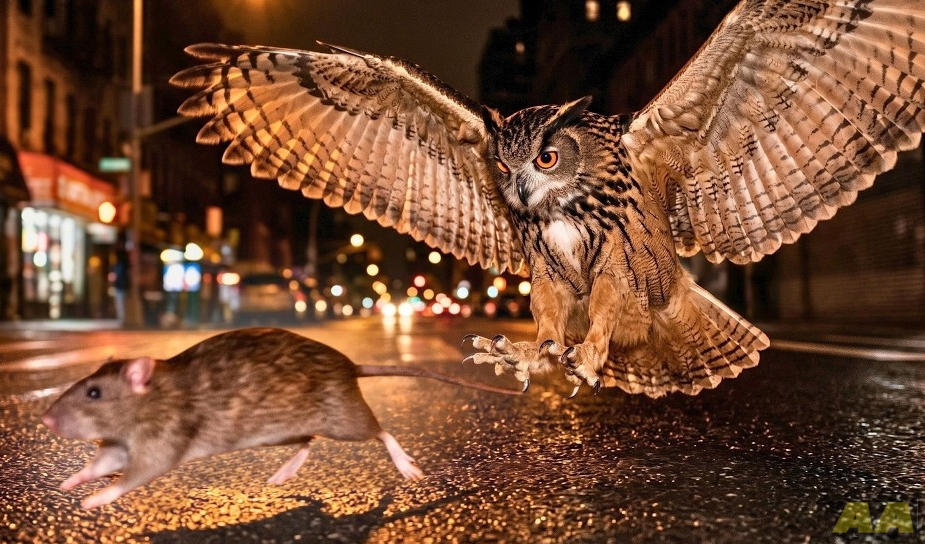
On the night of the 2nd of February, 2023, an ordinary enclosure at the Central Park Zoo suddenly became a doorway into an impossible experiment.
Someone approached the stainless steel mesh, cut through it, and disappeared into the darkness. No one was ever identified.
No explanation was ever given. But on the other side of that opening was an animal who had spent more than 12 years behind those walls.
His name was Flaco, a Eurasian eagle owl with enormous orange eyes, hornlike tufts above his head, and wings stretching close to 6 ft from tip to tip.
He had never needed to search for food. Meals arrived on a schedule. He had never needed to learn the complicated geography of a wild territory.
His world had been an enclosure roughly the size of a bus stop. Then, suddenly, Manhattan was waiting.
Within hours, people saw him on sidewalks and in trees. The largest city in America had acquired an unexpected nighttime resident, and almost everyone assumed his freedom would be brief.
They thought he would be brought back quickly. They thought he would struggle with the city.
They thought a bird raised under human care could not possibly learn the rules of a place this enormous.
But Flaco did something almost nobody expected. He stayed. He learned. He hunted. He crossed Central Park after dark and perched above the streets, fire escapes, rooftops, and water towers.
For one extraordinary year, the city watched him discover a life he had never been taught how to live.
But what exactly did Flaco discover when he began hunting through New York at night?
At first, the escape looked like a crisis that would resolve itself quickly. The zoo knew that Flaco had never lived independently.
He had spent virtually his entire life inside the Central Park Zoo. He had never needed to choose where to sleep.
He had never needed to locate prey. He had never needed to understand the strange mixture of lights, traffic, buildings, trees, rooftops, and human activity that surrounded his enclosure.
Everything he needed had been provided. Then the mesh was cut. Flaco stepped into a world with no walls.
The first sightings came quickly. People noticed the enormous owl on a sidewalk. Others saw him in trees near the zoo.
Soon, the news moved through New York. A Eurasian eagle owl was loose in Manhattan.
The immediate concern was understandable. An owl that has spent years being fed by people might not know how to hunt.
It might not recognize suitable prey. It might not understand where to rooSt. It might not know how to navigate such a complicated urban environment.
The zoo began trying to bring him back. Police officers attempted to approach him on 5th Avenue outside the Bergdorf Goodman department store.
Zoo staff watched his movements. A baited trap was placed on the ballfields in the southern part of Central Park.
Rats were used as bait. Recordings of eagle owl calls were played in an effort to encourage Flaco to come closer.
For a brief moment, the plan appeared to work. Flaco was caught. Then he escaped again.
He flew away and returned to the city. The people trying to recover him had to confront an unexpected problem.
He was becoming harder to catch. But that was not the most important change. Something else was happening.
Flaco was learning. During the first few days, his flying appeared uncertain. He had spent his life in a restricted space.
Suddenly there was an enormous amount of air around him. There were trees rising far above the sidewalks.
There were buildings stretching into the sky. There were rooftops and bridges and parks. There were thousands of possible places to land.
For an animal accustomed to walls, unlimited space could be as confusing as confinement had once been.
Then, around 8 days after his escape, bird watchers noticed something on the ground beneath one of his roosting places.
Flaco had coughed up a pellet. To most people, that might have seemed like an unimportant biological detail.
To someone who understands owls, it was a revelation. Owls swallow much of their prey whole or in large pieces.
Their digestive systems process the useful material, while indigestible fur and bones are later compressed into a pellet and brought back up.
A pellet means the owl has been eating. For Flaco, that meant something even more important.
He had caught something himself. He had hunted. The owl that had been fed every meal by humans had found food in Manhattan.
And once he had done it once, he did it again. Soon, people were seeing him catch rats.
His flying improved. His movements became more confident. The city that had initially seemed impossibly large was becoming a hunting ground.
By the middle of February, the zoo announced that it would stop actively trying to recapture him for the time being.
The situation had changed. Chasing him could create more danger than simply allowing him to remain where he was.
Flaco had found food. He was flying better. He was beginning to establish a routine.
During daylight hours, he often rested in trees around Central Park. After sunset, he became active.
People gathered beneath his favorite trees as evening approached. Bird watchers tracked his movements. Photographers waited for him to wake and launch into the night.
A local bird alert account posted frequent updates. Flaco became more than an escaped zoo animal.
He became part of the city. And the city had an extraordinary amount of food waiting for him.
New York is famous for its rats. They live around parks, subway entrances, buildings, sewers, basements, alleys, and piles of discarded food.
For an eagle owl, the abundance of nocturnal rodents created a remarkable opportunity. Flaco did not need to search through a remote foreSt.
He did not need to cross mountains. His prey was living beneath the same buildings where millions of people lived and worked.
The city had unknowingly created an enormous nighttime hunting ground. Flaco learned how to use it.
He learned the trees. He learned the rooftops. He learned the quiet spaces. He learned where rats moved.
And he learned how to fly through a landscape built almost entirely by humans. The transformation fascinated people.
Murals appeared. Songs were written. Poems were created. Tattoos were inspired by his image. A hashtag campaign encouraged people to keep him free.
A petition asked the zoo to stop trying to bring him back. People traveled across New York simply to stand beneath a tree and look up.
For many, Flaco represented something larger than an escaped owl. He had left an enclosure and entered a city that never seemed to stop moving.
He was alone, yet he appeared capable. He was unfamiliar with the environment, yet he was learning.
He became associated with the idea of a wild animal finding its own place in a human city.
People began calling him the ultimate New Yorker. But the story was becoming more complicated.
Flaco was not simply living in a park. He was living inside an urban ecosystem.
And every ecosystem has hidden costs. The first warning signs were easy to overlook. In November of 2023, Flaco left Central Park.
He was seen downtown. He appeared in a sculpture garden in the East Village. He was spotted on the Lower East Side.
No one knew exactly why he had moved. Perhaps the New York City Marathon had disturbed his usual area.
Perhaps crows were harassing him. Crows are intelligent and highly social birds, and they frequently react strongly to owls.
Or perhaps the movement was connected to the season. Late autumn is a significant period for eagle owls.
This is when they begin looking for mates and establishing territories. Flaco had another behavior that attracted attention.
He called. At night, he perched high above Manhattan and hooted into the darkness. One of his favorite locations was a tall wooden water tower on West 86th Street.
From there, his calls traveled across the rooftops. People inside nearby apartments could hear him.
Night after night, the owl called from above the city. But there was no other Eurasian eagle owl nearby to answer.
As far as anyone knew, Flaco was the only member of his kind living freely on the continent.
His calls therefore carried an unusual loneliness. He was behaving according to instincts that had existed long before Manhattan was built.
He was calling for territory. He was calling for a mate. Yet the city could provide almost everything except another eagle owl.
That contrast made his story even more remarkable. The bird had found food. He had found shelter.
He had found places to fly. But the city could not provide everything his species normally required.
Then another behavior appeared. Flaco began visiting windows. People saw him perched on fire escapes.
He rested on air conditioning units. He appeared on ledges. Sometimes he looked directly into apartments.
In December, one resident, a playwright, discovered Flaco staring through her window. At the time, the sight was extraordinary.
A giant owl looking into a Manhattan apartment was exactly the kind of strange encounter people wanted to share.
But windows represented another danger that was difficult to recognize until it was too late.
For birds, glass is almost invisible. Trees and sky can appear to continue beyond a window.
Reflections can create the illusion of open space. A bird moving quickly through a city can suddenly encounter a surface it never understood was there.
Flaco had learned many things in his first year of freedom. He had learned how to hunt.
He had learned where to reSt. He had learned how to navigate Central Park. He had learned how to move among buildings.
But there were still parts of the city that no owl could learn simply through instinct.
On the 23rd of February, 2024, almost exactly one year after his escape, residents of a building on West 89th Street found Flaco on the ground in a courtyard.
He was badly injured. They contacted the Wild Bird Fund. Staff arrived quickly. But Flaco could not recover.
At first, the explanation seemed obvious. The owl had collided with the building. The city had finally presented a hazard that even an experienced urban hunter could not avoid.
The story appeared to have a simple ending. An owl escaped. He learned to live in Manhattan.
He spent a year hunting beneath skyscrapers. Then a building ended his remarkable journey. But approximately one month later, the full examination revealed that the story was much more complicated.
The Wildlife Conservation Society, which operates the Central Park Zoo and the Bronx Zoo, conducted a complete examination and toxicology testing.
The results were released on the 25th of March, 2024. The examination confirmed traumatic injuries associated with the collision or fall.
But it also revealed two major conditions that had been developing inside Flaco. The first involved a virus.
Flaco had a severe infection of pigeon herpes virus. Feral pigeons can carry this virus without obvious illness.
For birds of prey that consume infected pigeons, however, the consequences can be far more serious.
The examination found extensive damage and inflammation involving multiple organs, including the liver, spleen, gut, bone marrow, and brain.
The second discovery involved rodent control chemicals. Flaco had been exposed to four different anticoagulant rat poisons.
These were the same kinds of compounds used to control rats throughout the city. The veterinary team concluded that the infection and chemical exposure would have caused severe and ultimately fatal illness even without the traumatic injuries.
They may also have weakened him enough to make a collision more likely. That changed the meaning of the final night.
The building was not necessarily the beginning of the problem. It may have been the final event in a much longer process.
Flaco had been living inside an ecosystem that looked ideal from above. There were rats everywhere.
There were pigeons everywhere. There was food. There were places to rooSt. There were trees.
There were rooftops. There was an enormous city full of opportunities. But every food source came with a hidden history.
A predator is connected to whatever it eats. Flaco had spent most of his life eating food prepared by zoo staff.
His meals were controlled. They were selected. They were part of a managed environment. Once he entered Manhattan, that protection disappeared.
He ate what the city provided. And much of what the city provided came from animals living around human waste, buildings, traffic, and pest control programs.
Pigeons became part of his diet. So did rats. The pigeons carried a virus that could affect birds of prey.
The rats could carry accumulated rodenticide. That created a pathway from the city’s pest management system to one of its most celebrated wild animals.
The rat poison was particularly important because of the way it works. Anticoagulant rodenticides interfere with the body’s ability to maintain normal clotting.
A rat that consumes the bait does not necessarily show an immediate reaction. The chemical can remain active over time.
The animal may become weak and less coordinated. That can make it easier for a predator to catch.
From an owl’s perspective, a slow rat in an exposed location is an easy target.
The owl has no way of knowing why the rat is behaving differently. It simply sees prey.
That creates a strange ecological loop. The city places poison to reduce rats. The poison makes some rats easier for predators to catch.
The predator consumes the rat. The chemical moves upward through the food chain. One meal may not create an obvious problem.
But repeated exposure can accumulate. Some of these compounds can remain in an animal for more than 100 days.
That means a predator consuming contaminated prey night after night is not experiencing each meal as an isolated event.
The chemicals can build up. And the compounds most often associated with serious secondary exposure in birds of prey are second generation anticoagulants.
These were developed because some rats had become less responsive to earlier compounds. They are more persistent.
They can be effective after a single feeding. And because they remain in the body longer, they can move through the food web.
Flaco had become a predator inside precisely that system. He was hunting rats in a city where rats were being targeted with chemicals.
He had no understanding of the connection. He only knew that the rats were food.
That is what makes his story so unsettling. The poison was never intended for him.
It was intended for another animal. But ecosystems do not recognize human intentions. A chemical placed on the ground can eventually reach an owl in a tree.
The scale of the problem becomes clearer when Flaco is compared with other birds of prey.
A Cornell University study published in 2022 examined 72 red tailed hawks in New York State.
Anticoagulant rodenticides were detected in 68 percent of them. Red tailed hawks are native predators that hunt rodents.
They occupy many of the same urban and suburban environments where rodent control chemicals are used.
Most people never notice when one of those hawks is carrying a chemical burden. There is no crowd gathering beneath its tree.
There are no daily updates about where it has flown. There is no mural waiting around the corner.
Flaco was different because the city was watching him. Thousands of people followed his movements.
They knew where he slept. They knew when he called. They knew when he moved from one part of Manhattan to another.
His life had become public. That meant his condition eventually became public too. The virus found in Flaco also showed how complicated an urban food web can become.
Pigeons are one of the most familiar birds in New York. They are so common that people often stop noticing them.
But to a predator, they are prey. A Eurasian eagle owl is not thinking about disease transmission.
It is thinking about food. Flaco had learned to hunt in Manhattan by taking advantage of what was available.
That ability allowed him to survive. It also exposed him to risks he had never encountered inside the zoo.
This is the paradox at the center of his story. The same city that gave Flaco his freedom also gave him the hazards that came with that freedom.
The rats allowed him to survive. The pigeons became another food source. The rooftops gave him places to reSt.
The water towers gave him high perches. The parks gave him hunting grounds. The buildings gave him shelter.
But the same buildings contained glass. The same rats were exposed to rodenticides. The same pigeons could carry pathogens.
The city was not simply good or bad for Flaco. It was an ecosystem. And ecosystems contain both opportunities and hazards.
That is why the story cannot honestly be reduced to a single explanation. Flaco did not simply prove that captive animals can become wild.
He also did not prove that cities are safe places for wildlife. He demonstrated something more complicated.
Animals can adapt quickly. But adaptation does not erase every danger. Flaco had learned to hunt within 8 days.
He had become an effective predator. He had established routines. He had crossed neighborhoods. He had moved from Central Park to downtown Manhattan.
He had called from water towers. He had become comfortable around the structures of a city that had never existed in his original world.
Yet some threats were almost impossible for him to understand. He could recognize a rat.
He could recognize a pigeon. He could recognize a tree. He could recognize a crow.
A pane of glass was different. A poisoned rat was different. A virus carried silently by prey was different.
Those hazards were hidden. And hidden hazards are difficult for any animal to avoid. After the examination results became public on the 25th of March, 2024, the meaning of Flaco’s year in Manhattan began to change.
People who had watched him from the beginning had believed they were witnessing a story about freedom.
Now they were also witnessing a story about the hidden connections between cities and wildlife.
His story led to renewed discussion about bird friendly building design. New York State lawmakers connected proposed legislation to Flaco’s name.
City Council members introduced measures involving bird safety, lighting, and rodent control. In October of 2024, New York City approved a plan to explore a different approach to reducing rats, one involving contraception rather than relying entirely on poison.
Flaco’s remains were donated to the American Museum of Natural History so scientists could continue studying him.
His year of freedom became part of New York’s natural history. And the mystery surrounding his escape remained.
Someone had cut through the mesh on the night of the 2nd of February, 2023.
That person was never identified. The reason was never established. Everything that followed began with that single opening.
If the mesh had never been cut, Flaco would probably never have experienced Manhattan. He would never have hunted rats beneath the trees of Central Park.
He would never have perched on a water tower above West 86th Street. He would never have been seen looking through a playwright’s window.
He would never have become one of the most recognizable wild animals in New York.
And the city would never have learned what an owl could accomplish after spending more than 12 years behind an enclosure wall.
That is what makes the story so difficult to place into a simple category. It contains escape.
Adaptation. Curiosity. Unexpected success. Hidden hazards. And a city discovering that wildlife does not always remain where humans expect it to remain.
Flaco had been raised without the lessons normally provided by wild parents. Yet within days, he discovered the basic rhythm of hunting.
He found prey. He learned the landscape. He improved his flying. He selected roosts. He established routines.
He did not become a perfect wild owl. He became Flaco. An individual animal solving problems one night at a time.
That may be why people connected with him so strongly. New York is a city where millions of people arrive from somewhere else and learn how to navigate an environment that was not designed specifically for them.
Flaco did something similar. He arrived unexpectedly. He had no map. He had no teacher.
He had no instruction manual. He simply began learning. And for one year, he succeeded well enough that people started believing he belonged there.
He became part of the nighttime landscape. A shadow crossing between buildings. A pair of orange eyes above a sidewalk.
A huge silhouette on a water tower. A call drifting through apartment windows. A bird that had once lived behind mesh now belonged to a city of millions.
But his story also revealed something important about urban wildlife. Survival is not only about finding food.
It is about finding safe food. It is about avoiding invisible hazards. It is about navigating glass.
It is about understanding traffic. It is about choosing safe places to reSt. It is about knowing which prey can carry disease or chemicals.
Wild animals do not have access to the information humans possess about these hazards. They respond to what their senses tell them.
For Flaco, a rat was a rat. A pigeon was a pigeon. A building reflected the sky.
A rooftop looked like a perch. A water tower looked like a perfect place to call.
The city added meanings to those objects that he could never fully know. And that is perhaps the most important lesson hidden inside his story.
An animal can adapt to a human environment without becoming immune to the consequences of that environment.
Flaco proved that adaptation was possible. He also revealed the price of adaptation. When people gathered beneath his Central Park tree after the examination results became known, they were not simply remembering an escaped zoo owl.
They were remembering a year in which the boundary between wild and urban had almost disappeared.
For those who followed him, Flaco had become proof that an animal could surprise an entire city.
He had escaped a controlled environment and entered one of the most complicated landscapes on Earth.
He found his own food. He found his own shelter. He found his own routes.
He found his own nightly rhythm. And he made millions of people look upward. The city had spent decades treating rats as a problem to control.
Then an owl arrived and began doing something humans had always wanted predators to do.
He hunted them. But his story showed that there is no such thing as a completely separate food chain.
The rat is connected to the owl. The pigeon is connected to the owl. The chemical is connected to the rat.
The virus is connected to the pigeon. The building is connected to the owl. And the people who live among all of them are connected to every part of that system.
Flaco never needed to understand any of it. He only needed to fly. He only needed to hunt.
He only needed to find another place to perch before sunrise. For approximately one year, that was enough.
And perhaps that is why his story continues to stay with people. It was never simply about an owl escaping a zoo.
It was about what happened when an animal that had spent more than 12 years inside a controlled world suddenly entered a city and discovered that the city itself was alive.
It had food. It had shelter. It had hazards. It had competition. It had hidden dangers.
And it had millions of people watching. Flaco did not follow a plan. He did not receive training.
He did not wait for the perfect conditions. He simply stepped through an opening and began learning.
The rest of the city had to learn too. And perhaps the final question is not whether Flaco belonged in New York, but what his year among the rooftops revealed about the city itself?
Disclaimer: This content may be created by Al for entertainment purposes. Any resemblance to real persons, events, or places is coincidental.








