America Built 70,000 Nuclear Bomb Triggers Here — Then Let Wild Animals Take It Back
On the morning of June 6, 1989, more than a hundred people arrived at a place that had spent decades keeping people out.
Federal vehicles rolled through the gates of a secret industrial complex sixteen miles northwest of Denver, carrying agents from the FBI and the Environmental Protection Agency.
They had search warrants, mobile laboratories, cameras, and enough equipment to spend eighteen days examining a facility built to manufacture the most secret components of American nuclear weapons.
This was Rocky Flats, a place where plutonium cores had been produced for decades behind fences, security checkpoints, and layers of government secrecy.
But the strangest part of the story was not what investigators found inside those buildings.
It was what remained outside them. Beyond the factories and buried waste, thousands of acres of prairie had survived almost untouched while the Denver metropolitan area grew around it.
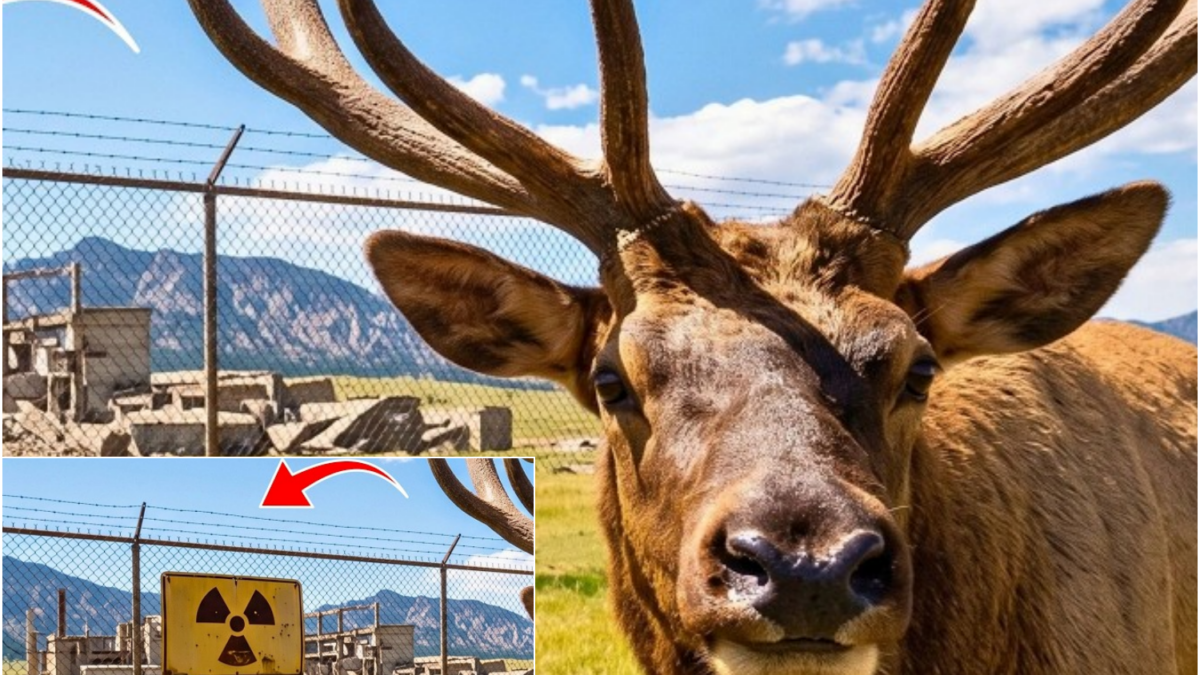
Elk still crossed the grass. Mule deer moved between the ridges. Coyotes hunted among the prairie plants.
Along the creeks lived a threatened mouse found only in this region. More than six hundred species of plants grew where neighborhoods and roads might otherwise have stood.
And decades later, people would argue in court over whether they should be allowed to walk there.
How could a place built around one of the most hazardous industries in American history become a refuge for wildlife, and why would anyone still be afraid to step onto its trails?
Rocky Flats had never been designed to become a wildlife refuge. When the plant opened in the early 1950s, the Cold War was transforming the United States and the Soviet Union into rival nuclear powers.
Rocky Flats had one highly specialized assignment. It manufactured plutonium pits, the spherical cores placed at the center of nuclear weapons.
Over its lifetime, the plant produced an estimated 70,000 pits. The material being handled there was unlike anything most industrial workers would ever encounter.
Plutonium was radioactive, and plutonium 239 had a half life of roughly 24,000 years. Outside the human body, much of the radiation it produced could be stopped by skin.
The greater concern came from microscopic particles that could enter the body through breathing or swallowing.
That made dust the central problem. Where did the particles go? How much remained in the soil?
And how much had ever escaped beyond the plant boundary? The answers became increasingly troubling as Rocky Flats grew older.
In 1957, a plutonium fire broke out at the facility. Another major fire followed in 1969.
Then, in 1974, an accidental release sent plutonium into the surrounding environment. But some of the most important contamination did not arrive through dramatic accidents.
It came from barrels. Beginning in 1958, drums containing oil and waste contaminated with plutonium were stored outdoors on an area that became known as the 903 pad.
Over time, some of those barrels corroded. Material entered the soil, and dust could be carried away by wind.
The prevailing winds moved toward the south and east, in the direction of the growing communities around Denver.
A study published in 1972 reported plutonium concentrations in soil east of the plant that reached levels hundreds of times higher than the contamination associated with global fallout from nuclear weapons testing.
There were other problems. Liquid radioactive and hazardous waste had been stored in open ponds.
Workers treated some of the sludge by mixing it with cement, producing a material known as pondcrete.
The solidified waste was placed into boxes, and some of those containers leaked. For years, much of this activity remained hidden behind the secrecy surrounding Rocky Flats.
The plant was producing weapons material for the federal government. The federal government owned the site.
And the same government responsible for the facility was also responsible for regulating much of its operation.
That arrangement began to unravel during the 1980s. In 1986, an internal Department of Energy memo described serious contamination problems at Rocky Flats.
The memo became public during a congressional hearing in 1987. Then investigators found another source.
Jim Stone, a former employee of the plant, provided information that helped investigators understand what might be happening inside the facility.
The FBI opened an investigation. But investigators still needed evidence strong enough to obtain a search warrant.
They found an unusual way to collect it. In December 1988, investigators arranged night flights over Rocky Flats.
They used infrared cameras capable of detecting heat patterns from above. The flights helped investigators develop evidence supporting allegations that an incinerator that was not supposed to be operating was being used at night.
The investigation moved closer to the plant. Then came June 6, 1989. Federal agents drove through the gates.
More than 75 investigators took part, supported by around 30 vehicles and mobile laboratories. They were not there as security officers.
They were there to search the facility. For eighteen days, investigators examined 31 buildings and removed thousands of documents.
It was one of the rare moments in American history when one branch of the federal government effectively descended upon a facility operated for another part of the same federal government.
The operation became known as Operation Desert Glow. The raid changed Rocky Flats permanently. In September 1989, only months later, plutonium production stopped.
The plant never returned to weapons production. But the legal consequences moved much more slowly.
A federal grand jury was assembled. It continued for approximately two years. More than 110 witnesses appeared before it, and hundreds of boxes of documents were reviewed.
In May 1991, the grand jury voted on indictments. Yet the case never became a full criminal trial against individual people.
In 1992, Rockwell International, the private company operating Rocky Flats for the Department of Energy, entered a plea agreement.
The company pleaded guilty to ten environmental crimes, including four felonies and six misdemeanors. It paid an $18.5 million fine.
No individual was charged. The grand jury report itself was sealed by the court. Parts eventually reached the press, but much of what the grand jury heard never became fully public.
Some grand jurors became frustrated enough to speak publicly about what they believed had happened.
The controversy continued. Then another legal battle began. In 1990, people who owned property near Rocky Flats filed a class action lawsuit against companies connected with the plant.
They argued that plutonium contamination had damaged their property. That case continued for decades. In 2016, it ended with a $375 million settlement, which the court approved the following year.
The settlement concerned property claims. It was not a finding that the contamination had caused particular health effects.
But it demonstrated something else. The story of Rocky Flats was not going away. The factory was gone.
The buildings would eventually disappear. The lawsuits would eventually end. But the land remained. And that land held a secret nobody had intended to preserve.
Prairie. While Rocky Flats had been operating, the land around the production facilities served an entirely different purpose.
It was a security buffer. The government had acquired roughly 2,500 acres for the original plant in 1951.
In 1974, another roughly 4,000 acres were added. Houses did not cover those fields. Shopping centers did not replace the native grasses.
Roads did not cut every ridge into smaller pieces. The land remained fenced, quiet, and largely inaccessible.
Outside the boundary, Colorado was changing rapidly. The Front Range was filling with homes, businesses, roads, warehouses, and industrial development.
Prairie disappeared beneath construction. Rocky Flats remained. The same restrictions that had kept people away from the area also kept development away from much of the prairie.
Then the weapons plant closed. The question became what should happen to the land. Cleanup began on an enormous scale.
During the middle of the 1990s, the government brought in Kaiser Hill to manage the cleanup.
Approximately 800 structures were dismantled. Radioactively contaminated buildings were taken apart. Hundreds of thousands of cubic meters of radioactive waste were removed and transported to other Department of Energy locations.
Contaminated areas were cleaned or capped. The project became one of the largest environmental cleanup efforts in American history.
The main contract cost approximately $7 billion. A later Government Accountability Office review estimated the overall cost, including long term stewardship and other expenses, at roughly $10 billion.
The work was declared complete in October 2005. But complete did not mean that every acre of Rocky Flats had become identical to ordinary undeveloped land.
The central industrial area covers approximately 1,300 acres. That portion remains under Department of Energy control.
It is fenced. It is closed to the public. Contaminated material remains buried beneath engineered caps, and the area continues to require monitoring.
The wildlife refuge surrounds that central area. And this is where the story becomes almost impossible to summarize with a single word.
Because the land outside the central facility had become something extraordinary. Congress passed legislation in 2001 establishing the future of the property as a wildlife refuge.
The Rocky Flats National Wildlife Refuge was formally established in 2007. It covers roughly 5,000 acres and is managed by the United States Fish and Wildlife Service.
The prairie that survived there is not ordinary. Rocky Flats contains xeric tall grass prairie, a dry grassland ecosystem found at the base of the Rocky Mountains.
It has been described as one of the largest remaining examples of this type of prairie in Colorado.
More than 600 species of plants have been recorded across the refuge. The grass supports insects.
The insects support birds. The plants support herbivores. Predators move through the same landscape. Elk became one of the most recognizable animals there.
Mule deer appeared among the grasslands. Coyotes traveled through the open country. Prairie dogs occupied portions of the refuge.
Raptors circled above it. Songbirds moved through the vegetation. Waterfowl used the wetlands. And at least one moose was recorded there.
Along the creeks lived another remarkable resident. The Preble’s meadow jumping mouse. It is a small animal with a long tail and large hind feet that allow it to leap through streamside vegetation.
Its range is limited to portions of Colorado and Wyoming, and it is listed as threatened under the Endangered Species Act.
The mouse needs healthy riparian habitat. Rocky Flats still provides it. For decades, the public could not walk through this landscape.
Then, on September 15, 2018, the refuge opened its trails. Around ten miles of paths became available for hiking, biking, and horseback riding.
The prairie that had been hidden behind fences was suddenly accessible. But access brought an argument that had been building for years.
Was the refuge safe for visitors? Federal and state officials said the available evidence supported opening the land.
Critics disagreed. The disagreement was not about whether Rocky Flats had ever been contaminated. That part of the history was established.
The disagreement centered on what remained and how confidently it could be measured. The federal government and state agencies conducted extensive soil sampling.
In a 2006 Department of Energy sampling effort, the average plutonium concentration in refuge soil was around one picocurie per gram.
The safety standard used for refuge workers and visitors was around ten picocuries per gram.
In 2011, federal and state officials concluded that the refuge lands were suitable for unlimited use and unrestricted exposure.
Colorado health officials also studied cancer rates in communities surrounding the site. An updated study covering 1990 through 2014 found that overall cancer rates in nearby communities were not different from those in the wider Denver metropolitan area.
A 2017 follow up examined thyroid and rare cancers and did not find elevated rates linked to Rocky Flats.
Those findings became part of the official case for opening the refuge. But another group of scientists and activists remained concerned.
Their argument focused on the way contamination behaves. Plutonium does not necessarily spread evenly through soil.
Tiny particles can form localized concentrations. A broad average can therefore look low while individual spots may contain higher readings.
Critics argued that sampling might fail to identify every such location. They also pointed to the extraordinary persistence of plutonium.
A substance with a half life measured in tens of thousands of years does not simply disappear because a cleanup project has ended.
Disturbing soil could potentially move particles. Then came the floods of 2013. Monitoring detected tiny amounts of plutonium in drainage creeks.
Critics interpreted that finding as evidence that contamination could still move through the environment. The dispute eventually reached federal court.
In 2018, groups including the Rocky Mountain Peace and Justice Center challenged the opening of the refuge.
John Lipsky, a former FBI agent who had participated in the 1989 Rocky Flats raid, joined the challenge.
His concern was straightforward. A visitor walking through the refuge could not know whether a tiny particle of plutonium might be present beneath the soil.
A federal judge declined to stop the trail work in 2018. In 2021, a court concluded that the Fish and Wildlife Service had followed federal law.
The court did not settle the broader scientific argument over whether opening the refuge was wise.
That distinction matters. Courts can determine whether agencies followed the law. They do not turn a complicated environmental question into a simple scientific answer.
Then came another puzzling result. In 2019, a soil sample taken just outside the refuge along a nearby road reportedly measured 264 picocuries per gram.
That figure was around five times higher than a cleanup standard of 50. But the same sample produced another result when a different portion was analyzed.
That portion measured around 1.5 picocuries per gram. State health officials later reviewed the testing and concluded that the remaining plutonium in that corridor presented a small risk within regulatory limits.
One sample had produced two dramatically different numbers. And suddenly the entire Rocky Flats argument could be seen in miniature.
The question was not simply whether plutonium existed. Everyone already knew it did. The question was where it existed, how much was present, how accurately it could be detected, and what level of exposure mattered.
The refuge itself was never the entire Rocky Flats site. The central 1,300 acres remained closed.
The Department of Energy continued to control that area. Material remained buried beneath caps. Monitoring continued.
Nobody had returned the landscape to some imaginary condition from before the 1950s. The cleanup had been designed around agreed standards.
That distinction became central to understanding the refuge. The official studies provided evidence supporting public access.
The critics raised questions about sampling, localized contamination, long term persistence, and soil disturbance. Both parts of the story mattered.
Neither the elk nor the prairie grass could answer the human safety question. Wildlife can show that habitat exists.
Wildlife cannot tell a visitor whether a particular particle of plutonium is present beneath a trail.
At the same time, the existence of radioactive material somewhere on a former industrial site does not automatically establish that every surrounding acre presents the same level of exposure.
Rocky Flats was a landscape where averages mattered and individual particles mattered. Where history mattered.
Where sampling mattered. Where the difference between the refuge and the central industrial area mattered.
And where a decision made in the 1950s continued to shape the land more than half a century later.
The strangest part may have been what happened to the prairie while nobody was watching.
The land was never intended to become a biological archive. Nobody fenced it off to preserve native grassland.
Nobody designed the security buffer as a conservation project. Nobody planned for elk to reclaim it.
Nobody planted six hundred species of prairie plants. The refuge emerged from a completely different history.
A weapons factory needed space around it. The space remained undeveloped. The surrounding city expanded.
The prairie survived. By the time conservationists began studying what was left, they discovered an ecosystem that had escaped the transformation happening all around it.
It was not untouched wilderness. People had altered the landscape before the weapons plant existed.
Roads crossed portions of the region. Water systems had been changed. The land had a complicated human history.
But compared with the development surrounding it, Rocky Flats had remained remarkably open. That is why the wildlife refuge became so important.
Colorado had lost enormous amounts of native prairie to development. At Rocky Flats, a large piece remained connected enough for animals to use.
Elk could move through open grassland. Mule deer could cross between habitats. Coyotes could hunt without crossing a subdivision every few hundred yards.
The Preble’s meadow jumping mouse could live beside its creeks. A moose could wander into a landscape where a moose would not normally be the first animal anyone expected to find.
And above all of it, the prairie plants remained. That does not make the history of Rocky Flats disappear.
It does not erase the fires of 1957 and 1969. It does not erase the 1974 release.
It does not erase the leaking drums at the 903 pad. It does not erase the pondcrete.
It does not erase Operation Desert Glow. It does not erase the grand jury. It does not erase the billions spent on cleanup.
And it does not erase the fact that the central industrial area remains fenced and monitored.
But the prairie creates another layer of the story. For nearly forty years, the land surrounding a secret plutonium factory was protected from one of the forces that had transformed almost every other part of the Front Range.
Development could not enter. Neighborhoods could not spread across it. Commercial buildings could not replace the grass.
The security boundary became, unintentionally, a shield. Then the factory disappeared. The shield became a refuge.
And the refuge became a place where people could once again walk through a landscape that had been hidden for generations.
That is where the story becomes difficult. Should the public have access? The official answer has been yes, based on extensive sampling, regulatory standards, and agency reviews.
Critics have continued to question whether the sampling fully captures localized contamination and whether disturbing the soil could create new exposure pathways.
The courts have allowed the refuge to remain open. The central industrial area remains closed.
The disagreement continues. But outside the fence, the animals continue doing what animals have always done.
Elk graze. Coyotes travel. Mule deer move between patches of grass. Birds cross the sky.
The Preble’s meadow jumping mouse remains beside the creek. The prairie continues growing. It does not know about the FBI raid.
It does not know about the grand jury. It does not know how much the cleanup coSt.
It does not know what a picocurie is. It does not know why a federal judge was asked to stop people from walking on a trail.
It simply occupies the habitat that remained. On the same land where workers once manufactured plutonium pits, an elk can now lower its head and graze.
Beyond it, the old central facility remains behind its fence. The two landscapes exist side by side.
One contains buried material that still requires monitoring. The other contains a functioning prairie ecosystem that survived because people were kept away.
That contrast is what makes Rocky Flats so difficult to understand. It is neither a simple story of a poisoned landscape nor a simple story of nature triumphing over industry.
It is both history and habitat. It is a place where secrecy created environmental harm and, unintentionally, helped preserve something valuable.
It is a place where billions of dollars were spent cleaning up a weapons complex while a rare prairie survived almost unnoticed around it.
It is a place where scientists, government agencies, activists, former investigators, and local residents can examine the same ground and reach different conclusions about what the evidence means.
And the disagreement is likely to remain because the underlying question is larger than Rocky Flats.
How should people judge a landscape where the contamination is real, the cleanup is real, the monitoring is real, and the surviving ecosystem is real too?
There is no single measurement that can answer every part of that question. The 1989 raid tells us what happened inside the plant.
The cleanup tells us what was removed. The monitoring tells us what remains measurable. The wildlife tells us that the prairie itself endured.
The court cases tell us that reasonable people continued to disagree about what those facts meant for public access.
And the fence around the central 1,300 acres tells us that even after the cleanup was declared complete in October 2005, Rocky Flats was never simply returned to ordinary land use.
More than thirty years after Operation Desert Glow, the strangest image is therefore not the agents arriving through the gates.
It is the image that came afterward. A person walking along a prairie trail. An elk several hundred yards away.
A coyote disappearing into tall grass. A tiny jumping mouse moving beside a creek. The Front Range rising in the distance.
And behind all of it, beyond another fence, the central Rocky Flats property where buried material remains under engineered caps and continued monitoring.
The place that once represented secrecy and weapons production now contains a landscape that many people would recognize simply as Colorado prairie.
But beneath that ordinary appearance is an extraordinary history. A weapons plant once stood here.
Federal agents once searched it. A grand jury once examined its records. A multibillion dollar cleanup followed.
A refuge emerged. And the prairie remained. Perhaps that is the most unusual thing Rocky Flats has to teach.
Nature does not always return to a place because humans carefully designed a restoration project.
Sometimes it survives because circumstances create a narrow window in which development cannot reach it.
Sometimes the land that seems forgotten becomes the land that matters later. And sometimes a place built for one purpose leaves behind something nobody intended to preserve.
The elk do not know that. The mouse does not know that. The prairie does not know that.
They simply remain. And every time the grass moves across Rocky Flats, it carries the story of a landscape that was once hidden, then investigated, then cleaned, then argued over, and finally opened to the public while one important section remained behind the fence.
The factory is gone. The trails are open. The prairie is still there. And the question that remains is not whether Rocky Flats has a complicated past, because it unquestionably does.
The question is what we choose to understand from a place where the most troubling part of the human story and one of the most resilient parts of the natural story now occupy the same landscape?
Disclaimer: This content may be created by Al for entertainment purposes. Any resemblance to real persons, events, or places is coincidental.








