All The Men In Town Feared That Outlaw—But The Widow In The Corner Of The Saloon Didn’t Even Look Up
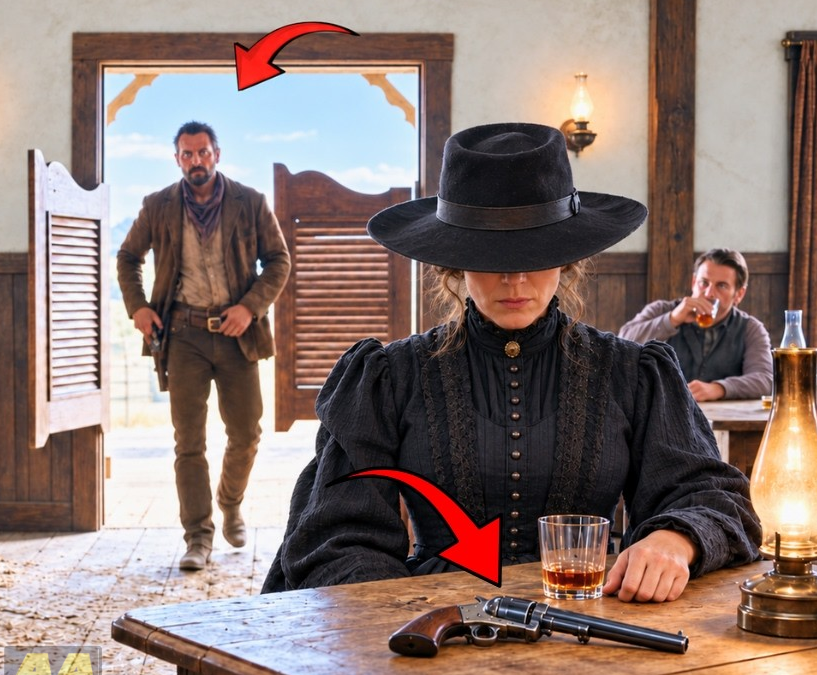
Cross Timber had learned to recognize Dutch Howerin before anyone saw his face. It was the boots.
Heavy heels struck the wooden porch outside the saloon, slow and measured, and every conversation inside seemed to lose its place.
A poker chip stopped rolling. A glass remained halfway to a miner’s mouth. The piano player lowered his hands from the keys.
Three men nearest the door suddenly remembered errands somewhere else. Cordelia Vance did not move.
She sat alone at a small table beneath the darkest window, dressed in black, her hat pulled low over her gray eyes.
Beside her untouched whiskey rested a small revolver. One hand lay close to it. A pale scar crossed the back of that hand.
Then the door opened. Dutch Howerin stepped inside smiling. Four men across three counties had learned to fear that smile.
Cordelia knew about a fifth. She also knew that Howerin had ridden hard to reach Cross Timber before someone else could warn him.
He stopped beside her table. “You don’t seem concerned about who just walked in.” Cordelia kept looking at her glass.
“You’re not the man I came to fear.” His smile weakened. “You expecting someone?” “You?”
The word seemed to empty another table. Howerin pulled out the chair opposite her. “Do I know you?”
Cordelia finally raised her head. “Cordelia Vance.” Something changed around his eyes. She saw it.
He covered the reaction by reaching for her whiskey. “You heard my husband ask you to spare the men working beside him,” she said.
The glass stopped halfway to his mouth. Outside, wind pushed dust beneath the door. Inside, nobody moved.
Cordelia had waited six months for this moment. But she had not come to Cross Timber merely to confront Dutch Howerin.
She needed him alive. She needed him afraid. And before the night ended, she needed him to speak one name.
Because what happens when the man everyone fears discovers that the person who hired him has already decided he is worth more silent than alive?
Six months earlier, Walter Vance had ridden home across another man’s saddle. Two riders brought him to the ranch after sunset.
They claimed they had found him beside Cottonwood Draw. Cordelia knew immediately that they were lying.
The taller rider had red clay caked along his boots. Cottonwood Draw was pale sand and limestone.
Red clay began three miles east near a spring that Nathaniel Reeves had wanted for years.
Cordelia said nothing. She took Walter inside. She cut the rope from his wrists. She removed his coat.
She washed his face. Then she sat beside him until the house became quiet. The next morning, men began arriving.
Some offered sympathy. Some offered advice. A few offered to buy the ranch. Nathaniel Reeves sent no flowers.
He sent a man with a contract. Cordelia refused. Reeves had been trying to acquire the Vance Spring for four years.
He had already purchased six struggling ranches. Each owner had first lost something. One lost access to water.
Another lost credit. Another lost cattle. Another discovered that papers filed at the land office no longer matched the papers in his own desk.
Then those families left. Walter had refused every offer. He believed the spring should remain open to neighboring homesteads during dry seasons.
He had told Cordelia more than once that a spring could be valuable without belonging entirely to one man.
Reeves disagreed. He believed ownership was power. After Walter was gone, people told Cordelia she should sell.
They said Reeves would eventually take the ranch anyway. They said she was alone. They said a woman could not hold a property dispute against a man who controlled half the cattle trade in the county.
Cordelia listened. Then she sold the ranch. Not to Reeves. She accepted less money from a young family who promised to keep the spring open to neighboring homesteads during drought.
Then she left Cross Timber. She visited land offices. She visited banks. She visited mining camps.
She asked questions. She learned which men carried Reeves’s money. She learned which gunmen had worked for him.
She learned which riders had disappeared after collecting payments. One name surfaced more often than any other.
Dutch Howerin. Outside Tucson, Cordelia found a former Reeves bookkeeper living in a small room behind a boarding house.
The man was sick and frightened. He would not testify. He would barely speak. But his wife gave Cordelia copies of five ledger pages.
The pages were enough. Walter’s name appeared beside a black cross. So did the names of the Ashford brothers.
So did the Petraus family. Next to each name was a payment. The entries did not describe what had happened.
They did not need to. At the bottom of one page was Dutch Howerin’s name.
Beside it was another black cross. The payment was not from Reeves to Howerin. It was from Reeves to another gunman.
Cordelia read it twice. Then she understood. Reeves was not sending Howerin after another target.
Reeves was paying someone to silence Howerin. That changed everything. Cordelia copied the pages. She mailed one set to a deputy United States marshal in Prescott.
She gave another to the justice in Cross Timber. She kept the third inside her coat.
Then she spread a rumor. Not a loud one. Not one carried through the streets.
She placed it in card rooms where men repeated interesting things without realizing who had planted them.
Dutch Howerin could be found drinking in Cross Timber. A widow there possessed something he would want.
The rumor traveled. Howerin came. Now he sat across from Cordelia. His hand rested near his walnut handled Colt.
Cordelia’s hand remained beside her smaller revolver. Neither drew. “If you meant to shoot me,” Howerin said, “you would have tried before giving me your name.”
“If I meant to shoot you, you would not have reached the chair.” His eyes narrowed.
“That’s confidence.” “No. Confidence is believing no one will ever make you answer for what you’ve done.”
The bartender stopped polishing a glass. A man near the door stood. Another followed him outside.
Howerin noticed. “You brought witnesses?” “I brought a question.” “And that little gun?” “The gun is there.”
“You keep looking at it.” For the first time, Howerin stopped smiling. Cordelia opened her coat.
She removed one folded sheet. She placed it between them. Howerin stared at it. He did not touch it.
“Say what you came to say,” he muttered. “Nathaniel Reeves paid you four hundred dollars after Walter refused to sell.”
Howerin’s eyes remained still. His thumb moved once against his gun belt. “Men tell widows ugly stories.”
Cordelia unfolded the paper. “Half before. Half after.” His expression changed. She saw it. “You recognize the handwriting.”
“Could belong to anyone.” “Then explain the mark.” He looked down. The black cross beside his name seemed darker than the rest of the page.
“Where did you get this?” “From a man Reeves tried to erase.” “Where is he?”
“Beyond Reeves’s reach.” Howerin read the page again. “You didn’t come here to make me confess.”
“No.” “You came to scare me.” “I came to give you the chance Reeves never intended you to have.”
Howerin leaned back. “What chance?” Cordelia pointed at the page. “Reeves has already paid someone to silence you.”
Howerin looked toward the saloon door. “And you expect me to believe that?” “You don’t have to believe me.”
She folded the page. “You only have to recognize your own name.” The saloon grew quieter.
Howerin watched the people leaving. One man slipped outside. Then another. The bartender lowered the shutters over the windows.
Howerin looked toward him. “What are you doing?” “Closing for the evening.” “It’s not evening.”
The bartender locked the door. The key turned loudly. Then the kitchen door opened. Cross Timber’s justice of the peace entered carrying a Bible and a leatherbound writing book.
Behind him came the widow of one Ashford brother. Then the surviving Petraus daughter. Then two ranchers Reeves had forced from their land.
Howerin stood so quickly that his chair struck the floor. Cordelia’s revolver was in her hand.
“Sit down.” Howerin stared at the people behind the bar. “You said witnesses.” “I said I arranged witnesses.”
“You expect me to confess in front of them?” “The court comes later.” Howerin looked at the justice.
Then at Cordelia. “The deputy marshal has the ledger pages,” she said. “Run and Reeves’s man finds you.
Ride back to Reeves and he has you silenced before supper. Stay here and tell the truth, and you may reach a real court alive.”
“You think a piece of paper saves you?” “No.” Cordelia held his gaze. “I think it denies Reeves the silence he paid for.”
The justice placed the Bible on the bar. “mrs. Vance says you want to make a statement?”
Howerin gave a dry laugh. “mrs. Vance says a great many things.” “Most of them true,” Cordelia replied.
Howerin looked down at the copied ledger. “If I talk, I hang.” “Perhaps.” The answer surprised him.
“You’re not offering mercy.” “Mercy is not mine to offer.” Cordelia lowered the revolver slightly.
“Neither is the sentence. Tell the truth, and I will deliver you alive with proof that you cooperated.
A judge decides what happens after that.” “And if I say no?” Cordelia nodded toward the ledger.
“Then Reeves decides.” Howerin stared at her. Then he walked to the bar. His spurs made small sounds against the floorboards.
He picked up the Bible. He did not place his hand upon it. “What stops me from taking that door?”
“The men who left through the front are covering the alley.” “What stops me from shooting you?”
“Nothing but your judgment.” Howerin turned. Cordelia stood in the open. Her revolver was held low.
Her face showed no certainty that she would survive the next moment. Only readiness. He placed the Bible down.
“Ask your first question.” The justice opened the ink bottle. Cordelia did not begin with Walter.
“Who ordered the supports cut in the Ashford mine?” Howerin’s jaw tightened. “Reeves.” The pen moved.
“Who carried it out?” “Kell and Brody.” “Why?” “Reeves wanted the mine closed.” “And you?”
“I showed them when the mine would be empty enough to make the collapse look accidental.”
The Ashford widow stood behind the bar. Her hands were clenched. “How much?” “One hundred for me.”
“And the others?” “Two hundred each.” The justice wrote every word. Cordelia waited. “The Petraus house.”
Howerin looked toward the young woman near the kitchen. “I wasn’t at the house.” “That was not my question.”
He swallowed. “Reeves wanted their deed.” “They refused?” “Yes.” “Then what?” “A man named Cobb chained the back door.”
The young woman lowered her eyes. “Another poured lamp oil beneath the porch.” Howerin paused.
“I watched the north road.” “Who lit it?” “Cobb.” The Petraus daughter finally spoke. “My mother was inside.”
Howerin looked away. “My little brother was eight.” No one moved. Cordelia allowed the silence to remain.
For years, Howerin had reduced everything to payments. Numbers had been easier. A hundred dollars.
Two hundred. Four hundred. Now every number had a face. The justice dipped his pen.
Cordelia looked at Howerin. “Walter Vance.” Howerin’s breathing changed. “Three men rode to Cottonwood Draw.”
She waited. “You were one.” He nodded. “Give me the other two.” “They are gone.”
“Give me their names.” Howerin did. The justice wrote them down. “What happened at the draw?”
Howerin stared at the tabletop. “We stopped Walter on the east trail.” “Why?” “Reeves wanted him to sign over the spring.”
“Did Walter agree?” “No.” “What did he say?” Howerin looked directly at Cordelia. “He said the spring belonged to the ranches below him as much as it belonged to him.”
Cordelia remembered those words. Walter had said almost exactly the same thing at their kitchen table.
Howerin continued. “He said no one man should own the thirst of a whole valley.”
Cordelia’s grip tightened around the revolver. “What happened next?” “He tried to ride through us.”
“Then?” “One man pulled him down.” “Walter fought?” Howerin nodded. “He broke the other man’s nose.”
Cordelia closed her eyes for one second. “He nearly reached his rifle.” “What happened?” Howerin looked down.
“He never begged.” Cordelia’s voice remained steady. “Who fired the shot?” Howerin did not answer immediately.
Then he looked at her. “I did.” The pen stopped. Cordelia stared at him. “Say his name.”
Howerin swallowed. “I killed Walter Vance.” The words settled over the saloon. Cordelia had imagined hearing them for six months.
She had expected rage. She had expected satisfaction. Instead, there was only a hollow space where certainty should have been.
“Why?” Howerin looked at the floor. “Reeves paid me.” He took a breath. “And I had spent so long calling it work that I stopped hearing what I was doing.”
Cordelia said nothing. The justice continued writing. Howerin spoke for nearly an hour. He named intermediaries.
He named false witnesses. He identified a clerk who had altered water filings. He described payments.
He described meetings. Then he revealed something else. Beneath Reeves’s branding shed stood a strong box.
Inside were deeds, payment orders, letters, and records of transactions. “Why keep them?” The justice asked.
“Because Reeves trusted blackmail more than loyalty.” Howerin looked at the ledger. “A man can deny a promise.
He cannot deny his own signature.” The justice looked at Cordelia. She nodded. Howerin drew a rough map.
He marked the loose plank. He named the night guard. The justice read the statement aloud.
Howerin corrected two dates. Then he signed. The bartender signed as a witness. The Ashford widow signed.
The ranchers signed. Cordelia lowered her revolver. “Take off your gun belt.” Howerin looked at her.
“You said you’d deliver me alive.” “I did not say armed.” Slowly, he unbuckled the belt.
He placed it on the table. Cordelia took the Colt. She opened the cylinder. Six cartridges.
She closed it again. Only then did she allow herself a full breath. Howerin watched her.
“Reeves has a watcher in town.” “He already knows.” Howerin stared. “How?” Cordelia looked toward a narrow gap in the shutter.
A rider was already disappearing down the southern road. “He heard enough.” “You let him go?”
“Yes.” “Why?” “Reeves has escaped every problem by making someone else carry it for him.”
She looked back at Howerin. “I need him to act where witnesses can see.” Howerin understood.
“You planned all of this.” “No honest plan survives another person’s fear.” Cordelia tucked the Colt into her belt.
“I prepared what I could.” “And if Reeves comes with twenty men?” “He won’t.” “How do you know?”
“Twenty men would make him look afraid.” Howerin gave a faint smile. “You understand him.”
“I understand men who think money makes them untouchable.” He glanced toward the road. “He’ll bring four.”
“How long?” Howerin listened. Forty minutes passed slowly. Then he said, “Less.” Cordelia turned toward the people inside the saloon.
“Then we use every minute.” The next forty minutes changed the room. The witnesses moved behind the kitchen wall.
The ranchers took positions near the rear door. The blacksmith returned with an old carbine.
The grain seller brought another rifle. Two miners who had once lost land to Reeves arrived through the alley.
They were not professional gunmen. Cordelia did not need them to be. She needed them to be witnesses.
She placed each person where he could see the doors. “No one fires unless they draw.”
The blacksmith looked at Howerin. “And him?” “He is in my custody.” Howerin glanced sideways.
“That is a generous description.” “Would you prefer prisoner?” “Probably more accurate.” Outside, hooves struck the hard street.
Slow. Deliberate. The riders wanted everyone in Cross Timber to hear them arrive. Howerin looked through the shutter.
“Reeves is in the middle.” Cordelia waited. “The man on his right?” “Bryce Tolen.” Howerin’s expression hardened.
“He is the one named beside me in the ledger.” “The man paid to silence you?”
“Yes.” “Quick with a pistol?” “Very.” The hooves stopped. Leather creaked. Spurs touched the dirt.
Someone laughed outside. Howerin looked at Cordelia. “You ever fired at a man?” “No.” “Targets don’t shoot back.”
Cordelia checked her revolver. “Walter taught me that fear tells you what matters.” Howerin looked toward her.
“Walter said something close to that at the draw.” “Do not borrow my husband’s wisdom to make yourself easier to forgive.”
Howerin lowered his eyes. “Wasn’t trying to.” The doors opened. Nathaniel Reeves entered firSt. He wore a clean gray coat and a cream colored hat.
His silver capped heels showed no duSt. Behind him came four men. Bryce Tolen stood nearest the bar.
His right hand hung loose beside his revolver. Reeves looked at Cordelia. Then Howerin. “Dutch.”
His voice was almost warm. “I heard a widow was troubling you.” Howerin said nothing.
Reeves noticed the empty gun belt on the table. “She took your Colt?” “She took my statement.”
The warmth disappeared from Reeves’s face. “What statement?” “The true one.” Reeves looked at Cordelia.
“mrs. Vance, grief has made you reckless.” “Give me the papers you stole, then walk away.”
“I did not steal them.” “They belong to those you robbed.” Reeves smiled. “You sold your ranch.”
“Yes.” “You took your money.” “Yes.” “Walter’s affairs no longer concern you.” Cordelia’s voice hardened.
“Walter is dead because of your affairs.” Reeves turned to Howerin. “Dutch, take your weapon from her and finish this.”
Howerin did not move. “You marked my name with the black cross.” For less than a second, Reeves looked at Tolen.
Howerin saw it. So did Cordelia. Reeves recovered. “She lied to you.” Howerin stared at him.
“Then why did you look at Bryce?” Tolen’s fingers tightened. Howerin stepped forward. He had no weapon.
“I killed for you.” Reeves’s expression hardened. “And now you blame me?” “I called it business because that made sleeping easier.”
Howerin looked at the ledger. “The Ashfords.” He paused. “The Petraus family.” Then he looked at Cordelia.
“Walter Vance.” “I’m done.” Reeves laughed. “You are nothing without me.” “Maybe.” Howerin glanced toward the door.
“But tomorrow I’ll be in a cell.” He looked directly at Reeves. “And you’ll be in the one beside me.”
Reeves laughed again. “On whose word?” “His?” He pointed at Howerin. “A hired gun trying to save himself.”
Cordelia answered. “His sworn statement.” She pointed toward the ledger. “The records in Prescott.” Then she looked toward the shadows.
“The strong box beneath your shed.” Reeves’s expression froze. “And every witness who heard your order.”
His eyes moved across the room. He saw no one. “You have no witnesses.” The justice stepped through the serving hatch.
The Petraus daughter appeared behind him. The blacksmith rose from the kitchen. A rifle appeared above the loft railing.
Reeves looked around. Howerin spoke quietly. “Reach for that gun and you will not erase my words.”
Cordelia added, “You will prove them.” Reeves’s right hand moved away from his coat. Bryce Tolen smiled.
“She has to live long enough to repeat them.” Tolen drew. Howerin moved firSt. He had no gun.
He drove his shoulder into Cordelia and knocked her behind the table as Tolen fired.
The bullet tore through the air above her. The saloon erupted. A lamp shattered. Men shouted from the kitchen.
A rifle cracked from the loft. Cordelia struck the floor hard enough to lose her breath.
Howerin fell beside her. Blood spread across his upper arm. Tolen swung his pistol toward them.
Cordelia rolled onto one knee. She aimed at his hand. Her revolver cracked. Tolen screamed.
His pistol spun across the floor. Rifles appeared through the serving hatch. The blacksmith stepped forward with his carbine.
Reeves’s men froze. “Weapons on the floor,” Cordelia said. One man obeyed. Then another. The third looked at Reeves.
Reeves offered no instruction. The man dropped his pistol. Only Reeves remained armed. “This is mob law,” he said.
Cordelia rose. Her shoulder hurt. Her hand wanted to shake. She kept it steady. “No one has judged you.”
Reeves stared at her. “No one has sentenced you.” She stepped forward. “You will face a court with more fairness than Walter received at Cottonwood Draw.”
Reeves glanced toward the door. Two ranchers blocked it. “You think these farmers can hold me?”
“These farmers survived you.” Cordelia raised her revolver. “Holding you will be the easier part.”
Reeves’s hand settled over his revolver. Every rifle followed the movement. Howerin pushed himself upright against the table.
“Don’t.” Reeves looked at him. “You expect me to take advice from a condemned man?”
“No.” Howerin breathed through the pain. “Take it from the man who knows how slow you are.”
For the first time, Reeves looked uncertain. He drew his weapon with two fingers. Then he placed it on the floor.
The bartender collected it. The blacksmith bound Reeves. Another man tied his riders. The justice pressed a towel against Tolen’s hand.
Cordelia knelt beside Howerin. “Let me see the arm.” “Bullet passed through.” “You could have stayed behind the table.”
“So could you.” Cordelia tightened the cloth. Howerin winced. “Does this make us even?” “No.”
He nodded. “Didn’t think so.” Outside, Cross Timber watched Reeves and his men being taken away.
Nobody cheered. There was nothing to celebrate. Something had simply been placed where it belonged.
The deputy United States marshal arrived shortly after sunrise with six men. He carried the original ledger pages Cordelia had mailed to Prescott.
The search of Reeves’s branding shed followed. Howerin’s map proved accurate. The strong box was beneath the loose plank.
Inside were altered deeds, payment orders, and letters. The documents supported the statement Howerin had signed.
Reeves could no longer claim that the widow had invented everything. The case moved beyond Cross Timber.
The local justice had done what he could. The federal authorities took the evidence. The witnesses gave statements.
Howerin repeated his confession. Reeves’s lawyers attacked the witnesses. They called Cordelia a grieving widow.
They called Howerin unreliable. They argued that the evidence had been gathered by people who hated Reeves.
But handwriting remained handwriting. Records remained records. And Howerin had led investigators to documents that only someone inside Reeves’s operation could have known about.
The trial came the following spring. Reeves was convicted of conspiracy, fraud, bribery, and the killing of Walter Vance.
He received a life sentence in prison. Several accomplices accepted lesser sentences in exchange for testimony.
Two officials lost their positions. One left the territory before investigators could find him. Dutch Howerin pleaded guilty.
His cooperation kept him from the gallows. It did not restore his freedom. The court sentenced him to life in the territorial prison.
Before he was taken away, Howerin asked to speak with Cordelia. They met beneath the courthouse steps.
Without his gun belt, Howerin looked different. Not harmless. Not innocent. Just tired. “I don’t expect forgiveness,” he said.
“Good.” He nodded. “I remember where Walter’s watch went.” Cordelia looked at him. “One of the men took it.”
“Where?” “He sold it to a pawn broker in Tucson.” Howerin handed a small piece of paper to the marshal.
“I wrote down the address.” Cordelia stared at him. “Why tell me now?” Howerin looked toward the prison wagon.
“Because saying his name made him a man again.” Cordelia’s anger returned. Sharp. Clean. “Walter was always a man.”
Howerin lowered his head. “You were the one who refused to see it.” “Yes, ma’am.”
She did not thank him. She watched the guards lead him away. Then she turned.
The watch was recovered several weeks later. The glass was cracked. One hand was missing.
On the back was an inscription Cordelia had placed there nine years earlier. “Whatever the hour, come home.”
Walter never did. Cordelia carried the watch back to the old ranch. The new owners had kept their promise.
The spring remained open to neighboring families during dry seasons. Children played near the water.
They floated pieces of bark along the surface and laughed when the current carried them beneath the willow branches.
Cordelia knelt beside Walter’s grave. She held the watch in her palm. “It is done.”
The wind moved through the grass. She remained there until the last sunlight touched the hill.
Then she stood. She did not feel healed. She did not feel forgiven. She simply felt finished with the part of her life that had required her to chase one man after another.
In the years that followed, Cordelia became known for something unexpected. She helped families read contracts.
She helped ranchers trace false deeds. She taught people where land records were stored and which offices kept copies.
She did not become a famous gunfighter. She never claimed to be an officer. She simply learned that men like Reeves depended on people being frightened and isolated.
A single person could be dismissed. A record was harder to dismiss. A witness could be threatened.
Five witnesses were harder. A rumor could be buried. A ledger could be copied. And a man who believed he controlled everyone often discovered too late that his power depended on nobody comparing notes.
Cross Timber remembered Dutch Howerin. People remembered the sound of his boots. They remembered how conversations stopped when he entered a saloon.
They remembered the man who had once believed fear belonged to the fastest gun. But they also remembered the night a widow sat across from him without raising her voice.
She had not drawn firSt. She had not shouted. She had not demanded that the crowd believe her.
She had waited. She had gathered records. She had found witnesses. She had given Howerin one choice that Reeves had never considered.
Tell the truth and live long enough to answer for it. Howerin had taken that choice.
It did not erase what he had done. It did not bring Walter home. It did not restore every acre Reeves had taken.
It did not repair every family. But it opened the door to something better than rumor.
Evidence. And that was what finally broke Reeves’s hold over Cross Timber. Years later, people told the story differently.
Some said Cordelia had faced five armed men alone. Some said she had beaten Howerin at cards.
Some claimed she had carried two revolvers. Others insisted she had walked into the saloon knowing exactly how everything would end.
Cordelia corrected none of them. She understood that stories grew. She also understood that stories were not records.
The real lesson was quieter. She had entered the saloon with one small revolver and six months of patience.
She had left with the truth written down. That was enough. The old spring continued running below the Vance ranch.
The water moved over stone. The children grew older. The families changed. The country changed.
But whenever drought came, neighbors still came to the spring. Nobody asked who owned the water that day.
The promise remained. Cordelia sometimes stood on the hill and watched them. She remembered Walter.
She remembered the red clay on the rider’s boots. She remembered the black cross beside Howerin’s name.
She remembered the sound of the pen scratching across paper while a feared gunman finally spoke.
Most of all, she remembered the moment Reeves realized that every path available to him had narrowed.
He could run. He could lie. He could threaten. He could reach for his gun.
Every choice only made the evidence stronger. Cordelia had understood something Reeves never did. Power does not always disappear when someone stronger arrives.
Sometimes it disappears when enough frightened people decide they have nothing left to lose by standing together.
That was what happened in Cross Timber. A widow came looking for one man. She found the man who had betrayed him.
She brought witnesses. She brought records. She brought a justice willing to write down the truth.
And when the powerful man came to silence them, he found that the saloon was no longer empty.
The people he had frightened for years were waiting in the shadows. Cordelia never called it revenge.
She never called it victory. She called it an answer. And in a place where rumors had once been enough to condemn a man, that answer began with something very small.
A page. A name. A black cross. And a woman who refused to look away.
The road beyond Cross Timber continued west beneath the evening sky. Cordelia mounted her horse.
The old watch rested inside her coat. Walter’s spring was behind her. The courthouse was behind her.
Reeves was behind her. Howerin was behind her. Ahead lay another road, another town, another place where someone might believe that fear was stronger than truth.
Cordelia gathered the reins. Then she rode on. Not because the past had disappeared. Because she had finally learned that carrying the past did not mean allowing it to decide where the road ended.
Disclaimer: This content may be created by Al for entertainment purposes. Any resemblance to real persons, events, or places is coincidental.








