Alien Married a Human to End the War Then Learned Why No Empire Dares to Fight
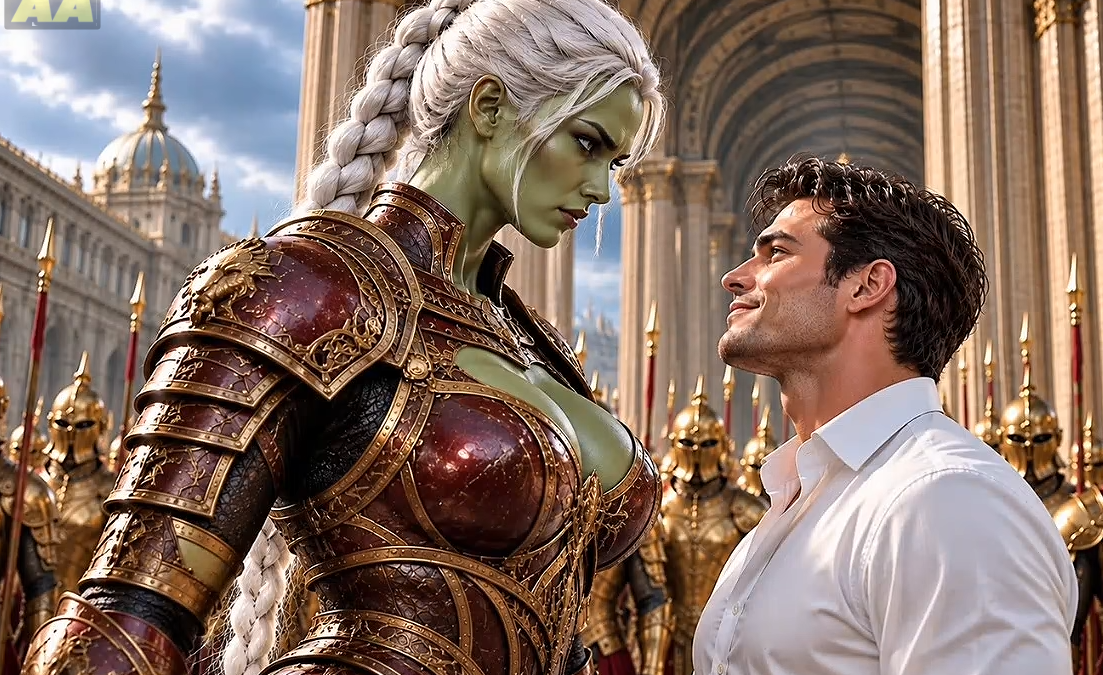
The grand hall had never been this silent. Thousands of polished armor plates reflected the afternoon light pouring through the enormous crystal windows, turning the marble floor into a river of gold and crimson.
Rows of soldiers stood perfectly still on either side of the ceremonial path, their weapons lowered but their attention fixed on the two figures approaching the center of the hall.
Marcus Bennett walked without armor. He wore only a plain white shirt and dark trousers, looking almost ordinary beneath the towering pillars and magnificent banners of the Thalassian Empire.
Beside him walked Princess Athra, dressed in red and gold ceremonial armor, every careful step carrying the weight of a royal family and an entire civilization.
For nearly a decade, their worlds had known little except conflict. Now the empire had placed its hope in an agreement that many considered impossible.
A human mediator from Earth would stand beside a Thalassian princess, not as a conqueror, not as a commander, but as the living promise of a new beginning.
Marcus could feel hundreds of eyes following him. Some were curious. Some were doubtful. Others were openly hostile.
Athra remained composed, but Marcus noticed the slight tension in her shoulders. “This is the moment they have been waiting for,” she whispered.
Marcus glanced at her. “Then let us give them something worth waiting for.” She looked at him for several seconds before turning toward the waiting assembly.
Neither of them knew what the coming months would demand. Neither knew how quickly peace could disappear.
And neither could have imagined that the quiet human walking beside the princess would soon become the one person standing between the empire and another conflict.
So what happens when an entire empire learns that strength does not always announce itself with armor or weapons?
The answer began with a simple promise. Peace. Marcus Bennett had never imagined that a quiet career in diplomacy would place him inside the most important ceremony in the history of the Thalassian Empire.
He had spent years working as a translator and mediator, usually in disputes that attracted little attention outside the worlds directly involved.
He was good at listening. He was patient when negotiations became repetitive. He rarely allowed irritation to influence his judgment.
Those qualities had made him useful. They had also made him an unexpected choice for something far greater.
The Thalassian Empire and a coalition of neighboring worlds had spent nearly a decade locked in a conflict neither side seemed capable of ending.
Resources had been stretched thin, trade routes disrupted, and entire generations had grown accustomed to uncertainty.
Eventually, both sides reached the same conclusion. They needed another way forward. Earth was not the strongest world in the region.
It did not possess the largest fleet or the most advanced military technology. What Earth did possess was neutrality.
That neutrality made Marcus valuable. When Earth’s diplomatic council selected him to represent humanity in a marriage alliance with the Thalassian royal family, Marcus had accepted without ceremony.
He had not considered himself heroic. He had simply understood what was being asked of him.
If one person could help create a lasting agreement between civilizations that had spent years opposing each other, then the inconvenience of palace life seemed insignificant.
The first time he met Princess Athra, however, she made it clear that not everyone shared his perspective.
They stood together in a private chamber overlooking the capital. Athra had studied him from across the room for several minutes before speaking.
“You are not what I expected.” Marcus smiled faintly. “I am not sure whether that is good or bad.”
“It is neither.” “That sounds encouraging.” A small change appeared in her expression. Almost a smile.
AlmoSt. “My advisers expected Earth to send someone important.” “I am important to someone.” “Who?”
“My mother.” Athra stared at him. Then, unexpectedly, she laughed. It was brief, quiet, and quickly controlled, but Marcus recognized the significance of it.
It was the first moment when she stopped treating him as a diplomatic obligation. Over the next several days, they learned how different their worlds truly were.
Thalassian society placed enormous importance on ceremony, hierarchy, and tradition. Every gesture carried meaning. The way someone entered a room, the position they occupied during a meal, even the manner in which they addressed another person could communicate respect or disagreement.
Marcus had to learn quickly. He made mistakes. Athra corrected him. Sometimes she corrected him with patience.
Sometimes she did not. Marcus accepted both. “You are not offended easily,” Athra observed during one of their early lessons.
“I try not to be.” “Why?” “Because being offended rarely solves anything.” “That philosophy would be considered strange here.”
“Then perhaps I have something useful to contribute.” Athra looked at him thoughtfully. “Perhaps.” Marcus gradually learned that Athra carried a burden much heavier than her ceremonial position suggested.
She had spent years preparing to become a leader. Her childhood had been filled with lessons in history, strategy, diplomacy, and imperial law.
She knew exactly how to stand before an assembly and project confidence. But Marcus noticed the things others overlooked.
She became tired after long council meetings. She quietly checked on servants who appeared overwhelmed.
She remembered the names of guards who had served her family for years. And when negotiations became tense, she sometimes remained silent because she knew that speaking too quickly would make matters worse.
Marcus respected that. Athra began respecting him in return. Three months into the alliance, they had developed an unusual friendship.
Neither called it affection. Neither called it love. Their arrangement had begun as a political necessity, and both understood the difference between duty and personal choice.
Still, something had changed. Marcus no longer felt like a visitor in the palace. Athra no longer treated him like an outsider.
They walked together through the palace gardens several evenings each week. They discussed history, philosophy, Earth customs, Thalassian traditions, and occasionally the absurdity of palace regulations.
One evening, they stopped beside a long reflecting pool surrounded by silver trees. Athra looked toward the water.
“You have never raised your voice at anyone here.” “I have been tempted.” “But you do not.”
“Usually there is a better way.” “Many people believe patience means hesitation.” “Then they should watch more carefully.”
Athra turned toward him. “What do you mean?” “Patience is not standing still. Sometimes it means waiting until you understand where to move.”
Athra remained quiet. Those words stayed with her. They would become more important than either of them realized.
The palace changed after the alliance. At first, some Thalassian nobles had treated Marcus as an unwanted symbol of compromise.
They believed Earth had been given too much importance. Others considered the alliance temporary and expected the empire to eventually return to its old position.
Marcus never argued with them. Instead, he listened. He attended council meetings. He learned the concerns of military officers.
He spoke with merchants whose routes had been affected by years of instability. He visited agricultural districts and industrial centers.
He learned what ordinary people wanted. The answer was remarkably simple. They wanted stability. They wanted to work without uncertainty.
They wanted their children to grow up knowing something other than constant tension between neighboring powers.
Marcus carried those observations back to Athra. “You spend a great deal of time listening to people who cannot offer you anything,” she said one afternoon.
“They offer me information.” “You could have asked your advisers.” “I did.” “And?” “They told me what they thought I wanted to hear.”
Athra considered that. “You think they do the same with me?” “Sometimes.” She smiled. “You are becoming dangerous.”
Marcus raised an eyebrow. “I thought I was becoming useful.” “Perhaps both.” Their relationship continued to change quietly.
Neither announced it. Neither needed to. Then, one evening, everything changed. The palace alarms began ringing.
The sound echoed through the corridors with enough force to shake the windows. Guards rushed toward the royal chambers.
Servants disappeared behind secure doors. Athra stood immediately, reaching for the ceremonial weapon mounted beside the chamber entrance.
Marcus remained still for one second. He listened. The alarms were not signaling a drill.
Something was wrong. Athra looked toward him. “What is happening?” “Someone has breached the outer defenses.”
“How do you know?” “The guards are moving toward the western corridor.” She looked at him sharply.
“You can hear that?” “Experience.” Athra moved toward the door. Marcus stopped her. “Not that way.”
“I need to reach the command chamber.” “So do I.” “Marcus.” “There are too many unknowns.”
Her expression hardened. “I am the princess.” “And that is exactly why you should not walk into an unknown corridor.”
For the first time since they had met, Athra saw something completely different in him.
The calm mediator was still there. But beneath that calm was someone trained to recognize danger before it became obvious.
“You have done this before,” she said. “A long time ago.” “Before diplomacy?” “Yes.” “What were you?”
Marcus looked toward the corridor. “Someone who learned to stay calm when everyone else was losing control.”
Athra studied him. Then she nodded. “Lead the way.” Marcus moved quickly. He knew the palace layout because he had spent months learning it.
He knew which corridors were narrow, which doors could be secured, and which stairways led toward protected sections of the royal complex.
He did not rush blindly. He checked every turn before moving forward. Athra followed closely.
Several guards appeared from a side passage. Marcus raised one hand. “Hold.” The guards stopped.
“Where is the royal chamber entrance?” “Blocked.” “Then we use the lower passage.” The senior guard hesitated.
“That route is restricted.” Marcus looked at Athra. She understood immediately. “Open it.” The guard obeyed.
They moved through the lower passage as alarms continued echoing overhead. The intruders had not expected the royal party to leave the main chambers so quickly.
That mistake gave Marcus an advantage. He guided Athra through a series of service corridors until they reached an old security junction.
There, they waited. Athra looked at him. “You are remarkably calm.” “I am trying to keep you calm.”
“That is not the same thing.” “No.” She studied his face. “You were afraid.” Marcus did not deny it.
“Yes.” Athra looked surprised. “You do not appear afraid.” “That is the point.” Before she could answer, footsteps sounded nearby.
Marcus motioned for her to remain behind him. The first intruder entered the corridor. Marcus moved quickly.
There was no unnecessary movement. No dramatic display. He simply used timing and leverage to disarm the attacker, sending the weapon sliding across the floor.
The second intruder hesitated. That hesitation was enough. Palace guards arrived from the opposite passage and secured the corridor.
Athra remained silent. Marcus looked toward her. “Are you all right?” She nodded. Then she looked at him differently.
Not as a diplomat. Not as an Earth representative. Not as a political husband. As a person she had finally begun to understand.
Later that night, the palace returned to order. The attempted attack had failed. The royal family was safe.
The intruders had been captured and their connection to a radical faction within the coalition was quickly uncovered.
The faction had opposed the peace agreement from the beginning. They believed the treaty had weakened the Thalassian Empire.
Their plan had been to create enough uncertainty to destroy the alliance before it could become permanent.
Instead, their actions produced the opposite result. Across the empire, people learned what had happened.
They heard that Marcus Bennett had remained beside Princess Athra during the crisis. They heard that he had guided her through the palace.
They heard that he had protected her without hesitation. More importantly, they heard that the alliance had survived.
Athra visited Marcus the following morning. He was sitting near a large window, reading reports.
She entered without announcement. Marcus looked up. “You should be resting.” “So should you.” “I am reading.”
“You always say that.” “It is usually true.” Athra sat across from him. For several moments, neither spoke.
Then she asked quietly, “Why did you never tell me?” Marcus closed the report. “About my past?”
“Yes.” “It never seemed relevant.” “It became relevant last night.” Marcus nodded. “I suppose it did.”
Athra leaned forward. “You could have told me.” “You never asked.” She frowned. “That is your defense?”
“No.” “Then what is?” Marcus thought for a moment. “I did not want you to see me differently.”
Athra was quiet. “Why?” “Because I liked the way things were.” Her expression softened. “You thought I would see you as a soldier.”
“I thought you might see me as something other than Marcus.” Athra looked toward the window.
“You still do not understand.” “What?” “I have been trying to see who you are since the day we met.”
Marcus said nothing. Athra continued. “I thought you were simply patient. Then I thought you were unusually observant.
Then I realized you understood people better than most of my advisers.” She paused. “Now I know there are parts of you that you have deliberately kept quiet.”
Marcus smiled faintly. “Everyone has those.” “Yes.” Athra looked directly at him. “But I would like to know yours.”
For once, Marcus did not immediately have an answer. The attempted attack changed more than palace security.
It changed public opinion. Nobles who had once opposed the alliance became less vocal. Merchants began openly supporting the treaty.
Military commanders who had viewed Earth as insignificant began requesting diplomatic meetings with human representatives.
The coalition itself began losing support for continued confrontation. The reason was not fear. It was exhaustion.
People had seen enough uncertainty. They wanted the agreement to work. Marcus spent the following weeks helping build practical connections between the empire and Earth.
Trade routes reopened. Academic exchanges began. Medical teams traveled between worlds. Engineers shared methods. Cultural delegations visited both planets.
None of these developments happened quickly. Peace rarely arrived in a single moment. It was built from thousands of small decisions.
A signature. A meeting. A compromise. A conversation. A promise kept when breaking it would have been easier.
Marcus understood that better than anyone. Athra began attending those meetings with him. They worked together more naturally now.
She no longer needed to explain every Thalassian custom. He no longer needed to explain every Earth approach.
They had learned each other’s rhythm. One afternoon, they stood inside a council chamber while representatives from several worlds argued over a proposed trade agreement.
The discussion became heated. Athra prepared to intervene. Marcus gently shook his head. She stopped.
He waited. The representatives continued arguing for another minute. Then Marcus spoke. “Everyone here wants the same result.”
The chamber became quiet. One representative frowned. “That is clearly not true.” Marcus looked at him.
“You want access to the eastern trade corridor.” “Yes.” “And you want the corridor protected.”
“Yes.” Marcus turned toward the other representative. “You want guarantees that your merchants will not be excluded.”
“Yes.” “Then the disagreement is not about what you want. It is about how you trust one another to achieve it.”
Silence. Athra watched him carefully. Marcus continued. “Give them the guarantees firSt. Then negotiate the route.”
The argument changed immediately. It did not disappear. But it became manageable. Athra smiled. Afterward, they walked together through the palace gardens.
“You knew they would agree,” she said. “I hoped they would.” “You never sound certain.”
“Certainty makes people stop listening.” Athra laughed softly. “You have an answer for everything.” “No.”
“You do.” “I have patience.” “That may be worse.” Marcus smiled. The months passed. The alliance grew stronger.
The rival faction that had attempted to disrupt the palace found itself increasingly isolated. Without public support, its influence weakened.
Worlds that had once prepared for further confrontation began discussing cooperation. The Thalassian Empire slowly entered a new period.
Not because one person had defeated another. Not because one civilization had proven superior. But because enough people had decided they were finished repeating the same mistakes.
Eventually, the final agreement was prepared. It would formally end the remaining disputes between the Thalassian Empire and the coalition.
The grand hall was filled once again. But this time, the atmosphere was different. The soldiers still stood along the marble floor.
The pillars still reflected the afternoon light. The banners still hung from the upper balconies.
Yet there was no tension in the room. People smiled. Children watched from the gallery.
Representatives from distant worlds stood beside Thalassian officials. Marcus stood beside Athra. He wore another plain white shirt.
Athra wore ceremonial red and gold. She glanced toward him. “You really refuse to wear formal armor?”
“I have learned that I am more comfortable without it.” “You are standing in front of half the empire.”
“I noticed.” “And you are not nervous?” “I did not say that.” Athra smiled. “You are impossible.”
“I have been told.” The final agreement was presented. Athra signed firSt. Marcus followed. Then the representatives of the coalition signed.
One after another. When the final signature was completed, the hall remained silent for several seconds.
Then the soldiers lowered their ceremonial weapons. The crowd began applauding. Athra looked toward Marcus.
“They thought strength would keep us safe.” Marcus nodded. “It helped.” “But it was not enough.”
“No.” “What was missing?” Marcus looked across the hall. “TruSt.” Athra considered that. “And patience.”
“Yes.” “And people willing to keep choosing peace even when conflict would be easier.” Marcus smiled.
“That too.” The ceremony continued for hours. Music filled the hall. Representatives embraced. Children ran between the columns.
The palace staff moved through the crowd with barely concealed smiles. Marcus stood near one of the windows for a while, watching the celebration.
Athra eventually joined him. “You are leaving.” It was not a question. Marcus looked at her.
“I have not decided.” Athra became quiet. “You were supposed to return to Earth after the agreement.”
“I know.” “And now?” Marcus looked across the hall. “I think there is still work to do.”
Athra smiled. “There is always work to do.” “That is why I am considering staying.”
“For the empire?” Marcus looked at her. “For the people I have come to care about.”
Athra held his gaze. Neither spoke for several seconds. Then she said, “That sounds almost personal.”
Marcus smiled. “Perhaps it is.” The princess looked toward the celebration. “When this began, I thought you were the strangest choice Earth could have made.”
“And now?” “Now I think they may have understood something we did not.” “What?” “That the person who speaks most quietly may sometimes be the one who can bring everyone together.”
Marcus looked at her. “I think you learned that yourself.” Athra shook her head. “No.”
She stepped slightly closer. “You taught me.” Marcus did not answer immediately. The noise of the celebration continued behind them.
For years, the empire had measured strength in fleets, fortifications, weapons, and victories. Now it was learning to measure strength differently.
In promises kept. In disagreements resolved without escalation. In people willing to listen. In leaders willing to admit when another path might work better.
And perhaps most importantly, in the quiet decision to trust someone who had once seemed completely different.
Marcus and Athra remained beside the window as evening settled over the capital. The alliance that had begun as a political arrangement had become something far more meaningful.
Neither of them had planned it. Neither had expected it. It had simply developed through countless small moments.
A conversation in a garden. A difficult council meeting. A quiet gesture of respect. A moment of protection.
A promise. Another promise. And another. Athra looked at Marcus. “Do you think this peace will last?”
Marcus watched the lights appearing across the city. “No peace lasts because people sign a document.”
“Then why will this one last?” “Because too many people have finally learned what it costs to lose it.”
Athra nodded slowly. The answer was simple. Perhaps that was why it mattered. Marcus looked toward the hall.
“Come on.” “Where?” “Your people are celebrating.” Athra smiled. “Our people.” Marcus paused. Then he smiled back.
“Our people.” Together they returned to the celebration. The empire had not become peaceful because its problems had disappeared.
It had become peaceful because people had finally learned to face those problems differently. Marcus Bennett had arrived from Earth as an overlooked mediator.
Princess Athra had begun their alliance believing she was fulfilling a duty to her empire.
Neither had expected the other to become important. Yet somewhere between negotiations and quiet conversations, between uncertainty and trust, they had discovered something neither political agreement nor ceremonial promise could create alone.
They had discovered that peace was not a single event. It was a choice made again and again.
And as the lights of the Thalassian capital shone across the evening sky, Marcus and Athra stood together among people who had once expected another chapter of conflict and now found themselves celebrating something they had nearly forgotten how to imagine.
A future built not on fear. Not on pride. Not on who possessed greater strength.
But on the quiet resolve to choose understanding whenever another choice remained possible. And perhaps that was the greatest lesson of all.
The strongest alliance was never the one with the most impressive ceremony. It was the one that survived when the ceremony was over.
The one that remained when the applause faded. The one sustained by two people who continued choosing patience, trust, and understanding long after everyone else had stopped watching.
Marcus looked toward Athra. She looked back. Neither needed to say anything. For the first time, the silence between them did not feel uncertain.
It felt like peace.
Disclaimer: This content may be created by Al for entertainment purposes. Any resemblance to real persons, events, or places is coincidental.








