Alaska’s New Predator Isn’t a Grizzly — And It Hunts Humans
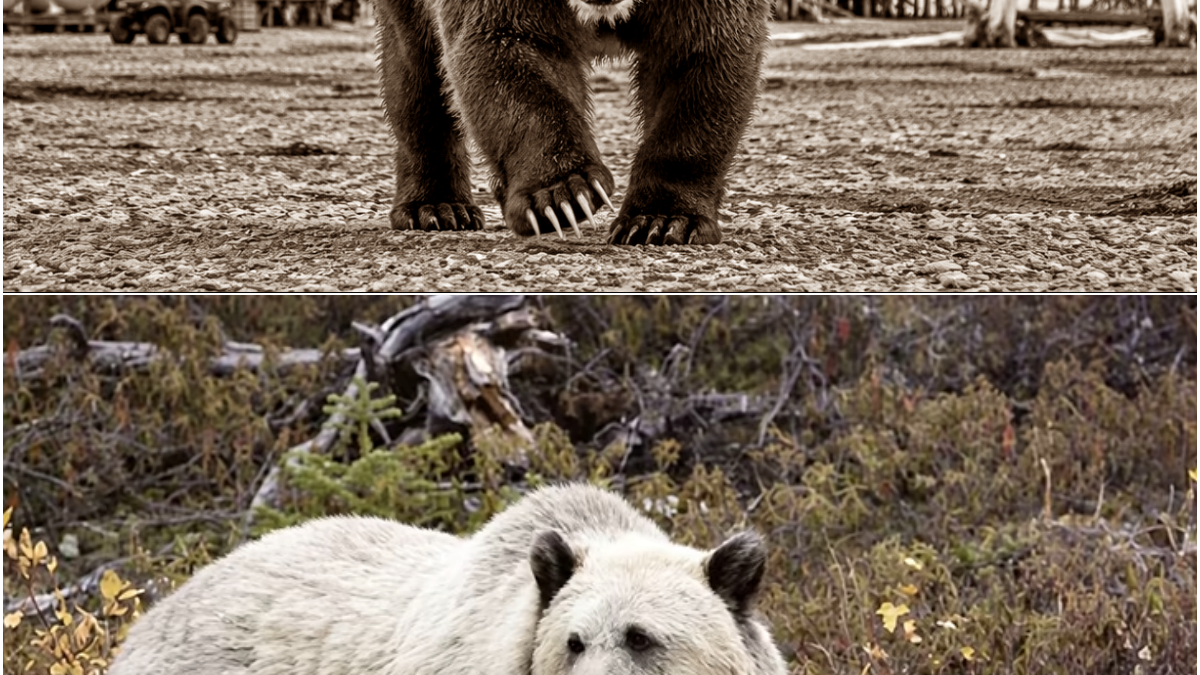
On January 17th, 2023, in Wales, Alaska, a young mother was walking her 1-year-old son toward the clinic when a polar bear emerged from a snowstorm.
The village was familiar with winter, familiar with the white silence that could swallow roads and buildings, but nothing about that morning prepared anyone for what followed.
The bear moved through the storm and continued toward the settlement, where people had little time to understand what was happening.
It then chased school staff toward the front door, turning an ordinary day into a moment the community would remember.
That bear became a symbol of a danger people thought they understood. But far beyond the village, another story was unfolding, one that began not with a storm, but with two kinds of bear meeting in a changing Arctic.
Polar bears and grizzlies had once occupied different worlds, separated by ice, distance, and the habits of their own species.
Now the boundaries were shifting. Their ranges overlapped, they encountered one another around food, and some began producing young together.
Those young were not simply curiosities. They could grow up, find mates, and pass their mixed ancestry into another generation.
And if their appearance could not reliably reveal what they were, what could their behavior tell us about the animal standing in front of us?
The first clear evidence that this was happening came from a bear shot near Ulukhaktok, a community on Victoria Island in the Canadian Arctic.
The date was April 8th, 2010. The village stood roughly 550 miles east of the Alaska line, surrounded by a landscape where sea ice, tundra, and open water shaped nearly every part of life.
That spring, a white bear had wandered through five empty cabins outside town. Then it began running toward the houses.
An Inuvialuit hunter named David Kuptana watched the animal approach and shot it from a distance.
At first glance, the bear seemed to have the familiar coat of a polar bear.
Its fur was thick and white, suited to the frozen landscape. But the rest of its body told a different story.
Its head was broad, its legs were brown, and its paws looked more like those of a grizzly.
The unusual combination prompted questions that could not be answered by looking at the animal.
Researchers needed its DNA. When the results came back, the family history was even more unusual than its appearance.
The bear’s father was a grizzly. Its mother was herself a hybrid, part polar bear and part grizzly.
The young animal was therefore a second-generation hybrid, carrying ancestry from both species through more than one branch of its family.
The Northwest Territories Wildlife Department said it might be the first second-generation polar and grizzly hybrid found in the wild.
That detail mattered. The bear was not simply proof that a polar bear and a grizzly could produce offspring.
It showed that the offspring could grow up and reproduce, creating another generation with a different balance of ancestry.
For a long time, hybridization between the two species had been treated as a possibility that might occur under unusual circumstances.
The animals were closely related, and their ranges were not entirely separate. But the Arctic had its own boundaries, and those boundaries had helped keep the two populations apart.
Now those boundaries were changing. That same spring, University of Alaska Fairbanks marine biologist Brendan Kelly said more hybrids should be expected as summer sea ice disappeared.
The prediction was not based on the idea that every polar bear would suddenly begin meeting grizzlies.
It came from a more gradual change: more polar bears spending more time on land, more grizzlies moving north, and more opportunities for the two species to encounter one another.
The first widely publicized hybrid had already been found four years earlier. In April of 2006, an American hunter named Jim Martell paid for guides and a permit to hunt one polar bear on Banks Island, near Sachs Harbour.
He had spent a substantial amount of money on the trip, including the costs of the guides and the legal permission to take a polar bear.
The animal he shot did not look quite right. It was mostly white, but brown patches marked its coat.
Its claws were unusually long, and a hump rose across its back. The features seemed to belong to different animals, and the uncertainty carried a practical consequence.
Martell had a permit for a polar bear, not a grizzly. If the animal turned out to be the wrong species, he could face a $1,000 fine and up to a year in jail.
The DNA test settled the question. The bear was half polar bear and half grizzly.
Its mother was a polar bear, and its father was a grizzly. Ian Stirling, a polar bear biologist with the Canadian Wildlife Service, said scientists had long understood that the two species could potentially interbreed.
What surprised many of them was that the possibility was becoming real in the wild.
Then came more evidence. In April of 2012, hunters took a female polar bear that had two 2-year-olds with her.
Both young bears were hybrids. Two years later, in April of 2014, biologists captured a female that appeared to be a hybrid herself.
She had three new cubs following her, and all three were hybrids too. The discoveries were no longer isolated stories about strange-looking bears.
They were pieces of a family tree. In 2017, a team of Canadian researchers published genetic work examining the bears that had been identified.
Their analysis showed that the animals were connected. All eight traced back to one female polar bear that had mated with two grizzlies.
Four of the eight were her offspring, carrying half their ancestry from each species. The other four were her grandcubs, with three-quarters grizzly ancestry.
Their fathers were the same two grizzlies that had contributed to the first generation. It was a small family, but it demonstrated something important.
Hybridization could continue beyond the first pairing. A mixed bear could become a parent, and its young could inherit a different proportion of each species’ ancestry.
The family also raised a question that could not be settled by genetics alone. What would these bears do?
Would they behave mostly like polar bears, following the hunting patterns and instincts of animals adapted to sea ice?
Would they act more like grizzlies, using the land, digging, searching, and competing for food in ways familiar to brown bear researchers?
Or would their behavior combine traits from both species in ways that made them difficult to predict?
The answer mattered because the Arctic was not changing in a laboratory. It was changing in places where people lived, traveled, hunted, worked, and watched wildlife.
One of those places was Kaktovik, a village on Barter Island along Alaska’s Beaufort Sea coaSt.
Kaktovik sits at the northern edge of Alaska, where the ocean and tundra meet. The community has a long relationship with bowhead whales, and local whalers are permitted to take up to three whales a year.
After the harvest, parts of the animals are used, while the remaining bones and other material are brought to a bone pile on a spit near the airport.
For polar bears, the pile is an extraordinary food source. In 2012, observers counted 80 polar bears at the site.
The number was striking because polar bears were spending increasing amounts of time on land, waiting for food while the sea ice was unavailable or farther away.
The village had responded with an all-night polar bear patrol. Patrol members carried 12-gauge shotguns loaded with beanbag rounds, using them to discourage bears from approaching people and buildings.
The bears had not always spent so much time ashore. The US Geological Survey examined nearly 30 years of surveys of polar bears along Alaska’s Arctic coaSt. The results showed a notable shift.
From 1986 to 1999, about 6% of the bears came ashore during summer. Between 2000 and 2014, that figure rose to 20%.
In 2013, it reached 37%. The amount of time they spent on land changed too.
Bears that once stayed ashore for around 20 days were now staying about 56 days.
And a large share of those bears were concentrated around Barter Island. Roughly 40% of the bears recorded coming ashore were found in that area.
The reasons were tied to the changing conditions of the Arctic. Polar bears rely on sea ice to reach their main hunting grounds, where they search for seals.
When the ice retreats or remains unavailable for longer periods, bears may spend more time on land.
Their presence on shore can bring them into closer contact with human settlements and new sources of food.
Kaktovik’s bone pile became one of those places. But the polar bears were not alone.
Grizzlies had begun visiting the same pile, creating encounters that researchers could observe over several years.
Between 2005 and 2007, biologists with the US Fish and Wildlife Service watched the site from vehicles, staying from dusk until dawn and recording interactions between grizzlies and polar bears.
They documented 137 run-ins. Some of the grizzlies were relatively small, not much larger than a black bear seen around Anchorage.
Compared with the polar bears, they could look almost half-sized. Yet size did not determine every encounter.
In about half of the recorded interactions, grizzlies pushed polar bears away from the bone pile.
Often, the polar bears backed down even when the grizzly did not appear especially aggressive.
The larger animal did not necessarily claim the food simply by being larger. The grizzly’s willingness to challenge the polar bear seemed to matter.
Richard Shideler, a Fairbanks biologist with Alaska Fish and Game who worked on the study, attributed part of the pattern to differences in attitude.
Grizzlies, he said, tend to be more aggressive in bear-to-bear encounters. At Kaktovik, the grizzlies were already demonstrating that they could displace polar bears from a valuable feeding site.
That observation made the hybrid question more interesting. If a bear inherited traits from both species, which would show up in the way it competed for food?
Would it approach another bear like a grizzly, or would it show the more cautious behavior sometimes seen in polar bears?
It would be tempting to assume that a hybrid would simply look like whichever parent contributed the most visible traits.
But appearance is not a reliable guide to behavior, and the Arctic had already supplied an example of how misleading a coat could be.
A white bear could carry mostly grizzly ancestry. A brown bear could carry polar bear ancestry that was no longer obvious in its appearance.
And a pale cub in a place where polar bears did not live could still be entirely a brown bear.
That last point became a story of its own when viewers noticed a pale cub on a live bear camera at Katmai National Park in southern Alaska.
The cub appeared almost silver-white. It was walking beside a mother brown bear known to the park as bear 677, and the color prompted questions about whether the young bear might be a hybrid.
A Katmai ranger, Sara Bruce, answered those questions by pointing out that Katmai was too far south for polar bears.
The park had no evidence that its bears traveled far enough north to meet them.
Katmai also had brown bears with a wide range of coat colors, including blond individuals.
The cub’s unusual appearance could be explained by its own genetics without involving polar bear ancestry.
The explanation was straightforward, but the speculation revealed how much people wanted to identify hybrids by sight.
In the Arctic, even experienced observers could be uncertain. In 2006, a wildlife officer in Nunavut named Colin Ajun said he had heard reports of a strange bear moving among polar bears.
He described it as light chocolate in color and noted how easily the eye could be mistaken.
The bear at Katmai looked like it might be a hybrid, but there was no evidence that it was one.
The bear found near Ulukhaktok had looked like a polar bear, yet it carried three-quarters grizzly ancestry.
Coat color, body shape, and even the proportions of the head and paws could offer clues, but none could reliably settle the question.
Genetics was necessary to establish ancestry. And even genetics could not answer the question that mattered most to people living alongside bears.
How would a hybrid behave? One possibility was that hybrids would struggle because they were not perfectly adapted to either environment.
Polar bears are specialized hunters, built for life around sea ice and the pursuit of seals.
Grizzlies are more flexible in their use of land, eating a varied diet and taking advantage of many different food sources.
A hybrid might inherit a combination of traits that worked well in some situations and poorly in others.
It might be less efficient at hunting seals than a polar bear and less suited to certain land-based food sources than a grizzly.
Evan Richardson, a polar bear scientist with Environment and Climate Change Canada who worked on the hybrid family, described the animals as a pretty poor polar bear and a pretty poor grizzly.
That description suggested a possible problem. An animal that could not perform either species’ usual role especially well might have difficulty finding enough food.
But the phrase did not establish exactly how a hybrid would behave, and it did not mean that every hybrid would be hungry or unsuccessful.
The bears had survived long enough to grow, and some had produced young. Their lives could not be reduced to a single expectation.
Still, the possibility of food stress raised concerns because hunger can change how bears interact with their surroundings.
The records of polar bear encounters with people offered another piece of the picture. In 2017, a study published in the Wildlife Society Bulletin reviewed the polar bear attacks the authors could identify from five countries between 1870 and 2014.
The researchers collected 73 recorded incidents. Twenty people died in those events. In many cases, the bears appeared to be acting as predators rather than simply responding defensively to a nearby person.
The bears most likely to approach people in this way were hungry adult males, and about six in ten of the attackers whose condition could be assessed were in below-average physical condition.
The pattern also appeared to be changing over time. The five years from 2010 through 2014 produced 15 recorded attacks, more than any complete decade before that period.
The bear involved in the Wales incident fit several details associated with a predatory encounter.
Alaska’s wildlife veterinarian examined the animal and identified it as an older adult male in poor condition.
Tests were negative for rabies and the other diseases they checked. The incident did not establish anything about hybrids.
The bear was a polar bear, and the available findings did not show that mixed ancestry had played a role.
But it highlighted why scientists and wildlife managers were paying attention to changes in bear behavior and movement.
When animals spend more time near people, the circumstances of encounters can change. When food is scarce, some bears may behave differently from animals that are simply trying to avoid disturbance.
A hybrid that spent more time on land and inherited some polar bear hunting behaviors could present a combination that researchers would need to understand carefully.
That was the central mystery. And to investigate it, scientists had to find a way to observe hybrid bears closely enough to document what they actually did.
The most useful observations came not from the Arctic coast, but from a zoo in Germany.
In January of 2004, a polar bear and a brown bear at the Osnabrück Zoo produced two cubs, one male and one female.
Their mixed ancestry made them unusual, but the setting offered something researchers rarely had in the wild: a chance to watch the same animals repeatedly under known conditions.
In 2007, a team of German researchers spent five months observing the pair, from July through November.
They recorded the cubs’ behavior and compared it with patterns known from polar bears and brown bears.
The animals looked like a mixture of the two species. The female’s fur was closer to the appearance of a polar bear, but their behavior drew the researchers’ attention.
Both hybrids performed actions associated with polar bears. They shifted their weight backward onto their hind legs, then brought their front feet down hard onto objects.
They grabbed jute bags and threw them aside. These were not random movements that happened once and disappeared.
The researchers observed repeated actions that resembled specific behaviors used by polar bears when hunting.
A polar bear hunting seals may need to break through snow covering a seal’s den.
Stamping down with the front paws can help it reach the animal beneath the surface.
The researchers recognized a connection between that hunting behavior and the way the hybrids handled objects in their enclosure.
The male performed the actions more frequently than the female. The team concluded that his behavior showed more polar bear influence than his appearance alone might suggeSt.
That finding complicated the simple idea that a hybrid would behave according to whichever species it most resembled.
The male could carry a behavior associated with polar bear hunting even when his visible traits did not make his ancestry obvious.
The observation was valuable, but it also had limits. The researchers were watching two captive animals, not a population of hybrids living on the Arctic coaSt. Their actions could demonstrate that polar bear-associated behavior was present in hybrids, but they could not prove exactly how wild hybrids would hunt or respond to people.
Still, the study supplied an important clue. A hybrid could inherit hunting behaviors from its polar bear ancestry.
And if that animal spent more time on land because of changing sea ice conditions, researchers would need to consider how those behaviors might work in a very different environment.
A behavior that helps a polar bear hunt beneath snow may not translate directly into a particular interaction with a person.
But the possibility of mixed behavioral traits means that people cannot safely assume a hybrid will follow the familiar patterns of either parent species.
That is why the question of which half appears in a hybrid’s behavior cannot be answered simply by looking at its coat.
The bear might have a grizzly’s broad head and brown paws, but display a polar bear’s way of investigating or striking objects.
It might carry mostly grizzly ancestry while retaining traits associated with polar bear hunting. Its behavior could depend on its age, experience, environment, and immediate circumstances, as well as its inherited traits.
For people who spend time in bear country, the practical lesson is not to guess a bear’s ancestry and then rely on a rule that applies only to one species.
The more useful question is what the animal is doing. A bear that is defending itself may behave differently from one that has become focused on a potential food source.
A bear that approaches with curiosity may behave differently from one that moves directly toward something it has selected as prey.
The distinction can be difficult to make in the moment, especially in poor visibility or at close range.
But wildlife guidance for polar bear country emphasizes watching the animal’s behavior rather than relying on coat color or size alone.
The US Fish and Wildlife Service describes signs associated with a predatory polar bear. It may approach stealthily, or it may move toward a person in a straight line at a steady pace, without showing the curiosity or defensive behavior that might accompany other encounters.
The agency’s guidance also stresses that people should not run. They should group together, stand their ground, and respond if the bear makes contact.
If a polar bear attacks, the guidance says to fight back and aim for the face and nose rather than playing dead.
Alaska Fish and Game provides similar advice for a bear approaching without defensive behavior. Those instructions are not a guarantee of safety, and they are not a method for identifying hybrids.
They are practical guidance for situations where a bear’s behavior suggests it may be approaching as a predator.
A hybrid could not be assigned a predictable response simply because it had a particular percentage of polar bear or grizzly ancestry.
The zoo observations show that polar bear-associated behavior can appear in hybrids, but they do not establish that all hybrids will behave the same way.
For that reason, wildlife professionals would still need more field observations before drawing firm conclusions about the risks posed by wild hybrids.
And the question of whether hybrids were spreading through Alaska required another look at the genetic evidence.
In 2024, researchers from Environment and Climate Change Canada and Polar Bears International conducted a new genetic test using 811 bear samples on file from Canada, Alaska, and Greenland.
The result surprised them. The only hybrids they identified were the same eight bears connected to the family discovered earlier.
They found no additional cases in the samples they examined. Richardson said hybridization was not currently a conservation concern.
That finding offered some reassurance. The documented family had not become evidence of a large, rapidly expanding hybrid population across the sampled regions.
The researchers had looked at hundreds of samples and found no new hybrids beyond the known group.
But the result did not mean that hybridization was impossible elsewhere, or that every bear population had been sampled.
It also did not mean polar bear ancestry had never spread into Alaska’s brown bears.
In fact, genetic evidence showed that polar bear ancestry had already moved into brown bear populations in the state long before the recent Arctic encounters.
The story went back to the end of the last ice age. In 1913, researchers at the University of California, Santa Cruz, examined the genomes of brown bears living on Admiralty, Baranof, and Chichagof Islands in Southeast Alaska, near Juneau and Sitka.
The region is known for its dense brown bear populations. Admiralty Island alone holds roughly 1,500 brown bears.
Its Tlingit name means fortress of the bears, a description that captures the long presence of the animals in the area.
But the bears carried a genetic pattern that researchers found unusual. About 6.5% of the X chromosomes in the Admiralty Island bears came from polar bears.
Beth Shapiro, one of the researchers, described the population as genetically unusual. The explanation that best fit the evidence involved a period when the ice was retreating and populations that had once been connected became separated.
At the end of the last ice age, polar bears may have been stranded on islands as the ice pulled back.
Male brown bears from the mainland could then have reached the islands by swimming across the water.
The two kinds of bear mated. Their offspring carried ancestry from both populations. Over many generations, the bears continued breeding with brown bears, and the population gradually became made up of animals that looked and behaved like brown bears, while retaining traces of polar bear ancestry in their genomes.
The result was not a population of obvious hybrids. It was a population of brown bears with an older history of mixing.
A follow-up study published in 2015 found polar bear DNA in brown bears on the Alaska mainland as well.
One brown bear from Denali carried more than 5% polar bear ancestry, while a bear from the Kenai Peninsula carried about 3%.
Some of the brown bear genomes examined in the study showed levels as high as 8.8%.
Researchers suggested that wandering male bears may have carried this ancestry away from the islands and into other populations.
The process was gradual. It did not require a large wave of hybrids moving across the state.
A few animals could pass ancestry along through generations, and their descendants could eventually become difficult to distinguish from other brown bears by appearance alone.
That ancient history offered a different way to think about the present. The recent hybrids in the Canadian Arctic were not necessarily the beginning of an entirely new phenomenon.
They were part of a broader history in which bear populations sometimes met, mixed, and passed their ancestry into later generations.
The difference now was the speed and the setting of the changes people were observing.
Polar bears were spending more time ashore along Alaska’s Arctic coaSt. Grizzlies were moving north and finding food in places where polar bears gathered.
At sites like Kaktovik, the two species were meeting over a resource that could draw them together repeatedly.
The question was no longer whether a polar bear and a grizzly could produce young.
That had been demonstrated. The question was how often such encounters would occur, whether additional hybrid families would appear, and what the mixed bears would do in the wild.
The genetic results from 2024 suggested that the known family had not been followed by a large number of newly detected hybrids in the samples examined.
That was important evidence against assuming that hybridization was already widespread. But the older Alaska studies showed that polar bear ancestry could persist and move through brown bear populations over long periods, even when the visible signs of mixing disappeared.
Both findings mattered. One described what researchers had detected recently. The other showed what could happen over many generations.
And neither one could tell scientists exactly how a particular hybrid would behave during an encounter with another bear or a person.
For that, researchers would need observations from the field, ideally involving animals whose ancestry had been confirmed and whose movements and behavior could be monitored over time.
Such work is difficult. Hybrids are rare, the Arctic is immense, and many bears live far from roads, settlements, or places where researchers can safely observe them.
A bear may be seen only briefly, and its appearance may not reveal its family history.
The conditions that make the Arctic challenging for research also make the subject important. As sea ice changes, animals may spend more time in places where their paths overlap.
Food sources can draw them together, and the same shoreline may attract wildlife, residents, and visitors.
Kaktovik is one of the places where that overlap is visible. Each fall, whalers bring the remains of their bowhead whales to the bone pile on the spit.
Polar bears come in from the water, while grizzlies may descend from the tundra. The two species gather around food, sometimes competing and sometimes simply occupying the same area.
People also come to watch. Between 2010 and 2016, the number of visitors traveling to Kaktovik to see polar bears rose from about 50 a year to roughly 2,500.
The bears had become an attraction, but their presence was not a performance arranged for visitors.
They were wild animals responding to food, weather, and the conditions of their environment. The bone pile offers a place to observe how the two species interact, but it also creates a setting where people need to follow local guidance and respect the patrols and rules intended to keep everyone safe.
So far, no hybrid has been confirmed on that stretch of Alaska’s coaSt. A few hundred miles east, however, the known hybrid family had already shown that mixed ancestry could continue into another generation.
The youngest bears in that family were three-quarters grizzly, yet their ancestry still included a polar bear grandmother.
The question hanging over them was not simply what they looked like. It was how their inherited traits would influence their lives.
Would they spend more time hunting on land? Would they display the object-stamping behavior documented in the zoo?
Would they compete with grizzlies at a food source like Kaktovik’s bone pile? Would they avoid polar bears, challenge them, or respond differently depending on the circumstances?
Researchers did not yet have enough evidence to answer those questions confidently. What they did know was that the Arctic was changing, that the ranges of polar bears and grizzlies could overlap, and that the animals had already produced fertile hybrids.
They also knew that hybrid behavior could not be predicted reliably from appearance alone. The story of the bear in Wales remained separate from the story of the hybrids.
It was a polar bear, not a confirmed mixed animal. Its condition and the circumstances of the encounter were relevant to understanding the risks associated with polar bears near communities, but they did not prove that hybrids would behave in the same way.
That distinction is important. A rare hybrid should not be treated as automatically more dangerous than either parent species.
Nor should its ancestry be used to assume that it will act like a grizzly or a polar bear in every situation.
The most reliable approach is to treat every bear encounter as a situation that requires attention to the animal, the surroundings, and the advice of local wildlife professionals.
For people heading into Alaska to hunt, fish, work, or explore, that means preparing before entering bear country.
It means knowing what to do if a bear appears, understanding the differences between defensive and predatory behavior, and avoiding the temptation to judge an animal by its color or shape.
A white coat does not prove polar bear ancestry. A brown coat does not rule it out.
And a mixed genome does not provide a simple forecast of what the bear will do next.
The most revealing clue may be the behavior unfolding in front of you. A bear that approaches cautiously, watches, or changes direction may be responding to something very different from a bear that advances steadily without showing signs of curiosity or defense.
Those distinctions can matter, but they are not always easy to recognize, and no single observation can remove the uncertainty of being near a large wild animal.
The research on hybrids is still developing. The zoo study gave scientists a rare look at behaviors that could be inherited from polar bears.
The genetic studies revealed how ancestry moved through one family and, over much longer periods, through brown bear populations in Alaska.
The 2024 survey provided evidence that the known Arctic family remained the only detected group among the samples examined.
Together, these findings tell a story that is more complicated than a simple contest between polar bear and grizzly.
The two species have different adaptations, different histories, and different relationships with their environments. Their offspring may inherit traits from both, but those traits do not necessarily combine in a predictable way.
A hybrid is not a precise midpoint between two animals, and it is not a guaranteed blend of the behaviors people expect.
The Arctic is now creating opportunities for encounters that were once less common. Some of those encounters may lead to competition for food.
A smaller number may lead to mating. And when offspring survive and reproduce, the genetic story can continue long after the original parents are gone.
At Kaktovik, the annual return of the whales and the bears will bring the same questions back to the coaSt. Polar bears will arrive from the water.
Grizzlies will come down from the tundra. The bone pile will draw them together, and observers will watch how they share or compete for the food.
Somewhere beyond the visible crowd of bears, the next part of the story may already be taking shape.
There may be no hybrid at Kaktovik this fall. There may be no new hybrid in the next survey.
The existing evidence does not justify assuming that mixed bears are spreading rapidly across Alaska.
But the history of the islands shows that genetic mixing can leave traces that persist long after the animals themselves no longer look unusual.
And the family found in the Canadian Arctic shows that hybridization can continue across generations when the conditions allow it.
The future will depend on what happens to the ice, where the bears travel, how they find food, and whether their paths continue to cross.
For now, the scientists have a small family, a few carefully documented observations, and a much larger landscape full of unanswered questions.
The bears at Kaktovik will keep coming to the bone pile. The grizzlies will keep testing the polar bears’ willingness to give way.
The polar bears will keep responding according to their own experience and circumstances. And if a hybrid eventually appears among them, its coat may not tell anyone what it is.
Its behavior may offer clues, but even those clues will need careful interpretation. A single action cannot establish a whole pattern, and a zoo observation cannot substitute for years of field research.
The most important thing may be to resist the urge to decide what a bear is before understanding what it is doing.
Because in a changing Arctic, the old boundaries are becoming less dependable, and the animals crossing them do not always fit the categories people expect.
The evidence from Alaska’s older brown bear populations adds one final complication. A bear can carry polar bear ancestry without looking like a polar bear, and that ancestry can remain in a population for many generations.
The visible animal and its genetic history may tell two different stories. That is why the question of hybridization is not only about the next unusual bear photographed on the coaSt. It is also about how wildlife populations change over time, and how researchers distinguish a recent hybrid from ancestry inherited from a much older encounter.
For the people who live and work in the Arctic, however, the immediate concern is more practical.
The bears are sharing places, and people are sharing those places with them. Knowing how to recognize a potentially dangerous approach, keeping a safe distance, and following local safety guidance matter regardless of whether a bear is pure polar bear, pure grizzly, or something in between.
The next confirmed hybrid may be found far from a village. It may be discovered through genetic testing after an encounter that nobody witnessed.
Or it may be observed repeatedly by researchers who can document how it feeds, travels, and responds to other bears.
Until then, the strongest conclusion is also the simpleSt. The two species can interbreed, their offspring can reproduce, and their ancestry can persiSt. What that means for the future of Arctic bears remains an open scientific question, one that cannot be answered by a coat color, a single encounter, or a guess about which parent a hybrid resembles moSt.
Disclaimer: This content may be created by Al for entertainment purposes. Any resemblance to real persons, events, or places is coincidental.








