A Woman Bought 15 Dead Semi-Trucks for $14,000 — They Laughed Until She Built an Business Empire
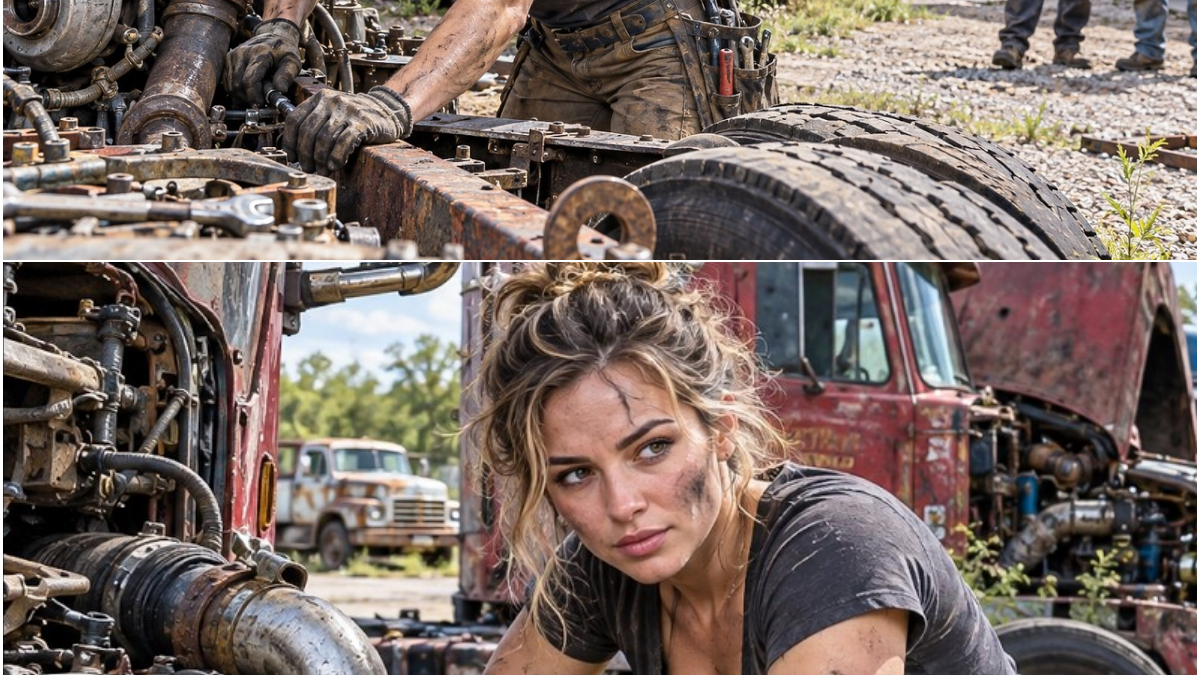
The morning Marlo Dean bought fifteen broken semi trucks for fourteen thousand dollars, the men standing behind the auction fence laughed so hard that one of them had to lean against a post to catch his breath.
The trucks sat in a muddy gravel lot outside Wister Creek, Oklahoma, their tires sinking into the earth and their faded blue lettering barely visible beneath years of duSt. They looked like the remains of a business that had run out of money, patience, and hope.
To everyone watching, they were fifteen expensive mistakes waiting to happen. Marlo saw something else.
She saw engines that might still have years of work left in them, transmissions that could be worth more than the trucks themselves, and a chance to build the business she had been trying to start since the day a bank turned her away.
She had fourteen thousand dollars in cash, a decade of experience with diesel engines, and no guarantee that even one of those machines would ever move again.
She also had a father who understood the trucking industry well enough to know how quickly it could swallow someone whole.
Yet she had already counted the money, shaken hands with the seller, and started walking toward the first open hood.
The men behind the fence were still laughing when she reached the Freightliner. She put one hand against the cold metal, leaned over the engine, and began examining the damage.
What she discovered in that muddy lot would challenge everything the town believed about her, and everything she believed about what a broken machine could become.
How could fifteen trucks everyone had abandoned become the foundation of a working fleet? The gravel lot behind Thies Freight Solutions sat just off exit 61 on I-40, outside a town called Wister Creek, Oklahoma.
On that flat gray morning in March, fifteen semi trucks stood in a crooked line across the property.
Their flat tires sagged into the mud. Weeds had pushed through the gaps in their frames, and three hoods remained open where somebody had stopped working and never returned.
The name Prairie Sun Trucking was still painted on the doors, though the blue lettering had faded until it looked almost transparent.
Marlow Dean counted fourteen thousand dollars into Cordell Thies’s hand. She had spent the previous evening arranging the bills into rubber-banded stacks at her kitchen table.
Some were twenties, some hundreds, and every one of them represented money she could not afford to lose.
She was twenty-seven, lean, sun-browned across the forearms, and wearing a ball cap marked Dean & Son Diesel.
There had never been a son. There had only been Marlo, working beside her father and learning to repair engines in a business where people often assumed a young woman had come to deliver paperwork rather than diagnose a truck.
Cordell, a man in his sixties with a Carhartt jacket zipped to his chin, accepted the cash with the expression of someone who had just discovered that an unwanted burden could still be turned into money.
“Well,” he said, counting the bills again, “you got yourself a hell of a scrap pile, young lady.”
Three men leaned against the chain-link fence behind him. They had come to watch the bankruptcy auction, and none had expected the most interesting part of the morning to be a young mechanic buying the entire collection.
Ronnie Shaw, who operated six trucks from a yard east of town, shook his head.
“Fourteen grand for fifteen dead Class Eights,” he said. “Marlo Dean, darling, you could have bought one truck that runs for that money.”
Marlo did not answer. She had already moved to the first truck and was studying the engine beneath its raised hood.
She had grown up in Dean Diesel, her father’s repair shop on the edge of town.
Gib Dean had driven long haul for eighteen years before his knees made the work difficult.
After that, he traded the driver’s seat for a mechanic’s stool and spent his days repairing the same kinds of trucks he had once driven across the country.
Marlo had been handing him ratchets before she was tall enough to see over the workbench.
By fourteen, she understood that an engine could communicate through its vibration, its rhythm, and the small changes in sound that most people ignored.
By twenty, she could often identify a bad injector from the way an engine missed without needing a scanner.
Two years earlier, she had tried to open a diesel repair shop of her own.
A small business loan had fallen through when the bank decided she lacked sufficient collateral.
Since then, she had worked part-time for her father, lived in the apartment above her parents’ garage, and waited for an opportunity that never seemed to arrive.
The auction was not the kind of opportunity she had imagined. It was fifteen abandoned trucks, a bankrupt carrier, and a collection of mechanical problems that might cost more to solve than the vehicles could ever earn.
Yet Marlo had spent nights studying the equipment market and reading discussions among owner-operators. She knew that trucks were sometimes parked for reasons that had little to do with the condition of their engines.
A carrier might run out of cash. A repair estimate might arrive at the worst possible moment.
A driver might leave, a contract might disappear, or a bank might demand payment before a truck could return to work.
Sometimes a machine was abandoned because the owner could no longer afford to discover whether it was worth repairing.
From a distance, a truck that needed eleven hundred dollars in work could look exactly like one that needed sixty thousand.
Marlo believed the difference between those two trucks was where her future might be hiding.
That evening, she sat at the kitchen table with her father. Gib worked a toothpick around his back teeth while Rhonda Dean stood near the stove, listening without interrupting.
“Fourteen thousand dollars,” Gib said slowly. “For scrap.” “For a fleet,” Marlo replied. “Marlo, I’ve seen good men lose everything chasing trucking.
Men who knew the business inside and out. You don’t know the business at all.”
“I know diesels.” “That ain’t the business. The business will eat you before the diesels ever get the chance.”
He had watched friends struggle through fuel-price increases, expensive breakdowns, and contracts that disappeared without warning.
He knew that a working truck was only one part of a much larger operation.
There were permits, insurance, drivers, fuel bills, repairs, freight rates, and customers who expected every delivery to arrive on time.
Marlo understood that he was not simply questioning her mechanical ability. He was questioning whether mechanical ability could protect her from the rest of the industry.
She was frightened, but fear did not make her reconsider the purchase. It made her wake before dawn the next morning and drive to the lot while frost still covered the windshield.
The first truck she examined was a long-nose Freightliner with a Detroit Series 60 engine.
Its hood had been left open, and the turbocharger was seized. The shaft had deteriorated after sitting without proper oil circulation, leaving the assembly rusted tight.
A new turbocharger would cost roughly twelve hundred dollars from a parts supplier in Oklahoma City.
Marlo found a rebuilt unit through a diesel parts forum she had discovered while scrolling on her phone late at night.
It cost four hundred dollars. She spent a day and a half replacing it, checking the surrounding connections, and preparing the fuel system.
When she finally turned the key, the starter labored through the first attempt. On the second, the engine caught with a bark of blue smoke.
The smoke thinned. The engine settled into a steady idle. Marlo stood beside the truck and laughed aloud.
There was nobody close enough to hear her, but she could not keep the sound inside.
The first truck had moved from abandoned equipment to a running machine. The second truck was a Kenworth with a Cummins ISX engine.
Its paperwork listed an emissions fault involving the diesel particulate filter, or DPF. Marlo knew the basic purpose of the system, but she had not yet worked extensively on the newer equipment.
She spent several nights reading technical discussions and studying diagnostic procedures. Modern diesel engines used several connected emissions components.
The DPF trapped soot and periodically needed to burn accumulated material through regeneration. The DEF system injected diesel exhaust fluid into the exhaust stream to reduce nitrogen oxide emissions.
The exhaust gas recirculation valve helped control combustion temperatures by directing some exhaust gas back into the engine.
When one part of that system failed, the consequences could spread. A clogged filter, faulty DEF pump, or stuck EGR valve might trigger a derate, reducing engine power.
If the problem continued, the truck could become nearly unusable. Dealership repairs could cost several thousand dollars.
For a company already struggling with debt, a large emissions estimate could make a truck impossible to return to service.
Standing beside the Kenworth with a code reader connected to its diagnostic port, Marlo began to understand why so many of Prairie Sun’s trucks had been abandoned.
The fleet might not have suffered fifteen unrelated disasters. Several trucks could have been parked because their owners could not afford to repair similar systems.
She removed the DPF and arranged for it to be professionally baked clean at a shop in Fort Smith.
The service cost three hundred dollars, far less than replacing the unit. She also found a used DEF pump from a wrecked truck for one hundred eighty dollars.
The total cost stayed below five hundred dollars, not counting her own labor. Four days after she began, the Kenworth was running.
Not every truck offered a reasonable path back to the road. The fourth truck had a cracked engine block.
A long brown stain beneath the oil pan marked the place where coolant and oil had escaped.
The dipstick showed milky sludge, evidence that the engine had overheated badly enough to damage the metal internally.
Marlo examined it carefully, then wrote it off. The seventh truck was worse in a different way.
Its frame had rusted through behind the cab. The metal flaked away in layers, leaving a structure that could not safely support a loaded trailer.
She had to learn that refusing to rebuild a truck was sometimes as important as knowing how to repair one.
The unusable machines still contained valuable components. A working transmission could bring eighteen hundred dollars.
Rear differentials might sell for up to a thousand dollars as a pair. A decent sleeper cab could help another owner-operator repair a damaged rig.
Even the remaining steel had value when weighed at a scrapyard. Marlo began dismantling the trucks that could not return to service.
She labeled the parts, recorded their condition, photographed components before removing them, and kept careful notes about where everything came from.
The parts sales helped pay for the repairs on the trucks that remained. Her most expensive early mistake came with truck number nine.
By then, three trucks were running, and Marlo had begun to feel that she understood the rhythm of the work.
She had injector parts ready for the ninth rig and wanted to finish the job quickly.
She rushed the fuel-system cleaning. After installing and priming the injectors, she started the engine.
Within forty seconds, a deep metallic clatter came from beneath the valve cover. She turned the key off so quickly that her hand nearly slipped.
Debris from an improperly flushed line had entered the fuel rail. One injector tip had already caused damage before she stopped the engine.
The repair cost six hundred dollars in parts and three days of work she had not planned to spend.
Gib watched her remove the cylinder head from the doorway of his shop. He had not offered to help with the project, but he had never stopped paying attention.
“Told you diesel don’t forgive being rushed,” he said. Marlo kept working. He did not need to repeat his concerns about the trucking business.
She had heard them enough times to know exactly what he meant. By the fourth month, six of the fifteen trucks had been brought back to life, though not all were ready for commercial work.
Marlo had learned that a running engine did not automatically make a legal truck. Before a big rig could haul freight on the highway, it needed to meet Department of Transportation requirements.
Its air brakes had to function correctly, its lights had to work, and its tires, steering, suspension, and other safety equipment needed to pass inspection.
The air-brake system demanded particular attention. Unlike the hydraulic brakes found in many passenger vehicles, heavy trucks used compressed air.
Marlo learned to inspect the fittings for leaks with soapy water, listen for escaping pressure, examine slack adjusters, and recognize worn brake chambers.
She replaced brake shoes across four axles on one of her rebuilds after finding a set worn down to the rivets.
She made herself a promise that she would never treat brakes as an optional expense.
An eighty-thousand-pound truck with an unreliable braking system was not a problem that could be postponed until the next paycheck.
The only creature who seemed entirely unconcerned about the dangers of the operation was Turbo.
He was a scruffy, sand-colored mutt of uncertain ancestry who wandered into the lot during Marlo’s second week.
Nobody knew where he had come from. He appeared one morning near the fence, watched her work, and decided the property was his new home.
By the third month, he had appointed himself co-pilot. Whenever Marlo climbed into a cab for a test drive, Turbo tried to follow.
He settled into the passenger seat as though the truck had been purchased specifically for him.
He also developed an intense interest in the air horn. Whenever Marlo tested one, he answered with a low, mournful howl that was strangely close to the same note.
She began testing the horns more often than necessary. Turbo claimed the sleeper bunk in the nicest rebuilt truck as his personal territory.
More than once, Marlo found him asleep inside a cab while she was preparing to show the vehicle to a potential buyer.
He refused to leave until she offered him a piece of jerky. Even then, he walked away with the wounded dignity of a dog who believed his house had been sold without his permission.
The mechanical work was difficult, but it was beginning to feel familiar. The paperwork and operating costs were an entirely different education.
To haul freight legally, Marlo needed operating authority, a DOT number, an MC number, and commercial trucking insurance.
She contacted brokers and began collecting quotes. The first annual liability quote for a new carrier with no safety history came back at approximately eleven thousand dollars for a single truck.
The number stopped her. New carriers often paid substantially more than established companies because insurers had no record of their performance.
Marlo had spent fourteen thousand dollars buying the entire fleet. Now one truck’s insurance could consume most of that amount.
She decided to insure vehicles one at a time as they became ready for work.
She would drive the first two herself. A family friend named Waylon Cobb, an experienced trucker whose old carrier had folded eighteen months earlier, agreed to help with a third truck on short local hauls.
Waylon had known Marlo since she was a child. At first, he found it amusing that she was organizing his work and checking his paperwork.
But he also understood that she was serious, and he treated the opportunity with the same care he would have given any employer who paid him fairly.
Finding freight was another challenge. Marlo started with load boards, online marketplaces where brokers posted available shipments.
She learned to compare rates with fuel costs, maintenance reserves, and the unpaid miles required to reach a pickup.
Her first loads paid barely two dollars per mile. Fuel alone consumed roughly sixty cents of every mile, and the rest had to cover insurance, maintenance, and the costs of keeping the truck available.
The numbers were tight. She gradually realized that competing on load boards could drive beginners into accepting work that barely covered their expenses.
The more dependable income often came from direct shippers and brokers who valued a carrier that arrived on time, communicated clearly, and did not cancel unexpectedly.
She also learned the importance of hours-of-service regulations. During one early trip, she planned a delivery window that would have pushed Waylon beyond his legal eleven-hour driving limit.
He stopped at a rest area outside Henrietta and called her. “Ain’t no load worth your DOT number,” he told her.
A late fee was cheaper than a fine or a violation that could threaten the company’s operating authority.
Marlo changed the delivery plan. She wrote the lesson into her notebook and made sure she understood the rules before dispatching another driver.
Her first meaningful freight sale came almost by accident. Boyd Purnell, an alfalfa farmer who lived two lots away, needed a flatbed to move hay sixty miles to a buyer in Salisaw.
His own truck had suffered a serious engine failure, and he had a deadline to meet.
He had seen Marlo’s trucks sitting in the lot and asked, half joking, whether one of them could actually pull a load.
Marlo quoted two hundred forty dollars for the round trip. It was not a large profit.
She knew that the payment would barely cover the fuel and her time. But the job would give her a real customer, a documented delivery, and another chance to prove that her trucks belonged on the road.
She loaded the hay, secured it carefully, and drove the route with Turbo riding beside her.
The dog howled at every semi that passed in the opposite direction. She delivered the hay a day early.
Boyd told the story at the feed store for the next week. Soon, two more farmers called about local hauling work.
Those jobs gave Marlo the operating history she needed to approach a small produce distributor in Fort Smith.
The distributor agreed to a trial arrangement moving refrigerated onions from a regional warehouse to grocery distribution centers across eastern Oklahoma.
The work was steady rather than glamorous. Three loads a week paid just under three dollars per mile.
The contract lasted four months, giving Marlo a record of completed deliveries and insured miles.
That history helped her secure additional dry-van work along the I-40 corridor. By the following spring, four trucks were running regularly.
Two more were nearly finished in the yard, and Marlo had enough revenue to bring Waylon on full-time as her first hired driver.
He appreciated the steady work and the opportunity to return to regular routes. He also found himself quietly amused at taking instructions from a woman he remembered wearing pigtails.
Marlo did not mind. She cared about whether the trucks were maintained, whether the freight arrived on time, and whether the business could pay its bills.
Then came the contract that nearly brought everything to a halt. Talia Okoro was a logistics manager for a mid-sized regional distributor based in Oklahoma City.
Her company supplied dry goods to grocery chains across three states. She had heard about Marlo’s operation through the produce distributor, which had recommended her reliability without being asked.
Talia offered a dedicated freight contract: five trucks running twice-weekly routes between Oklahoma City and Memphis, with guaranteed volume for a year.
It was the kind of agreement Marlo had hoped to secure since the auction. She signed in June.
The contract gave her predictable routes and a regular schedule. It also came with payment terms that were common among large shippers but difficult for a small carrier to manage.
Invoices were paid thirty to sixty days after delivery. Marlo understood the terms. She had read the contract, asked questions, and calculated the expected revenue.
What she underestimated was how much money she would need to keep the trucks moving while she waited for that revenue to arrive.
By August, five trucks were operating regularly. They burned fuel every week, often costing four hundred to five hundred dollars per truck in diesel alone.
Drivers expected their pay every Friday. Tires, brakes, oil, and unexpected repairs demanded cash whenever they were needed.
A set of eighteen tires could cost six hundred dollars each. A transmission repair on truck number six arrived unexpectedly and cost three thousand dollars.
Meanwhile, invoices for freight already delivered remained unpaid. Thirty days passed. Then forty-five. Some payments approached fifty-eight days.
The business looked successful from the outside. Five trucks were hauling regular freight under a year-long contract.
Marlo had more work than she had ever had before. But one late payment could now create a chain reaction.
By late August, she had only eleven hundred dollars in the business account, with payroll due in four days.
She sat at her kitchen table after midnight, staring at invoices spread across the surface.
The same table where she had counted out the auction money now held the paperwork for a business that was working harder than ever and running short of cash.
For the first time, she understood precisely what Gib had feared. It was not the engines.
It was not the driving. It was the distance between earning money and actually receiving it.
A carrier could have full trucks, reliable drivers, and customers waiting for deliveries, yet still run out of cash before the invoices were paid.
Marlo had been so focused on building a fleet that she had not fully understood the financial structure required to keep one alive.
She began searching owner-operator forums again, looking for ways to manage the delay between delivery and payment.
That was where she learned about factoring. A factoring company purchased unpaid invoices at a discount, advancing most of their value quickly rather than waiting for the customer’s payment terms.
The factor collected the invoice later and kept a fee for providing the cash early.
The cost was real. Marlo would lose roughly three cents of every dollar she billed.
After everything she had done to keep expenses low, paying a company to collect money she had already earned felt painful.
But she compared the fee with the cost of missing payroll, losing drivers, or having trucks sit idle because she could not afford fuel.
The choice became clear. In September, she signed with a small regional factoring company out of Tulsa.
Her invoices began funding within forty-eight hours instead of waiting nearly two months. The change did not make the business effortless.
It made the business manageable. Marlo started keeping a cash reserve rather than spending every available dollar as soon as it arrived.
She tightened maintenance schedules and tracked each truck’s condition more carefully. She began refusing loads whose rates could not cover fuel, driver pay, and a reasonable maintenance cushion.
She kept Talia Okoro’s contract and rebuilt the operation around the payment system that allowed her to fulfill it.
The contract finally became what it was supposed to be: the steady backbone of her business rather than the threat that could bring it down.
Growth followed, but it came in careful stages. The five-truck contract helped finance the rebuilding of three more vehicles from the original fifteen.
The parts and steel from the write-offs had already paid for an engine hoist and a hydraulic lift.
The gravel lot was gradually becoming a proper repair shop. Marlo hired a second driver, then a third.
She brought in Denny Ruiz, a young mechanic who had apprenticed under a diesel technician in Van Buren.
Denny wanted steady work and the chance to learn from a growing operation rather than continue taking occasional jobs wherever he could find them.
He was careful, organized, and good at keeping track of small details. Marlo trusted him with maintenance records and inventory, then gradually gave him more responsibility.
By the second full year of Marlo Dean Trucking, the company name had been painted in block white letters across the doors of its trucks, over primer gray.
Eleven trucks were running. Nine had been rebuilt from the original fifteen, and two had been purchased with profits from the operation.
The company employed six drivers and one full-time mechanic besides Marlo. Freight revenue had climbed above 1.6 million dollars a year, averaging just under 150,000 dollars in gross revenue per truck.
The fleet carried loaded freight across four states along the I-40 corridor and into Missouri on contract work.
Marlo still spent much of her day moving between the office and the shop. She checked the dispatch board, reviewed invoices, examined maintenance reports, and walked the yard before the first trucks departed.
She had become responsible for more than the machines she could repair with her own hands.
She was responsible for the people who depended on those machines to earn their living.
The people who had laughed at the auction began to treat her differently. Cordell Thies called her directly eighteen months after selling her the Prairie Sun fleet.
Another small carrier had folded outside Salisaw, leaving nine trucks sitting in a yard. “Figured you’d want first look before it goes to auction,” he told her.
He had learned that Marlo could recognize value where other buyers saw only expense. After that, he called whenever he heard about abandoned equipment.
Ronnie Shaw’s response was less direct. His own drivers began moving to Marlo’s company. Waylon’s cousin came over firSt. Then a driver who had spent years feeling underpaid and uncertain about maintenance joined after hearing that Marlo paid on time and kept her trucks in dependable condition.
Ronnie never offered a formal apology for the jokes he had made at the auction.
He simply stopped teasing her at the truck stop and began nodding when they crossed paths.
From Ronnie, that quiet acknowledgment meant more than a speech. Gib Dean took longer to change his mind.
For much of the first year, he watched from the doorway of his shop, arms crossed, unwilling to put his own tools into a project he still believed might end badly.
But sometime during the second year, he began showing up at Marlo’s yard most mornings.
At first, he said he was only checking on things. Then he started bringing his toolbox.
Eventually, he began working alongside her without needing to explain why he had come. One morning, the dispatch board showed eleven trucks assigned to routes.
Diesel exhaust drifted across the yard as a rig warmed up for its departure. Marlo reached for a ten-millimeter wrench.
Gib picked it up first and handed it to her. “Guess I was wrong,” he said.
Then he returned to the injector pump he was working on, as though he had said nothing unusual.
It was four words, but Marlo understood everything they carried. She took the wrench and continued working.
Neither of them needed to make the moment larger than it was. The morning she remembered most clearly came that same spring.
The old long-nose Freightliner, the first of the fifteen trucks to run again, was preparing to leave the yard fully loaded.
Its brakes had been tested. Its lights worked. Its DOT sticker was current. The doors carried the clean, dark-blue lettering of Marlo Dean Trucking, covering the faded Prairie Sun name that had once seemed to belong to a machine nobody would ever want again.
Waylon sat behind the wheel. Turbo was asleep in the sleeper bunk, despite Marlo’s repeated rules about where the dog was allowed to ride that week.
Nobody had the heart to disturb him. Marlo stood in the gravel as the Freightliner rolled toward the frontage road.
The engine settled into the same even growl she remembered from the cold morning when she had first replaced its seized turbocharger.
She watched it turn toward the interstate. For a moment, she could see the whole history of the truck in that departure: the rusted shaft, the rebuilt part, the long hours, the first successful start, and the miles it had traveled since.
She had spent years learning to listen to engines. Now she could recognize the sound of her own business moving forward.
The dispatch board in the office remained full most weeks. Denny’s neat handwriting listed truck numbers, driver names, routes, and delivery windows.
Talia Okoro’s contract occupied the center of the schedule, funded on time through the factoring company.
Around it, the produce runs continued. Dry-van work filled the remaining openings. Every so often, Marlo still accepted a flatbed job for a farmer, especially when it reminded her of Boyd Purnell and the two hundred forty dollars that had started everything.
The original fifteen trucks were no longer all in the yard. Some had returned to work, some had been stripped for parts, and others had been sold as scrap.
Marlo kept a spiral notebook with the unit number of every truck and a short account of what had failed and what had been repaired.
Gib had taught her that a mechanic who failed to record mistakes would eventually repeat them.
She had expanded that lesson into the rest of the business. She tracked repair costs, fuel consumption, invoice dates, insurance expenses, and the rates paid for every load.
She had learned that good instincts could start a company, but records and discipline helped keep it operating.
Turbo remained the least disciplined member of the fleet. He still tried to ride in every truck Marlo entered.
He still howled whenever an air horn sounded. He still treated the nicest sleeper bunk as though it belonged to him and occasionally fell asleep in a cab just as a buyer arrived.
Marlo had stopped trying to correct every one of his habits. The dog had become part of the yard, just as much as the gravel, the shop lift, the dispatch board, and the steady rumble of the engines.
Ronnie’s yard, fifteen miles east, was quieter than it had once been. Nobody along that stretch of the corridor needed to explain why.
The young woman who had bought fifteen abandoned trucks for fourteen thousand dollars had built a working fleet out of the machines that everyone else had rejected.
She had not done it by believing every truck could be saved. She had done it by learning which ones could, which ones could not, and what each decision would coSt.
She had learned to respect the difference between a repair that made sense and one that would consume the money needed for everything else.
She had learned that an engine could be healthy while a business was failing, and that a profitable contract could still create trouble if the money arrived too late.
Most of all, she had learned to look twice. The trucks had been sitting behind a bankrupt carrier’s fence for eleven months.
Their tires had sunk into the mud, weeds had grown through their frames, and their faded lettering made them look like relics from a business that had disappeared.
Everyone who examined them saw a collection of expensive problems. Marlo had seen a question worth investigating.
She had not known exactly what the answer would be when she handed Cordell Thies the money.
She had not known how many engines would run, how many frames would fail inspection, or how much insurance would coSt. She had not known that her biggest challenge would eventually come from invoices rather than machinery.
But she had understood something that the men behind the fence had overlooked. A machine could be abandoned without being worthless.
A company could be struggling without every part of its operation being beyond repair. And sometimes the most important skill was not the ability to fix everything, but the patience to find out what was actually broken.
On mornings when several trucks idled together before dawn, Marlo stood with a coffee in her hand and listened.
The Freightliner had a low, even growl. The Kenworth with the rebuilt emissions system ran slightly higher and cleaner than it once had.
Other engines carried their own familiar rhythms, each one shaped by its age, its repairs, and the work it had done.
She could still identify which trucks had come from the original fifteen just by listening.
The sound was no longer the silence of abandoned equipment. It was the sound of a business she had built, one repaired engine and one carefully chosen load at a time.
Disclaimer: This content may be created by Al for entertainment purposes. Any resemblance to real persons, events, or places is coincidental.








