A Wealthy Woman Posed as a Poor Farmer at Auction—Then She Saw an Old Man Selling His Last Tractor.
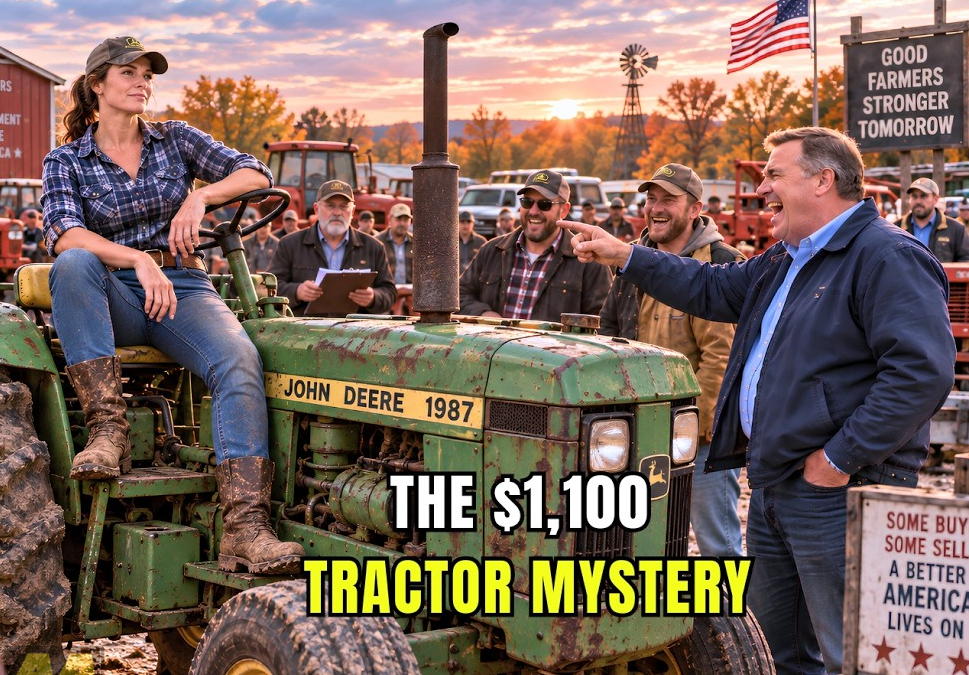
The auction lot was already loud when the old John Deere came up for sale, but the laughter around it was louder than the engine had ever been.
It was a 1987 machine with faded green paint, a scarred fender, and a cracked seat, the sort of tractor that looked ordinary until someone bothered to examine what mattered underneath.
Walter Grady had been standing beside it since six in the morning, one hand resting on the hood as though the machine were still part of a life he had not quite figured out how to put away.
His hands trembled slightly now. They had not always done that. For more than forty years, those hands had repaired agricultural equipment for farmers across Miller County.
They had opened engines, adjusted timing, rebuilt hydraulic systems, and kept old machines working long after other people had decided they were finished.
Now a dealer looked at Walter, looked at the tractor, and saw only an easy bargain.
“Old man, you’re wasting everyone’s time,” he said loudly. “That thing’s worth scrap price, and you know it.”
Walter did not argue. He simply kept his hand on the hood. Then a woman in a muddy jacket stepped forward from the crowd.
She had been watching the tractor for several minutes, but she was not watching the dealer.
She was watching Walter. She had seen something in his stillness that nobody else seemed to notice.
She made an offer that changed who would take the tractor home. But the tractor was not the real thing she had come to buy.
What she wanted from Walter was something far more valuable, and something he had not realized he still had to give?
The morning had arrived over Miller County beneath a low gray sky. By 7:30, the auction lot off Route 9 was already filling with pickup trucks.
Engines ticked as they cooled. Men in canvas jackets stood around paper cups of coffee.
Equipment sat in long rows across the gravel, each machine carrying a lot number and a condition description that was usually more optimistic than the machine itself.
There were tillers, balers, sprayers, combines, and tractors. Some had been maintained carefully. Others had been left outside until weather had become part of their appearance.
Nobody came to a farm auction expecting a leisurely morning. People came because something had broken.
A hydraulic line had failed. A belt had snapped. A harvest machine had become too expensive to repair.
Sometimes the bank had decided a piece of equipment belonged somewhere else. Victoria had arrived at 6:45.
She parked her dark green company pickup near the far edge of the lot. There was a small magnetic panel on the door, but she had removed it before she entered the auction.
She did not want the company name visible. She wore an old faded blue flannel beneath a canvas jacket.
Her boots had already been resoled twice. Mud from two days earlier still clung to the leather.
She preferred it that way. The clothes were not a disguise. They were a method.
When people saw a company executive, they became careful. They raised prices. They cleaned up their stories.
They described machines differently. They told her what they thought she wanted to hear. When they saw a woman in an old jacket and worn boots, they talked normally.
They admitted when a machine had problems. They told her what they could actually afford.
They complained about repairs. They revealed what they would never put into a written listing.
Victoria had learned years earlier that the most useful picture of a market was often the one visible only from inside it.
So she walked the rows. She checked wheel hubs. She pressed hydraulic fittings. She listened to engines.
She looked for stress cracks. She inspected tires. She watched operators start machines cold. She counted engine misses.
She did not care much about polished paint. Paint could hide things. Maintenance could not.
At the center of the lot, an auctioneer named Gary moved from machine to machine.
He was heavyset, experienced, and loud enough to carry across the entire field. He had been conducting sales in the county for longer than many of the machines he sold had been running.
The early lots moved quickly. A three point tiller sold for $900. A damaged sprayer went to a buyer purchasing parts.
The crowd became smaller as the morning progressed. People got what they needed. Or they gave up.
Either way, the work waiting at home remained. Victoria was nearly finished with the second row when she saw the John Deere.
1987. Two wheel drive. Faded green paint. Long scrape across the left fender. Cracked seat.
Open cab. Nothing about it looked impressive. But Victoria stopped. The tires were almost new.
That caught her attention. Good tires cost money. Someone had recently spent money on this tractor.
The hydraulic lines were clean. There was no obvious leaking around the fittings. The engine compartment was open.
She walked closer. The block was clean. Not polished. Not recently painted. Just clean. There was a difference.
A machine cleaned for sale often looked too clean. A machine maintained for years looked like this.
Clean where it needed to be. Dirty where work naturally reached. Grease where grease belonged.
Old paint where old paint belonged. Victoria crouched beside the front axle. She checked the kingpin bushings.
Tight. No obvious lateral movement. Recently greased. She stood. Then she noticed the man beside it.
He was not trying to sell the tractor. That was strange. Most owners at an auction spent the morning explaining their equipment to anyone who would listen.
This man did not. He stood with one hand resting on the hood. His back was partly turned toward the crowd.
He was looking beyond the fence toward a line of bare trees. He was tall, although age had drawn his shoulders inward.
His face carried the deep lines of someone who had spent decades outside. His hands were broad.
Scarred. The right one trembled slightly. Victoria watched him. The tractor had been maintained. The owner had not neglected it.
But something about the way he stood beside it suggested that this was not a sale he wanted.
He was saying goodbye. She walked over. She did not begin with a price. She crouched beside the front axle again.
Then she stood and looked into the engine compartment. “Runs?” The man turned toward her.
His eyes were gray green. Steady. “Every morning.” “How many hours?” “About 4,200.” “Original engine?”
“Never rebuilt.” Victoria nodded. That mattered. A forty year old machine could survive 4,200 hours on an original engine if someone had maintained it properly.
“You do the maintenance?” “My whole life.” She looked at his hands. Then back at the tractor.
“What happened to the shop?” The man’s expression changed slightly. “Closed two years ago.” “Why?”
He looked down. “Shop work is hands work.” He paused. “When the hands go, the shop goes.”
Victoria did not offer sympathy. She had learned that some people did not want sympathy when they were discussing something they had already accepted.
“What is your name?” “Walter Grady.” She introduced herself simply as Victoria. Walter told her he had operated a repair shop in Miller County for more than forty years.
Agricultural equipment had been most of the work. Some construction machinery had come through the doors during the early years.
But farmers were the people who kept the shop busy. He had repaired their tractors.
Their balers. Their sprayers. Their combines. He had helped them keep old machines running when buying new ones was impossible.
Victoria asked about the John Deere. Walter answered every question directly. No sales pitch. No exaggeration.
No attempt to make the machine sound better than it was. That told her more than any auction listing could have.
A young man wandered over about twenty minutes later. He was in his early twenties.
He wore a green cap. Grease covered his forearms. He looked at Walter with the nervous respect of someone who had heard of him.
Then he asked a technical question about injection timing on older direct injection engines. Victoria listened.
Walter answered in three sentences. He explained the principle. Then the application. Then the consequence.
The young man’s face changed. Victoria recognized the expression. It was the expression of someone who had just understood something that had been confusing him for months.
He thanked Walter. Then he stepped away. But he did not leave. He remained nearby.
Victoria noticed. Walter did not. She told him she would return before the lot was called.
He nodded. She walked away. But she had already made her decision. When Gary called lot 47, perhaps twelve people gathered around the John Deere.
Several were only half interested. One man was not. Rick Coloulton arrived firSt. Coloulton was in his mid fifties.
He wore a newer jacket than almost anyone else at the auction. He moved through equipment differently from ordinary buyers.
He did not inspect machines. He surveyed them. He was calculating what he could pay and what he could sell them for before anyone else had finished looking.
He examined the tractor. Then he looked at Walter. Then he looked back at the tractor.
He had made his judgment. “Next lot,” he said. Gary looked at him. Coloulton raised his voice.
“1987 John Deere. Runs clean. No reserve.” Then he turned toward Walter. “Old man, you’re wasting everyone’s time.”
Walter did not move. “That thing’s worth scrap price, and you know it.” “She runs fine,” Walter said.
Coloulton laughed. “He’s been standing here since 6:00 a.m. talking to a machine.” A few people smiled.
Someone chuckled. Coloulton continued. “Somebody’s got to tell him.” Nobody interrupted. “Nobody’s buying a rust bucket from a guy who can’t even hold a wrench anymore.”
Walter’s right hand trembled slightly against the hood. But his expression did not change. “I might.”
The voice came from behind Coloulton. Victoria stepped forward. Coloulton looked at her. He took in the boots.
The jacket. The muddy cuffs. Then he looked toward the dark green pickup at the edge of the lot.
“Sweetheart, you can’t afford the gas to drive it home.” Victoria looked directly at him.
“Make your offer.” He smiled. “Eight hundred cash.” Walter remained silent. Coloulton turned toward the auctioneer.
“We done here?” Victoria did not raise her voice. “$1,100.” The laughter stopped. Coloulton looked at her again.
For the first time, he was uncertain. He studied her face. Then her clothes. Then the tractor.
“You’re serious?” “Yes.” He shook his head. “Step aside.” Victoria did not move. “You made your offer.”
Coloulton stared at her. Then he walked away. Gary called the bid. Once. Twice. Sold.
The 1987 John Deere went to Victoria for $1,100. The dealer had thought he was going to buy it cheaply.
Instead, he walked away without it. Victoria paid in cash. Walter remained beside the tractor.
When Gary moved toward the next lot, Walter looked at her. “You didn’t need to do that.”
“I know.” “You wanted the tractor?” “Yes.” That was all she said. But the tractor was not the only thing she wanted.
A hauling company arrived later. The driver was a young man named Dale. He backed the flatbed toward the tractor.
Walter watched every movement. He followed the angle of the winch cable. He checked the placement of the chain.
He watched Dale secure the front axle. The young driver did everything correctly. Walter said nothing.
Victoria noticed that he wanted to. That instinct was still there. Even though the shop was gone.
Even though his hands no longer worked as they once had. The knowledge remained. “You drove it here?”
Walter shook his head. “Trailered it.” “Why?” “I don’t drive it on the road anymore.”
He paused. “Tires are too good to wear on pavement.” Victoria looked at the tires.
Then at Walter. “Old habit?” “Old habit.” Dale finished securing the machine. The tractor began its journey away from the auction.
Walter watched until the truck disappeared down the county road. Then the lot seemed suddenly quieter.
Victoria reached into the inside pocket of her jacket. She pulled out a small plastic sleeve.
Inside was an old piece of paper. Walter looked at it. She held it toward him.
He took it carefully. It was a work order. The paper was yellowed. The edges were soft.
The ink had faded. Across the top was the name Grady Agricultural Service. Walter stared.
His expression changed. The document listed repairs. Intake manifold cleaning. Timing adjustment. Fuel line replacement.
Hydraulic fluid flush and filter. Front axle bearing inspection. At the bottom was the total.
$0. Walter read it again. Then he looked at Victoria. “Where did you get this?”
“I’ve had it since I was eleven.” He looked down at the paper. “That is my handwriting.”
“Yes.” “You kept this?” “Yes.” Walter looked at the work order again. “I kept copies of every job.”
“I know.” “They are in boxes.” “Where?” “The outbuilding.” He paused. “I still have them.”
Victoria nodded. “My mother gave me this the spring after you repaired our equipment.” Walter looked up.
“She kept the original?” “No.” “She gave you the copy?” Victoria shook her head. “She gave me this one.”
Walter studied the paper. At the bottom, written beneath the zero, was a sentence. “Pay me back by helping someone else someday.”
He read it twice. The first time he recognized the handwriting. The second time he understood why Victoria had carried the paper for so long.
“What happened to your farm?” Victoria looked across the empty auction lot. “We kept it.”
Walter nodded. She continued. “It took three years before things were stable.” He waited. “And another two before my mother stopped worrying every time the weather changed.”
Walter folded his hands. “She kept it.” “She did.” “Good.” The word was simple. But it carried more than the syllable itself.
Victoria took the paper back. “I want to ask you something.” Walter looked at her.
“Why were you really selling the tractor?” He looked toward the place where the John Deere had been.
“A man who can’t use his tools doesn’t deserve to keep them taking up space that someone else could use.”
“That is not an answer.” Walter looked at her. “That is what you told yourself.”
He did not respond. “I am asking what you actually believe.” The silence stretched. A crow moved across the distant tree line.
Walter looked down at his hands. His right hand trembled. “I believe I’m not what I was.”
Victoria waited. “And I don’t know what to do with the part that’s left.” She nodded.
Then she reached into her jacket again. “My company operates a training program.” Walter said nothing.
“For young agricultural technicians. People between twenty and thirty who are working on farms or at equipment dealerships.”
She paused. “They know the manuals.” Walter looked at her. “They know the diagnostic systems.”
She continued. “What they don’t always know is why.” Walter remained still. “My company has equipment.”
“We have a facility.” “We have people who want to learn.” “What we do not have enough of is someone who understands the work from the inside.”
Walter shook his head. “I’m not a teacher.” “You have been one for forty three years.”
He looked at her. “Every apprentice who worked in your shop.” “Every farmer who asked you how to fix something.”
“Every person who stood beside a machine while you explained what it was doing.” She paused.
“You were teaching them.” Walter looked away. “My hands can’t do what they used to.”
“I know.” “I cannot rebuild an engine all day.” “I am not asking you to.”
She pointed toward the road where the young man in the green cap had disappeared.
“You explained injection timing to him in three sentences.” Walter did not respond. “He understood.”
She continued. “I watched his face.” “You gave him something a manual could not give him.”
Walter looked back at her. “The information might be in a manual.” “But the understanding was not.”
She reached into her pocket. This time she pulled out a business card. Plain white.
No elaborate design. She held it out. Walter took it. He read it. “Hail Agricultural Systems.”
“Yes.” He looked at her name. Then her title. Then the company name again. “You named it Hail.”
“My mother’s name.” Walter’s eyes narrowed slightly. “The name on the work order.” “Yes.” He held the card in both hands.
Victoria watched him understand the connection. “You built all this.” “I built it from the place your decision left us.”
Walter said nothing. “My mother kept the farm.” “I watched what that meant to her.”
“She had something solid to stand on when almost everything around her was uncertain.” Victoria looked at him.
“I spent the next twenty years trying to understand how to build things that could give other people that same foundation.”
Walter lowered his eyes to the card. “That work order is not a souvenir.” “It is the beginning of everything I built.”
He looked up. “Why?” “Because you looked at my mother and saw someone worth helping.”
Walter was silent. “You did not see a bad investment.” “You did not see a liability.”
“You saw someone who needed enough room to recover.” She paused. “That is different from charity.”
Walter looked toward the distant road. Victoria continued. “Most people never learn the difference.” He breathed slowly.
Then he looked down at his trembling hand. “I told myself I was selling the tractor because someone else could use it better.”
Victoria waited. “I know that was only partly true.” “I know.” He looked at her.
“I don’t know what the rest of it is.” “You do.” Walter remained silent. “You just have not said it yet.”
The auction lot had nearly emptied. The noise of engines and voices had faded. What remained was wind across gravel and the distant sound of traffic.
Walter looked at the place where the John Deere had stood. Then at the business card.
Then at his hands. Finally, he said, “The loader attachment is at my place.” Victoria looked at him.
“You said you could come by and pick it up.” “I can come Saturday.” He nodded.
“I’ll show you the outbuilding.” Victoria waited. “The shop equipment is there.” He looked at the card.
“Some of it might be worth looking at.” It was not a promise. It was not a contract.
It was not even a yes. But Victoria understood what it was. A door. She did not push it open.
She simply left it there. “I’d like that.” Walter nodded. Then he looked toward the parking area.
The young man in the green cap was walking away. Before he reached his truck, he glanced back.
His eyes searched the lot. He found Walter. For a moment, neither moved. Walter lifted one hand.
The young man lifted his own. Then he continued toward the parking area. Victoria saw it.
So did Walter. “You have someone waiting to learn from you,” she said. Walter smiled faintly.
“I don’t know about that.” “You do.” He looked down at the business card. Then he put it into his jacket pocket.
The same pocket where a person might keep something they intended to hold onto. Victoria extended her hand.
Walter took it. His grip was still firm. His right hand trembled slightly. She did not loosen her grip.
She did not compensate for it. She simply shook his hand. The way he would have wanted.
Then she walked toward her truck. Walter remained behind. The auction lot looked different now.
The tractor was gone. The crowd was gone. The dealer was gone. The noise had disappeared.
Only Walter remained beside the empty space. He looked down at the card in his pocket.
Then toward the road. Then toward the outbuilding where his old tools still waited. For two years, he had told himself those tools were taking up space.
He had told himself the shop was over. He had told himself that the useful part of his life had already happened.
But the old machines were still in the building. The apprentices were still somewhere. The questions were still being asked.
And the knowledge he had spent forty three years gathering had not disappeared just because his hands had changed.
Victoria started her truck. Before she pulled away, she looked through the windshield. Walter was still standing there.
But he was no longer looking toward the bare tree line. He was looking toward home.
Toward the outbuilding. Toward the tools he had almost decided no one needed anymore. She drove away.
The tractor went with her. Walter stayed behind. But somehow, the thing she had really bought that morning had not gone anywhere.
It was still standing there. Waiting. The next Saturday, Victoria drove out to Walter’s property.
The outbuilding was exactly where he had said it would be. It was smaller than his old shop, but carefully organized.
A lathe stood against one wall. A press occupied the corner. Diagnostic equipment sat on shelves.
Toolboxes were lined up in a row. Boxes of carbon copies were stacked beneath a workbench.
Walter opened one. Inside were decades of work orders. Names. Machines. Repairs. Notes. Problems solved before modern diagnostic systems existed.
Victoria understood immediately. This was not just equipment. It was a record of a disappearing kind of knowledge.
Walter pulled out another box. Then another. He began explaining the work orders. Not as a historian.
As a mechanic. “This one came in during winter.” “That tractor had a fuel problem.”
“This customer always thought it was the injection pump.” “It never was.” Victoria listened. Hours passed.
Walter forgot to watch the clock. His hands still trembled. But his voice was steady.
And when he explained a machine, the same clarity returned to him that the young man at the auction had seen.
Principle. Application. Consequence. Three sentences. Sometimes five. Never more than necessary. By the end of the afternoon, Victoria had made a decision.
The training program would have Walter. Not as a mechanic. Not as a man expected to work with tools all day.
As an instructor. A mentor. A person who could take forty three years of experience and turn it into something the next generation could carry forward.
Walter did not agree immediately. He asked questions. What hours? How many students? How much time in the classroom?
How much time in the shop? Would he have to travel? Would they expect him to operate equipment?
Victoria answered every question. Eventually Walter looked around the outbuilding. Then at the boxes of work orders.
Then at his hands. “I can explain it,” he said. “I know.” “I just cannot always demonstrate it.”
“You do not have to demonstrate everything.” He thought about that. Then nodded. “All right.”
The first training session began a few weeks later. The young man in the green cap was there.
So were several others. Walter stood at the front of the room. For the first five minutes, he looked uncomfortable.
Then someone asked a question. Walter answered. Another question followed. He answered that one too.
Soon the room became quiet. Not because anyone was afraid to speak. Because everyone was listening.
Walter explained how an engine could sound wrong before a diagnostic system identified the problem.
He explained why hydraulic pressure changed under certain loads. He explained why a mechanic should never trust a number without understanding what produced it.
He explained why machines told stories if you learned how to listen. The young man in the green cap wrote everything down.
At the end of the session, he approached Walter. “I think I finally understand what you meant at the auction.”
Walter smiled. “What did I mean?” The young man thought. “You said injection timing is not just about when fuel enters.”
Walter nodded. “It is about what happens because it enters at that moment.” Walter smiled again.
“That is right.” Victoria watched from the doorway. She thought about the work order in her jacket.
The one that had begun with a zero in the total field. The one that had ended with a sentence asking someone to help another person someday.
Walter had never known what that sentence would become. He had not known that the eleven year old girl watching her mother receive his help would remember every word.
He had not known that she would build a company. He had not known she would return decades later.
He had not known that the tractor auction would become the place where his own usefulness was handed back to him.
He had simply helped someone. Then he had moved on. That was how most important things happened.
Not with announcements. Not with applause. Not with anyone knowing what the moment would become.
A person simply chose to look at someone differently. And sometimes that changed the direction of an entire life.
The 1987 John Deere eventually became part of Hail Agricultural Systems. It was used during training sessions.
Students learned on it. They learned how to inspect an old machine before trusting it.
They learned what proper maintenance looked like. They learned that faded paint did not mean poor equipment.
They learned that a cracked seat did not tell the whole story. And they learned something else.
They learned to look past appearances. Walter remained with the program. His hands continued to tremble.
He did not hide it. He did not pretend he could do what he had done forty years earlier.
Instead, he did what he could still do. He taught. And sometimes, after a training session, he would stand beside the John Deere with one hand resting on the hood.
Exactly as he had done at the auction. But the meaning had changed. At the auction, he had been saying goodbye.
Now he was explaining why the machine mattered. Victoria would sometimes watch him from across the shop.
She knew what the dealer at the auction had seen. An old man. A rusted tractor.
A bad investment. She knew what Walter had actually been. A teacher who had never called himself one.
A mechanic whose greatest tool had not been a wrench. A person who had spent forty three years noticing problems other people missed.
And she knew something else. The dealer had been certain he understood the situation. He had looked at Walter and the tractor and decided the outcome before the bidding began.
But he had missed the one thing that mattered. Walter still had value. Not the kind measured by the resale price of a tractor.
Not the kind written on an auction sheet. The kind that only becomes visible when someone knows where to look.
Victoria had learned that lesson at eleven. She had carried it for years. And on a gray morning in Miller County, she had finally found the person who taught it to her.
The tractor nobody wanted had found a new home. So had Walter. And perhaps that was the part nobody at the auction could have seen.
The old John Deere had not been the thing that needed saving. It had simply been the reason two people who had never met before were standing in the same place at the same time.
One had spent decades believing his most useful years were behind him. The other had spent decades building something because of a kindness she had never forgotten.
Neither knew what the morning would become. But Victoria had noticed something the others missed.
Walter was not standing beside the tractor because he had nothing left. He was standing there because he had spent forty three years giving value to machines and people, and he had not yet learned that value could remain after the work changed.
Sometimes the person being written off is the person carrying the knowledge everyone else will need tomorrow.
Sometimes the thing that looks like scrap is simply a machine waiting for someone patient enough to inspect it.
And sometimes the most important purchase is not the one you make with the money in your pocket, but the one that begins when you recognize what another person still has to offer.
That morning, the auctioneer had called lot 47. Victoria had raised her hand. The dealer had walked away.
Walter had sold the tractor. And somewhere between the gravel lot and the old outbuilding, a man who thought he had reached the end of his usefulness discovered that perhaps he had only reached the end of doing the work with his hands.
What happens when the person who once gave someone else a second chance finally receives one of his own?
Disclaimer: This content may be created by Al for entertainment purposes. Any resemblance to real persons, events, or places is coincidental.








