A Scientist Decoded the Language of Birds and Spoke to Them — Their Response Shocked Everyone!
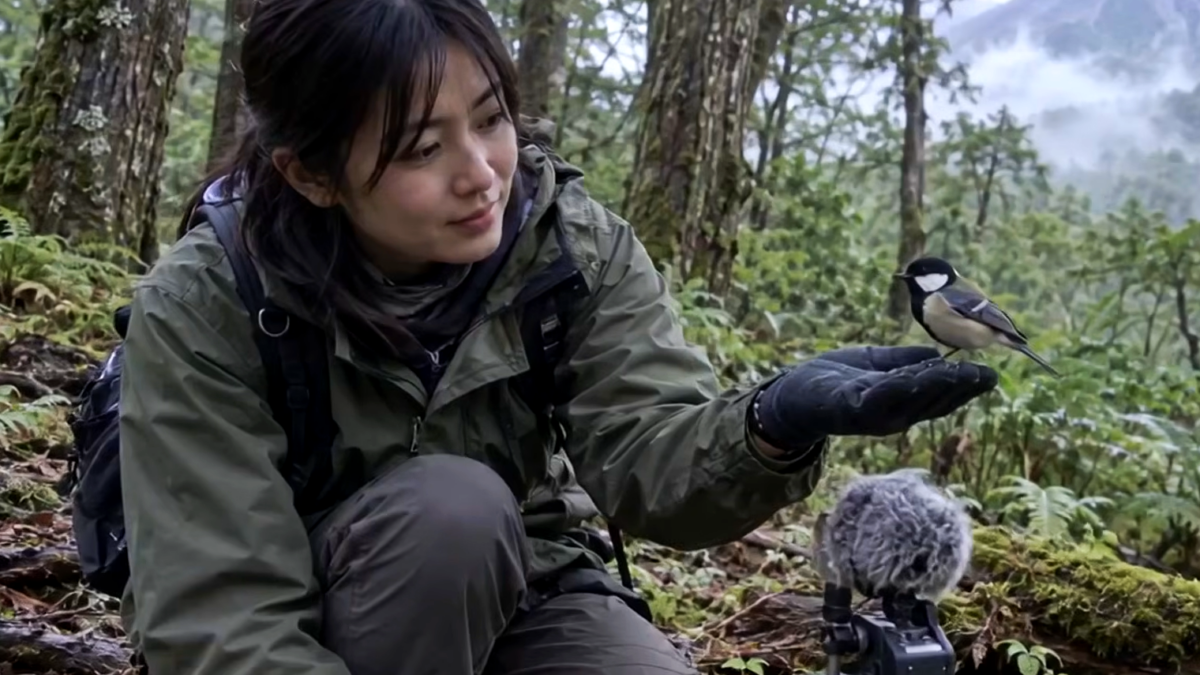
At the foot of Mount Asama, where the forest climbs through the mountains of central Japan, there is a place where the trees seem to hold their breath whenever the wind changes.
The ground is dark with volcanic soil, the trunks rise close together, and narrow paths disappear beneath ferns before reappearing beside old nest boxes nailed to the trees.
To an ordinary visitor, it looks like an ordinary forest. But one morning, a man crouches beneath the branches with fishing line wrapped around two fingers.
Fifteen meters away, a small speaker waits against a tree. Beside it lies a piece of dead wood no longer than a human hand.
There is no laboratory. No television crew. No dramatic equipment. Only a researcher, a speaker, a stick, and a question that has followed him through more than a decade of fieldwork.
Can a bird hear one particular sound and know what is waiting before it sees anything at all?
The speaker clicks. A Japanese tit lands above the clearing. The researcher slowly pulls the line.
The stick begins moving upward along the trunk. The bird watches. Then it flies down.
It searches the exact place where a snake would be. Eleven times out of twelve, the bird responds to the sound this way.
And suddenly the experiment is no longer about whether a bird can be frightened by a trick.
It is about whether a sound can place an image inside another animal’s mind. And if one tiny bird can do that with a few sounds, what else might the forest have been saying all along?
For much of the history of animal behavior research, scientists treated animal calls as signals rather than language.
The distinction seemed straightforward. A bird sees a predator. The bird calls. Other birds react.
The call communicates danger, but the assumption was that it did not work like human speech.
There was no vocabulary in the traditional sense. There was no grammar. There were signals for particular situations, but not individual meaningful units that could be rearranged to create a new message.
A smoke alarm gives you one basic piece of information. Something is wrong. It does not tell you whether the problem is a burnt piece of toast or a fire spreading through a building.
Human language works differently. We have individual words. We combine them according to rules. We can create a sentence that has never existed before and still make ourselves understood.
For a long time, nobody had convincingly demonstrated that a wild animal could do anything comparable.
That was the boundary. Then a Japanese researcher named Toshitaka Suzuki began listening more carefully to a small bird.
The bird was the Japanese tit. It was barely larger than a fiSt. It had a black cap, white cheeks, and a dark stripe running down its cheSt.
People in Japan knew the bird well. Suzuki knew it differently. His fascination began when he was young.
He had a pair of binoculars and an ordinary curiosity that refused to go away.
The Japanese tit produced many different sounds. More than ten distinct calls had been documented.
But why did one tiny bird need so many? What did they mean? Was every sound simply a different emotional reaction?
Or did each call carry information of its own? The question followed Suzuki for years.
Eventually, he took the question into the foreSt. At the foot of Mount Asama, an active volcano in central Japan, he began a long series of observations.
Nest boxes were placed among the trees. Cameras recorded what happened around them. Birds raised chicks.
Parents arrived with food. Predators moved through the foreSt. And Suzuki kept listening. He did not spend a week there.
He did not spend a season there. The forest became his workplace for years. Then, on June 10th, 2008, something happened that gave his question a much sharper shape.
Suzuki heard an unfamiliar call. A Japanese tit was repeating it from a branch. Below that branch, moving toward the nest, was a Japanese rat snake.
The snake could grow to about 2 m long. It could climb. More importantly, it could enter nest holes that were barely 3 cm wide.
Other predators had limitations. A crow could reach toward a nest entrance with its beak.
A martin could attack from outside. The snake could move directly into the hollow. For a nest full of young birds, that difference mattered.
Suzuki watched the scene carefully. The bird was calling. The snake was approaching. The timing looked meaningful.
But timing alone was not proof. The call might have been unrelated. The snake might simply have appeared at the same moment.
A careful researcher could not turn coincidence into a conclusion. So Suzuki tried to break his own idea.
He introduced different predators near the nests. A crow. A martin. A snake. And a pigeon.
The pigeon was important because it was not a predator of the chicks. If the Japanese tits produced the same special call whenever any unfamiliar bird appeared, then the pattern would become much less interesting.
But they did not. The pigeon produced no comparable alarm. The crow and martin produced one recognizable type of call.
The snake produced another. That difference became the first important clue. The birds appeared to distinguish between threats.
But Suzuki still needed to know what the snake call actually meant. There were two possibilities.
The call could mean something like, “Something dangerous is down there.” If so, the bird hearing it would still need to look around and figure out what the danger was.
Or it could mean something much more specific. It could mean, “Snake.” Those were very different possibilities.
The first was a warning. The second was a word. To separate them, Suzuki needed birds that could not see the predator.
He turned to chicks inside their nest hollows. Some were only a day away from leaving the neSt.
They had almost no visual information about the world outside. Suzuki placed a hidden speaker near the nest and played the calls.
There was no snake. No crow. No martin. No predator at all. Only a recording.
When the general alarm call played, the chicks pressed themselves against the bottom of the neSt.
That made sense. A crow or martin could reach toward the opening. Staying low and deep was useful.
Then Suzuki played the snake call. The behavior changed. The chicks moved toward the entrance.
Some left the nest earlier than expected. They scattered into the surrounding grass while their parents continued caring for them there.
The response was not simply fear. It was a behavior suited to one particular predator.
A snake enters through the nest entrance. The chicks move away from the hollow. The sound alone was enough to trigger that response.
Suzuki repeated the idea with adult females sitting on eggs. The results became even harder to dismiss.
When the general alarm played, only two out of 18 females left the neSt. Most remained near the entrance and looked outward.
But when the snake call played, 15 out of 18 came directly toward the opening.
Thirteen left the neSt. And when they emerged, every one of them looked down. Not toward the sky.
Not into the upper branches. Down. Toward the ground beneath the tree. The sound appeared to guide their attention toward the location where a snake would actually be.
But Suzuki still wanted stronger evidence. If the birds were simply becoming alarmed, perhaps they were responding to movement.
Maybe any strange object near the tree would attract them. That was where the fishing line came in.
The experiment was remarkably simple. A speaker was placed near a tree. A piece of dead wood, roughly the length of a hand, was positioned against the trunk.
A fishing line was attached. Suzuki hid about 15 m away. When the snake call played, he slowly pulled the line.
The stick crept upward. A Japanese tit approached. It inspected the moving object. The bird came within about a meter of it.
The result occurred in 11 out of 12 trials. Then Suzuki changed the sound. The general alarm played.
The stick moved. The birds rarely showed the same focused response. The movement alone was not enough.
Then he changed the movement. Instead of pulling the stick upward along the trunk, he swung it sideways.
The birds largely ignored it. The response depended on the combination. The sound created an expectation of a snake.
The movement then became meaningful because it matched that expectation. There was no snake. Only a recording.
Only a stick. And yet the bird searched for the right animal in the right place.
That changed the question. Suzuki was no longer asking whether birds communicated danger. He was asking whether the sounds themselves carried specific meanings.
And that was only the beginning. The Japanese tit appeared to have another important call.
A call that could mean something like, “Come here.” Parents used it in situations involving mates, food, and the neSt.
Sometimes the birds produced the danger call first and the invitation second. The order seemed consistent.
Danger firSt. Come here afterward. Suzuki tested the combination. When the two calls were played in that order, birds moved toward the speaker while also scanning their surroundings.
Then he reversed the order. The response changed. That looked remarkably similar to grammar. But Suzuki knew there was another explanation.
Perhaps the birds had memorized the entire sequence. Perhaps the two calls together were simply one longer signal.
If so, there was no grammar. There were only memorized sound patterns. Suzuki needed to break the sequence apart.
The forest provided the opportunity. A willow tit lived in the same region. It had its own version of a “come here” call.
The sound was different from the Japanese tit’s call. Suzuki took the Japanese tit’s danger call and combined it with the willow tit’s invitation call.
The resulting sequence had never been used naturally by the Japanese tits. It was effectively a new sentence assembled from familiar parts.
The birds responded. They approached while scanning their surroundings. Then Suzuki reversed the order. The response largely disappeared.
The important point was that the birds had not memorized the new sequence. The second component had come from another species.
Yet the Japanese tits still interpreted the combination. That suggested the calls had individual meanings.
And it suggested that order mattered. The forest had produced something that looked less like a collection of alarms and more like a small communication system.
Suzuki tested the idea again with another predator. The bullheaded shrike. It was a genuine threat to the tits.
The researchers used a model of the predator. When the complete two call phrase played from one speaker, the flock responded strongly.
They gathered around the model and behaved as they would around an actual predator. Then the experiment changed.
The first call came from one speaker. The second call came from another speaker about 10 m away.
The words were the same. The order was the same. The timing was the same.
But the response almost disappeared. The birds appeared to treat the complete phrase differently when it came from a single source.
That detail mattered. The communication system was not simply a collection of sounds. Context mattered.
Structure mattered. Who produced the message mattered. The tiny birds were living inside a world of information far richer than people had assumed.
Then came another surprise. The Japanese tit did not live alone. Its forest neighbors included other birds.
Cold tits. Willow tits. Long tailed tits. Nuthatches. Japanese white eyes. They had their own calls.
Their own social structures. Their own ways of responding to danger. Yet some of them reacted when Suzuki played the Japanese tit’s snake call.
They came closer. They examined the ground. They behaved as though they understood the basic meaning.
It was as if one bird species had accidentally developed a word that other species could decode.
That possibility opened a much larger question. Maybe the forest was not filled with separate languages that never touched.
Maybe some signals could cross species boundaries because survival created a shared vocabulary. A snake was dangerous to several birds.
The meaning of a snake warning could therefore become useful beyond the species that created it.
Other research began revealing similar complexity elsewhere. North American chickadees offered another example. Their calls could include repeated D notes.
The number of D notes changed depending on the threat. A slower, less agile owl could produce one response.
A smaller and faster predator could produce another. The call carried information about the level of danger.
Nuthatches living nearby could respond to those calls as well. They did not need to be chickadees to understand that a particular pattern meant greater urgency.
Elsewhere, parrots revealed another remarkable feature of animal communication. Researchers studying parrot nests recorded parents producing distinct sounds associated with individual chicks.
The young birds appeared to carry those individual names throughout their lives. Researchers then tested whether the names were inherited genetically or learned from the adults raising them.
Eggs were moved between nests. The chicks were raised by different parents. The names followed the foster environment rather than the biological family.
The implication was striking. The identity call was learned. It was given. It was social.
The forest held another surprise. Communication was not always vocal. Inside nest holes, space was limited.
Parents could not both enter at once. One bird might land near the entrance while the other was inside.
The waiting bird could flutter its wings in a particular way. It was almost an invitation.
A silent signal that seemed to mean, “You go firSt.” The other bird entered. The first waited.
Then it followed. If the signal was absent, the bird could simply enter itself. The behavior showed that communication did not always require a sound.
Gestures could carry meaning too. Yet Suzuki remained careful about what the evidence did and did not prove.
The Japanese tit had a set of meaningful calls. Those calls could be combined in particular ways.
The combinations could influence behavior. Other species could decode some of the sounds. That was extraordinary.
But it did not prove that the birds possessed human language. There was no evidence that Japanese tits could describe anything they wanted.
There was no evidence that they could discuss distant events, imaginary places, or abstract ideas in the unlimited way humans can.
Their system appeared specialized. It was shaped by the problems they faced every day. Predators.
Food. Nests. Mates. Chicks. Survival. That limitation did not make the discovery less interesting. It made it more precise.
The birds did not need human language to have a communication system of their own.
They had evolved a system that worked for their world. And Suzuki had spent years learning how to listen.
The most remarkable part of the story was not a single experiment. It was the patience behind all of them.
A person could hear one unusual bird call and decide it meant something. A less careful researcher might stop there.
Suzuki did not. He tested the call against different predators. He tested it with chicks.
He tested it with adults. He removed the predators entirely. He replaced snakes with sticks.
He changed the direction of movement. He rearranged calls. He borrowed sounds from another species.
He separated speakers. Every time an explanation seemed possible, he searched for a way to eliminate it.
That process transformed a strange observation into a body of evidence. The forest became a laboratory without walls.
Every tree could become part of an experiment. Every nest could reveal another piece of the puzzle.
Every call could be broken apart and tested. Eventually, the work expanded beyond the Japanese tit.
Suzuki’s research became part of a much larger scientific effort to understand animal communication. The goal was no longer simply to determine whether animals had words.
The deeper question became whether humans could someday communicate with another species in a meaningful exchange.
Not simply translating an animal sound into an approximate human phrase. Not assigning a human emotion to a bird call.
But identifying the animal’s own communication system and answering within it. Imagine standing in a forest and hearing a Japanese tit give a warning.
Instead of translating that sound into human language, imagine producing a response the bird itself would recognize.
The idea sounds like science fiction. Yet the first steps toward it came from experiments that were almost unbelievably simple.
A speaker. A recording. A stick. A piece of fishing line. And a researcher hidden behind a tree.
That is what makes the story so powerful. The experiment did not require a futuristic machine.
It required patience. The forest had been speaking the entire time. The birds had been warning each other.
Calling each other. Finding each other. Directing attention. Recognizing threats. Combining calls. Responding to the order of those calls.
And sometimes listening to the communication of another species. The information had been there. What was missing was someone willing to keep asking what it meant.
At the foot of Mount Asama, the trees still stand. The nest boxes still sit among the branches.
Birds still move through the canopy. A snake can still climb toward a hollow. A parent can still arrive with food.
A mate can still wait outside the entrance. And somewhere in that forest, a Japanese tit can still make a sound that tells another bird exactly what to look for.
The call lasts only a moment. A few notes. A tiny sound from a tiny body.
But behind those notes is a world of information. A world Suzuki spent decades learning to recognize.
Perhaps that is the most important lesson hidden in the foreSt. Nature does not always become mysterious because it is silent.
Sometimes it becomes mysterious because we hear it every day and assume we already understand it.
For generations, people heard birds calling and thought they knew what those calls were. Warning.
Fear. Excitement. Come here. Then someone stayed long enough to ask whether those sounds could mean more.
The answer was not simple. It was not human language. It was not a magical conversation.
It was something more precise and, in its own way, more fascinating. A small system built from sound, order, context, memory, and response.
A system shaped by the needs of a bird living in a forest where every branch can hide a predator and every nest must remain safe.
The final mystery is still waiting. If a Japanese tit can use a few meaningful sounds in structured combinations, and if neighboring species can sometimes understand those sounds, how far does that ability really extend?
Could the birds create new combinations for situations they had never encountered? Could they understand more calls than researchers have discovered?
Could other species have equally complex systems that humans simply have not learned to recognize?
Those questions remain open. And perhaps that is exactly how they should remain. Because the forest at the foot of Mount Asama has already taught us something valuable.
The unknown is not always somewhere distant. Sometimes it is sitting on a branch above your head.
Sometimes it weighs less than a handful. Sometimes it speaks in a voice so small that you almost miss it.
And sometimes, if you are patient enough, you discover that the forest was answering you long before you learned how to ask the question.
Disclaimer: This content may be created by Al for entertainment purposes. Any resemblance to real persons, events, or places is coincidental.








