A New Predator Is Being Born Near Alaska — And It Hunts Humans
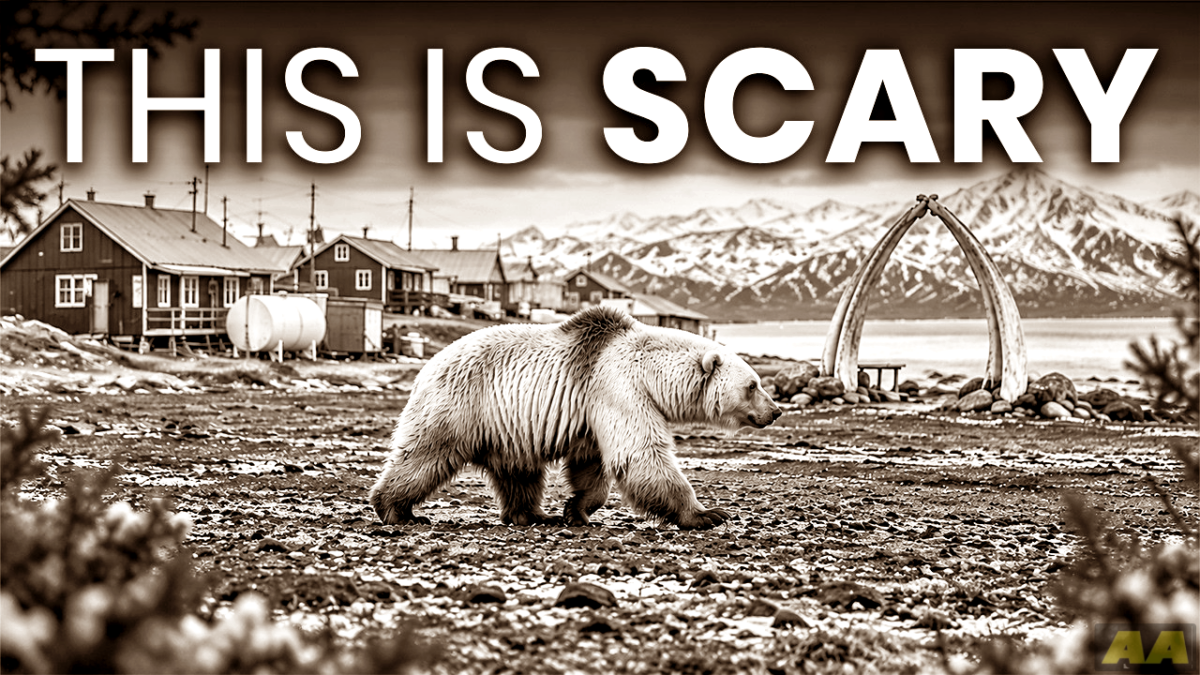
On the frozen edge of the Arctic, where the ocean becomes a landscape and the horizon disappears into endless white, a hunter expected to find what he had traveled so far to find.
It was the spring of 2006, and the sea ice near the southern edge of Banks Island stretched out beneath a silent sky.
Everything looked exactly as it should have. The cold, the snow, the vast emptiness, all of it belonged to the world of the polar bear.
But when the hunter finally reached the animal lying in the snow, something felt different.
The bear looked familiar and unfamiliar at the same time. Its fur carried the unmistakable white coat of a polar bear, but there were strange marks that did not belong.
Brown patches surrounded its eyes. Dark color ran along its legs and back. Its body had a shape that seemed to borrow from another animal entirely.
The claws appeared longer. The shoulders carried a slight rise that reminded experienced observers of a grizzly bear rather than a polar bear.
It was a bear that looked like two worlds had collided inside one body. For a short time, nobody knew exactly what they were looking at.
Then scientists examined its DNA, and the result changed how people understood the Arctic forever.
The animal was the offspring of a polar bear mother and a grizzly bear father.
It was not simply a strange individual. It was proof that a boundary that had existed for thousands of years was beginning to weaken.
And the most important question was not just how this animal came to exist. The real question was what happens when two powerful predators, built for completely different environments, begin sharing the same landscape again?
Because this story is not about an unusual bear from the past. It is about a change happening right now, far beyond most people’s daily lives, in a place where the frozen world of the Arctic is shifting faster than anyone expected.
To understand why that single bear mattered, you have to understand where these two animals came from.
Long before anyone recorded their movements or studied their genes, polar bears and grizzlies were connected by a shared history.
Hundreds of thousands of years ago, they came from the same ancestral line. Over time, one group moved farther north into a world of ice and frozen seas.
The other remained mostly on land. The polar bear became a specialiSt. Everything about it changed to fit its environment.
Its white coat helped it disappear against snow and ice. Its large paws helped it move across frozen surfaces and swim through cold water.
Its body became designed around a single resource: the seals that lived on the edges of Arctic ice.
The polar bear’s entire existence became connected to the frozen ocean. The grizzly took a different path.
Instead of becoming dependent on one environment, it remained flexible. It learned to survive almost anywhere.
It searched rivers for fish, dug through soil for roots and insects, moved across mountains, forests, and open tundra.
It was an animal built around opportunity. One bear became a specialist of ice. The other became a master of adaptation.
For thousands of years, their worlds remained separate. They lived close enough that their territories touched at the edges, but the conditions between them created a natural barrier.
The polar bear belonged to the frozen ocean. The grizzly belonged to the land. That invisible line stayed in place for generations.
Then the Arctic began changing. The region where their worlds came closest was the western Arctic, including areas around the Beaufort Sea and islands such as Banks Island and Victoria Island.
This region had always been a place where the two environments met, but the balance started shifting.
The sea ice that polar bears depended on began changing. The frozen platforms where they hunted formed later, disappeared earlier, and became less reliable.
At the same time, grizzly bears began appearing farther north than scientists had traditionally expected.
The animals that once stopped at the edge of the Arctic were now moving into it.
People living in these northern regions started noticing something unusual. Brown bears were being seen in places where polar bears had long been the dominant predator.
Some were even observed moving across sea ice. For a grizzly, that was an extraordinary change.
The open ocean ice was never its traditional world. It was not designed specifically for hunting there.
But the grizzly’s greatest advantage was its ability to adjuSt. Where one door closed, it searched for another.
The animal that had always survived by adapting was now entering the territory of the animal that had spent thousands of years mastering the ice.
The two bears were suddenly sharing the same space. Their breeding seasons overlapped enough that something once extremely unlikely became possible.
A polar bear and a grizzly could meet. And they could produce offspring. That was the environment surrounding the strange bear discovered near Banks Island in 2006.
Once scientists knew what they were looking for, they began finding more evidence. The first confirmed hybrid was not alone.
Researchers studying the western Arctic eventually identified eight confirmed hybrid bears. Some were direct combinations of the two species, with one polar bear parent and one grizzly bear parent.
Others represented another generation. They carried even more complicated combinations of ancestry, showing that these hybrids were capable of reproducing and passing their unusual genetic mixture forward.
One of these second-generation hybrids was discovered in 2010 near the community of Ulukhaktok on Victoria Island.
That discovery mattered because it showed that these animals were not simply isolated accidents. The connection between the two species could continue.
But the most surprising discovery came when scientists examined the family history of these bears.
All eight confirmed hybrids traced back to one female polar bear. One animal had started an entire line of unusual bears in that region.
Somewhere in the Arctic, a single female polar bear had produced offspring with grizzly bears, creating a family line that scientists could follow through generations.
Researchers gave these hybrids names that sounded almost too simple for such a complicated story.
When the father is a grizzly and the mother is a polar bear, the offspring is often called a grolar bear.
When the father is a polar bear and the mother is a grizzly, it is sometimes called a pizzly bear.
The names may sound unusual, but the animals themselves are very real. Each one carries traits from two different worlds.
A polar bear’s body is designed for the ice. A grizzly’s body is designed for change.
The hybrid exists somewhere between them. For years, scientists viewed these animals as rare curiosities.
The evidence suggested that hybridization was happening, but only on a very limited scale. A few unusual bears in a massive Arctic landscape did not mean that one species was replacing another.
Researchers wanted to know how common these hybrids really were. So they turned to genetics.
A large study examined more than 800 wild bears using adv@nced genetic testing. Scientists looked at samples collected across parts of Canada, Alaska, and Greenland over several decades.
They expected they might discover hidden hybrids among the population. But they did not. The results showed the same small group of known hybrids and no evidence of a widespread mixing between the two species.
The conclusion seemed reassuring. Polar bears were not disappearing into grizzly bears. The two species were not blending into one.
The hybrids remained rare. And that answer was correct. But it also answered only one question.
The question was whether polar bears were being genetically absorbed. The bigger question was something much harder to measure.
What happens when a hybrid animal inherits behaviors from two powerful predators? Because genes can tell scientists what an animal is made of.
They cannot always tell them what that animal will do. And that uncertainty is where the story becomes much more complicated.
The polar bear side of these animals carries something that separates it from most other bears.
Polar bears are not simply large versions of land predators. Their entire hunting strategy developed around the Arctic ocean.
They are built to search for seals across frozen water. Their relationship with humans is also different from that of many other bears.
Most encounters with black bears and grizzlies happen because the animal feels threatened, surprised, or protective.
A bear may react because it believes something dangerous is nearby. Polar bears have a different reputation.
Because of the environment they live in, they are among the few large predators that may view humans as potential prey rather than only as a threat.
That difference comes from their natural world. In the Arctic, food opportunities are limited. A polar bear depends heavily on successful hunting.
When sea ice conditions become difficult and hunting becomes harder, some bears spend more time on land searching for alternatives.
This is why researchers pay close attention to changes in Arctic conditions. The most concerning encounters often involve bears that are struggling physically, especially during periods when access to their normal food sources becomes limited.
Scientists studying polar bear behavior have documented that encounters with humans are rare, but the situations that do occur are often connected to changing conditions and increased time spent near communities.
The question surrounding hybrid bears is not simply whether they exiSt. It is whether a bear carrying traits from both species could behave differently from either parent.
Could it inherit the flexibility of a grizzly while also carrying some of the hunting instincts of a polar bear?
Could it survive in environments where neither parent is perfectly suited? Those questions remain unanswered.
There have not been enough hybrid bears observed in the wild for scientists to know exactly how they behave.
The animals are simply too rare. But the environment that created them is continuing to change.
And that means the story of these unusual bears may only be beginning.
The Arctic does not change quickly in the way a city changes. There are no new buildings appearing overnight, no roads being extended across the landscape, no obvious signs that something different is happening.
Instead, the transformation happens quietly. A little less ice each year. A little more open water.
A little more time when animals that once remained separated begin sharing the same spaces.
For polar bears and grizzlies, that slow shift is what brought them together. And while scientists continue studying the genetics of these hybrid bears, another question remains far more difficult to answer.
What happens when an animal carries the survival strategies of two completely different worlds? The first possibility is the one that attracts the most attention.
A hybrid bear could potentially combine the strongest qualities of both species. From the grizzly side, it could inherit adaptability.
The ability to move across changing landscapes, search for different food sources, and survive in places where conditions are unpredictable.
From the polar bear side, it could inherit traits designed for one of the harshest environments on Earth.
A powerful body, advanced hunting abilities, and a relationship with humans unlike that of many other large predators.
But science cannot simply predict behavior by looking at ancestry. An animal is not a simple mixture where every trait combines perfectly.
A hybrid might inherit some characteristics from one parent and not others. It might develop a completely unexpected combination.
It might even struggle because it belongs fully to neither world. The truth is that nobody knows yet.
There have only been a small number of confirmed hybrid bears, and observing them in the wild is extremely difficult.
Scientists cannot simply place these animals in controlled situations and see what happens. They must wait for rare encounters, collect evidence, and slowly build an understanding over time.
But while researchers are watching the hybrids, another change is already happening around them. Polar bears are spending more time on land.
As Arctic sea ice patterns shift, some bears are forced to remain away from their traditional hunting areas for longer periods.
When that happens, they naturally explore new places and search for different sources of food.
That brings them closer to human communities. One example occurred in the small Alaskan village of Wales in January 2023.
Wales sits on the Seward Peninsula near the Bering Strait, facing the water between Alaska and Russia.
It is a remote community where people have lived alongside Arctic wildlife for generations. On January 17, 2023, a polar bear appeared during severe winter conditions.
The event shocked the community because encounters with polar bears in that area are uncommon, especially ones involving aggressive behavior.
Residents responded quickly, and authorities later examined the animal. The bear showed signs of poor physical condition, matching a pattern researchers have observed in other unusual encounters.
The situation reflected a broader concern among scientists. Changes in the Arctic do not only affect where animals travel.
They affect the decisions animals make when searching for survival. A healthy polar bear with reliable access to its normal food sources usually has little reason to approach people.
A bear facing difficult conditions may behave differently. That is why researchers continue studying not only the number of hybrid bears but also the environmental changes creating more opportunities for these animals to meet.
The same forces that bring grizzlies farther north also affect polar bears. The same changing landscape that creates new encounters between species also changes how those species interact with humans.
This is why the discovery of hybrid bears matters. It is not because scientists believe polar bears will suddenly disappear into another species.
The evidence does not show that. The importance is that these animals reveal a larger transformation taking place in the Arctic.
For thousands of years, temperature, geography, and seasonal patterns created boundaries between animals. Those boundaries shaped where species lived, how they hunted, and how they survived.
Now those boundaries are becoming less predictable. The hybrid bears are evidence of that change.
They are living reminders that ecosystems are not fixed. They are constantly responding to conditions around them.
The Arctic has always been a place of movement. Animals have followed food, seasons, and changing environments for countless generations.
But the speed of recent changes has created situations that scientists are still trying to understand.
The first confirmed hybrid discovered in 2006 was once considered an unusual discovery. Today, it represents something much larger.
It shows how quickly old relationships between species can change when their environments shift. The story also raises questions about the future.
Will hybrid bears remain rare? Will more grizzlies continue moving north? Will polar bears spend increasing amounts of time on land?
Will future generations of hybrids develop traits that allow them to succeed in a changing Arctic?
Researchers are watching carefully because the answers will reveal much more than the future of one unusual group of bears.
They will reveal how ecosystems respond when old patterns are disrupted. The Arctic is often imagined as a frozen world that never changes.
A place of endless snow, untouched wilderness, and permanent landscapes. But that image hides what is really happening.
The Arctic is alive. It is a place where animals constantly adjust, compete, and respond to their surroundings.
The line separating the world of the polar bear from the world of the grizzly was never a physical wall.
It was a combination of distance, climate, and conditions. For thousands of years, those conditions kept the two species apart.
Now that separation is weakening. The strange bear found on the ice near Banks Island was not a warning that one species was immediately replacing another.
It was something more subtle. It was a signal. A sign that an ancient relationship between animals and their environment was changing.
The female polar bear whose descendants created the first known hybrid family became an unexpected part of that story.
Somewhere in the Arctic, her genetic legacy continues. Her descendants carry instructions from two different worlds.
One side comes from the frozen ocean. The other comes from the changing land. Together, they represent a future that scientists are still trying to understand.
The most important thing about these bears may not be what they are today. It may be what they reveal about tomorrow.
Because nature does not wait for humans to understand before it changes. Animals move. Habitats shift.
Boundaries disappear. And sometimes, the first sign of a massive transformation is something that seems impossible at first glance.
A bear with white fur and brown markings standing on Arctic ice. An animal that should not exist, but does.
A reminder that the natural world is always adapting, even when the changes are happening far away from where most people will ever see them.
The Arctic is not empty. It is not frozen in time. It is a living system responding to a new reality.
And somewhere beyond the last roads, beyond the communities and research stations, where the ice meets the land and two ancient bear species now share the same horizon, the next chapter of that story is still being written.
Disclaimer: This content may be created by Al for entertainment purposes. Any resemblance to real persons, events, or places is coincidental.








