A Mountain Trapper Went Into Town for Supplies, Then Rode Home With a Widow Who Refused to Disappear
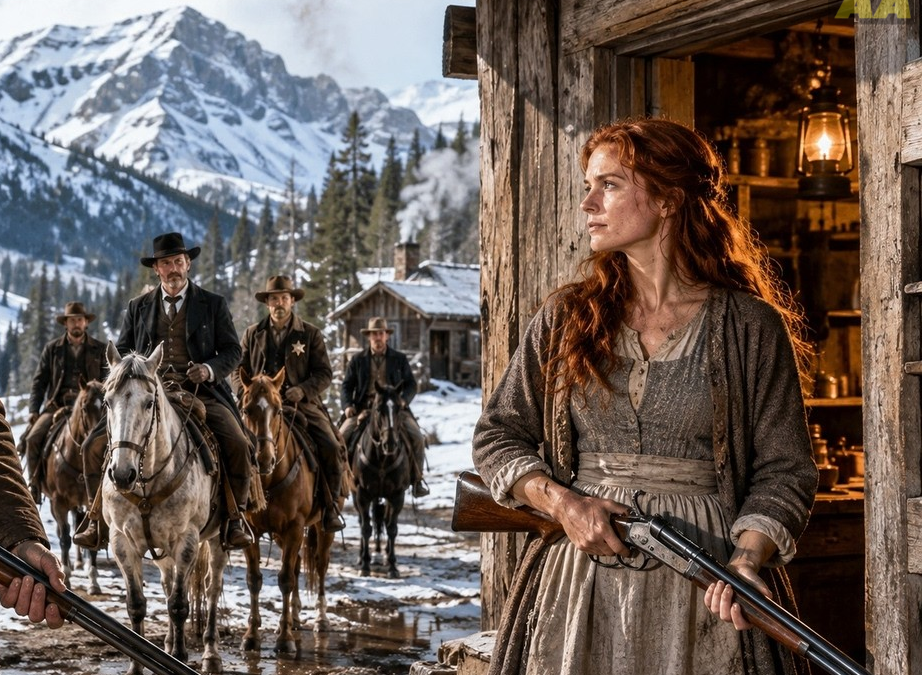
The four riders reached the clearing just after noon, when the mountain sun was bright enough to make the snow hurt the eyes.
They came slowly because the trail was still half buried, their horses picking through crusted drifts while the spruce crowded close on either side.
The man in front wore a town coat that was already stained with mud. He looked badly suited to the high country, and he knew it.
Behind him rode a deputy. Behind the deputy came two hired men. None of them looked toward the ridge above the cabin.
Everett Boone did. From three quarters of a mile away, he watched them through the narrow opening between two spruce trunks.
He counted four horses, four riders, one deputy star, two unfamiliar rifles, and the man he had expected to see sooner or later.
Croft. Everett stayed still for another few seconds. Then he turned downhill. He had twenty minutes, perhaps less.
By the time he reached the cabin, snow covered his coat and his palms were scraped raw from the descent.
Josephine Blaine was standing beside the stove, and she knew before he spoke that the winter had finally followed them home.
“Four,” Everett said. She looked toward the door. “How long?” “Twenty minutes.” Josephine reached beneath the sleeping platform and pulled out the shotgun.
It was the same weapon Everett had taught her to use months earlier. She held it without trembling.
But what would happen when the man who had spent the entire winter trying to escape the valley finally came looking for her in the mountains?
Everett Boone came into Cold Fork twice a year. Once before the first hard freeze.
Once in late spring, when the snowpack finally allowed the pass to breathe again. He did not come for company.
He came for salt, powder, and the particular brand of dark roasted coffee that Rutherford’s Dry Goods kept in a sealed tin behind the counter because it was the one luxury Everett allowed himself on the ridge.
He would sooner go without fresh meat than go without that coffee. He had been running the high country above the Gallatin for 11 years, and in those 11 years he had learned to move through Cold Fork the way a man moved through a sick room, quickly, quietly, and without touching anything he did not need.
The town sat in a narrow cut between two bluffs. The wind found it first and left it last.
Everett rode in on a large roan gelding with a pack mule behind him. Both animals were unhappy about the descent from the higher elevations and showed it in every step.
He hitched them at the rail in front of Rutherford’s and stood for a moment on the boardwalk, stretching the trail from his back.
He was 6 ft and 2 in, rope muscled from years of climbing, riding, hauling traps, and cutting wood.
He wore a coat of tanned elk hide that had seen five winters. His hair and beard were dark brown, the color of river water in shadow.
He looked exactly like what he was. A man the mountains had been slowly remaking for more than a decade.
He pushed through the door of Rutherford’s and felt the familiar tightening across his chest that always came with being indoors.
The store smelled of coal oil, cured tobacco, and the faint rancid sweetness of bacon grease left too long near the stove.
Everett pulled his list from his coat pocket, flattened it on the counter, and waited.
Rutherford came shuffling from the back, wiping his hands on a rag that had been used for everything except its intended purpose.
He was a short man with a face like old saddle leather and the permanently suspicious expression of someone who had been short changed too many times to start over.
He glanced at the liSt. Then the mule outside. Then Everett’s coat. “Good pelts this year.”
Everett did not answer. He placed a bundle of prime beaver on the counter, tied with cord.
Rutherford picked at the knot. His eyes became greedy in the careful way of a man trying not to look greedy.
He was halfway through his assessment when raised voices came through the back wall. Everett heard them the way a person heard weather coming up a canyon.
Indistinct at firSt. Then impossible to ignore. A man’s voice. Flat. Certain. The voice of someone accustomed to winning arguments by being larger than the other person.
Beneath it came a woman’s voice. Quieter. Controlled. She was not begging. That was what Everett noticed.
She was buying time. Rutherford cleared his throat and returned to the pelts. “Your storeroom,” Everett said.
The merchant set down the fur. “Domestic matter.” Everett lifted the curtain. The storeroom was cold and close, lit by a single lamp that threw more shadow than light.
A man named Croft stood beside a stack of feed sacks. Everett knew him by sight.
Croft was a cattle broker who spent the warm months finding uses for other people’s misery.
One fist was twisted into the collar of a woman’s dress. His other hand was raised.
The woman’s cheek was already marked. She was not crying. That landed firSt. Her eyes were dark and completely dry.
She was looking directly at Croft with the flat attention of someone memorizing every detail.
“Croft,” Everett said. The man turned. He had the slow, confident movement of someone who was not used to being interrupted.
Then he registered Everett’s size. The change in his expression was small. But it was there.
“Stay out of it, Boone.” Everett looked at the woman. Then at Croft. “Let her go.”
“She owes three months of storage fees on a barn that burned to the foundation.”
Croft’s voice had the texture of something rehearsed. “She owes it to me. Until she settles, she’s not leaving this building.”
Everett did not draw. He simply put one hand on the butt of the Remington at his hip.
His thumb touched the steel. The sound was very small. In the quiet room, it was enough.
Croft released the woman’s collar. He stepped backward. Then he delivered a speech about law, obligation, and what happened to people who obstructed legitimate debt collection.
Everett barely listened. Croft left. The woman straightened her collar with both hands. She did it slowly.
Precisely. Like she was alone in the room. Everett studied her. She wore a gray linen dress mended at both elbows.
Her hands were calloused in the particular way of someone who worked with them every day.
Not soft. Not decorative. The hard ridges of someone who had swung an axe, pulled harness, and done whatever work a farm demanded from whoever remained there.
She was not beautiful in the way that made men lower their voices. She was handsome in a way that made them uneasy.
Clear eyed. Straight backed. Uninterested in softening either quality. “He’s going to come back with the county deputy,” she said.
Everett looked toward the door. “The deputy is his wife’s first cousin.” Everett turned to leave.
“I need to leave Cold Fork.” He stopped. “I’m aware of how that sounds,” she continued.
Her tone remained even. “I have $40 in cash sewn into my boot. I have a sister in Missoula I haven’t spoken to in 4 years because my husband and her husband had a disagreement over a fence line.
I have no horse because Croft’s man took mine last Tuesday, claiming it against the debt.”
She paused. “I heard you run the high country north of here.” Everett looked at her.
“I know what that means in winter.” He said nothing. “I’m not asking to be carried.”
She held his gaze. “I’m asking for passage to somewhere that isn’t here.” Everett Boone trusted the ridge above all other things.
He trusted what it demanded from a person. He trusted that what it demanded was honest and indifferent.
Cold Fork was neither. He looked at the woman who had not cried when Croft had grabbed her.
She was standing straight in a cold storeroom, calmly making a practical case for her own survival.
He thought about the 11 years he had spent alone above the timberline. He thought about how completely he believed that life suited him.
Then he turned back into the store. “Rutherford.” The merchant looked up. “What does it show?”
Rutherford glanced toward the ledger. “Storage fees. Balance of seed. Handling.” “How much?” Rutherford studied the numbers as though he hoped arithmetic might change while he watched.
“$22.” Everett pulled the prime beaver back across the counter. He separated four pelts. “That’s her balance.”
Rutherford blinked. “Zero it out.” Everett picked up his liSt. He read off his supplies without looking at the woman again.
An hour later, he was riding out of Cold Fork with the woman on his pack mule.
Her name was Josephine. She told him that much when the trail had climbed high enough that the town disappeared behind the ridge.
He did not give her his first name in return. He had the feeling she already knew it.
She rode the mule without complaint. The animal had no proper saddle, only a pack frame with a folded canvas tied across it.
The trail steepened. The air thinned. Josephine gripped the rope with both hands and kept her eyes on the trail.
Everett watched her from the corner of his eye. She would not make it through a mountain winter.
He was nearly certain. She was tough in the way town life made a person tough.
Useful for a particular set of problems. Largely unprepared for what the high country demanded.
She would learn the difference within 6 hours. They camped on a stone shelf above the first drainage beneath a granite overhang that broke the wind off the peaks.
Everett built a small fire from dry aspen. It caught quickly. He did not offer to help Josephine down from the mule.
She climbed down herself. For a moment, her legs did something complicated before agreeing to hold her.
She collected wood without being asked. She found dry branches beneath the overhang and dragged one limb twice her own size across the shelf in several stages.
Then she dropped it beside the fire. Everett split it with his camp ax. Within 10 minutes, they had a proper fire.
He handed her hardtack, dried meat, and a tin cup of water heated on a flat stone.
She ate without comment. The fire threw orange light against the granite. Below them, the lights of Cold Fork disappeared among the dark pines.
Above them stood the enormous architecture of the stars. Josephine spoke. “I’m not going to Missoula.”
Everett looked across the fire. “I said that because I thought you wouldn’t take me if I told you the truth.”
She held the tin cup in both hands. “My husband is buried on the farm.
Croft has the farm now, or he will by next month. There is no farm to go back to, and there is no sister waiting for me, and $40 doesn’t buy passage to anywhere worth going.”
She looked into the fire. “What I have is the ability to work.” Everett remained silent.
“And enough sense to avoid preventable trouble.” She looked at him. “And apparently a trapper who felt obliged to pay $22 for a stranger’s grain debt.”
He said nothing. “You want me gone in the spring.” Everett watched the flames. “I’ll be gone in the spring,” she said.
“But I need somewhere to be until the pass opens.” She was not asking. She was proposing terms.
Everett studied her. “There’s one bed.” Josephine nodded. “It’s mine.” “I assumed it was.” “You’ll sleep on hides.”
“I’ve slept on worse.” “It’s 40° below in January.” “The cold does not negotiate.” “The snow gets to the eaves.”
She looked at him. “I understand.” Everett watched her for a moment. “I don’t talk.”
“I know.” He frowned. “You’ve said maybe 30 words since Cold Fork.” Everett threw another piece of wood onto the fire.
Then he lay down on his bedroll with his back to her. The negotiation was over.
The cabin sat at 9,000 ft among old spruce. It had three rooms if counted generously.
Everett never counted generously. There were two rooms and a lean to. The main room held an iron stove, a plank table, and a raised sleeping platform against the north wall.
The back room stored meat and pelts through the winter. The floor was packed dirt.
The walls were unpeeled logs chinked with moss and clay. A single window used 6 in of scraped elk hide stretched over a rough frame.
Josephine stood in the doorway for a moment. She did not gasp. She did not complain.
She looked at the stove. The table. The sleeping platform. The dirt floor. Then she stepped inside and set her bag down.
Within an hour, she had located the stockpile of goods. She had not been snooping.
She was simply competent. She understood the layout of a working space and moved through it like a woman who had organized other people’s disorder before.
Within 2 days, she had established a system for wood, food, water, and lamp oil.
She did not ask Everett’s permission. She made decisions. Then she implemented them. The cabin became more functional.
Everett did not thank her. Josephine did not appear to expect it. What he had not anticipated was the quality of her silence.
He had shared space with other people over the years. Briefly. A trapper passing through.
A surveyor once caught in an early storm. They had all produced the restless noise of people uncomfortable with quiet.
Josephine was different. She was quiet the way the mountain was quiet. Complete. Self contained.
Not waiting to be filled. It unsettled him more than noise would have. The first real storm arrived 3 weeks after she came.
A blue norther came down from the Canadian Rockies and stacked against the peaks like a wall.
The temperature dropped 30° in 4 hours. By morning, the drift against the door was chest high.
Outside, the world became one enormous field of white. Everett sat at the table cleaning his rifle when he smelled something unfamiliar.
Not smoke. Something warmer. Something richer. He looked up. Josephine had found his emergency sack of cornmeal and his can of bear lard.
She had made cornbread in the cast iron skillet. Real cornbread. It rose around the edges and turned dark gold beneath.
She cut it into wedges with his skinning knife and placed two pieces on a plate in front of him.
Everett looked at the cornbread. Then the plate. He took a piece. He ate standing because that was how he always ate.
He finished it before he had consciously decided whether he liked it. “It’s denser than it should be,” Josephine said.
“Altitude.” She glanced at him. “It’s fine.” Something almost resembling amusement touched her expression. The storm lasted 4 days.
On the third day, Everett’s wood supply became dangerously low. He put on all his gear and went outside.
The wind struck him like a physical opponent. He reached the woodpile against the south wall and loaded himself with split pine.
He made two trips. On the third, while carrying another armful through the deep drift, he went down.
He heard the cabin door before he managed to rise. Josephine stood there. The wind tore at her clothes.
She grabbed his coat with both hands. She pulled. She was not large, but she used her legs, her weight, and every bit of strength she had.
Everett found his boots. They fell together backward through the doorway. Josephine kicked the door shut.
The wind howled against the logs. Everett’s hands had gone numb. His left side ached where he had struck the snow.
He sat on the dirt floor trying to remove his coat. Josephine slapped his hands away.
She did it herself. She stripped away the outer layers and got him beside the stove.
Then she took his hands between her palms. For 10 minutes she worked them. Firmly.
Methodically. She ignored the tension in his jaw as sensation returned. When the worst of it passed, she sat back.
“You should have told me you were going out.” “I’ve been going out in storms for 11 years.”
“And I’ve been here for 3 weeks.” Everett looked at her. She raised one eyebrow.
“Which one of us needs to be smarter right now?” He had no answer. His fingers were mottled, painful, but still responsive.
She put beans on the stove. By midnight, Everett had developed a fever. Nothing dramatic.
Just the grinding kind that made a person weak and stupid. Josephine woke him twice during the night.
She made him drink willow bark boiled in water. It tasted bitter. Everett drank it because she made it clear the alternative would involve considerably less dignity.
On the second morning, he woke clear headed. Josephine sat at the table with his trapping records spread before her.
She was using a piece of charcoal. Everett watched. She was calculating. She had laid out records from the last two seasons.
He finally understood what she was doing. She was comparing the lines. Time. Distance. Return.
Food consumed. Fuel required. She was measuring his livelihood with the same practical precision she applied to everything else.
Everett said her name. She looked up. “Those are my records.” “I know.” She tapped the charcoal against the table.
“You have three lines that take a full day each way and produced four animals between them last season.”
She pointed to another set. “The three shorter lines produced 31.” Everett stared at the marks.
“I’m not telling you how to trap.” “I would hope not.” “I’m telling you what the numbers say.”
Everett looked toward the ceiling. She was right. He had known she was right in a general way for 2 years.
But he had continued running all six lines because routine kept him sane. He had mistaken repetition for structure.
Josephine returned to the figures. By January, they had found the shape of a shared life.
It was not a warm life. It had not been planned. But it worked. Josephine took over the cooking.
Everett spent more time on the trap lines. She managed wood, water, lamp oil, and food stores.
She skinned whatever he brought home. Cleanly. Quickly. Without instruction. He learned more about the life she had lived from that than from anything she said.
She read whenever the light allowed. She had three books in her bag. Small books.
Worn books. Cracked spines. Everett found her once sitting near the window with the scraped elk hide letting gray light fall across the page.
Her breath made small clouds in the cold air. She was completely absorbed. He watched longer than he intended.
She looked up. She did not ask why. He did not explain. Then came one of the deep cold nights in February.
The temperature outside had fallen so far that the number itself seemed meaningless. Everett woke to a sound he did not immediately recognize.
Josephine was sitting upright on the hide in the corner. She was very still. She was looking at nothing.
Or perhaps something only she could see. Everett stayed quiet. She spoke very softly. Not to him.
Not to the room. He heard only part of it. “I know. I know. JuSt.”
Then she pressed the heels of both hands against her eyes. Everett had seen people struggle before.
Some became loud. Some demanded attention. Josephine did neither. She simply sat there holding herself together.
Everett got up. He rebuilt the fire. He adjusted the damper. He fed the stove until the room became warmer.
He never looked directly at her. When he returned to his bedroll, he kept his back turned.
It was the only kind of privacy he knew how to offer. In the morning, Josephine was already awake.
Coffee was on the stove. Neither mentioned the night. March brought softer snow. The first mud appeared around the lower slopes.
Everett knew what that meant. The pass would eventually open. It also meant Croft could come.
A man like Croft did not spend an entire winter accepting that a woman had slipped beyond his reach.
A man like Croft had resources. And patience. On a gray morning, Everett told Josephine.
“He’ll send someone when the pass is clear enough.” She looked at him over her cup.
“How soon?” “A week.” She set down the cup. Everett watched her face. No panic.
No despair. Only calculation. “I can’t outrun it,” she said. “No.” “Then I need to be able to stop it.”
Everett went to the chest beneath the sleeping platform. He pulled out the shotgun. It was a 10 gauge.
A formidable piece of iron. He kept it for animals and situations that required no eloquence.
He placed it on the table. Josephine looked at it. “Have you fired one?” “A squirrel rifle when I was a girl.”
“The mechanics are the same.” She looked at him. “The consequences are larger.” He nodded.
“If someone comes up that trail meaning trouble, they won’t be alone. They won’t want a conversation.”
Josephine touched the shotgun. “You need to be able to make a decision before your hand starts shaking.”
She met his eyes. “Will you be here?” “I don’t know.” She waited. “Trap lines don’t stop because Croft has a grievance.”
Josephine pulled the shotgun toward her. He taught her that afternoon. They went into the clearing behind the cabin where the snow was still knee deep but packed enough to stand.
Everett showed her how to load the weapon. Shell. Chamber. Lock. He showed her how to hold it against her shoulder so the recoil moved through her frame instead of against it.
The first time he stood behind her, his hands over hers. She was rigid. Then she understood the mechanics.
Her shoulders relaxed. She found the geometry. She fired 12 times. On the ninth shot, she struck the pine stump they had dragged into the clearing at 40 yards.
The impact scattered wet wood across the snow. She fired three more. Then she handed the shotgun back.
“Don’t close your eyes when it breaks.” “I know.” “You did it twice.” “I know.”
He looked at her. Powder smoke drifted across the snow. She stood square shouldered with snow on her boots.
The cold had brought color into her face. Something Everett had spent several months refusing to examine pressed against his cheSt.
He turned toward the cabin. They came on a Thursday. Four of them. Two more than Everett had prepared for mentally.
Exactly enough to tell him Croft had taken this seriously. Everett saw them from the high rock above the clearing.
Three quarters of a mile away. He watched for 60 seconds. Then he went down the backside of the ridge.
By the time he reached the cabin, his palms were scraped raw. Josephine was at the stove.
She turned as he entered. She read everything in the way he came through the door.
“Four,” he said. She reached beneath the platform and pulled out the loaded shotgun. Everett checked the Remington.
They moved around each other in the cramped room with the wordless coordination of people who had shared close quarters through a brutal winter.
They understood each other’s economy of movement. The riders entered the clearing. Croft was in front.
He wore a town coat that was poorly suited to the altitude. Behind him came two men Everett did not know.
The fourth wore a deputy star. Croft called toward the cabin. “Boone.” Everett stood near the woodpile.
The Remington hung at his side. “Your property recovered itself,” Everett called back. “The trespass is yours.”
The deputy began reading legal language. Everett let him continue. It was the sort of document designed to sound inevitable.
He waited until the deputy finished. Then he said, “She doesn’t want to come.” “She doesn’t get a choice,” Croft answered.
“She owes.” “She owes nothing.” “Her account at Rutherford’s was settled in September.” Everett kept his voice flat.
“You’re on my land with a piece of paper that doesn’t mean anything past the county line.”
He looked at the men. “Take your riders and go back down.” Croft looked toward the two hired men.
They began separating through the clearing. That was when the cabin door opened. Josephine stepped outside.
She held the shotgun at her hip. Not raised. Not theatrical. Simply present. She stood in the doorway and looked across 30 yd of packed mountain snow.
Croft stared at her. He was accustomed to women adopting certain postures around him. Appeal.
Apology. Submission. Josephine offered none of them. The deputy shifted in his saddle. “mrs. Blaine, put that down.”
“I’m on private property.” Her voice was even. “The trespass is yours.” The deputy glanced toward Croft.
Josephine continued. “Your writ concerns a debt of $22 that was settled on the 14th of September and witnessed by Rutherford in Cold Fork.”
Croft’s expression tightened. “If you want the exact ledger entry, I can write it out for you.”
She held the shotgun steadily. “If you want to pursue this in district court, you are welcome to.”
A pause. “But you are not taking me anywhere.” The deputy looked at her. Then at the shotgun.
Then at Croft. Croft’s jaw tightened. He said Josephine’s name. She looked at him. He repeated it with the deliberate weight of a threat.
Josephine did not move. The 10 gauge remained at her hip. Finally, Croft pulled his horse around.
He said something quietly to the deputy. The deputy looked once more at Josephine. Then at Everett.
Then at the ground. The riders turned. They started down the trail. Everett remained beside the woodpile until the sound of the horses disappeared into the spruce.
He looked toward Josephine. She was still standing in the doorway. The shotgun remained in her hands.
Some color had drained from her face. Her grip on the stock was slightly too tight.
Everett walked past her. He entered the cabin. He put a log on the fire.
After a moment, he heard the door close. Josephine set the shotgun against the wall.
She sat at the table. Everett poured water into a tin cup and placed it before her.
She wrapped both hands around it. Neither spoke. The shaking came later. Not during the confrontation.
Afterward. When the danger had passed. Josephine lowered her eyes toward the cup. Everett sat across from her.
He understood then that courage was not the absence of fear. It was the ability to keep a decision steady while fear was trying to move it.
The spring came in April. Indecently sudden. One week brought frozen ground. The next brought dripping eaves, soft mud, and the sharp smell of wet stone.
The pass would be clear within a fortnight. The world below would become accessible again.
Everett checked the upper trap lines on a clear morning. When he returned, he found Josephine sitting on the chopping block outside in the pale spring sun.
She had a small notebook open across her knees. She was writing with charcoal. Everett dropped a burlap sack near the cabin door.
“Three.” Josephine nodded. She continued writing. Everett stood in the thin spring warmth. He watched the mountain.
Then he looked at her. “The Missoula story.” Her hand stopped. “You said you had a sister.”
“I do.” “You said you hadn’t spoken to her in 4 years.” “That part was true.”
Everett worked the laces on his snowshoes. He removed them and placed them against the cabin wall.
“There’s enough from this winter’s lines to carry two through next season.” Josephine looked up.
“If the east line produces what it did in ’15.” She studied him. “That’s a long winter to commit to.”
Everett looked toward the ridge. “I’ve had worse company.” The corner of her mouth moved.
It was barely anything. Over 6 months, Everett had learned that this was Josephine’s version of a smile.
She looked back down at the notebook. “The east line.” Everett waited. “You’ll need to move the stake 20 yd south.”
He looked at her. “The beaver sign shifted in late February.” “You checked it?” “When you had the fever.”
She closed the notebook. “I didn’t want to lose the whole line while you were down.”
Everett stood there in the April mud outside the cabin. The mountain stretched above them.
The spruce moved softly in the wind. The snow still covered the highest ridges. He understood something he could not have explained to anyone in Cold Fork.
He had come into town for salt. For powder. For coffee. He had expected to return to the ridge with supplies and nothing else.
Instead, Josephine Blaine had entered his life almost by accident. She had brought no promises.
No demands. No grand declaration. She had simply taken the place she needed to survive, worked until the cabin functioned better, learned the mountain, learned his habits, challenged his arithmetic, pulled him from a storm, rebuilt his fire, read his records, learned to handle a 10 gauge, and stood in a doorway facing the person who had spent months trying to decide where she belonged.
She had never asked Everett to save her. That was perhaps the first thing he had respected about her.
She had only asked for passage. Somewhere beyond Cold Fork. Somewhere she could work. Somewhere she could remain her own person.
The mountain had provided the reSt. Not easily. Not gently. But honestly. Everett picked up the burlap sack.
“Get the knife.” Josephine closed the notebook. She stood. For a moment, they looked at each other.
Then she went inside. Everett followed. The mountain would remain what it had always been.
Cold. Demanding. Unimpressed by comfort. The cabin would remain small. The winters would remain long.
The trap lines would still require checking before storms. There would still be 40° below mornings.
There would still be wood to split and pelts to skin and snow to clear from the door.
But Everett no longer thought of the cabin as a place where he lived alone.
He had spent 11 years believing solitude was the same thing as freedom. Josephine had never argued with him about it.
She had simply shown him another possibility. Two people could share a roof without either one becoming smaller.
Two people could work beside each other without pretending they had planned it. Two people could enter a mountain winter as strangers and emerge from it with an understanding neither had needed to name.
Josephine returned with the knife. She handed it to him. He took it. Then they walked toward the burlap sack.
Outside, the spring wind moved through the spruce. Far below, Cold Fork was beginning to wake.
The pass would soon open. The roads would become usable. People would return to the valleys.
Rutherford would unlock his store before sunrise. The coffee tin would sit behind the counter.
Croft would have to answer questions he had spent months avoiding. And Everett Boone would still have his cabin at 9,000 ft.
But now, when he returned from the ridge, someone would be there. Someone who knew the difference between silence and loneliness.
Someone who could read his trapping records and tell him where the numbers were wrong.
Someone who could put cornbread on a plate without asking whether he wanted it. Someone who had learned the mountain instead of simply enduring it.
Everett looked toward the trail. Josephine stood beside him. Neither spoke. There was no need.
The ridge had brought them together without permission. The winter had tested them without mercy.
And spring had arrived without asking either of them whether they were ready. Everett lifted the burlap sack.
Josephine took the knife. Together they walked back toward the cabin, while the last snow of winter melted beneath their boots and the first clear water of spring began running down the mountain.
Disclaimer: This content may be created by Al for entertainment purposes. Any resemblance to real persons, events, or places is coincidental.








