A Mountain Man Expected a Simple Bride — The Wild Woman Who Came Changed His Life Forever
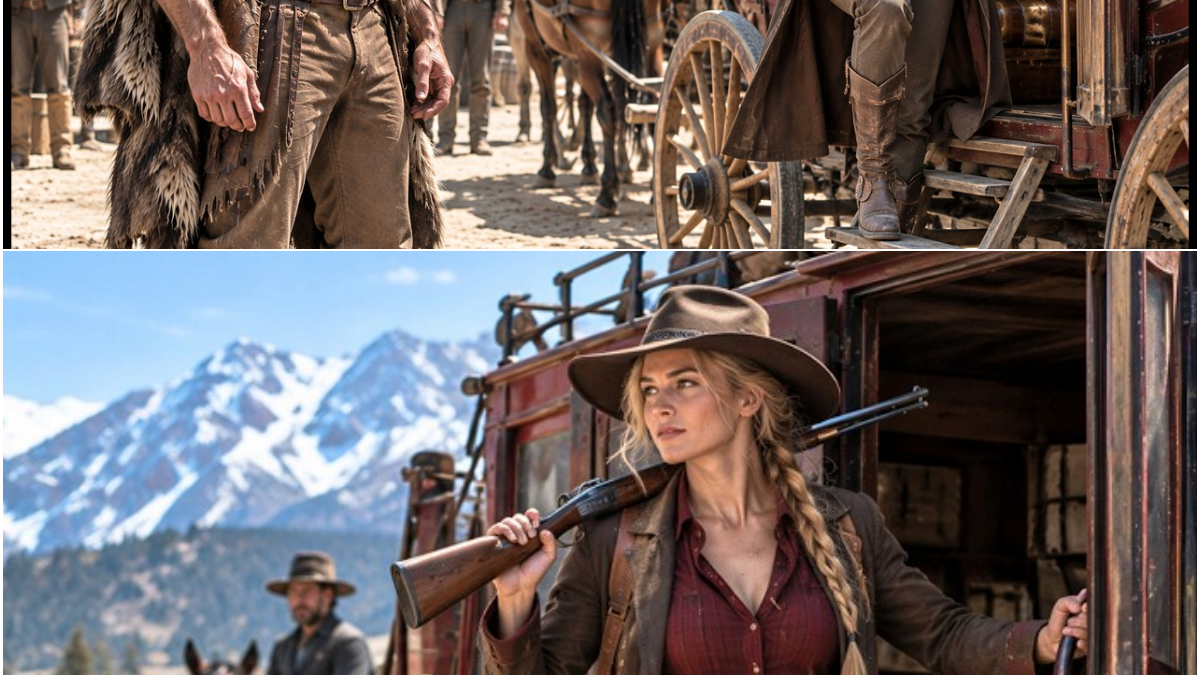
The mountain had never asked Elias Boon to be kind, and he had never expected it to be.
It had taught him to endure freezing nights, violent storms, and the endless loneliness of a life spent far beyond the reach of ordinary people.
For five years, he had built his existence around that simple understanding. He trapped animals, cut timber, repaired his cabin, and returned each evening to a silence that never questioned him.
He believed he understood exactly what he needed to survive. Then he sent a letter to Missouri asking for a wife, and the woman who arrived was nothing like the one he had imagined.
She stepped down from the stagecoach wearing men’s trousers, muddy riding boots, and a weathered canvas coat.
A Winchester rifle rested in one hand, while the other gripped a battered leather trunk.
Her wheat-colored hair was tied into a careless braid, and her pale blue eyes surveyed the settlement with the suspicion of someone who had learned that strangers rarely offered anything without expecting something in return.
She introduced herself as Clementine Miller, the sister of the woman Elias had intended to marry.
Abigail was gone, she explained, and Clementine had taken her place on the journey weSt.
Elias had expected a gentle woman who would welcome a warm kitchen and a quiet household.
Instead, he had found someone who looked capable of arguing with a mountain and winning.
He could have refused her, sent her back, or insisted that their arrangement was finished.
But something about her determined expression made him hesitate. What Elias did not understand was that the woman standing before him had already survived circumstances that would have driven many people to surrender, and the life awaiting them above Bitter Creek would demand everything both of them possessed.
The stagecoach driver spat into the dusty street and looked between them with open curiosity.
Bitter Creek was a small mining settlement surrounded by enormous stretches of mountain wilderness. Its buildings were weathered, its streets were rarely clean, and its population consisted mostly of miners, traders, drifters, and people who had found little reason to return to the places they came from.
Elias Boon was familiar to nearly everyone there, although very few could claim to know him.
At thirty-four, Elias was an imposing figure. His broad shoulders, heavy hands, and thick beard made him appear older than he was.
Years of trapping and cutting timber had strengthened his body while leaving his clothes permanently marked by the wilderness.
He rarely spoke unless he had something practical to say, and most people preferred to leave him alone.
He had come down from his mountain cabin carrying a small brass ring in one pocket and a letter in the other.
The letter had come from a matron in St. Joseph, Missouri, who arranged introductions between women seeking new lives and men living in distant settlements.
Abigail Miller had sounded suitable. She was described as religious, domestic, and interested in a peaceful household.
Elias had not imagined a grand romance. His expectations were modeSt. He wanted someone who could maintain a fire, prepare meals, and make the cabin feel less like a shelter occupied by a solitary hunter.
The winters were long, and the silence had become increasingly difficult to ignore. Now Abigail’s sister was standing in front of him with a rifle.
“You’re Elias Boon?” She asked. “I am.” “Then are we going up the mountain, or are you planning to stare at me until the next coach arrives?”
Elias studied her expression. “The arrangement was for Abigail.” “The arrangement was for a wife.
Abigail can’t come. I can.” He glanced at her rifle. “You understand where I live?”
“I understand it’s somewhere above that town, where the roads are terrible and the weather is worse.
I’ve traveled far enough to know that much.” “You’ve never seen my cabin.” “I’ve seen enough cabins to know what they look like.”
“Can you cook?” “Yes.” “Clean?” “Yes.” “Handle livestock?” “I can learn what I don’t already know.”
“And that rifle?” Clementine glanced down at the weapon. “It works.” Elias remained silent. He had wanted a woman who would make his life easier, but Clementine appeared likely to make it considerably more complicated.
Still, she was not asking for special treatment, and she did not appear frightened by the prospect of living far from town.
After a long moment, Elias walked past her and lifted her trunk into the back of his buckboard.
“The wagon’s ready,” he said. Clementine picked up her rifle and followed him. Their journey began without ceremony.
Elias climbed onto the wagon seat, took the reins, and guided the mules toward the mountain trail.
Clementine settled beside him, keeping her rifle within easy reach. Neither made an effort to begin a conversation.
The road climbed through increasingly difficult terrain. Rocky switchbacks twisted between pine trees, and deep ruts forced the wagon to sway violently.
Elias watched Clementine from the corner of his eye, expecting her to complain about the jolting ride or the cold air.
She did neither. When the wagon passed a steep drop, she simply braced her boots against the floorboard.
When the wind strengthened, she pulled her coat tighter. When Elias asked how recently she had fired her rifle, she answered that it had been two weeks earlier, after a man aboard the train attempted to take her belongings.
Elias did not ask for additional details. By the time they reached the cabin, the afternoon light had begun to fade.
The structure stood in a clearing surrounded by dense lodgepole pines. It was sturdy enough to withstand harsh winters, with thick logs, carefully packed chinking, and a large stone chimney.
Yet it had none of the comforts Clementine might have expected from a household shared by two people.
The yard was mostly bare earth. The porch roof sagged slightly, the woodpile was disorganized, and the chicken enclosure needed repairs.
Inside, the cabin contained a cast iron stove, a rough table, a single bed, and shelves crowded with canned food, ammunition, and tools.
Elias placed her trunk beside the bed. “The stove is there,” he explained. “Wood box is empty.
I’ll cut some.” “I’ll do it.” He turned toward her. “You know where the axe is?”
“It’s an axe, Boon. I expect it’s near the chopping block.” Before he could respond, she walked outside.
Elias watched through the window as Clementine found the splitting maul. She selected a heavy piece of pine, positioned it on the chopping block, and swung.
The first strike split the wood cleanly. She continued without wasting movement, working through the pile until enough pieces had accumulated to fill the box.
Within minutes, she had started a fire and placed water on the stove. Elias sat at the table, feeling strangely unnecessary.
“I bought a ring,” he said. Clementine glanced at him. “Keep it.” “You don’t want one?”
“Rings get caught in machinery. They can tear fingers apart. A piece of paper from the county clerk is sufficient.”
“You want to be married without a preacher?” “A preacher couldn’t help my sister. A clerk can write down what happened.”
Her voice softened slightly when she mentioned Abigail, but the change disappeared almost immediately. “Until we get the paperwork settled,” she continued, “I’ll sleep on the floor.”
Elias nodded. “Fair enough.” The first several days established the unusual rhythm of their household.
Elias continued waking before sunrise, tending his traps, checking the animals, and returning in the evening.
Clementine gradually reorganized the cabin according to her own standards. She cleaned the cooking equipment, sorted the supplies, and repaired small problems that Elias had ignored for months.
She found forgotten dried apples in a storage box and turned them into a dense loaf of bread.
She inspected the barn, discovered weaknesses in the fencing, and pointed out several places where the roof needed attention.
She did not perform these tasks with the cheerful enthusiasm Elias had imagined in a wife.
Her work was direct and unsentimental. She seemed to consider every unfinished job a threat to their ability to survive the coming winter.
Yet Elias found himself noticing things he had never paid attention to before. Clementine always sat facing the door.
She kept her Winchester within reach, even while eating. A jagged scar ran from beneath her left ear toward her collarbone, partially hidden by her shirt.
He did not ask about it. On the fourth morning, he discovered that Clementine had no intention of waiting for him to handle every danger around the property.
He was washing his face when he heard a metallic disturbance near the chicken enclosure.
Reaching for his revolver, he stepped off the porch and moved toward the sound. A large timber rattlesnake had curled itself beside the wire fencing.
Its body was thick, and its tail vibrated rapidly as it prepared to strike. The cold had driven it toward the warmth of the chicken coop.
Elias raised his revolver. “Clem, don’t move.” Clementine was already reaching for a garden spade.
The snake raised its head. She struck before Elias could say another word. The metal blade pinned the animal behind its jaw, and a second forceful movement ended the immediate danger.
Clementine leaned on the handle, breathing hard. Her bare feet stood on the freezing ground.
“Your fence needs a deeper trench,” she said. Elias looked at the snake, then at her.
“I’ll dig it today.” He did not ask whether she was frightened. He recognized the expression on her face: a stubborn refusal to display weakness, even when the circumstances demanded it.
For the first time, his expectations began to change. He had not brought a gentle housekeeper into his cabin.
He had brought someone who understood that survival depended on action. November arrived with a sudden change in the weather.
Elias noticed the pressure dropping and the wind shifting north. The mountain had warned him of approaching trouble long before the first clouds covered the peaks.
“Storm coming,” he announced as he entered the cabin. Clementine stopped kneading dough. “How bad?”
“Bad enough that we need to secure everything before it arrives.” They divided the work without arguing.
Clementine took responsibility for moving the goats into the barn, while Elias secured the firewood and repaired the loose roofing on the lean-to.
The temperature fell rapidly. Wind tore through the clearing, and snow began striking their faces in hard, icy pellets.
Elias hammered nails into the roofing while Clementine struggled with a stubborn billy goat. She dragged the animal toward the barn, refusing to surrender even when the mud made every movement difficult.
Then the full storm arrived. A wall of white swallowed the clearing. Visibility vanished, and the wind became so loud that Elias could barely hear himself shout.
He tied a rope around the porch post and secured the other end around his waist before making his way toward the barn.
Inside, he found Clementine sitting on a bale of hay, holding her left arm against her cheSt. Her face was pale, and her breathing was shallow.
“The door,” she managed to explain. “It caught my shoulder.” Elias examined the injury. Her shoulder had been dislocated when the barn door slammed backward against her.
“I need to put it back.” “I know.” “It’s going to hurt.” “Everything hurts. Just do it.”
He moved behind her and instructed her to lean against his cheSt. Clementine hesitated, unused to depending on another person, but eventually allowed herself to rest against him.
Elias secured her carefully and took hold of her injured arm. “On three.” He repositioned the joint in one decisive movement.
Clementine cried out, then collapsed against him, breathing sharply as the pain began to settle.
Elias kept his arms around her until she could sit upright again. The storm continued battering the barn, but for several minutes neither of them spoke.
“You’ve got a heavy hand,” she whispered. “Mountain work doesn’t teach much finesse.” She made a small sound that was almost a laugh.
Together, they returned to the cabin, using the rope to guide themselves through the blizzard.
Elias locked the door behind them and helped Clementine remove her heavy coat. He poured whiskey into two tin cups and handed one to her.
“You did good out there,” he said. Clementine looked toward the fire. “You don’t leave what’s yours.”
Elias considered the words. He had spent years thinking that a wife would be someone he needed to protect from the mountain.
Clementine had shown him that she understood the mountain as well as he did, and that she expected to contribute rather than simply be sheltered.
He was beginning to want something different from the arrangement he had made. The blizzard lasted four days.
Snow buried the clearing, and ice covered the windows. The cabin became a dim, enclosed world where the wind seemed to press against every wall.
Elias understood the isolation of such storms, but sharing the space with Clementine changed the experience.
Her injured shoulder made even simple tasks difficult. She tried to hide the discomfort, but Elias noticed whenever she struggled to lift a bowl or reach for something on a shelf.
On the second morning, she attempted to prepare biscuits with one hand. The mixing bowl slipped, nearly spilling flour into the ashes.
She froze, visibly angry with herself. Elias put down his tools and crossed the room.
“Sit.” “I can do it.” “I know. But I don’t care to eat ash.” He took the spoon and began mixing the dough.
Clementine stared at him before finally sitting in the rocking chair beside the hearth. The biscuits were terrible.
Elias burned the bottoms while leaving the centers undercooked, but Clementine ate three without complaint.
“They’re awful,” he admitted. “They are.” “But they’re hot.” “That they are.” Their conversation eventually turned toward the scar on her neck.
Clementine explained that she had received it while working in a laundry near the railroad yards in St. Joseph.
After Abigail became ill, the sisters had run short of money. Clementine took whatever work she could find, washing the clothes of miners and railroad workers.
One of the yard bosses decided that her lack of a husband or father made her vulnerable to his demands.
He cornered her in a drying room and threatened her with a knife. Clementine refused to remain silent.
She used a washboard and a pair of fabric shears to defend herself, then left before she could learn how badly he had been injured.
The following morning, she packed Abigail into a wagon and headed weSt. Abigail’s condition worsened during the journey, and she eventually died before Clementine could reach a place where proper care might have been available.
Clementine described the events without asking for sympathy. Elias listened carefully. When she finished, he simply said, “Good.”
She looked at him with surprise. “You didn’t stay quiet,” he explained. “That’s how you survive in a place like this.”
For Clementine, the response was unexpected. Most people either questioned her behavior or treated her as though she needed rescuing.
Elias understood that she had fought for herself because she had needed to. The silence that followed felt different from the silence of their first days together.
It no longer demanded that either of them prove anything. When the storm finally ended, the world outside was buried beneath several feet of fresh snow.
Elias prepared to check his trap lines, knowing that animals caught during the storm would need attention.
Clementine remained near the doorway, her injured shoulder still heavily bruised. “I’ll be back by midafternoon,” Elias told her.
“Take care of yourself.” He nodded and disappeared into the timber. The first trap he checked had been destroyed.
The iron chain was broken, not chewed through, and human footprints crossed the surrounding snow.
Someone had been stealing from his line. Elias followed the tracks through the woods until they led him to a narrow rocky draw.
There he found three men gathered around a poorly constructed fire. Several of his beaver pelts lay beside them.
He raised his Winchester. “Step away from the furs.” The largest man reached toward a shotgun, but Elias ordered him to stop.
A younger companion raised his hands and pleaded that they had not eaten properly in days.
Elias told them to leave the pelts and head down the mountain. The men appeared desperate, but he did not lower his rifle.
They had destroyed his traps and taken property that he depended on to purchase supplies.
Then the third man, who had been gathering wood nearby, emerged with a heavy buffalo rifle.
The confrontation changed instantly. The third man fired, and Elias dove behind a fallen tree.
The shot shattered rotten wood above him, leaving him trapped behind the deadfall. The bearded man grabbed his shotgun while the others began moving around Elias’s position.
He had little room to maneuver in the deep snow. His snowshoes prevented him from moving quickly, and removing them would leave him sinking into the drifts.
He prepared to defend himself as the men closed in. Then a rifle cracked from the ridge.
The man carrying the buffalo rifle cried out and dropped his weapon. A second shot struck the shotgun, knocking it from the bearded man’s hands.
Elias looked upward. Clementine stood on the ridge, her injured arm secured against her body with a leather belt.
She had followed his tracks through the snow and reached the overlook above the draw.
Her rifle rested against a low tree branch, providing support for her steady aim. “Walk,” she commanded.
The men had lost their advantage. The younger one began trembling, while the bearded man stared at his injured hands.
They retreated into the timber, abandoning the stolen pelts and leaving their wounded companion behind.
Elias approached the injured man and ordered him to follow the others down the mountain.
The injury was serious, but the man could still walk. When the draw was finally quiet, Elias climbed toward Clementine.
She was leaning against a pine tree, pale and exhausted. Her shoulder had endured more strain than it could comfortably bear, and the cold had begun to overcome her.
Elias removed his elkhide coat and wrapped it around her. “You shouldn’t have come,” he said.
“You were pinned.” “I could have handled it.” “No, you couldn’t.” He looked at her for a long moment, then gave a low laugh.
“Fair enough.” Clementine’s strength was fading. She had followed him into the wilderness, climbed the ridge, and fired her rifle despite the pain in her shoulder.
Elias pulled her close, allowing her to rest against his cheSt. For several moments, she remained rigid.
Then she slowly relaxed, letting her head rest against him. “You’re bleeding,” she murmured, noticing the cut on his cheek.
“Just a splinter.” “I was aiming for the center of his cheSt.” “You shoot better with one arm than most men do with two.”
“I missed.” “You didn’t.” They began the descent together, Elias breaking the trail while Clementine followed his footsteps.
By the time they reached the cabin, darkness had settled over the mountain. Inside, Elias built up the fire and helped her into the rocking chair.
He examined her shoulder and replaced the makeshift belt with a proper bandage. Her muscles were badly strained, and the joint needed time to recover.
Clementine endured the treatment without complaint. When he finished, he prepared two cups of rye whiskey.
“Thank you,” Elias said. She studied him. “For what?” “For coming after me.” “We’re partners.”
The words stayed with him long after she had finished her drink. Winter continued for another two months.
Snow covered the surrounding slopes, and the cabin remained their center of activity. Clementine’s shoulder healed gradually, although she was forced to limit her movements.
Elias took over the heavier chores. He chopped wood, hauled water, tended the animals, and kept the cabin supplied.
Clementine found other ways to contribute. She cooked with one hand, repaired clothing, cleaned the rifles, and maintained the household supplies.
Their evenings developed a quiet routine. Elias worked beside the fire, repairing traps or sharpening knives, while Clementine read her worn dime novels under the light of a kerosene lamp.
They did not need constant conversation. Their shared silence had become comfortable, and Elias found himself looking forward to the hours when the work was finished and the two of them could sit together.
Late in January, Clementine finally asked him why he had chosen to live so far from civilization.
Elias explained that he had fought for the Union at Antietam. The experience had left him longing for distance from crowded places and the noise of ordinary life.
He remembered the confusion of the battlefield, the cannons, and the terrible sounds of a conflict that had seemed to stretch endlessly across the landscape.
After returning home, he found that he could not comfortably settle back into his former routine.
The mountain offered something he could understand. It was difficult, but its dangers were visible.
Weather, hunger, and wild animals did not pretend to be anything other than what they were.
Clementine listened without interrupting. “And Abigail?” She asked eventually. “Why send for her if you wanted to be alone?”
Elias looked toward the fire. “A man can only talk to his mules for so long before he forgets how to be a man.
I wanted an anchor. Someone to remind me what day it was.” Clementine gave a small smile.
“You got a bad deal, Boon. Abigail would have baked pies and read scripture. You got a woman who shoots poachers.”
Elias met her eyes. “I got exactly what I needed.” For a moment, Clementine seemed unable to find a response.
She lowered her gaze and returned to her book, but her hands moved more slowly as she turned the page.
The words had reached her more deeply than either of them was prepared to admit.
April brought the thaw. Snow melted from the slopes, feeding swollen creeks that rushed through the valleys.
Mud replaced the hard winter ground, and birds returned to the foreSt. Clementine’s shoulder had healed enough for her to resume her ordinary work.
She returned to chopping wood, tending the animals, and repairing the remaining weaknesses in the property.
One morning, Elias announced that they needed to travel down to Bitter Creek. The trail was too muddy for the wagon, so they saddled the mules and prepared to ride.
Elias had a supply of cured beaver pelts to trade for coffee, salt, flour, and ammunition.
He also intended to visit the county clerk. Their marriage had remained an unfinished arrangement throughout the winter.
They had lived together, worked together, and relied on one another, but the paperwork had never been completed.
Clementine understood what the journey meant, although she said nothing about it. The ride into town was uncomfortable.
The mules struggled through deep mud, and the valley smelled of wet earth, smoke, and the remains of winter.
Bitter Creek had survived, but the settlement looked worn. Its boardwalks were warped, its streets were filled with brown water, and the miners who remained appeared tired from months of difficult conditions.
When Elias and Clementine rode into the center of town, people turned to watch them.
Elias was familiar to the residents. Clementine, however, attracted immediate attention. She wore the same men’s trousers and canvas duster she had worn when she arrived.
Her rifle rested across her thighs, and she sat upright in the saddle with an expression that discouraged conversation.
They tied the mules outside the general store. Elias went inside to trade the pelts while Clementine remained on the boardwalk.
Three miners approached her. The largest looked her over and made a crude remark about Elias bringing a woman down from the mountains.
Clementine did not move. “I look like a woman who knows how to gut a pig,” she replied.
“Step closer, and I’ll show you how quickly I can do it.” The miner’s confidence disappeared.
He glanced at her rifle and then at his companions before moving away. Elias emerged from the store carrying a small paper sack.
“Trouble?” “Nothing that needed shooting.” He handed her the sack. “Peppermint sticks.” She slipped them into her pocket, and they continued toward the county clerk’s office.
The clerk was a small, balding man who worked behind a wire cage. He recognized Elias and immediately began searching for the necessary forms.
“Marriage certificate,” Elias explained. The clerk looked from him to Clementine, clearly surprised by the arrangement.
He asked for their names, then began filling out the paperwork. When he asked about a ring, Clementine refused.
“The paper establishes the union,” she said. “I don’t need a piece of brass to prove that I belong to myself.”
The clerk appeared uncomfortable but continued writing. Clementine signed her name with bold, looping letters.
Elias signed beneath it and paid the required fee. Within minutes, the document was stamped and handed back to him.
There was no preacher, no ceremony, and no exchange of vows. They walked out of the office as legally married partners.
Yet Clementine seemed uneasy during the journey home. Her shoulders stiffened, and she rode ahead of Elias without speaking.
He watched her carefully, sensing that the paperwork had brought something to the surface that neither of them had fully discussed.
When they reached the cabin, the evening light was fading across the clearing. The woodpile stood neatly beside the porch, the barn had been repaired, and smoke rose from the chimney.
For Elias, the property no longer looked like a place designed simply to keep the cold away.
It looked like a home. Clementine dismounted and carried her saddle into the barn. She moved with unusual urgency, immediately beginning to rake the straw in the stalls.
Elias followed her inside. “Leave it, Clem.” “The stalls need turning.” “The straw is fine.”
She continued working. “Stop,” he said. Clementine dropped the pitchfork and turned toward him. “What do you want me to stop doing, Elias?
Working? Earning my keep?” He remained still as she approached. “I signed the paper. You have your housekeeper.
You have your partner. I’ll shoot your poachers and bake your bread. But don’t tell me to stop moving because I won’t sit here and pretend that a piece of paper hasn’t changed anything.”
Her voice rose. “I know what happens when a woman has nowhere else to go.
I know what it means to depend on someone who can decide whether you stay or leave.
I won’t become property just because the clerk wrote down our names.” Elias listened without interrupting.
Then he reached into his pocket and removed the small brass ring he had purchased for Abigail.
Clementine stared at it. “I told you I don’t want that.” “I know.” He stepped closer.
“You told me rings get caught in machinery. You told the clerk you belong to yourself.
I heard you.” He opened his hand, displaying the inexpensive band. “I bought this for Abigail because I thought I wanted a woman who would stay inside the cabin while I worked.
Someone who would make meals and keep the place quiet.” He looked directly into Clementine’s eyes.
“I was wrong.” Clementine’s expression changed, but she remained silent. “You aren’t property,” Elias continued.
“And you aren’t trapped here.” He gently took her hand. “I don’t want a housekeeper.
I don’t want someone who stays because she has nowhere else to go. I want the woman who chopped a rattlesnake’s head off in her bare feet.
I want the woman who followed me through a blizzard and climbed a ridge with an injured shoulder.
I want you, Clementine.” She looked at him for a long moment. For much of her life, Clementine had learned to distrust anyone who offered protection or promised a comfortable future.
Such promises had often come with conditions, expectations, and demands that she surrender control over her own decisions.
Elias had never asked her to become smaller to fit into his life. He had accepted her strength, respected her judgment, and trusted her when the mountain became dangerous.
Now he was telling her that he wanted her beside him, not beneath him. Clementine stepped forward and gripped the lapels of his elkhide coat.
She kissed him. The kiss was fierce and unrestrained, carrying the force of everything they had refused to say during the long winter.
Elias wrapped his arms around her waist and held her close, answering her with the same intensity.
When they finally separated, both were breathing heavily. “You threw the ring away,” she whispered.
“It was cheap.” “You bought it for Abigail.” “I did.” “What are you going to give me?”
Elias considered the question. “I’ll forge you one from a trap chain. It’ll hold better.”
Clementine laughed, the sound filling the barn. “Do that, and I’ll shoot you myself.” Elias smiled and kissed her forehead.
“Come on. Let’s make dinner.” They walked out of the barn together as the last sunlight disappeared behind the mountain peaks.
The evening air was cold, but Clementine no longer felt the need to keep a careful distance from the man beside her.
They crossed the muddy yard without holding hands, moving at the same pace. There was no need to prove anything to the town, the county clerk, or the mountain.
Their partnership had been established long before the paperwork was signed, through shared labor, difficult decisions, and the trust they had built during the harshest months of the year.
Inside the cabin, the fire was waiting. Elias closed the door behind them, shutting out the wind and the darkness.
Clementine went to the stove, and he began preparing the evening meal. Their home remained rough and imperfect.
The roof still needed attention, the yard would become muddy again, and the coming seasons would bring their own difficulties.
But the cabin was no longer simply a shelter for a solitary mountain man. It was a place where two stubborn people had chosen to remain together, not because either one required saving, but because each had discovered something worth sharing.
Elias had once believed that the perfect wife would make his life quiet and uncomplicated.
Clementine had arrived carrying a rifle, a battered trunk, and a lifetime of reasons to distrust the world.
Neither had received what they originally expected. Instead, they had found a partnership built on honesty, independence, and the understanding that love did not require one person to surrender their strength for the comfort of another.
And on that distant mountain, where the winters remained unforgiving and the wilderness never promised an easy season, that was enough.
Disclaimer: This content may be created by Al for entertainment purposes. Any resemblance to real persons, events, or places is coincidental.








