A Model Poured Wine on a Poor Waitress—Then a Mafia Boss Walked In and Turned the Tables on Her
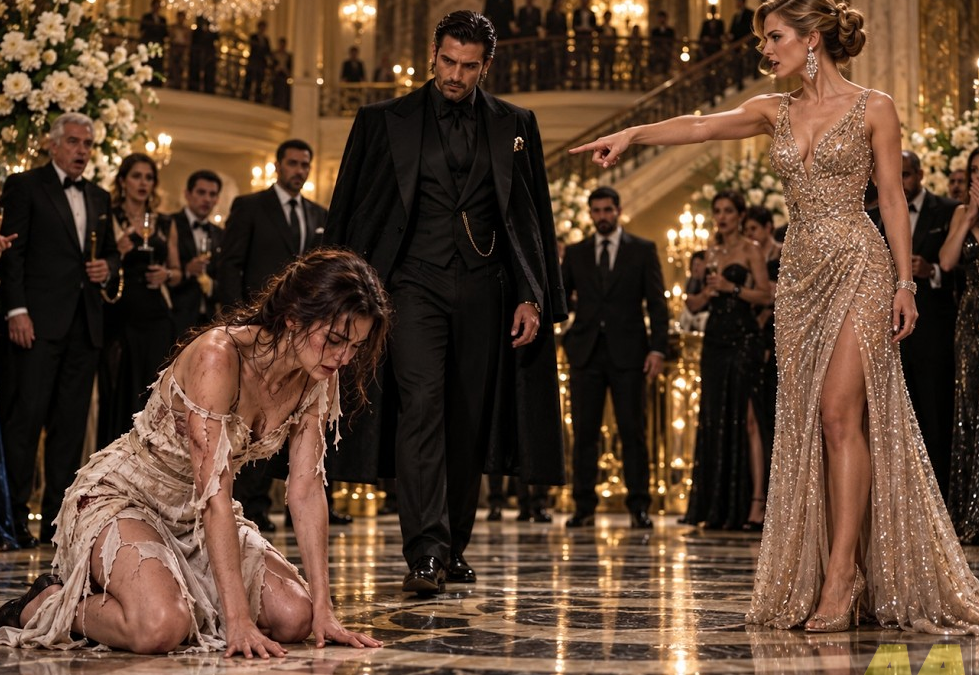
The wine came down before Billy Ror understood what was happening. One second she was walking beside the head table in the Grand Ballroom of the Windmir, balancing a tray with both hands and counting the glasses without looking down.
The next, dark red liquid was running through her hair, across her cheek, down her neck, and over the front of her uniform.
The glass struck the stone floor and shattered. Billy dropped to one knee. A sharp piece caught the palm of her right hand.
Three hundred guests turned toward her. Thirty eight camera lenses lowered. Nobody moved. Standing above Billy was Sabine Voss, the woman whose face had appeared on hundreds of invitations around Boston, still holding the empty stem of the glass.
Her expression was perfectly calm. “You need to learn what you are,” Sabine said. Billy looked down at her bleeding hand, then slowly raised her eyes.
At the back of the ballroom, the service corridor door opened. Rafe Santangelo stepped through.
He was supposed to marry Sabine Voss. He was also the man whose company had been connected to the one question Billy Ror had spent four years trying to answer.
Rafe looked at Sabine. Then he looked at Billy. And for one brief moment, neither of them understood that the other person was about to change everything they believed about the past.
How could a single broken glass uncover four years of hidden records, a secret buried inside one family, and a truth that powerful people had spent years making certain nobody would find?
Nine months earlier, Billy Ror lived by a schedule that allowed almost no room for anything except work.
Her alarm was set for 4:15 every morning, but she almost never allowed it to ring.
She would reach out in the darkness, silence it, and get dressed without turning on the hallway light.
The house in Dorchester was small. Her mother slept in the room beside hers, and Billy had learned which floorboard made a sound and which one stayed quiet.
She left the house before five. Two trains carried her toward the Windmir Hotel, and the banquet shift began at six.
Billy carried trays, arranged chairs, folded napkins, polished candle bases, and cleaned tables. By late afternoon, her legs ached so badly that she sometimes had to sit for a few minutes in the staff corridor before beginning the trip home.
But going home did not mean resting. In the corner of the living room stood an old sewing machine that had belonged to her grandmother.
Billy used it every night. She hemmed trousers for twelve dollars a pair, fifteen when the fabric was difficult.
That week there were thirteen pairs waiting for her. She ate standing in the kitchen.
Then she sewed. Sometimes she worked until midnight. Sometimes until one. Her mother, Deardra, watched from her wheelchair.
A caregiver came six days a week, six hours a day. The cost was nineteen hundred dollars every month.
Billy never said that number aloud. She did not have to. Deardra had kept the household accounts for thirty years.
One night, around eleven, Deardra rolled herself to the kitchen doorway and watched Billy guide another pair of trousers beneath the needle.
After several minutes she asked, “Are you sewing for other people, or are you sewing your own mouth shut?”
Billy looked up. She gave her mother the same polite smile she gave difficult guests at the Windmir.
Then she lowered her eyes and continued working. Deardra never asked the question again. That night, shortly after midnight, Billy ran out of black thread.
She opened the second drawer of the sewing cabinet. Inside were spools of thread, needles, an old envelope, and a thick collection of documents held together with black clips.
Billy looked at the documents for one second. Then she took the thread. She closed the drawer.
She returned to the sewing machine. There were questions in that house that had existed for years.
Neither woman spoke about them. At the Windmir, Billy followed another set of rules. Every Monday morning, Gideon Puit gathered the banquet staff in the employee room.
“Do not look guests directly in the face.” “Do not speak unless spoken to.” “Never argue, even when you are right.”
Then came the sentence Billy had heard so many times that she knew exactly where each pause would fall.
“You do not have opinions here. You have shifts.” Billy always nodded. A nod cost nothing.
Marisol Quantero, the morning supervisor, hated those meetings. She had worked at the Windmir for eight years and knew exactly what the rules were designed to accomplish.
If anything went wrong, the person wearing the uniform would be expected to absorb the blame.
But Marisol kept that opinion to herself. So did everyone else. Except Billy. Billy did not complain.
She watched. Every morning she arrived in the back courtyard before the rest of the staff.
At 5:35 she stood beneath a strip of corrugated roofing near the empty crates and held a cup of coffee she rarely finished.
At 5:40, the food delivery truck arrived. Three minutes later, the linen truck arrived. Then came the waste processing truck.
Billy knew each company name. She knew the logos. She knew the arrival times. She knew the license plate of the waste truck.
She knew the small patch where paint had chipped from its lower left corner. She knew because she had spent months studying them.
All three companies were connected to the same larger organization. Santangelo Provisions Group. Billy had already traced the connection before she ever applied to the Windmir.
She had applied five times. Five times she had been rejected. On the fifth attempt she applied directly to the banquet department.
That time, they hired her. Marisol thought Billy simply needed the work. She did not know Billy had another reason for being there.
Nine months passed. Then came the biggest event the Windmir had hosted that year. It was the closing night of Boston Fashion Week and the unveiling of Sabine Voss’s new collection.
Three hundred guests had been invited. Three cameras had been hired to record the entire evening.
The cameras were scheduled to run continuously from 6:15 until the final guest left. Sabine Voss was the center of the evening.
Her company had become famous for a distinctive beading technique, layers of beads arranged backward across fabric so that the pattern seemed to move against the light.
The new collection used that same design at several price levels. Billy knew that pattern.
She knew it better than almost anyone in the ballroom. At 6:15 the cameras began recording.
At 6:40 the first guests entered. By seven, the room was full. At 7:15 Sabine Voss entered.
Billy was carrying a tray when she saw the dress. She stopped for half a second.
Marisol almost walked into her. “What happened?” Marisol asked quietly. Billy blinked. “Nothing.” She continued working.
But something had changed. At 7:40 Sabine complained about the lighting. At 7:55 she found an error on one place card.
She demanded that all twelve cards at the main table be checked. Three employees knelt beside the table while Sabine watched.
The cameras continued recording. At table nine sat Everett Coyle, a seventy nine year old craftsman who had spent forty four years working with fabric.
He watched everything. When the place cards were finally corrected, Sabine asked for wine. Marisol started forward.
Sabine pointed toward Billy. Billy approached. She poured exactly one third of the glass. Sabine looked at the name tag on Billy’s uniform.
B. Ror. For half a second, Sabine froze. Billy saw it. Then Sabine looked at the glass.
“There is a mark on it,” she said. “I will replace it immediately.” “There is no need to rush.”
After that, every small mistake became Billy’s mistake. The napkin was not sharp enough. The wine was slightly too high.
Billy walked too close behind a chair. Marisol tried three times to replace her. Each time Sabine refused.
At table nine, Everett Coyle stopped eating. Then, at 8:22, Sabine reached for her phone.
Her elbow struck the wine glass. The glass tipped. Wine ran across the table and onto her dress.
Billy was three steps away. She had not touched the glass. Five people saw it happen.
Nobody spoke. Sabine stood. “She spilled it,” she said. Billy looked at the dress. Then at the broken glass.
Then at Sabine. “I am sorry for the inconvenience,” Billy said. “I can bring clean towels and cold water immediately.”
She did not say she had spilled anything. Gideon Puit arrived. He pulled Billy behind a stone column.
“You need to apologize properly.” “I did not knock over the glass.” “I did not ask you whether you did.”
He spoke quietly. He told her that the hotel had spent eleven months securing the event.
He told her there were three cameras recording. He told her to understand what the evening was worth.
Billy looked at him. Then she looked across the ballroom. Marisol was still standing with the tray in her hands.
Everett Coyle was staring at his plate. Three cameras were still recording. Billy stepped back toward the table.
She apologized again. Sabine smiled. Then the service corridor door opened. Rafe Santangelo entered. He was the chairman of Santangelo Provisions Group.
He was also Sabine’s fiancé. He crossed the ballroom without hurrying. Sabine began explaining what had happened.
Rafe walked past her. He walked past Puit. He stopped beside Billy. Billy had stepped backward and caught her palm on a piece of broken glass.
She had fallen to one knee. Rafe removed his jacket. He placed it around her shoulders.
Then he knelt. “Clean towels, cold water, and a first aid kit.” People moved immediately.
Billy looked at him. Rafe held out his hand. He did not grab hers. He simply waited.
After three seconds, Billy placed her hand in his. He looked at the cut. Then he noticed the callus on her index finger.
It was thick from years of handling fabric and guiding cloth beneath a sewing needle.
Rafe had seen a callus like that before. His mother had carried one for thirty years.
He looked at Billy again. “What is your name?” “Billy Ror.” “How long have you worked here?”
“Nine months.” He nodded. Sabine called his name. He did not answer. She called again.
“I am your fiancé.” Rafe stood. Then he faced her. “Being my fiancé does not give you the right to humiliate another person.”
The ballroom went silent. Rafe looked toward the guests. “Who saw the first glass fall?”
No one answered. He looked at Puit. “Does this ballroom have cameras?” Puit hesitated. He said it did not.
Rafe turned toward the documentary crew. “Were the cameras running the entire evening?” Priya, the camera operator, swallowed.
“Yes.” “Did any of them stop?” “No.” That answer changed the room. The footage existed.
The truth had been recorded. Rafe looked at Billy. Then he looked toward the service corridor.
Aldo Turzy stood there. For thirty years, Aldo had worked for the Santangelo family. Rafe lifted one finger.
Aldo understood. He disappeared. Billy was taken to a private room. A doctor treated her hand.
Seven stitches were required. The injury was expected to heal, although some sensation in her finger might take months to return.
Rafe sat across from her. “What do you want?” Billy looked down at her bandaged hand.
“I do not want money.” “What do you want?” “I want a written policy protecting every employee here.”
She explained what the policy needed to say. No guest could touch an employee. No manager could force an employee to accept blame for something they had not done.
No employee who reported an incident could have hours reduced, be reassigned as punishment, or receive a hidden disciplinary note.
And the policy had to apply to everyone. From the dishwashers to the banquet staff to management.
Rafe listened. “Anything else?” Billy looked at him. “Yes.” “What?” “Do not do anything to Sabine because of me.”
He said nothing. Billy continued. “If you hurt someone because I was embarrassed tonight, then I become part of something I do not want to become.”
Rafe studied her. Then he nodded. “All right.” That night changed several things. Before eleven, Santangelo Provisions suspended its food, linen, and waste contracts with the Windmir.
Funding connected to the Second Thread Foundation was frozen pending an independent review. Rafe ended his engagement with Sabine.
The next morning, the Windmir courtyard was empty. No trucks arrived. Then another problem appeared.
An article was published claiming that Billy had contacted Sabine Voss eight times over ninety days two years earlier.
The article gave the dates. It did not publish the messages. It called Billy a stalker.
The story spread. Billy’s mother lost her caregiver. A disciplinary warning suddenly appeared in Billy’s personnel file.
It was dated three weeks before the gala. The system records later showed it had actually been created at 2:14 in the morning after the incident.
Billy changed shifts so she could care for her mother. She worked nights. She came home at nearly two in the morning.
One night she sat on the kitchen floor in darkness. Deardra rolled into the room.
She did not ask whether Billy was all right. She simply took her daughter’s bandaged hand.
They sat together until daylight. Several days later, Rafe came to the house. He brought an envelope.
Inside was enough money to cover years of care for Deardra and treatment for Billy’s hand.
Billy returned it. “If I take this,” she said, “nothing changes.” Rafe understood. “What do you need?”
“I need to know who started that article.” “I will find out.” Then he asked the question that opened the locked door between them.
“How long have you been working at the Windmir?” “Nine months.” “And why did you want to work there?”
Billy looked through the windshield of the car. Then she told him. Her father had worked as a tile setter for forty one years.
Four years earlier, on a March morning, he had been traveling to a job. A truck connected to Santangelo Provisions crossed into his lane.
Billy’s mother had been in the passenger seat. After that morning, she could no longer walk.
Billy’s father was no longer there to support the household. A settlement followed. The amount her family received was twenty two thousand dollars.
Billy had always suspected that the amount was wrong. She had requested insurance records three times.
Each request was denied. She had searched for one number. She wanted to know how much had actually been paid.
That was why she had applied to the Windmir. That was why she stood in the courtyard every morning watching the trucks.
She wanted to see the Santangelo name with her own eyes. Rafe listened. He did not defend himself.
“I did not know,” he said. “I know.” He promised only one thing. He would find out.
Nine days later, the Windmir held a public board hearing. Billy sat beside Marisol. Rafe sat in the last row.
Then Everett Coyle stood. He described everything he had seen at the gala. He described the glass.
He described Sabine’s behavior. Then he opened an old leather briefcase. Inside was a piece of raw fabric.
It contained handsewn beads arranged backward, layered like fish scales turned against their natural direction.
Everett explained that he had kept the fabric for years. He had judged student exhibitions for decades.
This piece had been submitted by a young designer named B. Ror. The date was four and a half years earlier.
Everett looked toward Billy. He said he had never forgotten the work. Then he explained something else.
Sabine Voss’s famous beaded design had appeared eighteen months after that student exhibition. The room became silent.
Billy did not speak. She did not need to. The evidence was sitting on the table.
Other employees stood. Marisol spoke. A kitchen assistant spoke. A coat check attendant spoke. A dishwasher who had worked at the Windmir for twenty one years spoke.
They described incidents nobody had heard about. One after another, people stood because Everett had stood firSt.
By noon, the board had evidence that Billy’s disciplinary warning had been created after the gala, not before it.
Gideon Puit was removed from his position. Nine days later, the independent audit of the Second Thread Foundation concluded.
Only a small portion of the foundation’s budget had reached the young designers it claimed to support.
The remainder had gone toward events, publicity, production expenses, and other costs. Sabine stepped down from the foundation.
Giata Santangelo, twenty six years old, was appointed to lead the new board. Her first decision was to release records concerning rejected student applications.
The Windmir issued the employee protection policy Billy had requested. Four pages. Officially stamped. Given to every employee.
The first line stated that the policy applied to everyone. The dishwashers. The kitchen staff.
The banquet staff. Everyone. But Rafe was still searching. Nineteen days later, he returned to Dorchester.
This time he brought an accounting firm from New York that had never worked with the Santangelo family.
The auditors had reviewed five years of accident and transportation records. The truth was worse than Rafe expected.
The truck involved in the incident four years earlier belonged to his company. The driver was Bertrand Hollis.
Official records said Hollis had received the required rest period. Warehouse records said otherwise. Fuel records said otherwise.
Delivery records said otherwise. Hollis had been behind the wheel for nineteen hours. The driving log had been reconstructed.
The auditors found more than four hundred similar logs involving twenty seven drivers. Then Rafe turned the page.
The insurance company had paid three hundred forty thousand dollars. Billy stared at the number.
Her family had received twenty two thousand. The difference had been moved through several intermediary accounts.
The person who approved the process was Aldo Turzy. Billy sat perfectly still. For four years she had searched for one number.
Now it was sitting in front of her. Then Rafe showed her another page. A payment authorization carried his name.
The signature was supposed to be his. Handwriting analysis showed it was forged. Aldo had signed Rafe’s name on more than two hundred documents during the first years after Rafe took control of the company.
Rafe looked at Billy. “I knew before I came here.” Billy asked why he still said the signature was his.
Rafe answered quietly. “Because it happened under my name.” Nobody spoke for a long time.
The next week, Billy sat in a federal building waiting to give another statement. A man walked out of an interview room.
He was nearly sixty. His name was Bertrand Hollis. He had not driven a truck since the morning that changed Billy’s family.
He sat one seat away from her. He said he had tried to contact her family three times.
He had been told all communication had to pass through the company’s legal department. He said none of his requests received an answer.
Then he told her what happened that morning. He had been driving for nineteen hours.
He had asked to stop. The dispatch office told him that if he stopped, he should not expect to return to work.
He kept driving. He made the wrong choice. Billy listened. For four years she had imagined the person behind that steering wheel as a distant figure.
Now he was sitting beside her. She did not forgive him. She did not promise to.
But she listened. Before he left, Hollis turned around. “I thought you might need to know,” he said.
“Your father did not have time to see anything.” Billy sat alone after he left.
For four years she had searched through documents. Numbers. Signatures. Records. And the first person who gave her something honest had simply sat beside her and spoken.
Three weeks later, Rafe took the complete audit to federal investigators. He turned over the driving records.
The payment records. The forged signatures. The insurance information. Everything. His own company would face financial penalties and five years of judicial oversight.
He accepted that. Aldo Turzy was later indicted. The evidence against him included the forged signatures, the payment transfers, and records showing that he had monitored Billy’s requests for years.
He had known who she was before she ever entered the Windmir. He knew she had applied five times.
He knew she stood in the courtyard every morning. He had believed that as long as she had no documents and no money, she could not reach him.
Then she met Rafe. Everything changed. The Windmir policy took effect at the end of the month.
Employees celebrated in the basement break room. Marisol brought her seven year old son. The boy ran around the table carrying a box of cookies while everyone laughed.
Billy returned to the sewing machine the following month. Her right hand was still not exactly the same.
But the feeling in her index finger had begun to return. She could feel fabric again.
She could hold a needle. One evening, Deardra rolled beside the sewing cabinet. “Open the second drawer,” she said.
Billy did. Her mother told her that she had read the documents inside that drawer for four years.
She knew about the settlement. She knew about the denied requests. She knew about the applications.
Billy asked why she had never said anything. Deardra looked at her. “Because I could not stop you,” she said.
“And I could not help you.” She paused. “I only wanted to know who you would become when you finally found what you were looking for.”
Billy looked at her. “What do you think now?” Deardra reached across the table. “You are still you.”
That was enough. A year later, the Windmir ballroom looked almost exactly as it had on the night everything changed.
The same stone floor. The same tall windows. The same long tables. But something about the room was different.
Billy was now a floor manager. Her hand had recovered enough that she could work with fabric again.
That afternoon, a young employee named Juny Faircloth carried her first tray through the main aisle.
She was twenty one. Halfway across the room, a guest pushed a chair backward. The tray tilted.
Two cups slid toward the edge. Juny froze. “I am so sorry,” she began. Billy reached out and steadied the tray.
“Slow down.” Juny looked at her. “Did I ruin everything?” Billy shook her head. “Mistakes happen.”
Juny took a breath. Billy adjusted the cups. Then she said something she wished someone had told her years earlier.
“No one here has the right to make you feel small.” Juny nodded. She continued walking.
At table nine, Everett Coyle sat with his afternoon tea. He was eighty now. He looked toward Billy.
Seven steps separated them. They nodded to each other. At the far end of the room, a man sat alone with a cup of coffee.
Rafe Santangelo. He had not announced himself. He had not interrupted her work. Billy looked at him for one second.
Rafe looked back. Then Billy returned her attention to the young employee carrying the tray.
Rafe lowered his eyes. Neither of them needed to cross the room. Four blocks away, inside the gallery of the Second Thread Foundation, a small glass display case stood near the entrance.
Inside it was a piece of raw undyed fabric. Across it were handsewn beads arranged backward, layered over one another.
Beside the fabric was a card. The date of the student exhibition was printed on it.
The name beneath the date was Billy Ror. Every year, the foundation now awarded a full tuition grant in her name to a student facing a family crisis.
The grant carried no requirement for public thanks. No speech. No photograph. No obligation. Only an opportunity.
Billy never asked for her name to be placed on the grant. Giata had done it anyway.
And Billy never asked Rafe to visit the Windmir. He came sometimes. Usually alone. Usually he sat at the far end of the ballroom and drank coffee.
The Windmir still had rules. But they were different rules now. Employees could speak. Employees could report.
Employees could say no. And if a person made a mistake, the first response was no longer to ask who could be blamed.
It was to ask what had happened. Billy had spent four years looking for one number.
She had found it. But she had also found something she had never expected. The truth had not arrived all at once.
It had come through a seventy nine year old craftsman who stood when others stayed seated.
Through a supervisor who finally spoke. Through a driver who returned to tell the truth.
Through a man who was willing to open his own company records even when they could damage him.
And through a young woman who, after everything that had happened, still refused to become cruel simply because cruelty had once been used against her.
On another afternoon, Billy stood beside the sewing machine at home. Deardra sat nearby. Sunlight entered through the kitchen window.
Billy guided a piece of fabric beneath the needle. The machine moved steadily. Her mother watched.
For years, that sound had meant exhaustion. Now it sounded different. It sounded like work that belonged to Billy.
Not work forced upon her. Not work done to survive one more week. Work she had chosen.
Deardra smiled. Billy looked up. Neither woman said anything. They did not need to. Outside, a delivery truck passed on the street.
Billy heard it. For a moment, she stopped sewing. Then she looked at her mother.
Deardra nodded. Billy smiled. She lowered the needle. And the machine began again.
Disclaimer: This content may be created by Al for entertainment purposes. Any resemblance to real persons, events, or places is coincidental.








