A Girl Bought 500 Dead Car Batteries for $200 — Soon, Auto Shops Were Calling Her Back
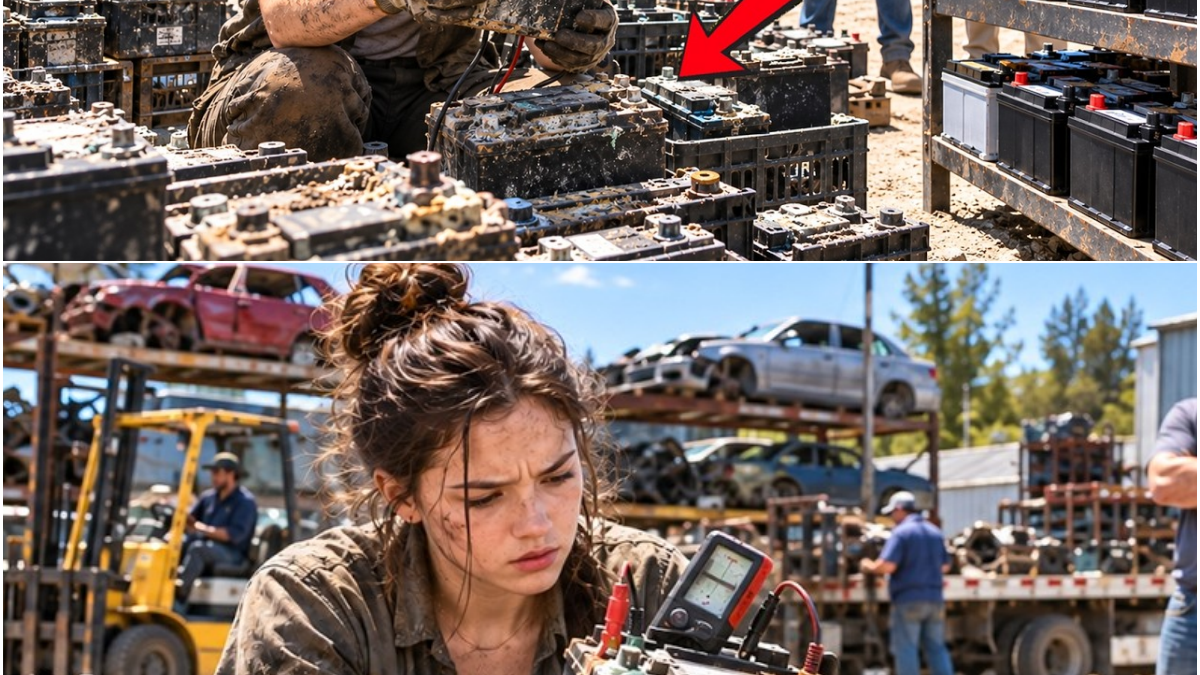
The scrapyard sat at the edge of Bracken Ridge, Pennsylvania, on a flat stretch of gravel between the river and an old rail spur.
On a gray Tuesday morning in October, the ground was still soaked from weeks of rain, and the air carried the sharp smell of rust, mud, and old machinery.
Near the office trailer, Sal Marquaretti stood counting two hundred dollars in mostly twenties, licking his thumb between bills as though he expected the young woman in front of him to have made a mistake.
A satisfied grin rested on his face. He believed he had just made a deal with someone who did not yet understand what she was buying.
“You sure about this?” He asked. “Twenty dollars,” Frankie Noak answered. “For all five hundred.”
She was nineteen, five feet six, with dark hair tucked beneath a pirate’s cap whose brim had faded soft and gray.
Her canvas jacket was two sizes too large, an old piece of clothing that had belonged to her father.
Her hands were already rough from work, and her expression was calm enough to make people assume she was easily persuaded.
Sal had made that mistake before. Frankie had learned not to let other people’s assumptions decide what she could do.
He pointed toward the far corner of the yard, past the crushed cars and the mountain of tires.
Five hundred old car batteries lay stacked in milk crates and scattered across the gravel.
Their cases were stained, their terminals covered in white corrosion, and several had swollen from years of neglect.
Every shop in the area had rejected them. Sal wanted the pile gone, and Frankie wanted what was inside it.
To him, she had bought a hazardous mess for two hundred dollars. To her, the heap represented a possibility no one else had bothered to investigate.
But how much value could really be hiding inside five hundred batteries that an entire town had already given up on?
Frankie had not arrived at that scrapyard because she had a comfortable life or a carefully prepared business plan.
She had arrived because the ordinary ways of earning money had stopped working. Her mother had been gone since Frankie was eleven.
There had been no single moment that explained the change, only fewer phone calls, longer silences, and the gradual disappearance of someone who had once been part of every day.
Her father worked pipeline crews in Ohio and Oklahoma. He sent money when he could and called on Sundays when he remembered, though those calls had become less regular.
The daily responsibilities had fallen to Frankie. Her household included her thirteen year old brother, Petey, a restless boy with elbows that seemed to grow faster than the rest of him, a constant appetite, and an endless interest in video games.
Their grandmother, Beia, was seventy one. She had raised children of her own, knew how to manage a household, and still attended the Thursday night card game at the fire hall.
She was sharp tongued, practical, and determined not to complain about how much energy another round of raising children required.
Beia’s detached garage on Fifth Street had once belonged to her husband. It had a single bay and a hand cranked door that stuck whenever the weather turned wet.
Since he was no longer around to use it, the building had become a storage place for paint cans, an old card table, and a workbench covered in duSt. Frankie began seeing it differently.
She had already gone through three jobs in eight months. The diner reduced her hours.
The warehouse closed. Cleaning offices at four in the morning brought in barely enough money to justify the exhaustion.
She was not looking for a grand opportunity. She was looking for something that could keep the lights on, put food on the table, and give Petey a little more security.
The idea came from an old magazine article she had read while waiting at a free clinic during Petey’s checkup.
It described a man in Ohio who rebuilt forklift batteries for a living. The details were brief, but one part stayed with her.
Batteries that seemed useless could sometimes be restored, tested, and sold again. Frankie began reading everything she could find.
She did not have a teacher or an experienced technician guiding her. She had a cheap internet connection, a secondhand computer, and a determination that made it difficult to stop when something did not make sense.
She studied battery engineering documents, repair discussions, and the experiences of hobbyists who called themselves reconditioners.
At night, while Petey slept, she searched for answers and filled notebooks with unfamiliar terms.
The central idea was simple enough to remember but complicated enough to take months to understand.
A lead acid battery could lose its usefulness without every part of it being ruined.
One common problem was sulfation. When a battery remained discharged for too long, lead sulfate crystals could harden on the plates inside it.
Those crystals reduced the surface available for the chemical reactions that produced electricity. The battery might show a very low voltage or fail to start an engine even when much of its internal material remained usable.
If the damage had not progressed too far, the battery might respond to a carefully controlled charging process.
Frankie understood that the possibility was not a guarantee. Some batteries were genuinely beyond recovery.
Her first task would be learning to tell the difference. The garage became her classroom.
She spent twelve dollars on an inexpensive analog multimeter and another eighteen on a load tester from Doug Reinhold’s auto parts counter.
The equipment was basic, but it gave her a way to move beyond guesses. She began collecting batteries from friends and neighbors, examining their cases, checking their voltage, and writing down what happened when she tried to charge them.
The first battery she attempted from Sal’s pile was among the least promising. Its terminals were heavily corroded, its surface was dirty, and its voltage was barely two volts.
A healthy, fully charged automotive battery would normally rest near twelve point six volts. This one appeared useless by every ordinary measure.
Frankie connected a charger at its lowest setting and left it alone. She checked it after an hour.
The voltage had climbed to four. Over the next hour, it rose again, first to six and then to nine.
By midnight, the meter showed twelve point six volts. From the back door, Beia called out that if Frankie caused trouble with the house, she would be the one paying to fix it.
Frankie barely heard her. She was staring at the meter. The battery had responded. It had not yet proven that it could start an engine, but the first result was enough to keep her working.
The pile in Sal’s yard no longer looked like a collection of failures. It looked like a collection of questions.
She learned to sort before she charged anything. A cracked case was a clear rejection because the acid inside could leak.
A battery with a shorted cell was another problem. Each battery contained six cells, and a damaged cell could prevent the whole unit from functioning properly.
Reverse polarity and signs of serious internal damage were also reasons to stop. Frankie separated questionable batteries into different crates.
Those that could not be restored might still have value as scrap because of the lead inside them.
A typical automotive battery contained substantial lead plates, and scrap yards paid for that material by weight.
The exact price changed with the market, but even a ruined battery could sometimes recover part of its purchase coSt.
The remaining batteries went to her recovery line, which was initially nothing more than three sawhorses, an extension cord, and a workbench that had not been used properly in years.
Her early attempts were far from perfect. One of her first serious mistakes involved the electrolyte level.
Flooded lead acid batteries require the correct amount of distilled water to keep their plates covered.
Frankie had read that much, but she had not fully understood how the liquid level could change during charging.
She filled one cell almost to the rim before starting a charge cycle. As the battery charged, the electrolyte expanded and began to bubble.
Eventually, one cell overflowed. Diluted sulfuric acid splashed across the bench and damaged her jeans, leaving small holes in the fabric.
The experience changed the way she worked. She began wearing protective equipment consistently and keeping baking soda nearby for accidental acid spills.
She learned that goggles, gloves, and proper clothing were not optional parts of a battery shop.
They were part of the job itself. Another mistake came from trying to make a slow process move faster.
Some heavily sulfated batteries required long, controlled charging cycles. Frankie had read about desulfation methods that used low current over extended periods, sometimes lasting twenty four or thirty six hours.
She wanted to move more batteries through the garage, so she increased the charging current on one stubborn unit.
The battery became hot. Instead of recovering, it suffered additional damage. By morning, it would not hold more than four volts.
Frankie wrote a sentence on a piece of cardboard and taped it above the bench.
“Slow is the whole trick.” The words stayed there as a reminder that rushing could destroy the very value she was trying to create.
Her third important mistake involved a customer. Before she had a real business, she sold a reconditioned battery to a neighbor for ten dollars.
She had checked its resting voltage and believed it was ready. But a battery could show a good voltage while still failing under the demands of an engine.
The neighbor installed it in his lawn tractor. When he tried to start the machine, the battery failed.
He was not furious. The sale had been inexpensive, and he understood that Frankie was learning.
But she understood the problem more clearly than ever. A charged battery was not necessarily a good battery.
She needed to test how much current it could deliver under load. She upgraded her equipment and began using a proper load tester.
The device applied a substantial electrical demand and showed whether the battery could maintain its performance.
She also added a hydrometer, which measured the specific gravity of the electrolyte in each cell.
A fully charged cell would generally show a reading around 1.265, though temperature and battery condition mattered.
Uneven readings could reveal trouble that a simple voltage check might miss. Frankie began recording every result.
She tracked the initial voltage, the response to charging, the electrolyte readings, and the final load teSt. She noted which batteries recovered quickly and which remained weak.
She learned that two batteries with identical cases and similar resting voltage could behave very differently when tested properly.
The garage also needed to be safe. Lead acid batteries could release hydrogen during charging, particularly near the end of a cycle.
In an enclosed space, accumulated hydrogen could become dangerous if exposed to a spark. Frankie kept the garage door open, used a fan to improve ventilation, and established rules about smoking and electrical equipment near the charging area.
Beia’s African gray parrot, Judge, became an unexpected part of the operation. Beia had won him in a card game two winters earlier.
Judge was intelligent, loud, and full of opinions. Frankie insisted that he remain in the house, well away from battery fumes and the workbench.
From the front office, however, Judge could hear the sounds of the garage. Over time, he learned to imitate the beep of Frankie’s load tester.
He also developed a habit of shouting “Good” or “Dead” at random moments, usually when someone was standing close enough to be startled.
Beia claimed the bird could recognize every customer by the sound of their footsteps. Frankie suspected Judge simply enjoyed making people nervous.
The first meaningful sale came through Reggie Palumbo, who operated a two bay repair shop on Route 28.
Reggie had been struggling with the cost of new batteries. Wholesale prices were high, and customers were reluctant to pay much more than the shop’s purchase price.
Frankie heard about his complaints at the diner and decided to approach him. She loaded three reconditioned Group 24 batteries into Beia’s old Buick and drove to his shop.
Each had been tested, and she offered them for twenty five dollars apiece. Reggie looked at her equipment, then at the batteries, and then back at her.
He was skeptical, but not unreasonable. He had seen cheap parts fail and understood that a low purchase price did not help if a customer returned with a problem.
He agreed to try one. A customer installed it in a Chevrolet Cavalier. Reggie expected to hear from the driver within a few days.
A week passed. Then another. No complaint arrived. Three weeks later, Reggie bought four more.
Six weeks after that, he mentioned Frankie’s batteries to Carl, who ran a transmission shop two towns over.
Carl came to Beia’s garage himself. He watched Frankie perform a load test, checked the readings, and bought six units.
The business began to grow, not through advertising but through mechanics talking to mechanics. People who repaired cars every day were more interested in dependable equipment than in a polished sales pitch.
When something worked, they told the next shop. Doug Reinhold was less interested. He had sold reconditioned batteries years earlier from a traveling wholesaler.
Many of those units had failed within three months, leaving him to deal with unhappy customers.
He did not want to put his own name behind a product he could not control.
When Frankie asked if he would carry a few batteries on consignment, Doug refused. “I’m not putting my name on somebody else’s problem.”
Frankie understood his concern. She had already learned how quickly one failed battery could undo several successful sales.
She would have to prove that her work was different, and she would have to do it consistently.
By the following spring, she was reconditioning close to sixty batteries a month. Sal had started selling her old cores for a nickel apiece because he was glad to have someone remove them from his yard.
Frankie could restore perhaps forty out of every sixty. The others went into the scrap stream.
For a while, the numbers looked promising. She bought low, restored what she could, and sold the finished batteries for twenty five to thirty dollars.
The scrap lead from the unusable units helped cover the cost of the failures. Then the market encouraged her to take a risk.
Scrap lead prices rose sharply. For a time, the value approached a dollar a pound, nearly twice what Frankie had seen the year before.
She began buying batteries in larger quantities, not only from Sal but from two other yards and a towing company that had accumulated its own pile.
The reasoning seemed straightforward. She could restore the useful batteries and sell the damaged ones for their metal.
Even if the restoration business slowed, the scrap would protect her investment. She spent nearly four thousand dollars on cores, using savings and borrowing a little from Beia’s card winnings.
The batteries filled every available corner of the garage. She imagined the additional inventory turning into steady income.
Then the lead market changed. A major overseas buyer reduced its purchases, while a domestic recycler increased the amount of material it was selling.
Within six weeks, the scrap price fell from near a dollar a pound to around forty cents.
The value Frankie had counted on disappeared before she could move the batteries. At almost the same time, she made a second mistake.
She had become impatient with the pace of reconditioning and needed money coming in. She began selling some batteries that tested weak but seemed acceptable.
She did not clearly distinguish them from her stronger units, and she charged customers the same price.
Three failed within two weeks. One stopped working in a customer’s car on a cold morning in a parking lot.
Reggie called Frankie that afternoon. He was not shouting, but the disappointment in his voice was unmistakable.
“I put my name behind these,” he said. “You have to tell me which ones are good and which ones are just okay.”
Frankie had no answer that would make the problem smaller. That night, she sat at Beia’s kitchen table with the books spread in front of her.
Judge muttered from the next room, making sounds that might have been words or might have been his usual commentary.
Petey was asleep, and the house was quiet except for the occasional movement of the old refrigerator.
Frankie added the numbers again. She had a large quantity of batteries that were not ready to sell and were worth much less as scrap than she had expected.
Her cash was tied up. Her customers had begun to question her judgment. The business had been built on trust, and she had weakened that trust by treating batteries like interchangeable merchandise.
The next morning, she began rebuilding the operation around a different principle. No battery would leave the shop without a grade.
From then on, every unit received a complete inspection and testing process. Frankie checked resting voltage, measured specific gravity in each cell, and performed a load test to establish its actual cranking performance.
She compared the results with the battery’s original rating and separated the finished units into three categories.
Premium batteries had to test above ninety percent of their original cranking amps. They would sell at full price and include an eighteen month replacement warranty.
Standard batteries had to fall between seventy and ninety percent of the original rating. They would be clearly labeled, priced ten dollars lower, and carry a ninety day warranty.
Anything below seventy percent would not be sold as a working battery. It would go into the scrap crate, regardless of the current price of lead.
Frankie also stopped buying truckloads simply because they were available. She had to rebuild her cash flow and earn back the confidence of her customers.
The extra inventory would take time to process, and she would not let it force her into another rushed decision.
The biggest change was the core exchange program. Instead of asking customers to buy a reconditioned battery as though it were an ordinary retail product, Frankie offered a simple exchange.
A customer could bring in a failed battery, pay a set fee, and leave with a tested, warrantied replacement.
The premium exchange cost forty dollars. The standard exchange cost thirty. Frankie kept the returned core.
If it could be restored, it went through the recovery line. If it could not, it was recycled.
The system gave her a steady supply of batteries without requiring her to gamble on large purchases.
It also gave customers a reason to return to her shop. They knew what they were receiving, and they knew what would happen if it failed.
The warranty became the center of the business. It was not just a promise printed on a receipt.
It was a statement that Frankie had tested the battery carefully enough to stand behind it.
Reggie watched the new system closely. For three straight months, none of the graded batteries he bought failed.
He increased his orders to fifteen a month and began paying on regular terms. That consistency gave Frankie something she had not enjoyed before: the ability to plan.
Carl’s transmission shop followed. A used car lot on the edge of town began buying twenty batteries a month because it needed dependable units for its inventory vehicles.
Frankie’s customers were no longer simply people looking for the cheapest battery. They were people who wanted a fair price and a clear understanding of what they were buying.
By the second full year, Beia’s garage was no longer large enough. Frankie took over a shuttered muffler shop on Third Street.
It had two proper service bays, room for storage, and enough space to install a ventilation system that met the requirements of the work.
The box fan and cinder block were no longer the foundation of her safety plan.
A sign went up outside. “Noak Battery and Core.” Frankie hired her first employee that year.
Dez Coleman had recently been laid off from the glass plant after it cut its second shift.
He was a large, careful man with steady hands and a patient manner. Frankie recognized that patience as a valuable skill.
She had learned the hard way that battery work rewarded people who paid attention and resisted the urge to rush.
She trained Dez on the sorting process, the hydrometer, the load tester, and the controlled charging cycles.
She showed him how to record every reading and how to reject a battery that did not meet the shop’s standards.
Above each bench, the rules were written clearly. “Slow is the whole trick.” Dez added his own reminder.
“Test it anyway.” Within eighteen months, four people were working on the floor. The shop was processing around four hundred batteries a month.
Roughly two hundred and eighty were sold as premium or standard units, either through direct sales or exchanges.
The rest were recycled for lead, but scrap had become a small part of the operation rather than the foundation of its income.
The business had grown because Frankie had stopped trying to make every battery valuable. Instead, she concentrated on identifying the ones that could be trusted.
One evening, Beia sat at the kitchen table with Frankie’s latest figures and a pencil.
She had been helping with the books since the earliest days, and she understood the difference between money coming in and money actually remaining after expenses.
She checked the totals once, then again. “Frankie, we’re clearing better than eleven thousand dollars some months.”
For a moment, neither of them spoke. Frankie looked at the figures and thought about the two hundred dollars she had handed Sal.
She remembered the first battery on the workbench, the needle rising slowly while the garage door stood open and Beia shouted from the house.
She had been excited then, but she had not understood how much work stood between a promising reading and a reliable business.
Now the numbers were real. They paid the bills, supported the household, and allowed Frankie to think about the future without measuring every decision against the next grocery trip.
Sal Marquaretti had changed, too. The man who once counted her money with a knowing grin began setting aside every old battery that came into his yard.
Instead of sending them all to scrap, he called Frankie when he had a couple hundred stacked.
He asked how the process worked and why some batteries responded while others did not.
Frankie explained it to him. By then, she was willing to talk openly about the work.
Her advantage was not a secret chemical or a mysterious trick. It was careful sorting, controlled charging, reliable testing, and the willingness to reject anything that failed her standards.
Doug Reinhold remained the last holdout. Frankie did not blame him. He had a reason to be cautious, and he had seen the damage that unreliable reconditioned batteries could cause to a shop’s reputation.
It was Reggie who finally changed his mind. One afternoon, Reggie brought a Noak premium battery to Doug’s counter and asked him to test it himself.
Doug connected the load tester and watched the needle. It stayed in the green. He checked the battery again, examined the case, and looked over the readings.
He was not convinced by one test alone. He checked another unit later and asked Reggie how long the first one had been in service.
A month passed. Then another. The battery continued to perform. Doug eventually placed an order.
He began stocking Noak premium units beside the new batteries on his shelves. Their lower price attracted customers, but their testing records and warranty gave him a reason to recommend them.
Before long, people came into his shop asking for Frankie’s batteries by name. The same mechanics who had once dismissed the idea of a nineteen year old running a reconditioning operation were now calling to ask when the next pallet would be ready.
Some apologized for their early doubts. Others acted as though they had always expected her to succeed.
Frankie did not correct either group. She had work to do. The moment she remembered most clearly came on an ordinary Tuesday afternoon, about a year and a half after the exchange program began.
Petey was sixteen by then and tall enough to look her directly in the eye.
He had started working at the front counter after school for pocket money. A garage two towns over called with a wholesale order.
Petey answered the phone, confirmed the account, wrote down the quantity, and read the total back to the customer without hesitation.
Eighteen premium units. A standing account. Net fifteen terms. Frankie stood in the doorway of the bay holding a hydrometer.
She watched her younger brother finish the call, organize the paperwork, and put the order in the right place for the floor crew.
The batteries that had once been called garbage were now part of a regular business relationship.
The boy who had eaten through the household groceries and spent his evenings playing games was helping manage a company that had grown out of his sister’s stubborn curiosity.
Frankie did not interrupt him. She did not need to tell him she was proud.
Petey had heard enough of her encouragement over the years to understand what the moment meant.
The shop kept growing, but Frankie refused to let growth replace discipline. Every battery still received the same basic tests that had begun on Beia’s workbench.
Resting voltage showed whether it had charge. The hydrometer helped reveal the condition of each cell.
The load tester showed whether it could deliver current under pressure. She knew that a battery could look clean, measure well at rest, and still fail when a driver turned the key.
She had built her business by refusing to trust appearances. She would not abandon that principle simply because the shop had more employees, more customers, and a steady stream of orders.
The old cardboard sign followed her through every stage of expansion. Its corners curled, and the writing faded, but it remained above the first bench.
When Frankie moved equipment to the Third Street shop, she brought it with her. She hung it where every employee could see it.
“Slow is the whole trick.” The words were no longer only about charging. They were about the entire business.
Sorting carefully took time. Recording results took time. Explaining grades to customers took time. Offering a warranty meant accepting responsibility for the occasional failure.
Frankie had learned that the quickest way to lose a customer was to pretend that a battery was better than it really was.
Dez understood the lesson. He became one of the most dependable people in the shop, and his careful habits helped the business maintain its standards as the volume increased.
He never treated a successful test as permission to skip the next one. Judge remained in the front office, far from the charging benches.
He outlasted two shop cats through one particularly difficult winter and continued supervising deliveries from the window.
He insulted at least one wholesale buyer directly and greeted the beep of the load tester with his familiar shout.
“Good!” Then, without warning, he would yell, “Dead!” New customers still jumped when they heard him.
Regulars barely looked up. Beia continued bringing the story to the Thursday night card game.
Each time she told it, she added a detail or improved the timing. The story of Frankie’s first purchase had become part of Bracken Ridge’s local history.
People remembered the young woman in the oversized jacket, the mountain of batteries, and the two hundred dollars Sal had counted so carefully.
There was another Saturday that Beia especially enjoyed retelling. A delivery truck had backed up to the Third Street shop carrying a pallet of new batteries that Doug Reinhold had ordered by mistake.
The driver, confused about the address, asked a counter worker where the Noak place was.
The worker pointed toward the shop around him. “You’re standing in it.” Beia always laughed at that part, even though the details changed a little every time.
Small towns remembered the shape of a story long after the exact facts became difficult to separate from the telling.
For Frankie, the important part was not that the town had finally recognized her. It was that the business had become useful.
Mechanics could offer customers a dependable alternative. Drivers could replace a failed battery without paying the full price of a new one.
Old cores no longer had to sit forgotten in yards when some of them could be restored and returned to service.
The scrap market still rose and fell. Frankie watched it, but she no longer built her future around it.
She knew that the price of lead could change for reasons far beyond anything she could control.
Her business depended instead on a process she could manage and a reputation she had earned one test at a time.
The original five hundred batteries were long gone from Sal’s yard. Some had returned to the road.
Others had been broken down and recycled. The first battery that climbed from two volts to twelve point six had long since left Frankie’s hands, but she never forgot the sight of the needle moving.
That first result had not made her an expert. It had given her a reason to learn.
The mistakes that followed had taught her what enthusiasm alone could not. The failed customer battery had shown her the difference between a hopeful reading and a reliable product.
The falling scrap price had shown her the danger of depending on a market she could not control.
The three warranty failures had shown her that trust could be damaged faster than it could be earned.
Each lesson changed the business. By the time Frankie was running the busiest battery reconditioning shop in the county, she understood that the real value of her work was not simply bringing an old battery back to life.
It was knowing which batteries could be trusted, which ones needed a lower grade, and which ones should never be sold as working units at all.
She had started with a pile everyone else wanted removed. She had built a business by asking a question that nobody else in the yard had bothered to ask.
What if these batteries are not finished? The answer had taken years of careful work.
It had required mistakes, patience, better equipment, honest records, and the courage to tell customers when a battery was not good enough.
It had also required people who were willing to give her a chance, from Reggie and Carl to Dez and eventually Doug.
The two hundred dollars Sal had accepted was a small amount compared with what the shop eventually earned, but Frankie never thought of it as the moment she had outsmarted him.
The purchase mattered because it gave her a starting point. The real achievement was everything she built after she carried those batteries away.
A town can decide that something is worthless because it no longer works in the condition it has been left.
Sometimes that judgment is correct. Sometimes it is simply a reason not to look any closer.
Frankie had learned to look closer. And every time a driver turned a key, heard an engine start, and drove away with a battery that had once been headed for the scrap pile, the lesson was repeated.
What people throw away and what they are willing to buy back may be closer together than they ever imagined.
Disclaimer: This content may be created by Al for entertainment purposes. Any resemblance to real persons, events, or places is coincidental.








