A Cowboy Let An Apache Stranger Stay The Night—By Morning, Nothing Was The Same
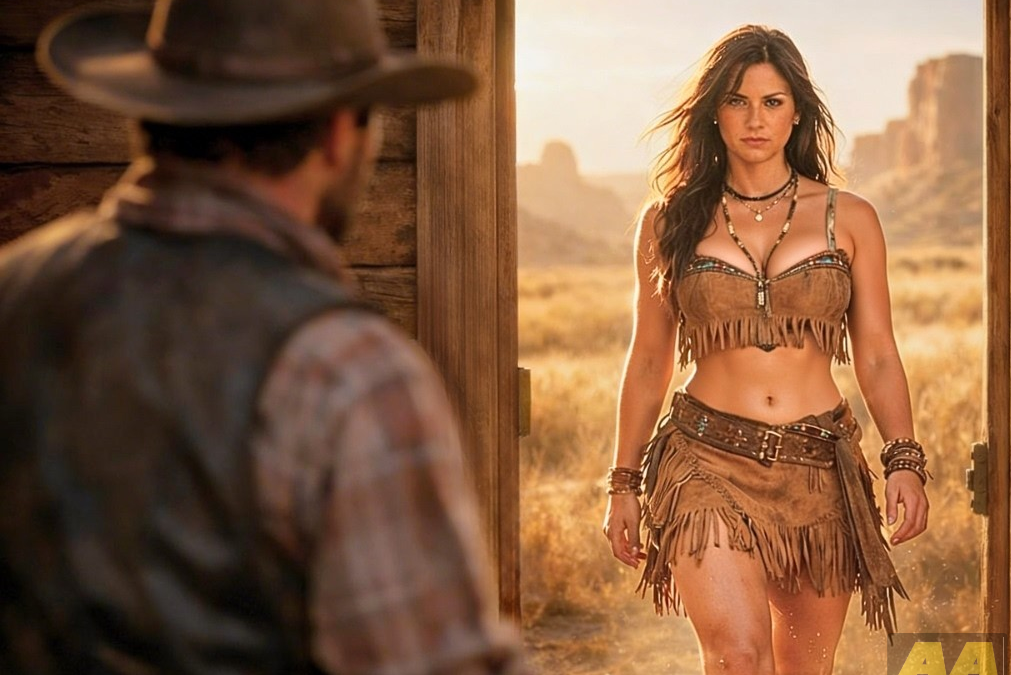
I was digging a hole when she arrived. Rain hammered the Arizona desert so hard that the red earth seemed to melt beneath my boots.
Water ran through the yard in narrow streams, carrying loose stones and pieces of broken wood toward the wash.
My shovel struck the ground again, then again, while thunder rolled across the mountains. I had spent three years trying to make my cabin a place where the past could not reach me.
That night, the past came walking through the storm. The cabin door stood open. I had never left it open.
I dropped the shovel and reached for the Colt at my hip. Lightning flashed across the desert, revealing the porch for one bright instant.
A woman stood beneath the doorway, soaked from head to toe, her long black hair hanging against her shoulders.
She held a knife loosely in one hand. She did not run. She did not beg.
She simply watched me approach. I stopped several yards away and raised the Colt. She lifted her chin.
Then she spoke in a calm voice that somehow carried through the storm. “I just escaped three men who were hunting me.
If you turn me away, they will find me before morning. If you let me stay, they may find you too.”
I should have told her to leave. Instead, I asked, “Who are you?” Her eyes never left mine.
“My name is Kaia. And your name is Elijah Stormwalker, isn’t it?” How could a stranger in the middle of the Arizona desert know my name?
And why had she come to my cabin on the one night when I had nowhere left to hide?
I lowered the Colt only slightly. “Drop the knife.” She looked at the weapon in her hand, then back at me.
“No.” “You are standing on my porch.” “And you are pointing a gun at me.”
“That is because you arrived carrying a knife.” “That is because I have learned not to walk through the world unprepared.”
There was something about the way she said it that made me believe her. I stepped backward.
“Come inside.” She entered without another word. I shut the door against the storm and slid the wooden bar into place.
For a moment neither of us moved. Rain struck the roof while wind pushed against the walls.
Kaia walked toward the fireplace. I tossed her a towel. She caught it and carefully wiped the knife clean before doing anything else.
Only when the blade was spotless did she place it beside the hearth. That told me enough.
The knife was not a decoration. “You want coffee?” “Yes.” I poured two cups and placed one in front of her.
She wrapped both hands around it. “You are half Apache,” she said. I looked at her.
“Who told you that?” “My father.” “Who is your father?” She studied me for several seconds.
“Chief Nahuel.” The cup nearly slipped from my hand. Nahuel had raised me after my mother died.
He had found me when I was three years old and treated me as his own son.
He taught me to ride, track, hunt, and survive. When I was sixteen, I left.
I never returned. “Your father was Nahuel?” “Yes.” She looked at me with something between anger and recognition.
“He talked about you.” “What did he say?” “That you were the boy he loved like a son.”
I looked away. “I did not abandon him.” “You left.” “I was sixteen.” “You never came back.”
I had no answer. She reached into her dress and pulled out a small leather pouch.
From it she removed a handmade book. “My father kept records.” She opened it. Names covered the pages.
Some were crossed out. Others were surrounded by notes, dates, places, and descriptions. “What is this?”
“The people responsible for what happened to my father.” I looked at the first page.
One name stopped me. Sheriff Marcus Webb. My old employer. The man who had given me my badge ten years earlier.
The man who had told me Mary and Emma had been taken by typhoid fever three years ago.
I stared at the name. “Why is Webb here?” “Because he helped arrange what happened to your family.”
I shook my head. “That is impossible.” Kaia opened another page. At the top was another name.
Judge Silas Thornfield. Mary’s father. The man who had paid for our wedding. The man who had held Emma on his knee.
The man who had stood beside me when Mary was buried. “No,” I whispered. Kaia watched me.
“My father discovered that Thornfield had been stealing Apache land for years. Mary discovered it too.”
“Mary was not investigating land.” “She was.” “She was at home.” “She was protecting you.”
I stood so quickly the chair fell backward. “You do not know my wife.” “I know what she found.”
Kaia opened the leather book again. She showed me records of forged land agreements, payments to officials, altered documents, and names of people who had been pressured into silence.
Then she showed me something else. A letter. Mary’s handwriting. My hands shook as I unfolded it.
My dearest Eli. If you are reading this, then something has happened to me. My father is not the man you believe him to be.
I have discovered what he has been doing to Apache families. I have found records proving that land agreements were forged and water rights were taken through deception.
If I cannot finish this, you must protect the truth. Protect Emma. I love you.
I read the letter twice. Then I looked at Kaia. “Where did you get this?”
“My father had copies of many documents.” “What happened to him?” “He tried to expose Thornfield.”
Her voice became quieter. “He did not get the chance.” I closed my eyes. For three years I had believed that everything had been an unfortunate chain of events.
Now I understood that someone had been arranging those events. Someone had wanted the truth buried.
Kaia reached into her bag again and removed a thick leather ledger. “This is why my father was targeted.”
I opened it. Inside were land records, financial accounts, photographs, names, dates, and correspondence. The pages connected powerful men across Arizona territory.
Sheriffs. Judges. Land agents. Businessmen. Officials. At the center of it all was Silas Thornfield.
“This could expose him,” I said. “That is why he wants it back.” “How many people know about it?”
“Enough.” “Then why bring it here?” “Because I needed someone I could truSt.” I looked at her.
“You do not know me.” “My father did.” That answer stayed with me. Before I could say anything else, horses sounded outside.
Kaia immediately moved toward the window. “How many?” “Six.” I took down my Winchester. She picked up her revolver.
The storm had hidden the riders until they were almost upon us. Then a voice came from outside.
“Elijah Stormwalker.” I looked at Kaia. She shook her head. The voice continued. “Hand over the woman and this ends peacefully.”
I almost laughed. “Do you believe that?” “No.” “Neither do I.” Gunfire struck the cabin.
Wood splintered from the walls. We dropped behind the table. Kaia moved with astonishing speed.
She fired through a gap in the shutters. One rider fell from his horse. The others scattered.
A second burst of gunfire struck the cabin. “They will try the back,” she said.
I moved toward the rear window. She covered the front. The attack became a contest of patience.
The riders expected panic. They did not expect two people who understood how to wait.
One man approached the roof. I heard him above us. Kaia looked at me. I pointed toward the chimney.
She understood. A moment later, the man retreated from the roof. Another tried the rear entrance.
Kaia stopped him before he could enter. The remaining riders finally withdrew into the storm.
Silence returned. Kaia found a folded telegram among the supplies they had dropped. She opened it.
I read the message over her shoulder. Kill the Stormwalker woman. Silence her before she talks.
Thornfield wants this ended tonight. I stared at the words. “He ordered them.” “Yes.” I looked around the cabin.
There was no going back. “What do we do now?” Kaia folded the telegram. “We find Sheriff Webb.”
“And then?” “We make him tell us everything.” I picked up Mary’s letter. “No more hiding.”
We left before dawn. I took the horses we had and packed what little remained.
Kaia carried the ledger. I carried Mary’s letter. We rode north toward an abandoned Apache camp where she believed we could find fresh horses.
The rain followed us for hours. At sunrise we reached a narrow canyon and stopped.
We rested for two hours. Inside a shallow cave, Kaia opened the ledger again. She showed me records proving that land had been taken through forged agreements.
She showed me water rights that had been transferred without the knowledge of the families who depended on them.
She showed me correspondence between Thornfield and Webb. Then she showed me a photograph. Mary.
She was standing on our porch with Emma. Under the photograph was an official record.
Mary Thornfield Storm Walker. Risk level high. Discovery of unauthorized records. Recommended action terminate. Authorization, Judge Thornfield.
Execution, Sheriff Webb. Method, poisoned water presented as illness. Collateral, daughter Emma, age six. Status, completed December 15th, 1880.
I could not breathe. Kaia closed the ledger. “I am sorry.” I walked outside. The desert was silent.
For three years I had blamed illness. For three years I had believed I had failed to protect my family from something beyond my control.
Now I knew someone had deliberately taken them from me. I looked toward the mountains.
“We find Webb.” “Yes.” “And Thornfield.” “Yes.” “We do not become like them.” Kaia studied me.
“That sounds different from what you said last night.” “I have changed my mind.” She nodded.
“My father used to say patience was the hunter’s greatest weapon.” “Mine taught me the same.”
We continued toward Copper Ridge. Three days later, the town appeared below us. Copper Ridge was small, dusty, and crowded around the mine.
Sheriff Webb had been stationed there after the Clearwater incident. Kaia studied the town through a small telescope.
“He is not here.” “Where?” “Thornfield’s estate.” “Who told you?” “One of the deputies.” I looked down at the town.
Then I saw a man enter the saloon. He wore a United States Marshal badge.
He was tall. Dark haired. Broad shouldered. His face looked strangely familiar. I entered the saloon alone.
The marshal saw me immediately. He walked to my table. “Mind if I sit?” “The chair is free.”
He sat. For several seconds he said nothing. Then he spoke. “You are Elijah Stormwalker.”
My hand moved toward my Colt. His hand moved faster. A pistol appeared beneath the table.
“Do not,” he said quietly. I stared into his eyes. Something about his face pulled at an old memory.
“Who are you?” “Cole Garrett.” I looked at him. Then I remembered the ledger. Cole Thornfield.
Adopted. Original name Cole RavencreSt. My mother’s family name. “You are my brother.” His expression changed.
Only slightly. “Yes.” He lowered his weapon. I did the same. “She died when I was two,” he said.
“My mother.” “Yes.” “I barely remember her.” “I remember almost nothing.” We sat silently. Then Cole spoke again.
“I have been investigating Thornfield for three years.” “You work for him.” “I work for the law.”
“You wear his name.” “I was raised by him.” “Then why are you helping me?”
“Because Mary tried to warn me.” He pulled a letter from his coat. It was written in Mary’s handwriting.
She had discovered Thornfield’s activities and had tried to warn Cole before she was silenced.
“I did not believe her,” he said. “You believe her now?” “Yes.” He looked at me.
“I want Thornfield brought before a court.” Kaia arrived at the saloon later that evening.
Cole told her the same thing. She did not trust him. Neither did I. But he had information we needed.
“Webb is at Thornfield’s estate,” Cole said. “When?” “Tonight.” “We go there.” Cole nodded. “We do it carefully.”
We met outside town after midnight. Cole arrived alone. Kaia checked him for hidden weapons.
He allowed it. “You could arrest us,” she said. “Yes.” “You are not going to?”
“No.” “Why?” “Because I want Thornfield exposed as much as you do.” We rode toward the estate.
The mansion stood behind high walls and carefully maintained gardens. Cole knew a servant entrance.
He told the guards he had captured Kaia. They allowed us inside. We moved quietly through the corridors.
Two guards stood outside the study. Cole dealt with them without gunfire. We reached the door.
Voices came from inside. Thornfield was speaking with Webb. “The woman has the ledger.” “We will recover it.”
“And Cole?” “If he becomes a problem, we remove him.” Cole froze. I looked at him.
His face had gone pale. His entire life had been built around a man who had just discussed him as an obstacle.
I whispered, “Now.” We entered. Thornfield looked up. “Cole?” Cole stepped forward. “You knew.” Thornfield tried to remain calm.
“Knew what?” “That I was investigating you.” “I raised you.” “You used me.” “You are my son.”
“I was never your son.” Webb reached for his weapon. I stopped him. “Do not.”
Kaia placed the ledger on the desk. “This is over.” Thornfield stared at it. “No.”
Cole pulled out his handcuffs. “Judge Silas Thornfield, you are under arreSt.” Thornfield laughed. “You think a badge makes you powerful?”
“No.” Cole looked at him. “The evidence does.” Webb eventually began talking. Not because Kaia threatened him.
Not because I forced him. He talked because Thornfield abandoned him. For two hours, he gave Cole names, locations, accounts, and records.
Cole wrote everything down. The ledger became stronger with every statement. By sunrise, the case against Thornfield was enormous.
Federal marshals arrived later that day. They took Thornfield and Webb into custody. Kaia agreed to testify in exchange for protection and legal immunity for the actions she had taken while recovering the ledger.
The trial lasted six weeks. Witnesses came from across Arizona territory. Families brought records. Former employees testified.
Cole presented documents. The ledger was examined by federal officials. Webb confirmed the information contained inside it.
Thornfield tried to claim everything was fabricated. The evidence told another story. At the end of the trial, the court found him responsible for the crimes charged against him.
His authority was stripped away. His property was seized. The land agreements connected to the conspiracy were reviewed.
Water rights were reopened for examination. For the first time in years, families who had been pushed aside had an opportunity to speak for themselves.
But I was not thinking about Thornfield anymore. I was thinking about Emma. There was something I had never told Kaia.
Emma was alive. Three years earlier, when Mary became ill, I had taken Emma away before anyone could reach her.
I brought her to Nahuel’s family. I allowed the world to believe she was gone.
It was the only way I knew to keep her beyond Thornfield’s reach. Now Thornfield was no longer in a position to find her.
Three days after the trial ended, I rode north. The Apache camp appeared near sunset.
Smoke rose from cooking fires. Children ran between the shelters. I found Nahuel’s sister. She looked at me for a long moment.
“You finally came.” “Where is she?” “She is teaching the younger children.” I found Emma near the edge of camp.
She was nine years old now. Her hair was braided. She carried a small bow.
She did not recognize me. I stopped several steps away. “Emma.” She looked at me.
“Do I know you?” “You did once.” She studied my face. “You are the man Aunt told me about.”
“Yes.” “The one who brought me here.” “Yes.” “She said my father was gone.” “I lied.”
“Why?” “Because someone wanted to find you.” She was quiet. “Who are you?” “My name is Elijah Stormwalker.”
She waited. “I am your father.” Her eyes widened. She looked at me as though trying to find a memory that had disappeared years ago.
“I do not remember you.” “I know.” “I do not remember my mother either.” “I know.”
“Why did you come now?” “Because you are safe.” She looked toward the camp. “This is my home.”
“I know.” “You want me to leave?” “No.” “Then why are you here?” I swallowed.
“To tell you the truth.” She looked at me for a long time. Then she held out her hand.
“Stay for dinner.” I took her hand. “All right.” We walked toward the fire together.
She asked about Mary. I told her about her mother’s laugh. I told her how Mary loved horses.
I told her that she used to sing while cooking. I told her that Mary believed people could build something better than the world they had inherited.
Emma listened. She asked questions. I answered every one. There was no instant forgiveness. There was no perfect ending.
There was only a father and daughter sitting together after three years apart, learning each other again.
Later, Kaia and Cole joined us. Kaia had begun working with Apache families to recover land and water rights.
Cole remained in Arizona as a federal marshal. He used his position to enforce the agreements that had been ignored for years.
I helped where I could. Sometimes that meant riding between settlements. Sometimes it meant carrying documents.
Sometimes it meant sitting with people who did not trust the law and listening to why.
The work was slow. Some agreements were restored. Others required years of negotiation. Some people refused to forgive.
Others did. Emma grew up between two cultures. She learned the language of her Apache family.
She learned the history of her mother. She learned about the world her father came from.
She never had to choose between them. That was the future we wanted for her.
One evening, years later, Kaia and I stood outside a new community meeting house. The sun was setting over the desert.
Cole was inside reviewing land documents. Children were playing nearby. Emma was among them. Kaia looked toward the horizon.
“My father wanted this.” “Yes.” “He thought people could live together.” “He was right.” She smiled.
“You sound certain.” “I am certain about one thing.” “What?” “That rebuilding takes longer than destroying.”
She nodded. “That is why it matters.” The desert wind moved through the grass. I thought about the night Kaia had arrived at my cabin.
I had believed I was alone. I had believed my life was finished. I had believed the only thing left was to protect what remained of my memories.
Instead, a stranger had appeared in the storm carrying a ledger. That ledger had opened a door.
Behind it were truths I had not wanted to face. But behind those truths were choices.
And those choices had led us here. Not to revenge. Not to another cycle of violence.
To land being returned. To water being shared. To records being opened. To families being heard.
To a daughter who knew where she came from. And to three people who had once believed they had nothing left to build.
The past could not be changed. But the future was still unwritten. Emma ran toward us.
“Father, come see what I found.” I smiled. “What did you find?” “A trail.” Kaia laughed.
“Where does it lead?” Emma pointed toward the hills. “I do not know yet.” I looked at Kaia.
She looked at Cole. Then all three of us followed Emma into the evening. For the first time in many years, I did not look behind me.
I looked ahead. And the desert, which had once seemed endless and empty, suddenly felt like the beginning of something.
Disclaimer: This content may be created by Al for entertainment purposes. Any resemblance to real persons, events, or places is coincidental.








