A Cowboy Found a Giant Apache Woman Being Drowned in the Mud — What He Did Next Terrified Everyone
The rifle cracked across the Montana valley just as the last light slipped behind the western mountains.
For a moment, everything seemed to stop. The cottonwoods stood motionless along Beaver Creek, the horses lifted their heads, and Silas Thornwell remained frozen beneath the shadow of his own barn, Winchester warm in his hands.
Three years earlier, he had stopped believing that his life could become anything other than an empty stretch of mornings, chores, cold coffee, and two crooked stones on a hillside.
He had accepted the silence because silence was easier than remembering. But that evening, a stranger stood bound beside the creek while three riders watched her like men who believed the entire valley belonged to them.
One of those riders carried a face Silas had spent three years trying to forget.
Another carried a secret that had crossed ten years of Montana country. And around the stranger’s neck hung a tarnished silver locket that someone had been willing to cross half a territory to recover.
Silas had every reason to turn away. He had every reason to let the riders disappear over the ridge and return to the lonely life he had built around his grief.
Instead, his hand tightened around the rifle. Something inside him, something he had buried deeper than memory, began to stir.
Was it courage, anger, or simply the desperate need to believe that a man could still choose what kind of person he wanted to be?
At dawn the next morning, the grave markers stood crooked beneath the wet Montana grass.
Silas Thornwell had never straightened them. Three years of wind had pushed them slightly sideways, and he had decided that they could remain that way.
There were some things a man could repair with enough lumber, rope, and patience. There were other things that resisted every tool he owned.
He stood between the stones with a tin cup of coffee in his hand. The coffee had gone cold.
“Morning, Marguerite.” The wind carried the words toward the cottonwoods. He looked at the second stone.
“Morning, Clementine.” Marguerite Thornwell, born 1823. Clementine Thornwell, born 1849. Both names were still clear beneath the weathered carving.
Silas poured the cold coffee onto the grass between the markers. It had become a habit.
He never questioned why he did it anymore. Then he turned toward the ranch. The horses needed tending.
The cow needed milking. A section of the north fence leaned badly. The barn door had been hanging from one hinge since the previous autumn.
The roof sagged, the yard was overgrown, and the wagon beside the shed still rested on a stone where he had left it months earlier.
This was what his life had become. Work without purpose. Morning without expectation. He had once been a Union Cavalry scout, a man who could read a trail across dry ground and recognize riders by the way they sat their horses.
Now he spent most days avoiding people. He rode toward Beaver Creek shortly after noon.
Spring runoff had changed the watercourse, cutting a new channel through the willows. Silas brought his Winchester, a hand ax, and a coil of rope.
He intended to clear the irrigation ditch before evening. He had just tied his bay mare near the cottonwoods when he heard laughter.
He stopped. It was not friendly laughter. Silas had learned long ago that cruel laughter sounded different.
It carried sideways, with an edge that made a man’s shoulders tighten before his mind understood why.
He put down the ax. Then he picked up the Winchester. Three horses stood near the creek.
Two bays and a paint. Three men. And a woman. She was kneeling in the mud with her wrists bound behind her.
She was tall, broad shouldered, and strong looking even in her weakened condition. Her black hair had been cut short and unevenly.
A man named Creel stood over her with a whip in his hand. Another man watched from horseback.
Silas recognized him immediately. Cormac Voss. The face had changed. The eyes had not. Silas remembered those eyes from three years earlier, from a broken wagon road outside Helena and three riders who had continued onward when help was desperately needed.
His breathing became slow. His hand tightened around the rifle. He could end this quickly.
He knew how. He had spent twelve years learning how to shoot accurately under pressure.
But then the woman lifted her head. She did not look frightened. She looked alert.
She was studying the men around her, waiting for a chance. That changed something. Creel raised the whip.
The rifle cracked. Creel stumbled backward. The valley went silent. Voss looked toward the trees.
Silas stepped into view. “Let her go.” Voss stared at him. Then he smiled. “Captain Thornwell.”
“I am not your captain.” “You used to be.” “Not anymore.” Voss glanced toward the woman.
“She has something that belongs to me.” “She belongs to herself.” Voss laughed softly. “You do not even know who she is.”
“I know she is walking away with me.” The third rider, a pale young man named Pike Ashford, kept his eyes lowered.
Voss studied Silas for a long moment. Then he lifted one hand. “Easy, Captain.” Silas raised the Winchester slightly.
“She walks with me.” Voss’s smile faded. “Very well. Take her.” Creel protested. “Cormac.” “Enough.”
Voss looked at Silas. “Take her today. But understand something. She has something I want.
I will come for it.” “You already came.” “Not properly.” Voss mounted his paint. “Sooner or later, Captain, you will learn what kind of man I am.”
“I already know.” Voss turned his horse. “Do you?” The three riders disappeared beyond the ridge.
Silas lowered the rifle. The woman remained where she was. “My name is Silas Thornwell.”
Her voice was rough. “Nayeli.” “Nayeli?” “My mother was Blackfoot. My father was a French trapper.”
She looked toward the ridge. “I am twenty eight years old. I have not eaten in two days.
I have not had enough water in one. I am going to fall down soon.”
Silas nodded toward his horse. “My ranch is two miles weSt.” “I would prefer somewhere with a roof.”
He cut the rope around her wrists. Her hands were bruised, but she flexed them carefully.
“Can you ride?” “I can do what is necessary.” She climbed onto the bay behind him.
For a long time, neither spoke. Then Nayeli said, “Why?” Silas thought about the two stones on the hill.
He thought about the riders who had passed a broken wagon three years earlier. “Because I have been a coward for three years.”
She said nothing. “Today I would like to stop being one for an hour.” Nayeli remained silent for several seconds.
“That is a better answer than most men would give.” The ranch appeared at sunset.
Nayeli studied it from horseback. The cabin was small. The barn leaned. The corral had missing rails.
The yard was full of weeds. Silas suddenly saw the place through another person’s eyes and felt embarrassed.
“There is a cot in the barn,” he said. “I would rather be in the cabin.”
He looked at her. “Why?” “I want to see the door.” He understood. “All right.”
Inside, the cabin smelled of smoke, dust, old coffee, and loneliness. Nayeli drank two cups of water.
Then she ate slowly. Silas brought her salt pork, hardtack, and a jar of chokecherry preserves.
She looked toward the rifles hanging above the door. “You have prepared for something.” “I prepared for nothing.”
“That sounds like something a prepared man would say.” He almost smiled. That night she slept beneath the window.
Silas remained in the chair. He did not sleep much. Near midnight, he heard her breathing change.
He looked toward her but did not wake her. She had one hand near the iron poker beside her.
Even asleep, she was ready. Silas understood then that whatever had happened before he found her had taught her never to trust a closed door.
At first light, she insisted on helping with the north fence. “You should reSt.” “I have rested.”
“You have slept one night.” “I have slept enough.” They worked together. Nayeli handled the post hole digger with practiced strength.
She lifted heavy posts without complaint and drove them into the earth with a maul.
Silas watched her. “Your father taught you?” “My father taught me to work.” “And your mother?”
“My mother taught me to fight.” They continued working. After a while Nayeli told him about her father.
Six months earlier, a man had arrived at their trading post claiming that her father possessed valuable information.
He did not. The man refused to believe him. That man was Cormac Voss. “He wanted something that did not exist,” Nayeli said.
“Then why keep searching?” “Because men like him do not need the truth. They need to believe they are right.”
Silas stopped working. “What is he after?” Nayeli touched the cord around her neck. Silas noticed it for the first time.
A small silver locket hung beneath her shirt. “I do not know exactly,” she said.
“But your mother gave it to you?” “When I was twelve.” She looked toward the eastern ridge.
“That was sixteen years ago.” That evening, three riders appeared. Voss had returned sooner than expected.
Silas stood in the yard with the Winchester. Nayeli went to the barn. Pike Ashford watched from horseback.
Voss stopped thirty yards away. “Captain.” “Leave.” “You should ask her about her mother.” Silas’s expression hardened.
“You should leave my land.” Voss smiled. “Ask her what happened in 1847.” Nayeli appeared in the barn doorway.
Voss pointed toward her. “She has carried that locket for sixteen years.” Then he turned his horse.
“I will return in two days.” Silas watched him disappear. That night, Nayeli finally told him the truth.
Her mother had been a trained fighter among her people. When Nayeli was twelve, riders attacked the camp.
Her mother fought back and was badly wounded. Before she could speak again, she removed the silver locket and placed it in Nayeli’s hands.
“There is a man who will come for this someday,” her mother had told her.
“Do not let him have it.” Nayeli had kept the promise for sixteen years. “I have never opened it,” she said.
Silas stared at the locket. “Why not?” “Because my mother told me not to let him have it.
She never told me to open it.” He understood. “What do you want from me?”
“Nothing.” “That is not an answer.” “I want to leave tomorrow.” “No.” She looked at him.
“He knows where you live now,” Silas said. “If you leave, he will follow you.”
“He will follow you too.” “Yes.” Silas looked toward the window. “Then we stay.” Nayeli considered him.
“For how long?” “Until he decides this costs more than he wants to pay.” She nodded.
“All right.” The next morning they began preparing. Silas knew twenty men could not be stopped in an open field.
So he made the land part of the defense. They dug pits. They stacked old fence posts.
They created false paths. Nayeli hung ropes with stones from the cottonwoods so horses approaching at night would encounter strange moving shapes.
Pike watched and learned. By sunset, the ranch looked almost unchanged. But it was not.
Every path now had a purpose. Every tree offered cover. Every approach carried a risk.
Then Pike returned. He came alone. He left his weapons on the ground before approaching.
Silas searched him. “I am finished with Voss,” Pike said. “Why?” “Because I finally understood that there is nowhere to go if I keep following him.”
He told Silas that Voss planned to return with nearly twenty riders. “He is coming tomorrow.”
“How many?” “Maybe twenty.” Nayeli looked at Pike. “Why tell us?” Pike lowered his eyes.
“Because I do not want to be that man anymore.” Silas believed him. Pike stayed.
That night Silas rode to Two Springs. He went to Ingrid Kurtz, a sixty two year old widow who ran the dry goods store.
She had been sending letters to Voss. She admitted it. A letter had claimed that her son needed money and that Voss could help.
Silas eventually realized there had probably never been such a son in trouble. Voss had used her loneliness.
He had used her fear. He had convinced her that helping him was the only way to protect someone she loved.
Silas burned the letter. Then he gave her instructions. “You will write him one more letter.”
She looked at him. “What will it say?” “That Pike returned to my ranch and that I sent him away.
Tell Voss I am alone. Tell him Nayeli is too weak to move. Tell him the barn gate is unlatched.”
Ingrid understood. “You are using my lie.” “I am giving you one chance to make the lie mean something.”
She began to cry. Silas did not threaten her. He simply told her to leave Two Springs after the letter was sent.
She agreed. Silas returned to the ranch before dawn. Nayeli and Pike had changed the defenses.
The horses had been moved. The back of the barn was now heavily protected. Pike had thought of it.
Silas looked at him. “You have a good eye.” “It is the only thing I have.”
“It is enough.” Silas went inside and slept for the first time in days. At dawn, Nayeli had coffee ready.
She placed his rifle beside him. “You slept.” “I did.” “Good.” Silas looked at her.
“Nayeli.” “Yes?” “I do not want you to sacrifice yourself for me.” She stared at him.
“And I do not want you to sacrifice yourself for me.” He nodded. “Then neither of us does.”
“Both of us?” “Both of us.” She placed her hand against his cheSt. His heart was beating hard.
“Good.” Three hours before sundown, Pike came running from the barn. “They are early.” Silas stepped outside.
Riders appeared on the eastern ridge. Sixteen, perhaps seventeen. They spread across the land. Silas stood in the yard.
Nayeli took position inside the cabin. Pike climbed into the hayloft. The first riders approached.
They expected an empty ranch. Instead, they found a trap. A horse stepped into one of the hidden pits.
The formation broke. Pike fired from the loft. Nayeli fired from the cabin. Silas held the center.
The riders scattered. Those who remained retreated toward the cottonwoods. Silas searched the ridge. Voss was nowhere among them.
Then one of the retreating men shouted that Voss had gone to town. Silas immediately understood.
Ingrid. He turned toward the weSt. Nayeli was already outside. “He will not stay in town,” she said.
“Where will he go?” “The willow draw.” Silas looked at her. She was right. Voss had always been looking for the clever route.
The willow draw was narrow and hidden. They moved toward it. Silas wanted to stay behind.
Nayeli refused. “Both of us.” He followed. They reached the draw. The creek moved quietly between the willows.
Nayeli stood near the water. Silas stayed hidden above the bank. Then horses appeared. Voss rode at the front.
Nine men followed him. He stopped. “There you are.” Nayeli raised her rifle. “You have been looking for me.”
“I have.” “What do you want?” “The locket.” “You will not have it.” Voss smiled.
“You have carried it for ten years.” “Sixteen.” “Open it.” “No.” “I have waited long enough.”
“You waited for something that does not belong to you.” Voss moved forward. Nayeli raised the rifle.
Silas saw the change in her posture. He knew what was coming. The first shot sent Voss’s horse stumbling.
The draw exploded into motion. Silas moved from cover. Nayeli fired. Pike fired from the ridge.
The riders scattered. Voss abandoned his horse and moved toward the creek. Nayeli fell beside the water.
Silas reached her. She was conscious. “Stay with me.” “I am here.” “You are not leaving.”
She looked at him. “Then you stay too.” “I will.” He helped her out of the creek.
Voss remained farther down the bank. Silas approached him. Voss looked toward the locket. “Why did you come for it?”
Voss stared at him. “You really do not know?” “No.” Voss smiled faintly. “Greed makes fools of men.”
Silas looked at him. “What is inside?” Voss did not answer. The valley became quiet.
Silas returned to Nayeli. She reached for the locket. “Open it.” “Not now.” “You promised.”
“I never promised.” “You promised both of us.” He understood. Together, they opened it. Inside was a tiny photograph of Nayeli’s mother.
Behind it was a folded note. Silas opened it. The message was simple. “My daughter, the man who comes for this carries the sickness of greed.
There is nothing here for him. Tell him I said no.” Silas read it again.
Nayeli began to laugh softly. Then she cried. “My mother knew.” “She knew exactly what kind of man would come.”
“She sent him after nothing.” Silas looked at the little photograph. “She protected you.” Nayeli nodded.
“Yes.” They returned to the ranch. Pike rode for Doc Finch. The doctor arrived the next day.
For several weeks, Nayeli remained weak. Silas stayed beside her. Pike stayed too. The ranch changed slowly.
The barn was rebuilt. The fences were repaired. The yard became orderly again. By the end of summer, the place no longer looked abandoned.
It looked lived in. Pike became part of the household without anyone formally deciding it.
Doc Finch came every week. Ingrid Kurtz left Two Springs and traveled weSt. The valley moved forward.
One cold morning in October, Silas stood beside the well. Nayeli approached carrying two buckets.
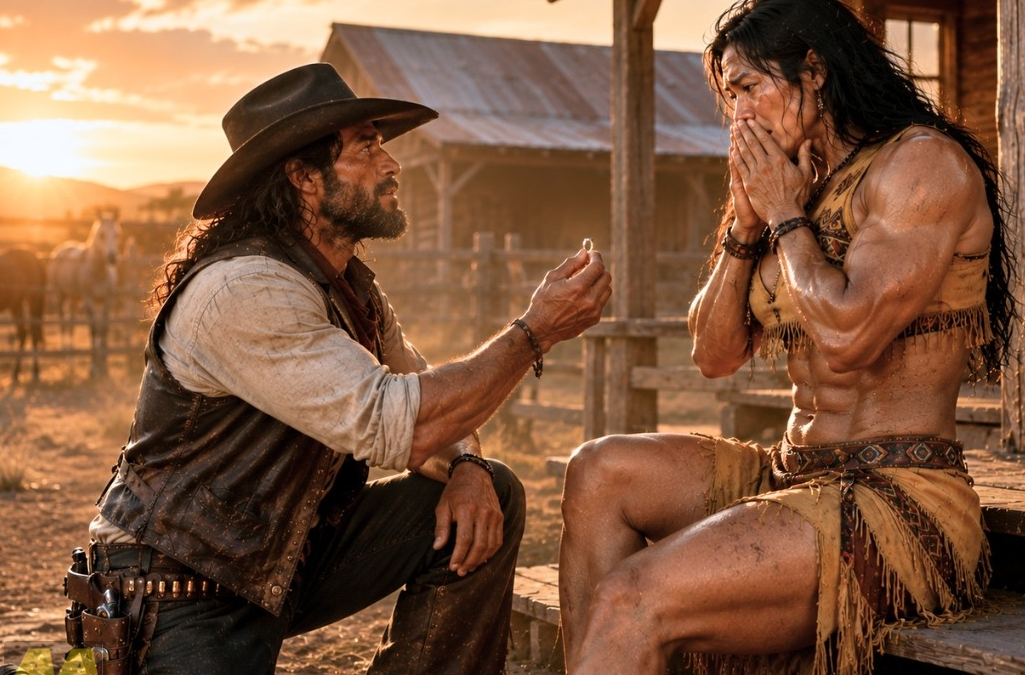
He looked at her. “Nayeli?” “Yes?” “Marry me.” She blinked. Then smiled. “All right.” “That is yes?”
“That is yes.” “You did not even think about it.” “I have been waiting since June.”
Silas looked embarrassed. “I am slow.” “You are very slow.” “I am sorry.” “You are forgiven.”
She picked up the buckets. Then she stopped. “On one condition.” “What?” “You never say I am too tall.”
Silas smiled. “You are exactly tall enough.” “For what?” “For everything.” They married in November beneath the cottonwoods.
There were four people there. Silas. Nayeli. Pike. And Doc Finch. It was the fullest the ranch had felt in three and a half years.
The following spring, Nayeli told Silas that they were going to have a child. He stood very still.
Then he sat down beside the well. Nayeli placed her hand on the back of his neck.
She knew what he was remembering. She knew the names that still lived inside him.
She let him sit quietly. After a while, he rested his head against her. Neither spoke.
The child did not know the paSt. The child did not have to carry it.
Life could begin without asking permission from memory. In October, Silas walked to the two crooked stones.
He carried wildflowers. He placed them gently between the markers. “Marguerite.” He looked at the second stone.
“Clementine.” The wind moved through the grass. “I am all right.” He paused. “I have a wife now.
Her name is Nayeli. She is tall, brave, stubborn, and better at telling the truth than I am.”
He smiled faintly. “She loves me.” He took a breath. “I love her.” The words felt strange.
But they also felt right. “We have a child coming soon.” He looked at the stones.
“I did not think I could love another child the way I loved you.” He paused.
“I was wrong.” The wind moved through the cottonwoods. “It turns out the heart grows.”
He placed his hand over his cheSt. “I did not know that.” He stood there a while longer.
Then he turned toward the cabin. Nayeli was waiting on the porch. She was carrying the child beneath her heart.
Silas climbed the steps. He stood beside her. They looked across the ranch. The rebuilt barn stood straight against the evening sky.
The north fence was strong again. The horses moved quietly in the pasture. Pike was repairing a gate near the corral.
The valley was calm. Nayeli reached for Silas’s hand. He took it. “Both of us,” she said.
“Both of us.” The sun disappeared beyond the mountains. The first stars appeared above the ridge.
Inside the cabin, the small life they had been waiting for moved quietly beneath the darkness.
Silas looked toward the two crooked stones in the distance. For three years, he had believed his story had already ended.
He had been wrong. Sometimes a life did not begin again with a grand promise.
Sometimes it began with a stranger beside a creek. Sometimes it began with a rifle lowered instead of raised.
Sometimes it began with a question. Sometimes it began with two people choosing, again and again, to remain.
And sometimes, after years of believing there was nothing left to build, a man discovered that the future had been waiting for him all along.
Disclaimer: This content may be created by Al for entertainment purposes. Any resemblance to real persons, events, or places is coincidental.








