A Broke Widow Tried to Sell Her Last Horse for $2—The Rancher’s Response Changed Her Life Forever
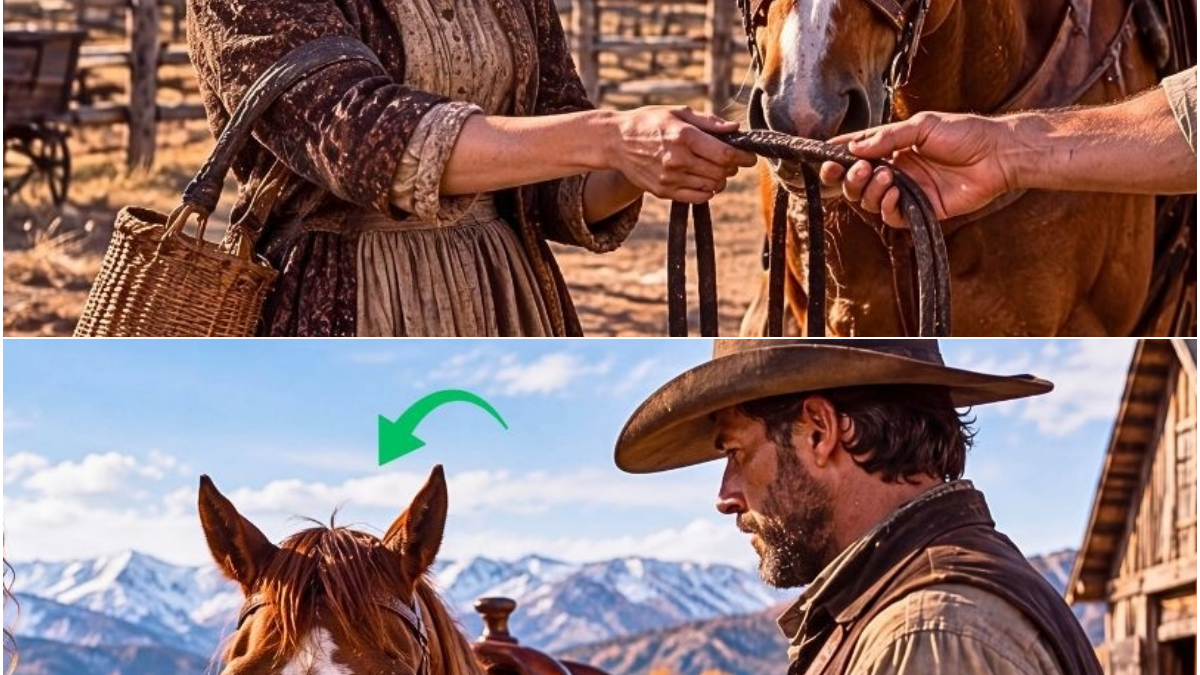
Ruth Bellamy counted the money twice because sometimes a person needs to believe the numbers might change if she looks at them long enough.
They did not. Sixty cents sat in a small pile on the kitchen table in her Wyoming Territory cabin in October 1887.
That was everything she had in cash, every coin she could call her own, and across the room her six year old daughter, Sarah, sat quietly because she had learned that asking about supper did not make supper appear.
For three days, the child had eaten nothing but dry bread. Ruth looked through the window at the little homestead her husband Thomas had built with his own hands.
Thirty acres. A small cabin. A lean to barn. A hen that had stopped laying.
And beyond the fence stood the finest thing Ruth still possessed, a five year old chestnut mare with a white blaze across her face.
Mercy. Thomas had named her five years earlier, when he brought the young mare home and joked that he could not promise Ruth goodness, but he could give her mercy.
Now Ruth needed to sell that mercy for two dollars. Nine miles away, a man named Silas Cain lived on six hundred acres of rich pasture, and Thomas had trusted him more than Ruth had ever understood.
Her husband had left her one final instruction thirteen months earlier, and Ruth had carried it like a sealed letter inside her heart.
Go to Silas Cain. He will do right by you. But what could Ruth possibly find at the gate of a wealthy rancher when all she wanted was two dollars and enough flour to get her little girl through another week?
Ruth Bellamy folded her hands on the kitchen table and stared at the sixty cents.
Her father had always taught her that numbers were honeSt. Figures did not lie, he used to say, and they did not take pity either.
Sixty cents was sixty cents. She counted again. Nothing changed. The flour barrel was empty.
The garden had surrendered to the cold weeks earlier. The last preserves had been sold.
The cured pork was gone. Her mother’s brooch was gone too. There was still a debt of sixty dollars attached to the homestead.
Harmon Price held the paper. Twice that week, he had sent word that the property would go to auction at the beginning of the following month unless Ruth paid the sixty dollars owed.
She had no sixty dollars. She had sixty cents. There was no arithmetic that could turn one into the other.
Ruth pushed back from the table and looked toward Sarah. The little girl was six years old, but hunger had made her seem younger and older at the same time.
Her face was too thin. Her clothes hung loosely around her shoulders. She had stopped asking when they would eat.
That frightened Ruth more than the asking ever had. A child who asked still expected an answer.
A child who stopped asking had begun to understand. Ruth stood and crossed the room.
“Come here, sweetheart.” Sarah rose from her chair and walked over. Ruth knelt and buttoned the little girl’s coat.
“We’re going for a ride.” “Where?” “To see someone your father trusted.” Sarah looked toward the window.
“Is there food there?” Ruth swallowed. “There will be.” She did not say how she knew.
She had no idea whether Silas Cain would even remember her. She had never spoken more than a few words to him.
But she remembered what Thomas had said. Thirteen months earlier, when fever had taken hold of him, he had become thin and strangely clear eyed.
Ruth had spent four days beside his bed, hoping each morning would bring improvement. It never did.
Near the end, Thomas had taken her hand. “Ruth, when you get to the end of your rope, and you will, girl, don’t argue.
Everybody does. You take Mercy up to Silas Cain on Cedar Creek. He’ll do it right by you.
Promise me you’ll go.” Ruth had tried to silence him. “Hush now, Thomas. Don’t talk like that.”
But he had squeezed her hand with the last strength he had. “Silas Cain. He’ll do right by you.”
She had promised. Then she had buried her husband. And for thirteen months she had not gone.
Ruth Bellamy did not ask strangers for favors. She worked. She sewed until her eyes burned.
She preserved food. She repaired fences. She kept the accounts. She raised Sarah. She kept the thirty acres standing.
She did everything Thomas had once done, except somehow she was expected to do it with half the hands, half the strength, and almost no money.
Now she finally understood his instruction. Thomas had meant the mare. Mercy was worth far more than two dollars.
A good horse could bring thirty or forty dollars to the right buyer. Two dollars would buy flour.
Two dollars would put food in Sarah’s stomach. Two dollars might buy Ruth enough time to figure out what came next.
She could sell Mercy to a man Thomas trusted. She could keep the rest of her life intact.
At least that was what she told herself. Ruth saddled Mercy. She wrapped Sarah in the one good coat.
Then she mounted and settled the little girl in front of her. The ride to Cedar Creek was nine miles.
On a mild day, it was an easy journey. That morning, the Wyoming air had a sharp edge.
The valley stretched beneath a pale sky, with the grass already turning dull beneath the approaching winter.
Ruth knew every acre of her own land. Thirty acres was enough for a careful family when the weather behaved.
Thomas had worked those acres until his hands were rough and his shoulders permanently bent from labor.
Silas Cain owned six hundred. His ranch was among the largest in the county. He had not inherited it.
He had built it. People said Silas worked harder than any man around him and asked better questions than his pride could afford.
Ruth knew him only by reputation. He was fair at market. Quiet in church. Usually seated in the back pew.
A widower himself. He had lost his wife and infant son to the same fever that had swept through the valley.
After that, Silas had buried himself in work. He had never remarried. He kept to himself.
Men respected him. That was all Ruth knew. What she did not know was that Silas had ridden past the Bellamy homestead many times during the previous year.
He had seen the lamp burning late in Ruth’s window. He understood what late lamp light meant.
A woman doing the work of three people. A woman trying to keep a household standing with fewer resources every month.
More than once, Silas had thought about turning his horse down the Bellamy lane. More than once, he had decided against it.
Thomas Bellamy had once saved his life. Fourteen years earlier, Silas had been twenty years old and nearly helpless after being caught in a flood along Cedar Creek.
Thomas had pulled him from the water. He had given Silas a place beside the fire.
He had given him food. He had given him work. Most importantly, Thomas had treated him like a man when Silas had almost nothing to offer in return.
Silas had never forgotten. But he also knew Thomas’s pride. He would not insult his friend’s widow by arriving uninvited with charity.
So he waited. Sometimes he wondered whether waiting was respect or cowardice. On that cold Monday morning, he finally received his answer.
Ruth reached the Cain ranch at ten. Silas was in the corral, working with a young horse.
He looked up. He saw a woman sitting very straight in the saddle. A little girl was in front of her.
A chestnut mare stood beneath them. Silas recognized Ruth immediately. Something in his chest went still.
He dropped the lead rope and walked toward the gate. He removed his hat. “Ma’am.”
“mr. Cain.” Her voice was level. Silas could tell she had rehearsed what she intended to say.
“My name is Ruth Bellamy. I believe you knew my husband Thomas.” Silas became very quiet.
“I knew him.” He looked down for a moment. “I owe him more than I ever paid.
I was sorry to hear he passed. I should have come to say so.” Ruth waited.
Silas looked back at her. “I should have come for a lot of reasons I didn’t.
That’s on me.” That was not what Ruth expected. She gathered herself. “I’ve come to sell my mare.”
Silas looked at Mercy. Then at Sarah. Then back at Ruth. He said nothing. Ruth took that as permission to continue.
“She is five years old. Sound. Gentle. Good under saddle and in harness. Thomas raised her from green.”
She lifted her chin. “I’m asking two dollars.” The morning seemed to become completely still.
Silas stared at her. “Two dollars?” “Yes.” “That mare is worth forty if she’s worth a nickel.”
“I know.” “You know?” “I know exactly what she’s worth.” Silas looked at the little girl.
Ruth’s expression remained steady. “Forty dollars is what she’s worth,” she said. “Two dollars is what I need.”
She paused. “My daughter has eaten nothing but bread for three days. I have sixty cents.
There’s a barrel of flour at the store in Clearwater that costs two dollars.” Her voice became quieter.
“I would rather sell you a forty dollar mare for two than watch my child go hungry another night because I was too proud to ask.”
She held his gaze. “So I’m asking. Will you buy her or won’t you?” Silas looked at the mare again.
He thought about Thomas. He thought about the young man he had been fourteen years earlier.
He thought about a verse he had heard in church. A father to the fatherless, a defender of widows is God in his holy dwelling.
He had listened to those words many times. That morning, they sounded different. “No,” he said.
Ruth’s face closed. Silas continued. “I won’t buy your mare for two dollars.” She began to turn the reins.
“I’ll do better than that.” Ruth stopped. Silas stepped closer to the gate. “I’m taking you home.”
Her eyes narrowed. “The child, the mare, all of it. There’s a warm kitchen. Food enough for forty people.
Empty rooms in the house. I don’t know what to do with half of them.”
He took a breath. “I’ve prayed on a good many things in my life and gotten no answer I could hear.
But I believe God sent you to my gate this morning.” Ruth’s expression hardened. “And I believe he sent me to look after you.”
Silas spoke gently. “Put that two dollars out of your mind. You’re coming home. You’ll be protected.
That’s the end of it.” For a moment, Ruth did not move. Then she dismounted.
She helped Sarah to the ground. She faced Silas across the gate. “The end of it?”
“Ma’am?” “I rode nine miles in the cold to make an honest trade.” Silas opened his mouth.
Ruth did not let him speak. “My husband has been gone thirteen months. I have kept that child alive and that homestead standing every day since by myself.”
Her voice remained controlled. “I will not hand my entire life and my daughter over to a man I met four minutes ago because he has decided the Lord appointed him my keeper.”
Silas looked stunned. “I need two dollars,” Ruth said. “I do not need a keeper.”
The silence that followed was broken by Sarah. She tugged on her mother’s skirt. “Mama?”
Ruth looked down. “Is there really supper?” Silas’s face changed. He slowly knelt until he was level with the child.
“There is supper, honey.” Sarah stared at him. “Biscuits?” “There are biscuits.” “Ham?” “There is ham.”
“Even for me?” Silas smiled gently. “Especially for you.” He glanced at Ruth. “And honey for the biscuits, if your mama says it’s all right.”
Sarah looked at her mother. Ruth closed her eyes for half a second. Silas rose.
“You’re right,” he said. Ruth looked at him. “I got ahead of myself.” He turned his hat in his hands.
“I see something that needs fixing and I fix it before I ask whether anyone wanted it fixed.”
His voice was quiet. “It is probably the worst thing about me.” He looked toward the ranch house.
“So let me ask instead.” He explained that his housekeeper had left in September. He needed someone to manage the kitchen, keep the household organized, and handle the ranch accounts.
“The position pays four dollars a week,” he said. “Room and board for you and the girl.
Pasture and feed for Mercy. And the mare remains yours.” Ruth studied him. “You’d be working for me,” Silas continued.
“Not accepting charity.” She looked toward the house. “And I could leave whenever I wanted?”
“Yes.” “And take my mare?” “Yes.” Ruth was quiet. Silas waited. Finally she said, “That is different.”
“It is.” “I’ll take the position.” Silas nodded. “And I’ll keep Mercy.” “Yes, ma’am.” The following Wednesday, Ruth began working at the Cain ranch.
Within an hour, she discovered that Silas Cain could manage six hundred acres of pasture more effectively than he could manage a kitchen cupboard.
Flour sat beside kerosene. Receipts were mixed with letters. Tools had no proper place. The account books were not exactly wrong.
They were simply chaotic. Ruth began organizing. She created lists. She separated receipts. She counted supplies.
She checked invoices. By Friday, she discovered that three suppliers had been overcharging the ranch.
The total came to more than ninety dollars. Ruth carried the figures to Silas during supper.
He studied them. Then he looked at her. “Your husband once told me you kept better books than he did.”
Ruth waited. “I thought he was being sweet about you.” He looked back at the figures.
“I am beginning to think he was giving me information.” Ruth lowered her eyes to the ledger.
She had expected irritation. Instead, she found respect. Sarah changed quickly once there was regular food.
Within a week, color returned to her cheeks. She discovered a barn cat. She discovered the ranch horses.
Most importantly, she discovered that Silas Cain answered questions. All of them. She followed him around the property and asked why fences were built where they were.
Why horses disliked certain sounds. Why cattle gathered near one corner of a pasture. Why the sky changed color before snow.
Silas answered every question seriously. Ruth often watched from the kitchen window. One evening, she saw Sarah walking beside him along the fence line.
Every few yards, the child stopped to show him something. Silas stopped every time. Ruth turned back toward the stove.
She told herself she was simply grateful. Nothing more. Gil Hawkins, the oldest ranch hand, watched the same scene from the bunkhouse.
One evening, he leaned toward a younger hand. “Two bits says the boss marries that widow before spring.”
The younger man laughed. “The boss doesn’t have it in him.” Gil put two bits on the table.
“He’s had it in him for three days. He just hasn’t figured it out yet.”
Winter arrived. December covered the valley in snow. Ruth’s ride between the Bellamy homestead and the Cain ranch became longer and harder.
Eventually Silas said what seemed obvious. “The east room is empty.” Ruth looked at him.
“You could stay here during the winter.” “I can manage the ride.” “I know.” “The homestead is my responsibility.”
“I know.” She studied him. Silas added, “I’m not telling you what to do.” That made her pause.
“The room is there if you want it.” Ruth accepted. She moved into the east room.
She told herself it was practical. Nothing more. She began to learn Silas in small ways.
He drank his coffee black. He read his Bible for twenty minutes each morning. When something weighed on him, he sometimes read the same passage twice without realizing it.
He woke at five. He checked the horses before breakfaSt. He rarely complained. And he was learning to ask before fixing things.
That mattered to Ruth. One morning in January, Ruth rode to Clearwater. She still owed Harmon Price sixty dollars.
She intended to pay it herself. She had earned two dollars that month and brought the money to Price’s store.
She placed it on the counter. The clerk looked at her. Then he looked at the ledger.
Then back at her. “mrs. Bellamy?” “Yes?” “This account has been settled.” Ruth stared at him.
“Settled?” “Paid in full.” He turned the ledger around. There it was. The Bellamy note.
Sixty dollars. Paid in full on December 20th. The name beside it was Silas Cain.
Ruth stood very still. The clerk continued. “Your homestead is clear.” Ruth took her two dollars.
She folded the bills into her pocket. Then she rode home. Silas was repairing a section of fence when she found him.
He looked up. “You went to Price’s.” “I did.” He put down the pliers. Ruth dismounted.
“You paid my debt.” “Yes.” “Without asking me.” Silas did not defend himself. “I should have asked.”
“You knew I would say no.” “Yes.” “Because it was my debt.” “Yes.” He looked at her.
“You were right.” Ruth had prepared an angry speech. Now she did not need it.
Silas continued. “I paid it because I could not stand to watch you lose the last thing Thomas built with his hands.”
He paused. “And because I owed him.” Ruth looked away. “But I was wrong to decide for you.”
He took a breath. “Helping you never gave me the right to choose for you.”
Ruth’s voice was quiet. “You keep doing the same thing.” “I know.” “You see something that needs fixing.”
“I fix it.” “Before asking.” “Yes.” She looked toward the mountains. “There is a kind of protection that gives a person shelter while leaving them free.”
Silas listened. “And there is another kind that becomes a cage while pretending to be love.”
He nodded slowly. Ruth continued. “The Bible says wings.” She looked at him. “Wings, Silas.
Not bars.” Silas looked down. “That may be the truest thing anybody has told me in years.”
He picked up the deed papers. “You can pay me back two dollars a month.”
Ruth looked at him. “Or I can go to Price and undo the payment.” “You would?”
“If that’s what you want.” He met her eyes. “Both doors are open.” Ruth smiled faintly.
“That is the first thing you’ve said today that sounds like respect.” “I am better at doing than saying.”
“I know.” “I am working on the saying.” That almost made her laugh. That evening, after Sarah was asleep, Silas came to the kitchen doorway.
He carried something wrapped in cloth. He placed it on the table. Ruth opened the cloth.
Her hands stopped. It was a woodworking plane. Old. Worn. Carefully maintained. The handle had a familiar maker’s mark.
Her father’s mark. Ruth touched it. “That was my father’s.” “Thomas lent it to me four years ago.”
Silas sat down. “My own had cracked. I was building the horse barn.” Ruth looked at him.
“I always intended to return it.” He looked at the plane. “Then Thomas became sick.”
He paused. “I kept it.” Ruth said nothing. “I told myself it was the last thing he lent me.”
Silas’s voice became quieter. “The truth is that I did not know how to walk up to your door and give it back.”
Ruth ran her thumb over the worn handle. “It should have come home a year ago.”
“Yes.” She looked at him. “I am sorry it took this long.” For a moment, Ruth could see Thomas in the memory of the object.
His hands. His work. His patience. She looked at Silas. “Keep it.” He raised his eyes.
“Thomas would rather it be used than sitting in a drawer.” Silas nodded. Ruth folded the cloth around it.
“My husband talked about you near the end.” Silas became still. “He did?” “He said if I ever reached the end of my rope, I should bring Mercy to you.”
Silas looked down. “He said you’d do right by me.” Ruth’s voice remained steady. “I thought he meant you’d give me a fair price for the mare.”
She smiled sadly. “I think I may have misunderstood him.” Silas said nothing. “I think Thomas knew your heart better than I did.”
The kitchen grew quiet. Ruth stood. “Give me until Sunday.” Silas looked up. “To decide what?”
“Whether I can trust you with more than the accounts.” He waited. “You have to keep being honest with me.”
“I will.” “You have to ask before you fix my life.” “I will.” “And if I tell you no?”
“I will listen.” Ruth nodded. “Sunday.” “Sunday.” Three days passed. On Sunday, Ruth came back from church.
Silas was on the porch. He had clearly been waiting. She tied Mercy and climbed the steps.
For a while, they sat without speaking. Snow covered the pasture. The mountains stood beyond the ranch.
Sarah came onto the porch. She looked at Silas. Then she climbed into his lap without asking.
Ruth watched. Sarah looked up. “Are you going to be my papa?” Silas became completely still.
He looked at the child. Then at Ruth. “That is your mama’s decision.” Sarah looked at Ruth.
Silas continued. “And nobody else’s.” Ruth reached over and took his hand. “Ask me properly.”
Silas looked at her. He understood. He took a breath. “Ruth Bellamy.” She waited. “I would like to court you honestly.”
His voice was steady. “And if you will have me, I would like to marry you.”
He looked toward Sarah. “I would like to be a father to your girl.” Then he looked back at Ruth.
“Not over you.” He squeezed her hand. “Not in front of you.” “Beside you.” He paused.
“Will you let me?” Ruth smiled. “Yes.” Sarah looked between them. “Is that a yes?”
They both laughed. Outside, Mercy lifted her head from the pasture. She looked toward the porch for a moment.
Then she returned to grazing. Gil Hawkins collected his two bits. The wedding came in June.
They married in the little church at Clearwater. The whole valley seemed to turn out.
Ruth wore a pale blue dress she had made herself. It was beautiful, but practical.
She intended to wear it again. Silas wore his best shirt, though he looked more comfortable in work clothes.
The Bellamy homestead remained Ruth’s. The debt was gone. The thirty acres remained in her name.
Silas never suggested otherwise. The two properties continued side by side. Ruth managed the Cain household and the ranch accounts.
By the end of the first year, neighboring ranchers were asking her to keep their books too.
She charged fair wages. She never apologized for what her work was worth. Silas continued managing his six hundred acres.
He understood land. He understood horses. He understood cattle. And slowly, he was learning something more difficult.
He was learning that loving someone did not mean making every decision for them. Sarah grew up calling him Papa.
To her, it was never complicated. She had been hungry once. Then she had found a home.
Mercy remained part of the family too. She moved freely between the two properties. Sometimes she wandered where she pleased.
Once, she took Gil Hawkins’s hat from a fence post and carried it into the south pasture.
Gil found her standing beside it. He retrieved the hat and shook his head. “You’ve got no respect for property, Mercy.”
The mare simply stared at him. Years later, Ruth would still remember that cold Monday morning.
She would remember sixty cents on a kitchen table. She would remember Sarah’s thin face.
She would remember the empty flour barrel. Most of all, she would remember riding nine miles through the cold with the intention of selling the last valuable thing she owned for two dollars.
She had believed Thomas’s final instruction was about the mare. It had not been. He had been pointing her toward a person.
Toward a man who owed him an old debt. Toward a man who would make mistakes but would learn from them.
Toward someone who could provide shelter without taking away her independence. Thomas had known Silas.
Perhaps better than Ruth had. Perhaps that was why he had repeated the instruction so firmly.
“Take Mercy to Silas Cain.” Ruth had thought the meaning was simple. Sell the horse.
Buy food. Survive another week. Instead, the mare had carried Ruth and Sarah into a new chapter of their lives.
Not because Ruth needed someone to control her future. Because she finally found someone willing to stand beside her while she built it herself.
One evening in the second spring, Ruth sat on the porch with Silas. The light was fading across the valley.
Mercy grazed in the near pasture. Silas brought out two cups of coffee. He handed one to Ruth.
She took it. “Silas?” “Hmm?” “My husband knew.” Silas looked toward the pasture. Then back at her.
“Yes.” “I think he did.” They sat quietly. Ruth remembered the woman she had been on that cold morning.
Proud. Tired. Afraid. Determined. She remembered the sixty cents. The two dollars. The nine mile ride.
The gate. The argument. She remembered the first time Silas had tried to protect her by deciding for her.
She remembered how quickly he had learned to stop. That mattered. Because Ruth had not needed a savior.
She had needed room to remain herself. Sarah came running across the porch. “Papa.” Silas looked over.
“Yes?” “Mercy is in the garden again.” Silas sighed. Ruth laughed. “Then I suppose you had better fix it.”
Silas looked at Ruth. He smiled. “Should I ask first?” Ruth nodded. “You should.” He stood.
“Ruth, may I move the mare?” “You may.” Silas walked toward the garden. Sarah followed.
Ruth watched them go. The chestnut mare lifted her head. The white blaze on her face caught the last light of evening.
Mercy had been named before Ruth knew how important that word would become. Goodness and mercy.
That was what Thomas had joked about five years after bringing the young mare home.
At the time, Ruth had laughed. Years later, she understood. Mercy was not always a thing a person bought.
Sometimes it was a door that opened when every other door seemed closed. Sometimes it was a man who knew when to step forward and when to step back.
Sometimes it was a child asking whether supper was real. Sometimes it was a debt quietly paid and then honestly offered back.
Sometimes it was the freedom to say no and still know you were loved. And sometimes, on a cold Monday morning in the Wyoming Territory, mercy was a five year old chestnut mare carrying a widow and her hungry little girl nine miles toward a gate they had never expected to cross.
Ruth had ridden there expecting to sell what remained. She had come home with something far more valuable.
Not a fortune. Not a rescue. Not a life chosen for her. A family. A future.
And a man who had finally learned that the strongest way to protect someone was not to stand in front of them and decide where they should go.
It was to stand beside them and let them choose the road. Ruth looked across the pasture.
Silas was walking beside Sarah. Mercy followed them. The Wyoming evening settled softly over the ranch.
And for the first time in a long time, Ruth did not count what she had left.
She simply looked at what she had found.
Disclaimer: This content may be created by Al for entertainment purposes. Any resemblance to real persons, events, or places is coincidental.








