A Black Girl’s Old Horse Kept Scraping at One Spot — What She Found Below Stunned Her
24 years old and you are still letting that old horse decide where this farm is going.
Your grandfather would never have allowed this. The words crossed the fence line with the weight of a final judgment.
Nia Carter stood in the middle of her eastern pasture, boots covered in dust, one hand resting against the weathered wooden post that marked the edge of the land her family had owned for three generations.
Across from her, Earl Dawson leaned against his pickup truck, his arms folded, his expression carrying the confidence of someone who believed the answer had been obvious for years.
The farm was failing. Everyone could see it. The fields were dry. The grass was thin.
The soil had hardened beneath the endless summer sun. The numbers in Nia’s green notebook had become a collection of problems she could not seem to solve.
Every month brought another expense, another repair, another reason for people around her to tell her that she was holding onto something that could no longer support her.
But there was one thing Earl had never been able to explain. Why did Dusty keep returning to this exact spot?
The old gray mare had spent 24 years walking these fields. She had carried Nia when she was a child, stayed beside her through every season, and understood this land in a way no person ever could.
For weeks, Dusty had ignored the rest of the pasture and returned to the same patch of dry ground near the eastern fence.
Every morning. Every time. And every morning, she scraped at the dirt like she knew something was waiting underneath.
Earl called it meaningless. He called it an old horse acting strangely. Nia saw something different.
Because sometimes the land remembers things people forget. Sometimes the smallest clue is hidden beneath the surface, waiting for someone patient enough to notice.
And if Dusty was not searching for nothing, what exactly had this old horse been trying to show her?
The Carter farm had once been one of the strongest properties on the high desert plateau of eastern Oregon.
The land stretched across rolling hills where the summer winds moved freely through tall grass and winter snow covered the ridges for months at a time.
Nia’s grandfather had built the place with determination and years of hard work. He knew every section of the property, every slope, every creek bed, and every place where the soil changed beneath his boots.
He always told her the same thing when she was young. “Land speaks if you are willing to listen.”
At the time, Nia thought it was just something old farmers said. A phrase passed down through generations because it sounded wise.
Years later, standing on a struggling farm with bills piling up and empty fields surrounding her, she began to understand what he meant.
When her grandfather passed away, most people expected the property to be sold. The farm was valuable, but running it was another matter.
The land looked impressive on paper. The acreage was large. The location was good. But the reality was much harder.
Only certain sections produced enough to provide reliable income. Other areas had slowly declined over the years.
The soil had become compacted and dry. The grass had disappeared from places where it once grew thick.
The farm was not failing overnight. It was failing quietly. That was sometimes worse. Problems that arrived suddenly forced people to react.
Problems that appeared slowly gave people time to accept them as normal. Nia refused to accept that.
At 22 years old, she signed the paperwork that kept the farm in her name.
Her family thought she was making an emotional decision. Maybe they were right. But it was not only emotion.
It was memory. She remembered riding across those fields with her grandfather. She remembered the way he would stop in the middle of a workday just to look across the property and smile.
He never saw the land as just dirt and numbers. To him, it was something alive.
Nia wanted to believe he was right. Even when the bank account suggested otherwise. Every year became a balancing act.
Feed for the cattle. Repairs for aging equipment. Seeds for pasture restoration. Maintenance on an irrigation system that seemed older than most of the buildings on the property.
She kept track of everything in a green notebook that stayed on the kitchen table.
Every expense. Every repair. Every plan. And every time she opened it, she saw the same truth.
The farm needed something to change. Her neighbor Earl Dawson had been watching that struggle for years.
He owned the land east of hers and had spent most of his life working farms across the region.
He was not someone who lacked experience. He knew agriculture. He knew weather patterns. He knew what worked and what failed.
That was why his opinion carried weight. And why Nia found it difficult to ignore him.
Earl had never been cruel about it. He did not insult her or laugh at her efforts.
Instead, he spoke with the calm certainty of someone who believed he was offering practical advice.
“You cannot fight the land forever,” he told her one afternoon while they stood near the shared fence line.
Nia remembered those words. Not because they hurt. Because they stayed with her. She had spent years hearing people explain what was impossible.
But nobody had ever asked what was still possible. Earl believed the eastern acreage should be sold.
A buyer had already shown intereSt. According to him, selling that section would give Nia enough money to stabilize the rest of the farm.
It was not a bad suggestion. It was simply not the answer she wanted. Then Dusty changed everything.
The old mare had always been predictable. That was what made the change so noticeable.
She moved slower than she once had. Cold mornings required extra time before her joints loosened.
Her gray coat showed every year she had spent under the open sky. But her mind was still sharp.
Nia noticed it the first week. Dusty separated from the herd and walked toward the eastern fence.
At first, Nia assumed she was simply exploring. Older animals sometimes developed strange habits. But Dusty did not wander.
She walked directly to one place. A section of ground that looked no different from the reSt.
The mare would stop beside a rotting fence post, lower her head, and scrape the earth with one hoof.
Then she would stand there quietly. The first few mornings, Nia watched from a distance.
The fourth morning, she followed. The fifth morning, she began wondering why. By the second week, it had become impossible to ignore.
Dusty was not randomly pawing at the ground. She was focused. Intentional. Almost like she was trying to reveal something.
When Earl noticed Nia standing near the fence one afternoon, he shook his head. “That horse is probably chasing a mouse or smelling something underneath,” he said.
Nia looked down at Dusty, who was standing beside the same patch of dirt. “Maybe.”
Earl leaned on the fence. “You know old animals get unusual habits.” Nia nodded. She knew that.
But she also knew Dusty. And something about this felt different. She tried leading the mare away several times.
Dusty followed. Then the next morning, she returned. Always to the same spot. Always to the same patch of ground.
Then came the rain. A rare summer storm passed over the property, leaving the hard earth dark and damp.
The following morning, Nia found Dusty already there. But this time, the mare was more determined.
She scraped deeper than before. Nia stepped closer. “Dusty?” The mare stopped. Her ears moved slightly.
Then she looked back at the ground. Nia followed her gaze. At first, she saw nothing.
Just mud. Just dirt. Then she noticed a thin line running through the soil. A pale line.
Straight. Too straight. She knelt down. Using her fingers, she cleared away the loose dirt.
The line continued. Her curiosity grew. She returned to the barn and came back carrying a small shovel.
For nearly half an hour, she dug carefully. Then she uncovered enough to understand. It was not a root.
It was not a rock. It was old pipe. Clay pipe. The kind used decades ago in agricultural systems before modern materials became common.
Nia sat back and stared. The pipe disappeared beneath the ground, running toward the driest section of the property.
A place where nothing had grown properly in years. Her heart began beating faster. Because suddenly, the dry land did not look empty.
It looked like a question. And Dusty had been pointing toward the answer all along.
Nia spent the rest of the day searching through every record she could find. Current property maps showed no irrigation system in that area.
No active water lines. Nothing. But the pipe was real. That meant something had existed there before.
Something forgotten. The next morning, she drove into town and visited the county records office.
She searched through maps, documents, and old property records. Most of what she found was incomplete.
Until someone suggested she visit the local historical society. The building was small, filled with old photographs, handwritten documents, and boxes of records that had never been transferred into digital files.
That was where she met Helen Moore. Helen was a retired teacher who had spent years organizing the archives.
When Nia explained what she had found, Helen became interested. “Old systems disappear faster than people realize,” Helen said.
She walked to a shelf and returned with a faded map. The paper was fragile.
The ink had faded. But one marking caught Nia’s attention. A small notation near the eastern section of the Carter property.
Spring box. Nia looked up. “What does that mean?” Helen carefully flattened the map. “A collection chamber built over a natural water source,” she explained.
“Older farms used them to move water through gravity-fed systems.” Nia stared at the location.
It was almost exactly where Dusty had been digging. And for the first time in years, the eastern section of the farm did not feel like a lost cause.
It felt like something waiting to be uncovered.
Nia left the historical society with a copy of the old map and a feeling she had not experienced in a long time.
Hope. Not the kind of hope that ignored problems. Not the kind that came from wishing things would somehow fix themselves.
This was different. This was the kind of hope built on a question. What if the farm was not failing because the land was finished?
What if something had simply been hidden? Before she could answer that, she needed more information.
Helen Moore had given her one more name. Walter Briggs. “He worked on your grandfather’s property when he was young,” Helen explained.
“If anyone remembers what that land looked like before, it would be him.” Nia found Walter two days later.
He lived in a small farmhouse outside town, surrounded by old equipment and carefully maintained gardens.
At 89 years old, he moved slowly, but his memory was sharp. When Nia mentioned the eastern fence line, the old man became quiet.
Not confused. Not surprised. Remembering. “You found the spring box, didn’t you?” He asked. Nia froze.
“You know about it?” Walter looked toward the window. “I wondered if someone ever would.”
He told her that when he was young, the eastern side of the Carter property was completely different.
That section had once been one of the most productive parts of the farm. Water moved naturally through the land.
Fields stayed green longer. Plants grew stronger. The system had been built decades earlier, before modern irrigation became common.
A spring box collected water from a natural underground source and directed it through a network of old clay pipes.
It was simple. Reliable. And forgotten. Walter explained that the change happened when a contractor came to drill a new well.
The new system worked well for the household and livestock, but during the installation, one of the old underground pipes was damaged.
Nobody considered it a major problem at the time. The newer system seemed easier. The older one seemed unnecessary.
So the broken pipe was covered. The ground was leveled. And slowly, the eastern fields changed.
The water was still there. It simply stopped reaching the surface. Nia listened carefully. For years, people had looked at that section of land and assumed it had reached its limit.
But maybe everyone had been looking at the wrong problem. Maybe the land was not empty.
Maybe it was blocked. She returned to the farm before sunset. The eastern pasture looked exactly the same as it always had.
Dry. Quiet. Unpromising. But now she saw it differently. The ground was no longer a symbol of failure.
It was a locked door. And she might have just found the key. The next morning, Nia went to work.
She followed the old map and began searching for the spring box. It was harder than she expected.
Decades of soil buildup had hidden every trace. There were no markers. No visible signs.
Only the information left behind by people who had worked the land long before her.
For two days, she dug. The summer sun burned overhead. Her hands became sore. Her shoulders ached.
But she kept going. Then, on the third morning, her shovel struck something different. Not stone.
Not wood. Something hollow. Nia stopped. She carefully removed the dirt around the area until she uncovered a concrete cover buried beneath the ground.
Her heart raced. She had found it. The spring box. The cover was cracked and stained from years underground.
Using a metal bar from the barn, she slowly lifted it. At first, nothing happened.
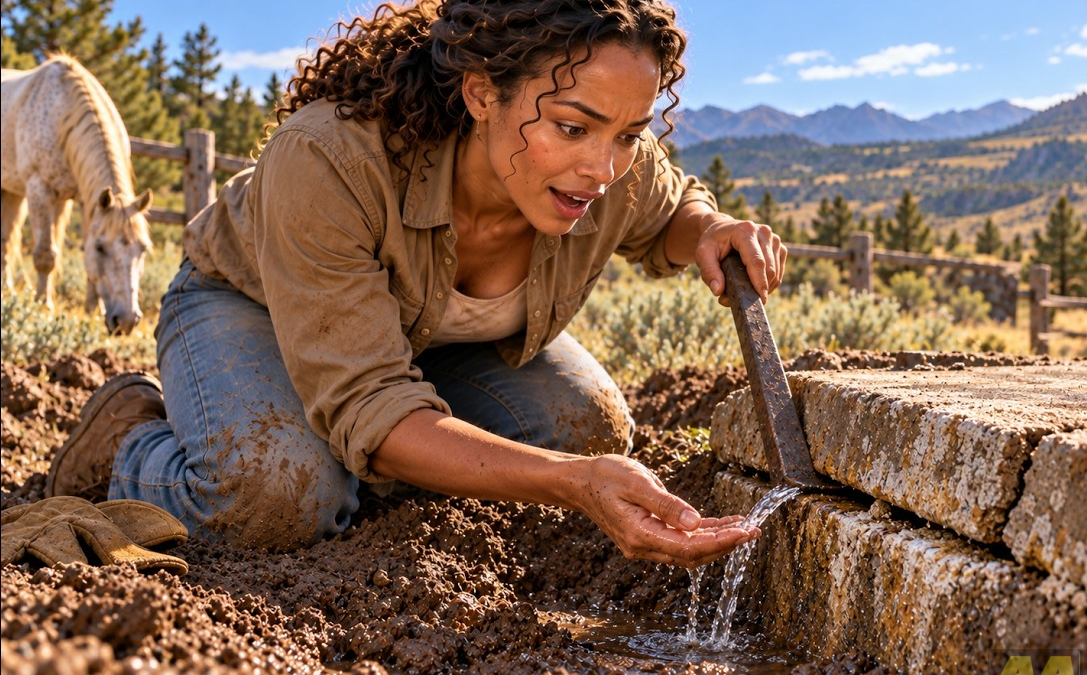
Then she saw it. Water. A thin stream moved through the opening. Cold water. Real water.
Nia sat back in the dirt, staring. After everything she had heard, after all the doubts and warnings and years of watching the land struggle, she had expected disappointment.
Instead, the water was still there. Waiting. She replaced the cover carefully and immediately began searching for someone who could help her understand what she had discovered.
A water specialist visited the farm the following week. He examined the spring box and the old pipe system.
His answer was not what Nia wanted to hear. The system existed. The spring existed.
But years underground had damaged much of the network. Some sections had collapsed. Others were filled with dirt and roots.
Restoring everything would require time, money, and a lot of work. The estimate was far beyond what Nia could comfortably afford.
But walking away was not something she could do anymore. She had spent years believing the land had abandoned her.
Now she knew the opposite. The land had been waiting. Nia hired two workers from town to help on weekends.
During the week, she worked alone. She bought replacement materials whenever she could afford them.
She dug trenches. She repaired broken sections. She followed the old system inch by inch.
Every discovery brought a new problem. A damaged connection. A blocked section. A collapsed piece of pipe.
There were moments when she wondered if Earl had been right. Moments when the work seemed too large.
Too expensive. Too uncertain. Then she would look toward the eastern fence. And Dusty would be standing there.
Watching. Waiting. The old mare never left that area for long. Almost like she was reminding Nia why she started.
After several weeks of repairs, they opened the first restored section of the pipeline. Everyone gathered around.
Nia held her breath. Water appeared. But barely. A small stream. Almost nothing. The two workers exchanged looks.
They did not say anything, but Nia understood. It was not enough. That evening, Earl stopped by.
He looked at the open trenches and the equipment scattered across the property. For once, he did not sound confident.
“You have worked hard,” he said. Nia leaned against the fence. “But?” Earl looked toward the eastern fields.
“But sometimes things are gone because they are gone.” He explained that maybe the spring had weakened over time.
Maybe the system was too old. Maybe the land had changed. He was not trying to insult her.
He was giving her the answer he believed was realistic. Then he offered again to help her sell part of the property.
A buyer was still interested. Nia thanked him. She told him she would think about it.
That night, she sat at the kitchen table. The green notebook was open. The numbers were not good.
She had spent most of her savings. Winter was coming. The cattle still needed care.
The farm still needed repairs. She wrote three options. Sell part of the herd. Lease the eastern acres.
Sell the farm. She stared at the final line for a long time. Then she closed the notebook.
She did not cross anything out. She did not make a decision. Instead, she stepped outside.
The night air was cool. The farm was quiet. Near the eastern fence stood Dusty.
The old mare was facing the same spot as always. But this time, she was not scraping.
She was simply standing there. Nia watched her for several minutes. Then she went back inside.
The next morning, instead of calling Earl, she called the county extension office. She needed another opinion.
Someone who understood old water systems. That was how she met dr. Rachel Monroe. Rachel arrived in a county truck carrying equipment Nia had never seen before.
She did not immediately give advice. She walked. She observed. She asked questions. Then she went directly to the spring box.
Unlike the first specialist, Rachel carefully removed the remaining sediment before taking measurements. She checked the water level.
Then checked it again. Afterward, she followed the pipeline. Slowly. Carefully. She was not only looking at what had been repaired.
She was looking at what had been missed. Nearly 40 meters from the spring box, beside the oldest cottonwood trees on the property, Rachel stopped.
She pressed a measuring rod into the ground. Then she moved a few feet and tried again.
Her expression changed. “What is it?” Nia asked. Rachel looked toward the ground. “I think we found the problem.”
They started digging. The answer was buried deeper than anyone expected. Beneath the soil was an old section of clay pipe.
But it was not cracked. It was crushed. Almost completely flattened. The roots of the cottonwood trees had grown around it for decades, slowly pressing down until the water channel closed.
The spring was not weak. The water was not gone. It had simply been trapped.
Nia stood there silently. All those years. All those dry fields. All those assumptions. The answer had been beneath their feet the entire time.
Rachel explained that once the blockage was removed, the water should move again. Together, they cut away the damaged section and replaced it.
The work took hours. The sun moved across the sky. Then finally, they opened the system.
This time was different. Water rushed through the pipe. Not a weak stream. Not a small trickle.
A steady flow. Cold, clear water spread across the dry ground. Nia watched as the soil darkened.
For the first time in years, that part of the farm looked alive. Rachel checked her measurements carefully.
Then she looked at Nia. “The spring has enough flow to change this property,” she said.
Nia looked across the fields. The same fields everyone had called finished. The same fields Earl had told her could never recover.
The same fields Dusty had walked toward every morning. She placed a hand on the old mare’s neck later that afternoon.
Dusty stood quietly beside her. Almost as if she knew. The farm had not needed a miracle.
It had needed someone willing to listen.
Disclaimer: This content may be created by Al for entertainment purposes. Any resemblance to real persons, events, or places is coincidental.








