3 Great Smoky Mountains Hikers Who Realized Their Partner Wasn’t Human
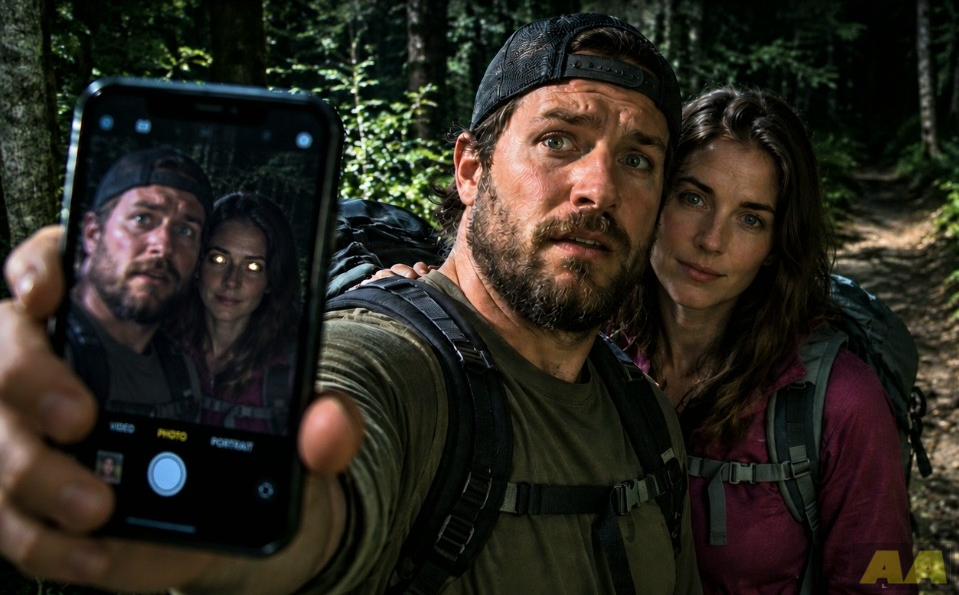
At 62 miles into the Great Smoky Mountains, you stop expecting the trail to belong entirely to you.
That is one of the first things people learn out there. Even when you begin a morning alone, someone eventually appears at a shelter, at a water source, or around a bend where the trees open just enough for two hikers to pass.
Names are exchanged. Mileage is compared. Someone complains about the same climb you were already complaining about in your head.
Before long, a stranger can become a trail partner without either of you making a formal decision about it.
That is what happened when I met Weston. He seemed ordinary. He talked about his route, his plans, and a supply drop he expected near the next road crossing.
We walked together for two mornings, sharing the easy rhythm that develops between people who spend hours moving through the same wilderness.
Then, somewhere beyond Charlie’s Bunion, he repeated something he had already told me. Not approximately the same thing.
The exact same words in the exact same order. A few minutes later, I noticed his footsteps were landing with mine perfectly.
When I stopped, he stopped. When I changed direction, he seemed to know before I moved.
Then I looked directly into his eyes and realized something I had never noticed before.
They were pointed at me, but they did not seem to be seeing me. If you were walking through the Great Smoky Mountains and suddenly realized the person beside you had learned how to imitate you, how long would it take before you stopped thinking of them as a person?
I had met Weston two mornings earlier at a shelter near Newfound Gap, deep inside the Great Smoky Mountains.
He told me he had come up from Cades Cove. His plan was to reach Mount Le Conte by the weekend.
There was nothing unusual about the conversation. He knew the trail. He carried the sort of equipment you would expect from someone who had already spent time in the mountains.
His pace was comfortable. He did not talk too much. He did not talk too little.
We simply fell into step together. That happens often on long trails. People who begin the morning alone may finish it beside someone they had never met before.
You exchange names. You compare distances. You talk about water. You talk about food. You complain about climbs.
Then the hours pass. By the second day, I had already started thinking of Weston as my trail partner for that stretch.
Not a close friend. Not someone I knew away from the trail. Just the guy I expected to see beside me for another few days.
The sort of temporary friendship that exists because two people happen to be walking in the same direction.
Late in the morning, somewhere past Charlie’s Bunion, we were talking about a supply drop he was planning near the next road crossing.
He explained what he was having sent. He described the location. He mentioned coordinates. He told me when he planned to pick everything up.
I listened and nodded. Then, roughly 90 seconds later, he said it all again. The same words.
The same sequence. The same details. I laughed. I told him he was repeating himself.
He did not laugh. He did not look embarrassed. He did not say he had forgotten.
He did not even give me the confused expression most people make when they realize they have just repeated something.
His face simply remained exactly as it had been. I kept walking. I told myself there was nothing strange about it.
Two days on a trail can make anyone tired. Maybe I had misunderstood the first conversation.
Maybe he had been explaining two different parts of the same supply plan. I let it go.
Then I noticed his boots. Every step was landing at exactly the same time as mine.
At first I thought it was coincidence. After all, two people walking together naturally develop similar rhythms.
But this was different. My left boot came down. His left boot came down. My right boot came down.
His right boot came down. Again. And again. And again. It was not merely similar.
It was exact. I slowed down slightly. His pace changed with mine. I sped up.
His pace changed with mine. I stopped. He stopped. There was no delay. No small adjustment.
No moment where he had to realize I had stopped. His movement simply ended at the same instant mine did.
I crouched beside a boulder and started retying a bootlace that did not need to be retied.
I told him I needed five minutes. He remained standing. He did not sit. He did not lean on his trekking poles.
He did not adjust his pack. He did not look around. He did not shift his weight.
He simply stood there facing the direction we had been walking. I looked up. His eyes were pointed toward me.
Everything about the position of his head looked normal. The height was right. The angle was right.
The distance was right. But something about his eyes was wrong. There is a difference between eyes aimed at you and eyes actually seeing you.
It is a small difference. Almost impossible to explain until you notice it. Then it becomes impossible to ignore.
I stood. I told him I had changed my mind. I said I wanted to push ahead alone for a while.
The moment the words left my mouth, something changed. Not after I started walking. Not after I turned away.
The instant I decided to leave, Weston turned his head toward the trail ahead. It was as though whatever had been holding his attention on me had suddenly switched off.
I did not wait. I picked up my pace. I walked for three miles before reaching the next shelter.
The entire way, I resisted the urge to look behind me. When I finally arrived, I went straight to the trail register.
Hikers passing through were expected to sign in. First name. Entry date. Direction of travel.
I looked for Weston. His name was not there. I checked the current day. Nothing.
I checked the day before. Nothing. I checked the date when he said he had come up from Cades Cove.
Still nothing. I asked two hikers at the shelter whether they had seen a man matching his description earlier that morning.
Neither had. One of them told me the stretch had been quiet since sunrise. I did not tell them everything.
I simply sat there and tried to make sense of what had happened. What stayed with me was not the repeated sentence.
It was not even the synchronized footsteps. It was the moment his head turned away.
It happened at exactly the instant I decided I was leaving. That detail stayed in my mind because it suggested something I did not want to consider.
Maybe he had not been following my movements. Maybe he had been following my decisions.
Two days later, Priya and I entered another section of the Great Smoky Mountains together.
We had been hiking partners for four years. Four years is long enough for two people to become extremely familiar with each other’s habits.
We had shared gear. We had shared meals. We knew how the other person drank coffee.
We knew who complained first on steep climbs. We knew when the other needed a break without asking.
There is a point in a long partnership where you stop thinking of two people as separate hikers.
You begin moving as a unit. The woods become a place where each person knows what the other is about to do.
That familiarity made what happened next much harder to explain. We reached a shelter just before dusk on the second night of that stretch.
The last shelter was six miles behind us. Its register showed only one person ahead of our names.
A solo hiker had signed out that morning and continued north. By the time we settled into the shelter, it seemed obvious that we had the place to ourselves.
Just Priya and me. The shelter had three sides and an open front facing the surrounding foreSt.
We cooked dinner. We ate. We talked about ordinary things. At one point Priya mentioned the ridgeline we had crossed earlier that afternoon.
She compared it to a climb we had done together the previous year. I remember her exact phrasing because it made me laugh.
We eventually climbed into our sleeping bags. It was a little after 9:00. Sometime after 1:00 in the morning, I woke to a voice.
Male. Calm. Unhurried. It was coming from the open front of the shelter. The voice sounded as though someone were casually talking to another hiker.
It discussed the trail ahead. Mileage. Water sources. The kind of conversation you might hear at a shelter during the afternoon.
Nothing about the words was immediately alarming. The problem was that nobody should have been there.
I remained still. I told myself another hiker might have arrived late. Maybe someone had walked in while we were asleep.
Maybe the person was talking quietly to themselves. Then I noticed Priya’s breathing had changed.
She was awake. She was listening too. Neither of us moved. The voice continued. It spoke normally for another minute or two.
Then it said Priya’s name. It placed her name naturally inside a sentence about the next water source.
That was when I sat up. Priya was already sitting up beside me. In the darkness, I could see that she had become completely still.
We listened. The voice continued. Then it said the exact sentence Priya had spoken during dinner.
The joke about the ridgeline. Word for word. The same sentence that had made me laugh several hours earlier.
The voice repeated it from somewhere outside. It was not Priya’s voice. It was not mine.
And there was no person standing in the clearing. I got up and moved toward the open side of the shelter.
The clearing was empty. The fire ring was cold. The trail disappeared into the darkness in both directions.
There was no pack. No headlamp. No figure moving away. Nothing. Then I heard breathing.
It was not coming from the clearing. It was coming from the right side of the shelter.
The solid wall. The side with no opening. The breathing was slow. Careful. Controlled. It sounded close enough that the shelter boards carried every breath directly toward us.
I stepped backward. I told Priya. She was already reaching for her phone, although we both knew there was no reliable signal that deep inside the park.
We moved to the far corner. There was nowhere else to go. We stayed there.
Neither of us wanted to speak. The breathing continued. Slow. Even. Patient. The strange part was how consistent it sounded.
It did not seem to become tired. It did not become louder. It did not become softer.
It simply continued. For almost two hours. A little before 4:00 in the morning, it stopped.
There was no sound of footsteps. No movement through leaves. No branch snapping. Nothing. The breathing had been there.
Then it was not. Priya and I did not wait to discover whether it would return.
We packed our equipment in the dark. We put on our headlamps. We left the shelter.
We hiked four miles toward the nearest access point. We did not stop until we could see pavement.
The next afternoon, we returned with two other hikers we had met at the trailhead.
Part of the reason was practical. Another part was that Priya wanted to know whether she had somehow imagined the whole thing.
The ground along the shelter wall was soft. It stayed shaded. It was slightly damp for much of the year.
If someone had stood there for nearly two hours, we expected some sign. A boot print.
Compressed leaves. A disturbed patch of ground. Anything. There was nothing. We searched carefully. Nothing.
No tracks. No flattened vegetation. No indication that anyone had been standing against the wall.
Priya and I have discussed that night many times. The detail that remains strongest is not the breathing.
It is the sentence. Our sentence. Something had apparently heard us talking beside the camp stove hours earlier.
Then, sometime after 1:00, that same sentence came back through the darkness in a voice neither of us recognized.
The sound came from a location where we could find no physical evidence of anything having stood there.
We continued hiking together. We still return to the Great Smoky Mountains. Neither of us wanted one strange night to determine whether we would continue doing something we both loved.
But we changed some habits. We no longer sleep in shelters with a solid wall beside us.
We are more careful about what we say around a campsite. And when one of us finishes a sentence, the other does not automatically repeat the joke later.
There are some things that are better left unsaid twice. The third story began in October.
Naomi and I had been hiking together for six years by then. Six years creates a kind of familiarity that is difficult to describe.
You stop consciously noticing the small details of another person. You simply know them. You know how they adjust their pack.
You know how they breathe during a climb. You know the way they stand when they are deciding whether to stop for a photograph.
You know how they move when they are tired. You know how they carry themselves when they are happy.
Recognition becomes automatic. That was why the photograph bothered me so much. We had stopped at an overlook a little after noon.
The ridgeline stretched across the distance, with layers of mountains disappearing one behind another. It was the kind of view that makes people reach for their phones without thinking.
I held mine out and took a selfie of Naomi and me. She laughed just as I pressed the button.
I took another a few seconds later. The first photo looked completely normal. The second one did not.
At first I thought I was imagining it. Then I zoomed in. Naomi’s eyes contained a thin ring of amber light.
It looked almost like the reflection you might see in an animal’s eyes when a camera catches them in darkness.
But it was noon. There was no flash. The first photograph had been taken only seconds earlier.
Her eyes looked normal in that one. I stared at the second picture. I told myself it was lens flare.
A reflection. A problem with the phone camera. Something technical. Anything except what it looked like.
Naomi wanted to continue toward a water source about two miles farther along the trail.
I decided to remain behind for a while and take photographs. We agreed to meet there.
She left. I stayed at the overlook for another fifteen minutes. Then I started walking.
About a mile later, I saw someone standing in the trees. It was Naomi. She was about 50 feet off the trail.
She stood completely still. My first thought was that she had turned back. Maybe she had forgotten something.
Maybe she had changed her mind. I called her name. No response. I called again.
Still nothing. I stepped off the trail. The closer I got, the more familiar everything looked.
The pack was hers. The faded green Osprey. The small tear near the top pocket that she had promised to repair.
The jacket was hers. The hair was hers. The height was hers. Even the way she stood seemed correct.
Her weight rested slightly more on one side. Exactly as Naomi often stood. The accuracy should have made me feel relieved.
Instead, something inside me tightened. I stopped about 15 feet away. Her face was Naomi’s face.
Every feature appeared correct. The proportions were right. The expression was almost right. But there was no movement in it.
Not the normal stillness of someone waiting. It was more like a face that had been arranged and left in place.
Her eyes were open. They were aimed directly toward me. But they did not track my movement.
They did not blink. They did not make the tiny adjustments human eyes constantly make.
They were pointed at me. They were not seeing me. I said her name again.
Nothing. I took another step. Nothing. Then I knew I had to leave. I did not make a dramatic decision.
There was no long thought process. I simply decided that whatever was standing there was not Naomi.
The instant that decision formed in my mind, the figure’s head turned. Slowly. It turned away from me and toward the trail.
It happened before I stepped backward. Before I said anything. Before I moved. It was almost exactly what had happened with Weston.
The moment I decided not to approach, its attention changed. I left. I reached the trail and began walking quickly.
Then faster. I looked behind me every few hundred feet. Nothing followed. I eventually reached the water source.
Naomi was there. The real Naomi. She was filling bottles. She looked exactly as she always did.
She told me she had been waiting there for almost half an hour. I told her what I had seen.
The trees. The figure. The clothing. The pack. The face. The eyes. She listened without interrupting.
Then she went quiet. We compared everything I had seen with what she had actually been wearing and carrying.
Every detail matched. The jacket. The pack. The hair. The height. Even the way she had been standing.
Finally, Naomi asked one question. “How long do you think it had to watch me to get all of that right?”
We did not remain in the park that night. We hiked toward the nearest road crossing while there was still daylight.
We waited until we had cell service before talking about the experience again. That was when I remembered the photograph.
I pulled out my phone. I showed Naomi the second selfie. The one with the amber rings in her eyes.
She stared at it. Then she reminded me that the flash had not fired. She would have noticed.
I knew that too. The photograph bothered us because it seemed to connect two things that should have remained separate.
The figure in the woods. And the strange reflection in the photograph. Maybe the explanation was entirely ordinary.
Maybe the camera had captured an unusual reflection. Maybe the figure had been another hiker wearing similar clothing.
Maybe distance and memory had distorted what I thought I saw. Those explanations were possible.
But they did not explain everything. The part that remained difficult was the timing. Weston had stopped moving when I stopped.
The strange figure near the shelter had repeated words spoken hours earlier. The figure resembling Naomi had changed its behavior at the exact moment I decided to leave.
Three different experiences. Three different hikers. Three different kinds of imitation. And yet each story involved something that seemed to understand human behavior without behaving quite like a human being.
Weston copied footsteps. The voice copied words. The figure copied a person. That pattern is what made the Great Smoky Mountains feel different afterward.
Not because the forest suddenly seemed dangerous. It was something more subtle. The woods began to feel observant.
A person can walk through a forest for hours without seeing another human being. That does not mean the person is alone.
There are animals hidden in trees. Creatures moving through leaves. Birds watching from branches. Sounds traveling from places the listener cannot see.
The wilderness is full of things that remain outside our awareness. Usually that is part of its beauty.
But once you experience something that appears to be watching you, the same distance can become unsettling.
A trail bends. The trees block the view. Something moves somewhere beyond them. You continue walking.
Then you begin wondering whether it has been following you. The strangest part of all three stories is that none of the encounters behaved like an ordinary confrontation.
Weston did not chase me. The figure near the shelter did not enter the clearing.
The person resembling Naomi did not approach. They remained nearby. They watched. They copied. And when I made the decision to leave, the attention disappeared.
That is what I remember moSt. Not the face. Not the eyes. Not the missing trail register entry.
The timing. Something seemed to know the moment I had decided to stop interacting with it.
That detail is difficult to explain. Maybe human perception naturally creates patterns during stressful situations.
Maybe coincidence can look impossibly precise when viewed afterward. Maybe exhaustion changes the way sounds and movements are interpreted.
Those explanations matter. They should not be ignored. But they do not erase the experience.
For Priya and me, the sentence still matters. We know exactly what she said at dinner.
We know exactly what the voice repeated later. For Naomi and me, the photograph still exists.
We know the time of day. We know the flash was not used. And for me, the trail register still matters.
Weston told me he had come from Cades Cove. He told me where he was going.
He told me about his supply drop. Yet his name was not in the register where I expected it to be.
Maybe he had forgotten to sign. Maybe he had entered from another route. Maybe I remembered the conversation incorrectly.
Those explanations are possible. But they leave one detail untouched. The footsteps. My footsteps. His footsteps.
Perfectly synchronized. When I think back to that morning, I remember something else too. The forest was not particularly quiet.
There were birds. Wind. Branches moving. Distant sounds from the trail. The Great Smoky Mountains were doing what they always do.
The strange thing was not the environment. The strange thing was how perfectly one person appeared to fit into my movement.
Like an echo that had learned to walk. Priya remembers the breathing differently. She says the worst part was its patience.
It never rushed. It never became louder. It never tried to make us leave. It simply remained on the other side of the wall.
Waiting. Listening. That is what made us leave before sunrise. Naomi remembers the face. She says she cannot explain why she immediately believed the figure was not her.
Everything was correct. Every visible detail. Yet the overall impression was wrong. Human beings are remarkably good at recognizing other people.
We notice tiny movements without realizing we are doing it. A blink. A shift of weight.
A change in expression. A slight adjustment of the head. Those movements happen constantly. Perhaps that is why the figure frightened me.
It had learned the visible structure of Naomi. It had not learned the small things that make a person seem alive.
And perhaps that is the only reason I recognized the difference. The face looked like Naomi.
The body looked like Naomi. The clothing was Naomi’s. But the behavior was not. That distinction may be the most important thing in all three stories.
Imitation is not the same as understanding. A recording can repeat words without knowing what they mean.
A person can match footsteps without sharing your rhythm naturally. A photograph can capture a face without capturing the tiny movements that make that face belong to someone you know.
Maybe that is what we encountered. Maybe it was nothing more than coincidence, exhaustion, unfamiliar wildlife, strange acoustics, and a camera behaving badly.
Maybe every piece has an ordinary explanation waiting somewhere. But the Great Smoky Mountains are large enough that there will always be places where nobody is watching.
Trails disappear into trees. Shelters sit beneath dark ridges. Sounds travel through valleys. A person can walk for miles without seeing another hiker.
And that leaves a lot of room for uncertainty. I still hike. Priya still hikes.
Naomi still hikes. We did not give up the trail. But we pay attention differently now.
We notice footsteps. We notice repeated sounds. We notice when something appears to be watching.
And if someone we know suddenly becomes very still, we notice that too. Because once you have seen a person standing perfectly motionless in the trees, wearing the exact clothes of someone you love, you learn that familiarity alone is not enough.
You have to watch how they move. You have to listen to how they speak.
You have to notice the little things. And most importantly, you have to trust the difference between something that looks at you and something that actually sees you.
The Great Smoky Mountains have always been full of people passing through. Hikers meet. Partners separate.
Footsteps overlap. Voices carry. Names appear in registers. Then everyone continues down the trail. But somewhere beyond Charlie’s Bunion, somewhere near that shelter, somewhere among the trees where Naomi’s copy stood perfectly still, there may be another explanation for what happened.
Maybe one day someone will find it. Maybe someone will discover exactly who Weston was.
Maybe the strange voice will be identified. Maybe the photograph will finally make sense. Maybe the figure in the trees was something ordinary that only looked impossible for a few seconds.
Or maybe the most unsettling part is that the forest does not need to explain itself to the people walking through it.
It only has to remain quiet long enough for them to wonder what might be listening?
Disclaimer: This content may be created by Al for entertainment purposes. Any resemblance to real persons, events, or places is coincidental.








