3 Appalachian Campers Found Footprints Around Their Cars — None Were Theirs
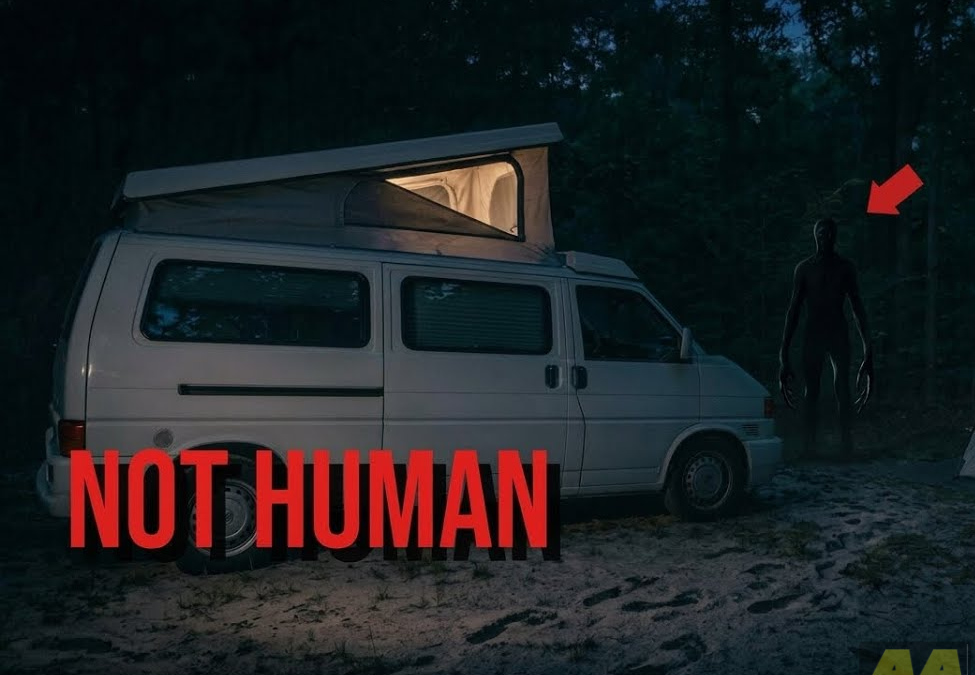
For six years, I had slept in the back of my car whenever I wanted to get away from people, roads, and the ordinary noise of everything else.
About 40 nights a year, I would drive onto public land, find a pullout nobody else had chosen, fold down the seats, and make a bed out of blankets and camping gear.
I liked places where there was nobody around for miles. That was the whole point.
The first time I found the footprints, I thought somebody had walked around my car during the night.
They were bare footprints in white dust, long enough to make my size 11 boots look small.
They formed one perfect ring around the vehicle, about 18 inches from the tires, with no beginning and no end.
There was no trail leading toward the ring and none leading away from it. The dust beyond it was untouched for 200 yards in every direction.
I should have packed up immediately. Instead, I stayed for another night because I wanted an ordinary explanation.
At 2:00 in the morning, I heard something walking around the car at exactly the same distance as those prints.
It stopped at every door. It tested every handle. Then the whole vehicle leaned toward one side as something heavy pressed against it.
I drove away without turning on my headlights and crashed 400 yards down the track.
Years later, another traveler found two rings around his vehicle in November snow, and another discovered three loops recorded by a camera that showed footprints appearing one at a time without anything making them.
So what would you do if you woke up surrounded by footprints that had no trail leading in and no trail leading out?
I had slept in the back of my car maybe 40 nights a year for six years.
Most of those nights were on BLM land where there was nobody around for miles.
That was exactly what I wanted. I liked the quiet. I liked driving until the pavement disappeared, finding some rough pullout beside a wash or ridge, and knowing I could spend the night without hearing another engine.
The place where this happened was in the San Rafael Swell in Utah. It was an alkali flat.
White dust covered the ground, and the landscape was so open that there was nowhere to hide for hundreds of yards.
The silence there was different from ordinary quiet. You could hear your own breathing. Sometimes you could hear your pulse if you stayed still long enough.
I arrived late in the afternoon, parked at a pullout, and settled into the back of the car.
Nothing seemed unusual. There were no other vehicles. No voices. No lights. The sky was clear.
I made dinner, cleaned up, and went to sleep. Around 6:00 the next morning, I woke up and climbed out to make coffee.
That was when I saw the footprints. At first, I thought there were only a few.
Then I walked around the car. There was a complete ring. Bare feet. The prints were about 18 inches from the tires, forming one continuous circle around the vehicle.
The stride was even. There were no gaps. No places where the person had stumbled.
No section where the footprints became deeper or shallower. Just one perfect loop. I stood there holding my coffee cup and looking at them.
The first thing I noticed was their size. I wear a size 11 boot. I took one of my boots from the car and placed it beside one of the prints.
Mine was smaller. Not slightly smaller. By some distance. I crouched down. The print was long and narrow, with the toes clearly visible in the duSt.
I walked around the entire vehicle again. One set. Only one. My own boot prints were still there from the previous evening.
They ran from the driver’s door to the spot where I had stood while cooking.
They stopped exactly where I had stopped. Nothing else entered that area. Nothing left it.
The ring simply existed. Beyond it, the white dust was clean. I walked out about 200 yards in several directions.
Nothing. No footprints. No tire tracks. No sign that someone had approached from the ridge.
I should have packed. Instead, I stood there drinking coffee and building explanations. Maybe somebody had come down from the ridge.
Maybe someone had been walking barefoot. Maybe some teenagers from Green River had driven out and decided to mess with me.
None of those explanations made much sense. But they were ordinary. Ordinary was enough. I stayed.
For about 4 hours, I went back and forth between the footprints and the car.
Eventually, I convinced myself it was nothing. Then I made the decision that I still regret.
I decided to stay another night. I wanted to prove to myself that there was nothing unusual about what I had found.
That evening, I locked the doors. I normally did not bother. The car was isolated, and I had never felt the need.
That night was different. I left the windows cracked about an inch and lay down in the back.
Around 2:00 in the morning, I heard something outside. It was the duSt. There is a particular sound when someone walks across alkali.
Soft. Dry. A faint crunch that carries farther than you would expect. The sound moved around the car.
Exactly where the footprints had been. I did not move. I told myself that if I stayed still, whoever was outside would eventually leave.
The footsteps continued. Around the front. Along the passenger side. Around the back. Then they stopped at the driver’s door.
I heard the handle move. Not a hard pull. A careful one. Someone testing it.
Then the sound stopped. A few seconds later, the footsteps moved to the rear driver’s door.
The handle moved again. Then the back of the car. Then the rear passenger door.
Then the front passenger door. All four doors. In order. Slowly. Deliberately. I was lying in the back of the car with my hand over my mouth.
The sound stopped. For several seconds, nothing happened. Then the entire vehicle shifted. The suspension leaned toward the passenger side.
Then returned. It happened again. The car moved as if something heavy had leaned against it and released its weight.
I stopped thinking. I climbed into the driver’s seat. I put the key in. The engine started.
I drove. I did not turn on the headlights. That was the stupidest thing I have ever done.
I did not want to see what might be standing in front of me. I accelerated down the track.
About 400 yards later, I hit a wash. I was going maybe 30 mph. The front of the car slammed into a bank.
The airbag deployed. My right wrist struck the steering wheel. I knew immediately that something was wrong with it.
I got out. Then I started walking. The county road was 9 miles away. I walked the entire distance in the dark with one hand held against my cheSt.
I did not stop. I did not turn around. But I listened. That is the part people always misunderstand when I tell this story.
The walk itself was not the frightening part. Nothing followed me. I could hear perfectly well.
There was no movement behind me. No footsteps. No vehicle. No sound in the distance.
Nothing. And somehow that made everything worse. Whatever had been around my car had not cared about me once I left.
It had been interested in the vehicle. It had gotten what it wanted there. After that, I did not matter.
A man in a truck picked me up around 6:00 in the morning. I ended up with a broken scaphoid in my right wriSt.
The bone took 6 months to heal, and it never healed properly. They recovered my car 3 days later.
My cooler was still inside. My camp chair was still folded against the back seat.
I never went back for either. The ring of footprints was gone by then. That was expected.
Dust changes. Wind moves it. Tracks disappear. I could accept that part. What I could not accept was the memory of hearing those footsteps move from door to door.
I stopped sleeping in isolated pullouts after that. Not immediately. I tried once or twice.
But I always found myself listening. Every little sound became important. A branch. A bird.
A stone rolling down a slope. I could never sleep the way I had before.
Then I heard about another person who had experienced something similar. He had been on a forest road above Winthrop in November.
The day before, there had been light snow. About an inch. Enough to hold a print perfectly.
The gate was closed 2 miles below him. There was no signal. Nobody else was supposed to be up there.
He was driving a 4Runner. The first morning, he found prints around it. At first, he did what I had done.
He took photographs. He stood there staring at them. Then he stayed. He had driven 2 hours to get there and had booked the time off.
He did not want to leave because something strange had happened. He wanted an explanation.
When he examined the tracks carefully, he realized there were two complete loops. One inside the other.
The inner loop came so close to the doors that the snow had been scuffed against the lower sills.
Bare feet. In November. At 4,000 feet. In an inch of snow. He stood there with his coffee getting cold and tried to think of a normal reason.
He could not find one. A lost person would not likely walk barefoot through snow at that elevation.
Neither would somebody simply passing through. The distance alone made it difficult to accept. He stayed anyway.
The second night, he locked the 4Runner and went to sleep. At about 10:03, he heard the snow.
Snow is quieter than duSt. But when someone steps on it, there is still a faint compression sound.
A soft squeak. He heard it outside. It was moving around the vehicle. He listened for several minutes.
Then he made the same mistake I had made. He decided he needed to see a person.
He opened the door. He took his phone. He followed the prints. He told himself he only wanted to know who had made them.
He walked about 20 yards along the outer loop. Then the sound changed. It had been ahead of him.
Now it was behind him. Between him and the car. He turned. His phone light reached maybe 15 feet.
Beyond that was black timber. Nothing appeared. He moved the light toward the sound. Nothing.
Then the snow compressed behind him. He turned. Nothing. Then to his right. Again, nothing.
The sound kept shifting. Side to side. It crossed the route between him and the vehicle.
He knew the 4Runner was only 20 yards away. He also knew he could not simply run straight toward it.
Something kept moving across that line. He had to change his route. He decided to approach from the back.
He moved toward the rear of the vehicle. Then came around toward the passenger side.
Instead of going around the front, he climbed over the hood on his hands and knees.
Something struck his arm. He never saw what hit him. He felt the impact and kept moving.
He reached the passenger door. He pulled it open. Got inside. Locked it. Then he looked at his left forearm.
The injury ran from near his elbow almost to his wriSt. It was deep enough that he could see structures underneath the skin that he should never have been able to see.
He wrapped the arm in a fleece. Then he heard movement on the roof. It came from the rear.
Up the tailgate. Across the roof rails. Then directly above him. The roof panel moved.
Slowly. The metal flexed downward and returned. Then downward again. He lay across the front seats with his injured arm wrapped against his cheSt.
The roof above his face was moving only about 14 inches away. It continued for about 40 minutes.
Whatever was up there never tried to enter. It could have reached the glass. It did not.
Around 4:00, he heard it move away. Back across the roof. Down the rails. Over the tailgate.
Then onto the ground. After that, silence. He did not start the engine. He did not move.
He stayed across the front seats until the light became strong enough to see the forest clearly.
That took about 3 hours. He finally drove out. He had 22 stitches. He told the doctor he had caught his arm on a broken window frame.
That was what the doctor wrote down. There were three sets of prints on the roof.
The dent in the roof panel cost $1,100 to repair. The third account came from Michigan.
Forest Road east of Baldwin. April. The ground was soft from the melt. The kind of ground that holds a print like wet plaster.
The person who sent the account had been going there for 11 years. He knew the road.
He knew the pullouts. He knew where the ground stayed wet and where it dried firSt.
He had found unexplained prints around his vehicle twice before. Both times, he had assumed somebody had walked through.
Once could be coincidence. Twice was harder to dismiss. This time there were three. Three complete loops.
He counted them the next morning with a stick. He walked each one. By then, he had stopped assuming anything.
But there was another reason this account was different. He had a camera. A dash camera with parking mode.
It recorded the front and the cabin whenever it sensed movement. He had installed it years earlier after an incident in a supermarket parking lot.
He had never thought much about it while camping. That changed when he checked the files from that night.
The first file began at 1:47. The camera showed the front of the vehicle. The bonnet.
The road. Soft ground. Clean ground. Nothing unusual. At 1:48, the first print appeared. It was about 6 feet from the front left side.
Nothing walked into view. There was no person. No animal. No movement. One frame showed clean ground.
The next showed a footprint. At 1:49, another appeared farther around the vehicle. At 1:51, another.
They appeared roughly 90 seconds apart. One at a time. Each was closer to the vehicle.
Every frame showed clean ground surrounding the new print. There was nothing in the image that could have created it.
He watched the file about 30 times during the first week. Then he asked another person to examine it frame by frame.
They could not find an edit. At 1:53, the prints stopped. The final print was beside the driver’s door.
Right against the sill. The toes pointed toward the car. It was the only print in the entire sequence that showed clear weight.
The mud had been pushed upward around the edges. Then the cabin audio activated. The camera had detected movement inside.
The man was awake. His breathing was loud. He was lying inside the vehicle. Then he spoke.
“What do you want?” He had no memory of saying it. The recording ended at 1:54.
It did not show the camera powering down. The next file began at 3:09. There was no error message.
No corrupted card warning. No explanation for the missing 75 minutes. He could not remember them either.
At around 7:00 that morning, a man on a quad found him 300 yards up the road.
He was sitting in the mud. He was wearing only his base layers. His boots were beside the car.
Placed side by side. Upright. The laces were tucked neatly inside. They were next to the driver’s door.
Beside the footprint that pointed toward the vehicle. He never remembered removing them. He never remembered walking up the road.
When the man on the quad approached, he looked up and said, “Good morning.” Then he asked what time it was.
Nothing about his voice sounded unusual. That was what made the missing time harder to understand.
There were no obvious signs of confusion. No clear explanation for the distance. Just 75 minutes that did not exist in his memory or on the camera.
Three people. Three vehicles. Three different locations. Three different nights. The distances between them were enormous.
None of them saw what made the tracks. None found another vehicle nearby. None found a person.
And none could explain why the prints stopped where they did. I used to think the first account was just a strange encounter.
Then I heard about the 4Runner. Then the camera recording from Michigan. The details were different, but the pattern was too similar to ignore.
The tracks appeared around the vehicles. They formed loops. They stayed close to the doors.
They had no visible beginning. They had no visible end. And when something finally happened, it happened at the vehicle itself.
That was the part that stayed with me. Not the size of the footprints. Not the injuries.
Not the missing time. The vehicles were always the center. The tracks did not wander randomly through the landscape.
They circled. They inspected. They stopped at doors. The first person heard the handles being tested.
The second heard something move over the roof. The third saw a print appear directly beside the driver’s door.
It was almost as if the vehicle itself mattered. As if whatever was outside was learning its shape.
Learning where the doors were. Learning where the people inside were sleeping. That is why the advice that came afterward was so simple.
If you find something around your vehicle that you cannot explain, leave that day. Not later.
Not after dinner. Not after you have spent 4 hours convincing yourself there is an ordinary explanation.
Leave. The first man had all the information he needed that morning. The prints were larger than his boots.
There was no trail leading toward them. There was no trail leading away. The dust outside the ring was untouched for 200 yards.
He knew something was wrong. He stayed anyway. The second lesson is even simpler. Do not get out to investigate.
The person above Winthrop had a locked vehicle. He was safe inside it. Then he decided he needed to find a person.
He opened the door. He followed the tracks. He went 20 yards into the darkness.
What he found was not an explanation. He found something that could move around him without allowing him to see it.
And when he finally returned to his vehicle, he had an injury that required 22 stitches.
The third lesson is the one I think about moSt. Do not answer. The man in Michigan spoke through the glass.
He asked a question. After that, there were 75 minutes he could not account for.
Maybe the camera malfunctioned. Maybe there was a perfectly ordinary reason for the missing file.
Maybe his memory failed under stress. There are explanations for almost anything if you are willing to search long enough.
But there was still the matter of his boots. They were standing beside the driver’s door.
Neatly placed. And beside them was a footprint facing directly toward the car. I have spent years sleeping outdoors.
I know what ordinary tracks look like. I know how wind changes duSt. I know how melting snow behaves.
I know how mud records pressure. That knowledge is exactly why those accounts bother me.
Because the strange part is not that a footprint can appear. The strange part is the absence of everything around it.
A person walking across dust should leave a path. A person walking around a vehicle should approach from somewhere.
A person leaving should go somewhere. The first ring had none of that. The snow loops had none of that.
The Michigan recording had none of that. There was only the print. Then another. Then another.
And eventually the vehicle. I have not slept in the San Rafael Swell since. I still camp.
I still go into remote country. But I do not sleep alone beside an isolated track anymore.
If I pull over somewhere and see fresh tracks around the vehicle, I leave. I do not measure them.
I do not photograph them. I do not follow them. I do not wait until morning.
I start the engine and go. Because the worst thing about those footprints is not finding them after you wake up.
It is realizing that they may have been made while you were asleep. Just a few feet away.
On the other side of a thin piece of glass. And if you ever wake up in an empty place and find a perfect ring of footprints around your vehicle, remember that the most important question is not who made them.
It is why they stopped exactly where your door begins?
Disclaimer: This content may be created by Al for entertainment purposes. Any resemblance to real persons, events, or places is coincidental.








