1931 Texas Horror – The Real Story Behind The Texas Chain Saw Massacre
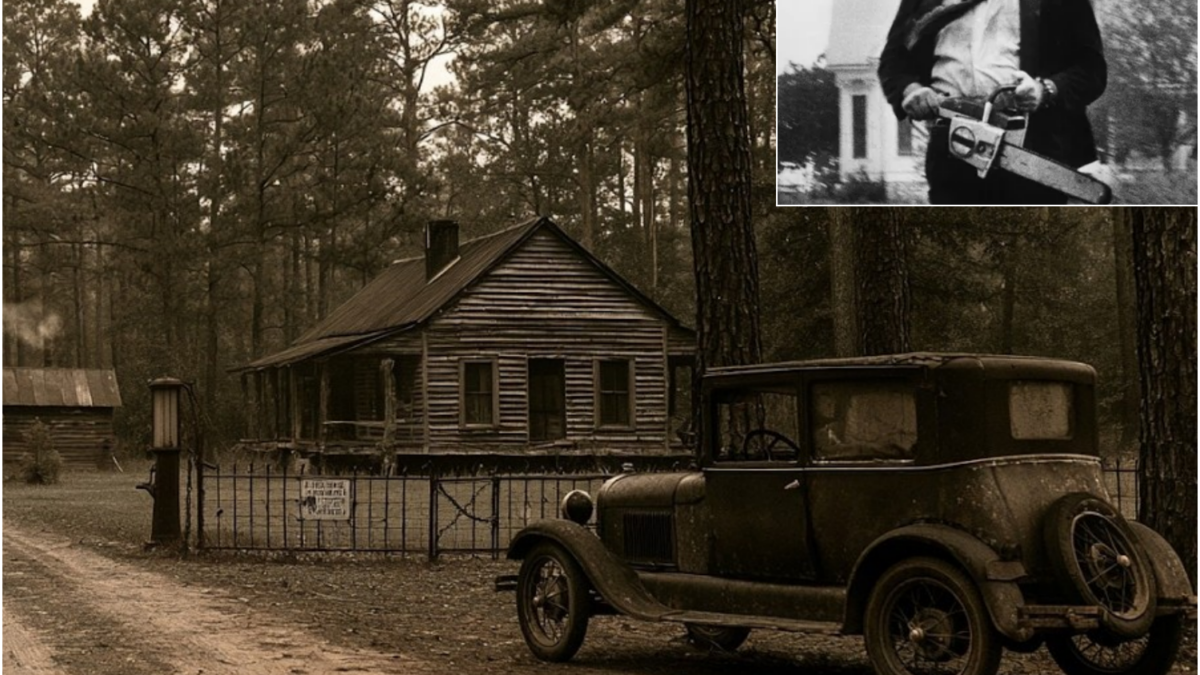
There was a road in East Texas that almost disappeared before anyone decided it should be forgotten.
It ran through the pine woods of Sabine County, away from the rail line, away from the oil fields, and away from the roads that still appeared on official maps.
By 1931, the old timber route had become little more than two muddy tracks disappearing beneath pine needles.
The trees were reclaiming it one year at a time. There were no signs pointing toward it, no maintained bridges, and no reason for an ordinary traveler to turn that way.
Yet on the Fourth of July that year, Rosco Culper drove onto that forgotten road because several farmers had reported something strange.
Their livestock had vanished without broken fences, open gates, or tracks leading away. Rosco was thirty nine years old, a claims investigator with a notebook in his pocket and a sidearm he had not used in eleven years.
He believed there had to be an ordinary explanation. A broken fence hidden in the woods, perhaps, or someone moving animals at night.
He expected a long afternoon, a few measurements, and another report for his employer. Instead, he found a locked gate, a silent farm, a sawmill that should not have been running, and a pair of footprints that seemed to lead into the trees without ever returning.
What he did not know was that the old road had another name among the people who lived nearby, and that everyone who knew that name understood one simple rule.
Never go beyond the second gate after sundown. But why had nobody ever explained what waited beyond it?
The stretch of forest had never been much of a place for maps. The oil boom had gone south.
The railroad had gone north. The wagon road that once crossed the middle of the timber had stopped being maintained around 1924, after the last of the old timber companies packed up its saws and moved away.
By the summer of 1931, only three buildings still stood in the abandoned settlement. There was a cotton gin that had not operated in six years, a general store with paper covering its windows from the inside, and a sheriff’s substation that remained locked more often than it opened.
There had also been a timber spur for the railroad. The rails were gone. Someone had taken them for scrap in 1928.
Only the old wooden ties remained, slowly sinking into the soil while young pines grew between them.
The road itself was called the Bled Soak Cut, at least by the few people who still used the name.
It was not printed on the county map in 1931. An older map from 1896 showed it.
A state survey from 1912 showed it too. After that, the name disappeared from official records.
On the 1896 map, the road ended at a small square marked with a cross.
The surveyor had used that symbol to indicate a private holding whose owner did not want the property identified by name.
That property belonged to the Wallrop family. And on July 4th, 1931, Rosco Culper was sent there.
Rosco was six feet tall and thin in the way of a man who had spent years walking fields and fences.
His hair was dark with gray beginning at the temples. He had a quiet manner that made people comfortable around him, although those who knew him well sometimes said he noticed more than he admitted.
He worked for a livestock and property claims office in Nakogdosh. His job was straightforward.
When someone reported missing cattle, horses, or other livestock, Rosco went to the property, examined the fences and surrounding land, interviewed whoever remained, and wrote a report.
That summer, the office had been paying too many claims. Six farms in one corner of Sabine County had reported nearly identical losses.
Animals were present one evening and gone the next morning. There were no obvious breaks in the fences.
No gates stood open. There were no clear trails leading into the woods. Two families had also reported losing dogs.
Another had lost a horse. Rosco’s employer did not want to approve a seventh claim without sending someone to investigate.
So Rosco went. He left Nakogdosh in a 1929 Model A. Inside the car were six copies of the claim forms, a rolled map, a canteen, his notebook, and a sidearm he had not fired in eleven years.
His wife, Ida May Culper, had packed his lunch. Ida had once been a schoolteacher, and although she no longer taught, she still corrected Rosco’s grammar whenever he spoke too quickly.
That morning she packed him ham on light bread, two hard boiled eggs, a slice of pound cake wrapped in wax paper, and a small jar of pickled okra.
Rosco left before the heat became unbearable. It caught him anyway. By the time he crossed the Angelina River, the air had become heavy and still.
Near Milam, he stopped at a general store. An elderly woman stood behind the counter.
Her name was Verly Suggs. Rosco asked if she knew the Bled Soak Cut. The woman’s expression changed immediately.
She did not answer for several seconds. Then she asked him what he wanted there.
Rosco told her about the livestock claims. Verly listened. Then she said, “Do not go past the second gate.”
Rosco waited. She added, “If you have to be there after sundown, do not be there after sundown.”
Rosco thought she was joking. She was not smiling. Then she said, “And do not eat anything put in front of you if you cannot see it being cooked.”
Rosco wrote the words into his notebook. He did not know why. Writing things down was simply what he did.
Verly returned to counting coins. Rosco tipped his hat and left. The road beyond Milam became rougher with every mile.
Pines closed over the road. Black gum and sweet gum appeared in the lower ground.
The road narrowed until branches brushed both sides of the Model A. He passed the farm of Wilburn Riddle, one of the men who had filed a claim.
The house was empty. The porch was swept clean. A cane rocker sat motionless beside the door.
A yellow dog slept beneath the steps. Rosco passed another farm two miles later. Nobody was home there either.
Then the road divided. One branch had a hand painted sign warning people away. The other had no sign.
Rosco took the unsigned road. That was the Bled Soak Cut. He drove nearly six miles before seeing the first gate.
It stood open. The gate was made of weathered pine boards, wired shut in a way that appeared to have been recently undone.
Rosco stopped long enough to write it down. Then he continued. One mile later, he found the second gate.
This one was different. It was made of iron. A chain crossed it, secured by a padlock.
A piece of tin had been nailed to one poSt. The words WALLROP had been punched into the metal one letter at a time.
Rosco got out of the car. Immediately, the forest seemed quieter. It was still hot.
The cicadas were loud. But there were no birds. Not one. Rosco stood beside the gate and listened.
Then he heard something deeper in the trees. A saw. It moved slowly. Long strokes.
Steady strokes. It sounded like an old sash mill, the kind that had disappeared from common use decades earlier.
Rosco listened until the saw stopped. It did not slow down. It simply stopped. He looked toward the trees.
Nothing moved. Rosco unlocked the chain by lifting the gate just enough to drive around it through the ditch.
He later said that driving past the gate was the decision that saved him. Beyond it, the trees opened into a clearing.
A white farmhouse stood in the center. The paint had probably been fresh before the war, but no one had maintained it since.
A long porch ran along the front. A barn stood to the north. A smaller smokehouse stood to the south.
Beyond the buildings, partially hidden by pine trees, was the roof of an old sawmill.
Smoke rose from its stack. Rosco stopped the Model A. There was no dog. No chickens.
No livestock. For a working farm, the silence was wrong. Two men appeared from the barn.
The older one introduced himself as Frell Wallrop. He was tall, thin, and stooped, with pale blue eyes.
His clothes were simple work clothes, and a length of cotton rope served as a belt.
The younger man was his brother, Odell. Odell carried a piece of wet burlap. His right arm was stained with something dark.
Rosco noticed that Frell positioned himself between Rosco and his brother. Not aggressively. Just enough to make sure Rosco could not see directly into the barn.
Rosco explained his reason for coming. He mentioned the missing livestock. Frell listened without interrupting.
When Rosco finished, Frell said, “We keep to ourselves.” Then he asked whether Rosco intended to leave that afternoon.
Rosco said yes. Frell nodded. “Good.” He advised Rosco to leave by the same road and close the second gate behind him.
Rosco agreed. Then he asked if he could add water to his radiator. Frell pointed toward a pump beside the house.
“Help yourself.” Rosco walked to the pump. He worked the handle. Cold water came out.
As he filled his cup, he noticed wagon tracks in the mud. The rain had fallen two days earlier.
The tracks were fresh. Near them were bootprints. They were not Frell’s. They were not Odell’s.
They belonged to someone wearing narrow dress boots. The tracks came from the porch. They ended beside the wagon.
They did not lead back. Rosco kept his face expressionless. He worked the pump again.
Behind him, something moved inside the smokehouse. It sounded like careful chopping. Slow. Rhythmic. Deliberate.
Rosco did not turn around. He filled the radiator. He thanked Frell. Then he returned to the car.
As he drove away, he closed the second gate exactly as he had found it.
He drove until he reached Milam. Then he pulled onto the shoulder and sat behind the wheel.
His hands were shaking. He remained there for several minutes. He had seen enough to know that something was wrong.
He simply did not yet know what. That night, he told Ida what happened. He did not mention everything.
He left out the sound from the smokehouse. He left out the bootprints. He did tell her about the gate.
Ida listened quietly. When he finished, she said, “You are not going back there alone.”
Rosco agreed. He said he would go to the courthouse in the morning. He would make it someone else’s problem.
But he knew that was not how these things worked. The next morning, Rosco drove to the county seat.
At the courthouse, he asked for the deed clerk. Her name was Lerene Boatright. She had worked there since 1920 and remembered nearly every family name in the county.
When Rosco asked about the Wallrops, she disappeared into a back room. She returned carrying two ledgers.
The Wallrop family had acquired the property in 1868. Two brothers, Isaac and Elum Waldrop, had purchased twelve hundred acres of mostly bottom timber.
They had built a small sawmill. The mill had operated until the timber industry collapsed in 1924.
After that, the property became increasingly isolated. Lerene told Rosco that the family had never sold the land.
She also told him something stranger. There were almost no children recorded in the Wallrop family line.
The family seemed to continue through a series of missing records, unexplained transfers, and handwritten agreements.
Elum Waldrop had disappeared from the records in 1892 after what the newspaper described as a milling accident.
Isaac’s son had left the property in 1902. A document supposedly showed that he had surrendered his interest in the land.
But the signature was only an X. The ink looked newer than the rest of the page.
Rosco asked about the six farms. Lerene checked the records. Every one of them bordered Wallrop property.
Then she mentioned two other names. Kermit Boatright. Hollis Yansy. Kermit had entered the Bled Soak Cut in April 1929.
He never returned. Hollis Yansy was a livestock buyer who disappeared in June 1930. Lerene wrote both names on a piece of paper.
Then she told Rosco that Kermit had been carrying one hundred twenty dollars in a leather pouch when he went to the Wallrop property.
The pouch was never found. Rosco folded the paper into his notebook. Then he visited Sheriff Arlus Scaggs.
The sheriff listened. He had a Bible beneath his folded hands. When Rosco finished, Arlus told him the county would handle the matter.
Then he suggested Rosco return to Nakogdosh and file his report. As Rosco reached the door, Arlus placed a hand on his shoulder.
He said Verly Suggs was known for exaggerating stories. Rosco had never mentioned Verly. He walked to his car without saying anything.
That was when he understood the problem was larger than a strange family living at the end of an abandoned road.
Someone was watching. Rosco returned to his office. He called his employer, Elmer Wadd. He explained everything.
Elmer listened. Then he told Rosco to stay in Nakogdosh. Rosco did. For four days, he slept on a cot in the back office.
He rewrote his report. Then he wrote another. He made three copies. One went to himself.
One went to Ida. One went to the state office in Austin. On the third day, a car with Sabine County plates passed the office three times.
Rosco watched from an upstairs window. He did not go outside. On the fourth evening, a Texas Ranger arrived.
His name was Dwayne Kilgore. Kilgore was fifty one years old and had spent more than two decades in law enforcement.
He read Rosco’s report twice. Then he asked two questions. Could Rosco find the second gate in the dark?
And would Rosco go back with him in daylight? Rosco said yes. The next morning they drove toward the Bled Soak Cut.
They stopped at Verly Suggs’s store. She looked at Kilgore. Then she looked at Rosco.
She said nothing until they were almost outside. Then she quietly told Rosco something. There was a woman at the mill.
Her name was Maholda. Verly said the woman came to the pump every afternoon between two and two.
She carried two buckets. She never looked toward the sawmill. Then Verly said, “If you see her, do not waste the minute asking questions.
Look.” Rosco thanked her. At the second gate, the chain was there. The padlock was not.
Kilgore noticed. They entered on foot. Halfway to the clearing, Kilgore stopped. Two boots sat beneath a pine tree.
They had been placed neatly side by side. They were small dress boots. The name Yansy was written inside one.
Kilgore examined the ground. He said the boots had been placed there recently. Someone wanted them to be found.
They continued toward the clearing. At two seventeen in the afternoon, Maholda appeared. She carried two galvanized buckets.
She walked to the pump. Rosco stepped out of the trees. Kilgore remained hidden. Maholda looked at Rosco.
Then she looked toward the woods. She understood immediately. Rosco kept walking. Maholda moved her lips.
Three words. Run. Get. Out. Then she returned to the pump. Rosco turned around as if he had forgotten something.
He walked back toward Kilgore. They left. When they reached the gate, the Model A was no longer where they had parked it.
Someone had pushed it into a ditch. Kilgore opened the passenger door. Rosco climbed across the seats.
The engine started. They drove. Something moved through the trees. A whistle sounded on one side of the road.
Another whistle answered from the other. Kilgore kept the Winchester across his knees. Neither man spoke.
A pine tree had been cut and placed across the road. Rosco drove over it.
The Model A scraped the ground but continued. Near the final bend, Rosco saw Odell standing among the trees.
He carried a long handled tool. He did not approach. He simply watched them leave.
They reached the highway. Kilgore looked at Rosco. Then he said, “That woman just saved your life.”
Rosco nodded. He knew. They drove directly to Austin. Two days later, a larger party entered the Bled Soak Cut.
Six Rangers. Seven deputies from neighboring counties. A doctor. A photographer. The Wallrops were gone.
The farmhouse had been thoroughly scrubbed. The smokehouse had been burned. The sawmill had been burned as well.
The machinery was gone. The barn floor had been disturbed. In the woods, investigators found a deep pit filled with animal bones.
Under the bones was sand. Under the sand was clay. They found no human remains.
But the well behind the mill contained something else. Four wristwatches. Three pocketknives. A fountain pen.
The pen belonged to Kermit Boatright. And beneath those objects was a small leather ledger.
Inside were forty one names. Dates. Marks. The earliest entries went back to 1894. The latest was from May 1931.
The ledger was written in neat handwriting. It looked less like a diary than bookkeeping.
The Rangers took it to Austin. Its contents were never publicly released. The Wallrops were never located.
Arlus Scaggs resigned in November 1931 and moved away. Maholda was never traced. Rosco never returned to the Bled Soak Cut.
He moved to Beaumont in 1933 and continued working until his retirement in 1958. He rarely spoke about the case.
Once, years later, he told his sons about the woman at the pump. He told them she had shaped three words with her lips.
Run. Get. Out. He told them he hoped she had escaped before the property was cleared.
He never learned whether she had. Dwayne Kilgore remained a Ranger until 1946. He kept a note in his desk that read, “Only Sabine, 31, woman at a pump.”
No one knew exactly what the note meant. His final partner once asked what he listened for whenever they approached an unfamiliar private road.
Kilgore answered, “For whatever stops when it hears me coming.” After that, he said nothing more.
Rosco kept copies of his report until retirement. Then he burned the file himself. He did not want anyone else to read it.
The Bled Soak Cut eventually disappeared beneath the foreSt. The old road vanished. The second gate disappeared.
The tin sign marked WALLROP rusted into the earth. But the story did not disappear completely.
Because Rosco remembered. Verly remembered. Lerene remembered. Kilgore remembered. And somewhere in the records of Austin, there remained a small leather ledger containing forty one names that had no business being there.
The strangest part was that the story did not end in 1931. In 1934, another livestock claim appeared in Louisiana.
Six farms. The same pattern. Animals gone overnight. No broken fences. No clear tracks. Rosco saw the paperwork.
He refused the assignment. He gave it to another investigator. That investigator filed an ordinary report.
Rosco kept a copy anyway. In 1942, a sheriff in southeast Missouri contacted the Texas Rangers about a family called Walden.
They had arrived in 1938. They lived quietly on isolated timberland. Then, in 1941, the property was abandoned.
The house had been scrubbed. A building had been burned. The Rangers said they had no records concerning the family.
That was technically true. They did not mention the Wallrop file. In 1950, a man calling himself Delbert Walden worked for six months at a slaughterhouse in San Antonio.
He had pale blue eyes. He rarely spoke. He always brought his own food. He never ate with the other workers.
One morning, his tools remained on a shelf. He did not return. Nobody proved that Delbert Walden was Odell Wallrop.
Nobody proved that he was not. Rosco lived long enough to see most of the people connected with the original investigation disappear from public memory.
He never forgot the woman at the pump. Near the end of his life, he told his oldest son that he believed he owed her something.
His son asked what. Rosco only smiled. Then he said, “A thank you.” That was all.
After Rosco passed from the family’s records years later, Ida found an envelope tucked behind his clothes.
Inside was a small scrap of gray cloth. She did not know where it came from.
She almost threw it away. Instead, she placed it in a drawer. Nobody knows what happened to it after the house changed hands.
The Bled Soak Cut is no longer marked on modern maps. The pine forest has grown thick over the old road.
The railroad ties have vanished beneath the soil. The cotton gin is gone. The general store is gone.
The sheriff’s substation is gone. But if someone who knows the woods walks far enough through that part of East Texas, they may still find pieces of the old road.
They may find an iron hinge buried beneath roots. They may find a rusted piece of tin.
They may even find an old depression in the ground where a gate once stood.
And if they stand there long enough, they may notice something strange. The forest has sounds.
Wind through pine needles. Cicadas. Distant birds. Branches moving. But sometimes, according to the stories told by people who have searched that country, there are places where the sounds suddenly stop.
No birds. No insects. Nothing. Just silence. Rosco Culper spent the rest of his life believing that silence was the first warning.
Not the second gate. Not the old sign. Not the abandoned road. The silence. Because before he ever saw the Wallrop house, before he saw the pump, before he found the boots, he had already heard the forest change.
Something had noticed him. Something had stopped. And for reasons Rosco never fully understood, a woman standing beside an old pump had decided that a stranger deserved one chance to leave.
That was the part of the story he remembered moSt. Not the ledger. Not the abandoned mill.
Not the names. Not even the second gate. The woman. Two buckets. One afternoon. Three silent words.
And a road that almost disappeared from every map. Perhaps that is why Rosco never trusted an unmarked road again.
Perhaps that is why Dwayne Kilgore always stopped at the first gate and listened. Or perhaps there are places in the world where the safest thing a person can do is notice when everything around them suddenly becomes quiet.
Because sometimes the road ahead is not the dangerous part. Sometimes the warning is the silence that comes just before you reach it.
Disclaimer: This content may be created by Al for entertainment purposes. Any resemblance to real persons, events, or places is coincidental.








