1856, Kentucky – The Most Sinister Mountain Bloodline History Ever Covered Up
There are places in this country that seem to have been erased without anyone ever admitting they were there.
Their names disappear from old records, their roads end where no road should end, and their boundaries become blank spaces on maps that were otherwise drawn with extraordinary care.
The strangest part is not that these places were forgotten. It is that somebody once knew exactly where they were and made a deliberate choice to leave them out.
In the eastern hills of Kentucky, one such place was called Sorrel Notch, a green hollow surrounded by ridges and hidden behind a stretch of mountain that seemed to resist every attempt to measure it.
For decades, the county had avoided the place, its residents had refused to discuss it, and the state had quietly accepted that an entire tract of land could remain unrecorded.
Then, in the fall of 1856, a surveyor named Ephraim Vale was given a simple assignment.
He was to travel into the hills, locate the missing property, identify the people living there, and establish its boundaries.
He was an experienced man who trusted numbers, instruments, and the certainty of a line that returned to its beginning.
But what happens when a man who has built his entire reputation on making boundaries close walks into a place where even the years refuse to stay in order?
And what if the most dangerous thing he could bring back was not a secret, but a record of having been there?
Ephraim Vale was forty-three years old when the state land office in Frankfort placed the folder before him.
He was tall, narrow in the shoulders, and already somewhat gaunt from years of work that required long walks, careful observations, and hours bent over paper.
His right hand was permanently stained with ink, and his left leg carried a slight hitch from an accident on a survey tower many years earlier.
He had never considered either inconvenience worth discussing. His employers valued him for his quiet manner and his dependable measurements.
When Ephraim surveyed a property, his boundary lines met exactly where they were supposed to meet.
His reports were neat, his figures consistent, and his conclusions difficult to challenge. The assignment seemed ordinary enough.
A tract in Caldwell County had remained outside the tax records since approximately 1816. The state wanted the land identified, measured, valued, and returned to the county rolls.
Somewhere in the eastern hills, the old maps indicated a settlement that had never been properly recorded.
The property was known as the Harrow tract, and the older district surveys placed it in a hollow called Sorrel Notch.
The folder contained very little information. There were no reliable measurements, no recent descriptions, and no useful list of residents.
Ephraim found that strange, but he initially assumed the records had been lost through neglect.
The county was old, the hills were difficult to reach, and rural property disputes were common enough that a missing page or an incomplete survey did not seem remarkable.
Then he discovered the note dated in the summer of 1849. It mentioned another surveyor, Corwin Peel, who had been sent to the same tract approximately seven years earlier.
According to the note, Peel had returned that autumn and submitted a report described as unfit to file.
No copy of the report was attached. There was no explanation of what made it unacceptable, and the clerk who had signed the note had since passed beyond the reach of further questions.
The matter, the note stated, had been closed. Ephraim read that sentence several times. A survey could be inaccurate, incomplete, or disputed, but an official report was rarely dismissed without some description of the problem.
He wondered whether Corwin Peel had become ill, encountered a property dispute, or simply failed to complete the assignment.
Whatever had happened, the state had apparently decided that another surveyor should try. Ephraim packed his instruments and departed for Caldwell County.
After two days on the road, he reached Caldwell Courthouse, a modest settlement surrounded by wooded hills and narrow roads.
He rented a room at a small lodging house, dried his boots beside a smoky stove, and visited the county clerk the following morning.
Barnabas Quill was forty-nine years old, heavyset, and known throughout the county for his remarkable memory.
He could recall the details of old property transactions, the names of former landowners, and the circumstances of disputes that had occurred long before Ephraim was born.
His office contained shelves of ledgers, bundles of correspondence, and carefully arranged documents that represented generations of county business.
When Ephraim mentioned the Harrow tract, Quill’s pleasant expression faltered. He asked Ephraim to wait while he checked the records.
Then he disappeared into the back room and remained there long enough for Ephraim to begin examining the shelves around the counter.
When Quill returned, he carried a large deed ledger. He opened it to the section where the Harrow property should have appeared.
There was no entry. Instead, one page had been carefully removed from the binding. The cut was so precise that the surrounding pages remained attached, and the stitching showed no obvious damage.
A narrow pale strip marked the place where the missing sheet had once protected the paper beside it from the light.
Quill stared at the empty space. He said he had never noticed the missing page before.
Ephraim asked whether the Harrows had ever owned the land. Quill hesitated. He explained that people had lived in Sorrel Notch for as long as anyone in the county could remember.
They rarely came down from the mountain, perhaps twice a year, usually to trade. They brought old coins and silver, purchased supplies, and returned home before evening.
Yet the family had left almost no ordinary record of its existence. No Harrow had served on a jury.
None had brought a lawsuit or appeared in one. No Harrow marriage had been recorded in a county church, and no member of the family had been placed in a county burial ground.
Quill had spent most of his life studying the county’s records. Until Ephraim asked about the Harrows, he had never considered the absence unusual.
Then he offered a warning. “You will not find a soul in this town who will ride up there with you, not for any money.”
Ephraim believed him after three days of trying. Men suddenly remembered obligations elsewhere. A wheelwright announced that he needed to travel to another county.
An elderly farmer listened politely to Ephraim’s request, nodded several times, and then walked into his barn and closed the door.
No one openly explained the refusal. On the third evening, a woman approached Ephraim and advised him to visit a small store at the foot of Sorrel Notch.
Its owner, Prudence Ashmore, she said, was the last person on the road who would speak honestly about the Harrows.
Ephraim followed the advice. The store stood near the edge of the settled country, where the road narrowed and gradually surrendered to a rough track.
The building was made of weathered boards and leaned slightly uphill. Inside, shelves held flour, nails, lamp oil, and the ordinary supplies needed by families living far from town.
Prudence Ashmore was seventy-one years old. She was small, upright, and sharp-eyed, with thin hands and a face that seemed to have forgotten how to be surprised.
She studied Ephraim before allowing him inside. “You are the second one they have sent,” she said.
Ephraim explained that he had found the reference to Corwin Peel in the state folder.
Prudence made a quiet sound of disapproval. “The paper was being kind,” she said. She prepared tea and began telling him what the county had chosen not to discuss.
The Harrows had arrived in Sorrel Notch around 1811. No one agreed about where they had come from.
They were not particularly hostile, but they kept their own customs and rarely welcomed visitors.
They maintained their own place of worship, their own burial ground, and their own household arrangements.
They also married within the family. Prudence paused before explaining the detail that had troubled her moSt. The Harrows seemed neither to increase nor decrease in number.
The same small collection of given names appeared in one generation after another, but the people carrying those names did not seem to change in the ordinary way.
Her mother had traded with a Harrow woman called Mahala when she was young. Prudence herself had traded with a woman called Mahala only a few seasons earlier.
Both women had the same crooked finger. Prudence had spent years avoiding the thought. Then she described the winter of 1831.
That year, the Harrows failed to come down the mountain during the spring. It was the first time anyone in living memory could recall such a thing.
Concerned residents organized a small group and rode into Sorrel Notch to investigate. The men returned, but they would not explain what they had found.
Within a month, the county court met behind closed doors. The court sealed the visitors’ report, removed the Harrow property from the tax rolls, and decided that no further official inquiry would be made.
Prudence believed that meeting was the true beginning of the blank on the map. The county had not forgotten Sorrel Notch by accident.
Its leaders had chosen to stop acknowledging it. Before Ephraim left, she gave him one final warning.
“The mountain keeps what it is owed,” she said. “And it has been owed for a very long time.”
Ephraim wrote the sentence in his notebook and underlined it twice. Prudence then helped him find a guide.
Silas Ordway was sixty-two and lived near the old mill below Sorrel Notch. His family had once operated the mill, and he knew the lower mountain trails well.
He agreed to take Ephraim as far as the building, but he refused to travel beyond it.
His fee was unreasonable enough to discourage most men. Ephraim paid without bargaining. They set out the following morning.
A thick fog covered the lower slopes, although the weather had been clear near Prudence’s store.
As they climbed, Ephraim noticed that the fog did not behave like ordinary mountain miSt. It seemed to maintain a fixed distance ahead of them, revealing only a narrow stretch of trail and concealing everything beyond it.
The sounds of their journey also became strange. Their footsteps seemed to return a fraction of a second late, sometimes from the wrong direction.
Ephraim occasionally turned around because he thought someone was walking behind him, only to find the trail empty.
The temperature dropped as they climbed. It was not the clean chill of higher ground.
The cold felt trapped and enclosed, like the air inside a room that had remained shut for many years.
Silas said almost nothing. After approximately two hours, the trees opened around the old mill.
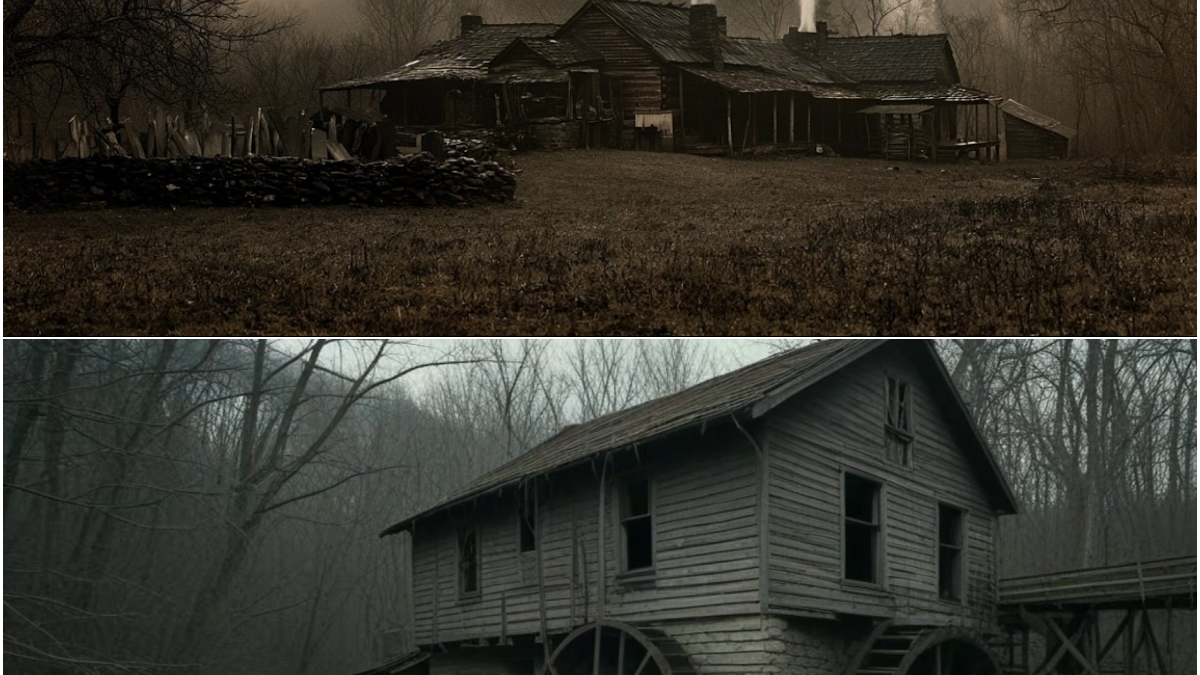
The building stood beside a narrow creek on a foundation of old stone. Its waterwheel had long since stopped turning, and several of its wooden paddles had rotted away.
The entire structure leaned toward the water. Silas dismounted and looked at it for a long time.
He explained that his grandfather had built the mill and his father had operated it.
As a young man, Silas had carried grain along the same trail without thinking anything of it.
That ended when he was twenty. He refused to explain further. He told Ephraim that he would go no higher and advised him to return to town.
When Ephraim asked whether he believed the stories about Sorrel Notch, Silas replied that belief had nothing to do with the matter.
The notch was a place, not a story. It was still there, beyond the mill, and it did not care what a surveyor from Frankfort thought about it.
Then Silas turned his mules downhill and disappeared into the fog. Ephraim continued alone. Beyond the mill, the trail was little more than a shallow depression in the leaves.
He climbed for nearly an hour. The fog followed him, always keeping its narrow distance, while the trees gradually changed.
The hardwoods grew closer together. Their trunks bent in the same direction, leaning downhill as if the whole forest were trying to move away from the upper slopes.
Then the ground suddenly leveled. The fog thinned. Ephraim stood at the edge of Sorrel Notch.
The hollow was a broad green bowl enclosed by two ridges. The grass remained unusually bright for the season, and the land appeared carefully maintained.
It was not the neglected settlement he had imagined. But the first thing that caught his attention was the burial ground.
It stood near the trees, enclosed by a low wall of stacked stone. Inside were leaning markers of different sizes and shapes.
Ephraim counted them automatically. Nineteen. He recorded the number in his notebook. Then he walked the property, examining the terrain and noting the visible features that might help him establish the boundaries.
When he returned past the burial ground, he counted the stones again. This time there were twenty-one.
He stopped. He counted a third time, slowly and carefully, but the result remained the same.
Twenty-one. Ephraim wrote the second number beneath the firSt. He did not cross out either figure.
He also made a decision not to count the stones again. The change was not merely confusing.
It suggested that the act of counting might be part of the problem. If he repeated the exercise and found another number, he would have no reliable way to determine which result belonged in his report.
He continued toward the houses. The Harrow homestead consisted of several connected structures built from dark logs.
Covered passages linked the main house to smaller rooms, sheds, and storage buildings. Smoke rose from two chimneys.
A well stood in the yard beneath a peaked wooden roof, and the surrounding fences appeared to be in excellent condition.
A garden had been turned for the season. A smokehouse stood near the rear of the property.
Everything suggested an established household. Yet the place was unnaturally quiet. It was not the silence of an empty building.
It was the silence of people who had stopped speaking because they were listening to someone approaching.
Ephraim called out. His voice seemed to disappear into the far side of the hollow without returning as an echo.
He walked forward anyway. An elderly woman emerged from a covered passage before he reached the door.
She wore dark homespun clothing and a shawl the color of ash. Her face was pale and deeply worn, but her posture remained straight.
When she folded her hands, Ephraim noticed the crooked finger. She introduced herself as Mahala.
She did not ask his name. Instead, she said the family had been expecting a county surveyor for some time.
Then she stepped aside and invited him in. Ephraim entered. The front room was warm and clean.
Seven adults sat along the walls, watching him with calm expressions. They looked remarkably alike, not merely in the way relatives might share features, but as though the same face had been repeated several times and gradually altered by different amounts of wear.
Mahala seated him at a long table and served him cornbread and a dark stew.
The food was good. As he ate, she spoke about the county’s history. She discussed its founding, the early settlements, and the winter of 1831 with the familiarity of someone describing events she had personally witnessed.
One of the men listening nearby nodded when she mentioned the winter. He appeared to be no older than forty.
Ephraim put down his spoon. He pointed out that 1831 was twenty-five years earlier and asked whether the man had been very young at the time.
The room became quiet. Mahala smiled. She explained that time did not pass through Sorrel Notch in the same way it passed elsewhere.
According to her, it gathered in the hollow, settling into the low ground like cold air.
The Harrows had learned to live within that stillness. She presented the explanation as an ordinary fact of mountain life.
Ephraim found that more disturbing than an elaborate story would have been. The explanation seemed to fit the evidence he had already encountered.
It accounted for the repeated names, the familiar faces, and the crooked finger that Prudence had described.
He asked to see the family’s records. Mahala brought him a register. It contained births, marriages, and other family entries extending back approximately two centuries.
The ink at the beginning had faded to brown, while the later entries remained dark and fresh.
The names repeated throughout the book. Mahala. Halpheus. Verly. Amasa. The same small collection appeared again and again, accompanied by dates that seemed to stretch across generations without bringing the people themselves to an ordinary conclusion.
Very few entries contained a date marking the end of a person’s time in the household.
Ephraim turned the pages slowly. Near the back, he discovered a loose sheet of survey paper.
The handwriting was professional and familiar in its careful arrangement of measurements and bearings. He recognized it as the work of Corwin Peel.
The page appeared to be part of the report that had been rejected in 1849.
It contained a series of measurements, but the final line stopped in the middle of a figure.
The writing ended abruptly, as though Peel had been interrupted while working. Ephraim looked at the incomplete measurement and then at the people around the table.
He asked whether Corwin Peel was still in Sorrel Notch. Mahala folded her hands. She answered that everyone who came up to stay was still there.
“The mountain keeps its own,” she said. The words sounded almost like a blessing. That evening, the Harrows gave Ephraim a room in the house.
It was comfortable and dry, with a rope bed, a wool blanket, and a candle.
But the room contained several objects that clearly belonged to someone else. A good town coat hung from a peg near the door.
A leather satchel rested in the corner, holding a surveyor’s chain and a brass instrument that had turned green with age.
Ephraim recognized the likely owner. Corwin Peel had slept there. He sat on the edge of the bed and remained fully dressed.
He did not intend to sleep until he understood what was happening. Throughout the night, he heard movement in the covered passages.
The footsteps were slow and steady, as if the household were taking turns keeping watch.
At one point, he heard the wooden roof of the well creak. Then came the sound of a bucket descending.
The rope continued traveling downward for an extraordinary length of time. Ephraim waited for the expected splash, but none came.
The rope kept moving into silence. Other sounds came from within the walls. They resembled quiet speech, although Ephraim could not distinguish any words.
The murmuring continued with the rhythm of someone reading from a long liSt. Once, he thought he heard his own name.
Later, he thought he heard Corwin Peel’s. The candle flame began to weaken despite the absence of any noticeable draft.
The room grew cold enough that Ephraim could see his breath. He thought of the trees outside, their trunks all leaning downhill.
He had entered the one place on the mountain where everything seemed to be trying to move away, and he had done so willingly.
Then he remembered Prudence Ashmore’s warning. She had not said the mountain took what it was owed.
She had said it kept what it was owed. The difference suddenly seemed important. A debt was not simply something that happened to a person.
A debt could be entered into. It could be accepted, even without understanding the terms.
Ephraim thought about the supper, the tea, the bed, and the blanket. The Harrows had offered everything freely.
He had accepted everything freely. And perhaps every kindness had been another entry in the family’s register.
The register no longer seemed like a record of people trapped by an unexplained force.
It might have been an account of people who had accepted the mountain’s hospitality and remained to repay it.
Corwin Peel had eaten at the same table. He had slept in the same room.
He had brought his instruments and had apparently been unable to leave them behind. Ephraim understood that he had to depart before morning.
He would take nothing from the house. He would also return whatever he had brought into it that could reasonably be considered part of the arrangement.
His instruments were valuable. They were also essential to his profession. Leaving them behind meant abandoning the work that had defined his entire life.
But he would leave them. He folded the blanket and placed it on the bed.
He left the coat hanging and the satchel untouched. Then he climbed out through the window rather than risk being seen leaving by the front door.
The yard was cold and covered in fog. He began walking toward the burial ground.
The stones stood faintly visible through the gray. He remembered the two numbers in his notebook, nineteen and twenty-one.
He refused to count them. He kept his eyes down and continued walking. That decision seemed to matter.
Counting the stones would have been another attempt to establish the mountain’s total, another way of treating the place as a subject that could be recorded and measured.
He wanted no further part in that business. The house remained dark and silent behind him.
Nobody called after him. Nobody tried to stop him. The lack of pursuit frightened him more than any chase could have.
The Harrows seemed certain that he would eventually return, because whatever he owed had already been entered into the account.
The trail proved difficult to follow. The fog made the trees appear unfamiliar, and the path seemed to bend in directions Ephraim did not remember taking on the way up.
He passed a fallen log. Then a split stone. After some time, he passed the same objects again.
He stopped and realized that he was walking in a circle. He tried another direction, but the same landmarks returned.
The trees leaned over the path, their branches reaching downhill. Ephraim began to suspect that the mountain was not merely hiding the trail.
It was guiding him back toward the hollow. He had left his instruments and the blanket.
He had taken no coat or tool from the house. Yet something still held him there.
He searched his pockets. Then he remembered the bread. During supper, he had taken a small loaf and placed it in his pocket without thinking.
It was the only thing he had carried away from the table. He drew it out and held it in his hands.
The bread had been given to him by the Harrows. He had accepted it as part of their hospitality, and now he was carrying it away.
Perhaps that was enough. Ephraim found a flat stone beside the path and placed the loaf on it.
He spoke aloud, telling the mountain that he wanted no part in its keeping. He acknowledged that he had eaten and that the bread had been given to him, but he was returning what he had carried away.
He said he owed Sorrel Notch nothing. Then he continued walking without looking back. The cold around his neck eased slightly.
The fog remained, but it no longer seemed to press so closely against him. He walked for a long time, uncertain whether he was following the real trail or another path that would eventually circle back.
But the fallen log stopped appearing. The split stone did not return. At last, he understood that the circle had released him.
He was going downhill. The old mill appeared in the dim light of the approaching morning.
It stood where it belonged, a ruined but ordinary building beside the creek. Ephraim placed one hand against its cold stone foundation.
For several minutes, he simply stood there and breathed. The sight of the mill was so ordinary that it almost overwhelmed him.
Its broken wheel, leaning walls, and weathered boards belonged to a world where objects remained where people had left them.
He continued down the trail. Prudence Ashmore’s store had a lamp burning in its window.
She was sitting near the door, already dressed, with her hands folded in her lap.
Ephraim understood that she had spent the night waiting. She did not ask him what had happened firSt.
Instead, she asked whether he had carried anything away from the mountain. He told her about the instruments, the blanket, the satchel, and the bread.
He explained that he had left everything behind except the loaf, which he had returned to a flat stone in the fog.
Prudence closed her eyes and released a long breath. She said the bread might have been what allowed him to leave.
Her grandmother had told her that the people who came back from Sorrel Notch were those who returned owing nothing.
Most travelers could not bring themselves to abandon their valuable possessions, and the mountain understood that weakness.
Corwin Peel, she believed, had been unwilling to leave his brass instrument. Ephraim had been willing to leave his.
That was the difference. Prudence made him tea. This time, he drank it without hesitation.
The tea had been offered at the foot of the mountain, by a woman who had not asked him to stay.
The distinction mattered. Before he left, Ephraim asked why Prudence continued living beside Sorrel Notch when she could have moved to town and avoided the place altogether.
She looked toward the trail. “Somebody has to keep the last light burning on that road,” she said.
She explained that the county had chosen to stop acknowledging the hollow, but ignoring a place did not make it harmless.
It only made it more difficult for anyone who came out of the fog to find help.
She wanted the next traveler, if there was one, to reach a lit window and find someone awake.
Ephraim did not write that answer in his notebook. Some things, he had begun to understand, did not belong in a county record.
He returned to Caldwell Courthouse that same day. Barnabas Quill was waiting. The clerk wanted the names of the residents, the acreage of the property, and the estimated value of the land.
He expected a conventional report, perhaps one explaining why the Harrows had resisted official registration.
Ephraim sat at the desk and wrote a brief statement. He did not list the family members.
He did not estimate the number of people living in the hollow. He could not be certain the number would remain the same from one hour to the next, and he refused to create a figure that might encourage another surveyor to investigate.
Instead, he wrote that Sorrel Notch could not be surveyed by ordinary means. Its boundaries did not close, and the land should remain outside the county’s tax rolls.
He signed the report and handed it to Quill. The clerk read it twice. Then he looked up and said that Corwin Peel had used the same word.
Unfit. Ephraim agreed. It was the only honest description he could provide. He told Quill that no third surveyor should be sent into the hollow.
Another official visit would not simply repeat the county’s mistake. It would create a new obligation, entered knowingly and deliberately.
Quill listened without interrupting. Then Ephraim asked to see the deed ledger. The clerk brought it from the back room and opened it to the missing page.
Ephraim placed his hand over the pale stripe left by the removed sheet. He understood the significance of the careful cut.
The missing page had not necessarily been removed to hide a crime or conceal a property dispute.
It might have been taken out to prevent the Harrows from being recorded at all.
The county had discovered that acknowledging the hollow carried a coSt. The sealed report, the missing deed, and the blank space on the map were all parts of the same decision.
The county had chosen not to write Sorrel Notch into its records because writing it down might have been another way of accepting its terms.
Ephraim closed the ledger. He did not add a single word. Before leaving Caldwell County, he tried to find Silas Ordway so he could return part of the fee.
The old guide would not come to the door. A neighbor explained that Silas had been quiet since the morning he returned from the mill with his two mules and an empty saddle.
He had stood at his gate for a long time, staring into the fog as though trying to count something.
He had not traveled up the mountain since. Ephraim left the money with the neighbor and departed.
The Harrow tract was never surveyed. It remained off the tax rolls, and when later mapmakers redrew the district, they found no reliable information to fill the empty square.
So they left it blank. The blank passed from one map to the next, copied by people who had no idea why it was there.
The absence became part of the official geography of the county. As for Ephraim Vale, he never completed another field survey.
He accepted indoor work in Frankfort, keeping records and checking other men’s figures. His reputation remained intact, but the work that had once given him confidence no longer seemed dependable.
He had seen a place where boundaries shifted and time gathered in ways that ordinary instruments could not explain.
He could no longer trust a straight line to remain where he had drawn it.
Two habits stayed with him for the rest of his life. The first was counting.
He counted the stairs in buildings, the panes in windows, and the coins in his pocket.
When he counted something twice and received the same answer both times, his shoulders relaxed.
But if he obtained two different totals, even through an ordinary mistake, he became pale and had to sit down.
His landlady said he counted the fence posts along his route to work every morning.
There were forty-one. When a storm knocked one down and left only forty, Ephraim refused to go to work until a carpenter had replaced it.
The second habit was keeping a lamp burning in his front window every night. He placed it where it could be seen from the road and kept it lit until his final days.
When people asked why, he offered a simple explanation. He did not want someone who had traveled a long distance in the dark to arrive at a house with no light and no one awake to greet them.
Those who knew him well understood that the answer was not the whole truth. Once, late in a long evening, an old friend asked whether Ephraim believed he had truly escaped Sorrel Notch.
The friend wondered whether the loaf of bread had settled the debt or merely persuaded the mountain to wait.
Ephraim sat quietly before the fire. At last, he admitted that he did not know.
The uncertainty, he said, was the price. Some nights, he still woke before dawn with the familiar cold at the back of his neck.
He would lie in bed thinking about the green hollow, the unfinished report, and the family register with its endless repetitions.
He imagined his own name written somewhere near the bottom of that long column. Beside it would be a date of arrival.
The space beside it would remain empty. And the mountain, he feared, would have no reason to hurry.
I have spent a long time thinking about the account of Ephraim Vale, and the detail that troubles me most is not the shifting stones or the well that seemed to have no bottom.
It is the ordinary judgment of the people involved. The county court had been frightened by what its visitors discovered, so it sealed the report and removed the tract from its records.
The clerk who removed the page had acted with enough care to preserve the surrounding ledger.
Corwin Peel had brought his professional instruments into the hollow because he believed his work required them.
Ephraim Vale had spent his life trusting numbers, and he had nearly been drawn into a place where numbers could not be trusted.
None of these people believed they were making foolish decisions. Each acted according to the information available to him, and each found a reason to avoid confronting the full meaning of what had happened.
Perhaps the county’s silence protected everyone beyond the mountain. Perhaps Sorrel Notch required acknowledgment, written records, and the attention of outsiders in order to extend its influence.
Or perhaps the story of the missing page was simply a way for frightened people to make sense of a place they could not understand.
There is no surviving report that settles the question. The tract remained blank, and the people who knew the reason did not leave behind a complete explanation.
That is what makes the story difficult to put away. A blank space on a map can mean many things.
It can indicate missing information, an old surveying error, or a decision made by someone who believed that recording a place would cause more trouble than leaving it alone.
But in the account of Sorrel Notch, the blank seems to have become more than an omission.
It became a boundary of its own. It separated the ordinary world from a place where the rules of ordinary life appeared to have stopped working.
It protected the county from having to answer questions that no official report could resolve.
And it left Ephraim Vale with a lesson that contradicted everything he had learned as a surveyor.
Sometimes the most important thing a person can do is refuse to finish the measurement.
He had entered the hollow intending to give it a name, a boundary, and a place in the county’s records.
He returned with no usable measurements and no list of residents. He had abandoned his tools, left behind a warm bed, and walked through the fog carrying nothing but the clothes he wore.
The only thing he had taken from the mountain was the memory of what it had offered him.
And even that may have been more than he could safely carry. So imagine yourself traveling through the eastern hills on a quiet autumn afternoon.
The road narrows, the trees grow close, and a stretch of country opens before you that looks unusually green for the season.
You find a house beyond the trees. Smoke rises from its chimneys, and the fences are in good repair.
Someone old and kind comes out to greet you. They offer you a warm meal, a comfortable room, and a place beside the fire.
There is nothing obviously threatening about the invitation. There is no demand, no argument, and no warning that anything unusual is happening.
You are tired, and the hospitality seems generous. Would you accept? Would you notice the way the residents watch you from the walls, or the repeated names in their family register?
Would you recognize the strange stillness of the place, or would you explain it away as the quiet of a remote household?
And if you woke during the night and discovered that your own name had appeared in a book you had never seen before, would you know what to do?
Ephraim Vale’s escape depended on a small act of refusal. He had to leave behind the objects that defined his profession and return the one simple thing he had carried away.
He could not prove that the bread had been the key. He could not prove that the mountain had accepted his declaration.
All he knew was that the path eventually led him down, and that he never returned.
Perhaps that was enough. Perhaps it was only the beginning of a debt that would remain unsettled long after his own careful records had been put away.
The blank on the map survived him. And somewhere in the eastern hills of Kentucky, the old hollow remained outside the county’s official count, its houses joined beneath the ridges, its burial stones leaning in the grass, and its residents living within a strange pool of time.
If Ephraim’s account is true, the safest thing to do when you find a place like Sorrel Notch is to leave it exactly as you found it.
Do not count what cannot be counted. Do not write down what should remain unrecorded.
And do not mistake kindness for a gift that carries no obligation. Because the mountain keeps what it is owed, and the most dangerous debt may be the one you never realized you agreed to pay.
Disclaimer: This content may be created by Al for entertainment purposes. Any resemblance to real persons, events, or places is coincidental.








