15 Terrifying Insects Now Spreading Across America That Will Attack You Instantly
On a warm American night, when the air is still and the last light has disappeared behind the trees, the backyard can look completely empty.
The porch is quiet. The grass barely moves. The wood pile sits exactly where it was left.
Mulch covers the flower beds, leaves rest beneath the shrubs, and somewhere inside a wall, something small is moving through a space you cannot see.
Most people imagine the dangerous creatures of the world living somewhere far away, in deserts, jungles, or places they will never visit.
But some of the strangest biters and stingers on the continent are already here. Some have lived in American soil for generations.
Others arrived from across an ocean and spread almost invisibly. One was so feared that an entire scientific effort was organized to find it before it could establish itself.
Another can float through the air on a thread of silk. One looks like a tiny piece of velvet.
Another resembles a harmless caterpillar covered in soft hair. And one of the most famous creatures on the list spent years becoming a national legend because of a photograph that made it look several times larger than it really was.
The deeper you look, the stranger the backyard becomes. So how many of these creatures could be closer to you tonight than you ever imagined?
The story begins with the creature that probably deserves the biggest correction. Number 15 is the camel spider.
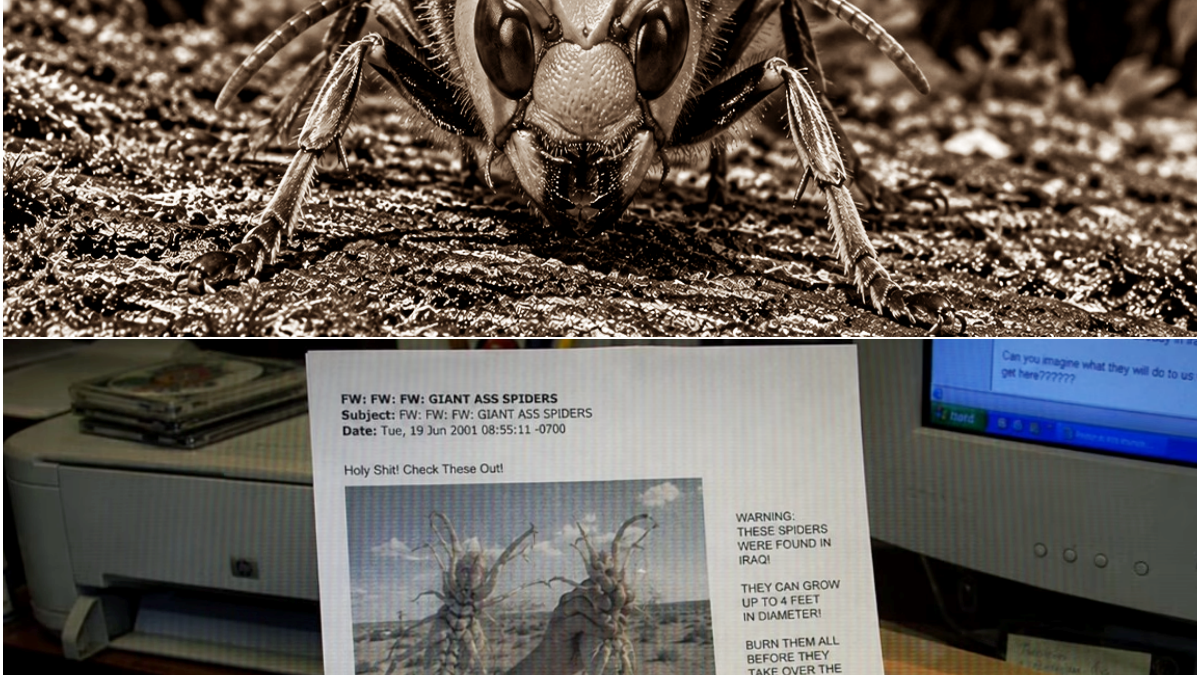
For years, this animal has been presented as something almost monstrous. During the period surrounding the first Gulf War and later the war in Iraq, an email photograph began circulating from one inbox to another.
The image showed two pale, long legged creatures held against a desert background. Because of forced perspective, they appeared enormous, almost the size of a person’s forearm.
The story attached to the photograph was even more dramatic. It claimed that camel spiders could run at extraordinary speeds, produce frightening sounds, leap onto camels, and feed on sleeping people.
The photograph looked convincing enough that thousands of people believed it. But the reality was very different.
The creature commonly called a camel spider is actually a solifuge, sometimes known as a wind scorpion.
Despite its name, it is neither a true spider nor a scorpion. It also does not possess venom.
What it does have are powerful jaws that can reach roughly a third of the length of its body.
Those jaws are impressive enough without the exaggerated stories. The animals can also move surprisingly quickly.
That speed helped create another piece of folklore. People sometimes believed the creatures were chasing them.
They were not. Solifuges generally avoid intense sunlight, and when one appears to run directly toward a person, it may simply be moving toward the nearest patch of shade.
Unfortunately, on a sunny day, that patch of shade can be the shadow cast by the person watching it.
Around 100 species live in the American Southwest, meaning this bizarre looking animal is not some distant desert legend.
It is a real creature living on real ground. But the actual animal is much smaller than the internet version.
One rarely grows longer than a thumb. The legend became enormous. The animal did not.
Number 14 is very different because this one is becoming much easier to notice. The Joro spider first appeared in Georgia around 2013.
It is native to Eastern Asia and is believed to have reached the United States through international shipping.
The female is difficult to overlook. She can reach roughly the size of a hand, with striking yellow and blue black markings and enormous webs made from golden silk.
A web can stretch several feet across a porch, between branches, or across other structures in a yard.
But the strangest part of the Joro spider’s story is not its appearance. It is the way young spiders travel.
Joro spiderlings can climb to elevated points, release silk threads, and allow moving air to lift them away.
The process is called ballooning. Instead of needing a truck, a ship, or a road, the spider can simply let the wind carry it.
That makes the expansion of its range especially unusual. The spiders have been recorded as far north as Maryland, and research indicates that their bodies tolerate colder conditions surprisingly well.
That has raised questions about how far they might eventually spread. Yet despite the dramatic appearance, the Joro spider is generally not interested in people.
Its bite is usually described as comparable to a mild bee sting, and its fangs typically have difficulty penetrating human skin.
When researchers have tested how the spiders respond to disturbance, they have often reacted by freezing rather than attacking.
The thing that frightens people is therefore almost the opposite of what the animal actually does.
It looks enormous. It looks bright. It builds giant golden webs. And yet the spider itself is generally trying to stay out of trouble.
Number 13 is one that many people have probably walked past without ever learning its name.
The wheel bug is the largest assassin bug in North America. It can grow beyond an inch in length and has a gray armored body with one unmistakable feature.
A raised structure runs along its back and resembles part of a wheel or cog.
It looks almost mechanical. But the wheel bug is a predator. It slowly moves along plants and searches for insects such as aphids, caterpillars, and soft bodied beetles.
When it finds one, it uses its curved mouthpart to pierce the animal. Digestive enzymes are introduced into the prey, breaking down its internal tissues so the wheel bug can consume the resulting fluid.
In a garden, that makes the wheel bug useful. Many of the insects it hunts are pests that gardeners would rather not have around.
But the same mouthpart that makes the wheel bug an efficient hunter can also serve as its defense.
A person who handles one carelessly can receive an extremely painful jab. The pain can be intense and may continue for days.
That makes the wheel bug an unusual backyard resident. It is widespread throughout the eastern United States.
It may be sitting on an ordinary plant in an ordinary yard. And almost nobody recognizes it.
Its greatest protection may simply be anonymity. Number 12 is the velvet ant. The name sounds harmless.
The appearance can be even more misleading. A velvet ant may be brightly colored, often with red or orange sections and a body covered in hair that gives it the appearance of a tiny piece of plush fabric.
A child seeing one crossing a sidewalk might easily want to touch it. That would be a mistake.
The velvet ant is not an ant at all. It is a wingless wasp. The females are the ones people need to watch because they possess a powerful stinger.
In parts of the southern United States, velvet ants are sometimes called cow killers. The name comes from folklore claiming that their sting could incapacitate a cow.
That story is exaggerated. The animal is not capable of doing what the nickname suggests.
But the sting itself can be extremely painful. The Schmidt pain index, created by entomologist Justin Schmidt, places some velvet ant stings around level three.
One related species has also been ranked above dozens of other bees and wasps in comparative pain tests.
The sensation can continue for roughly half an hour. Yet the velvet ant is not an aggressive hunter of people.
It generally stings when handled, trapped, or pressed against the skin. The bright colors serve as a warning.
The soft appearance does not mean softness. Number 11 is the creature that pushes the pain scale even higher.
The tarantula hawk is a large wasp, often around the length of a thumb, with a dark blue black body and striking rust colored wings.
It is one of the most impressive insects in the American SouthweSt. It also has one of the most unusual hunting strategies.
A female tarantula hawk searches for tarantulas. The spider can be many times heavier than the wasp, but the wasp approaches anyway.
A confrontation follows. Eventually, the wasp delivers a precise sting, usually near a joint in one of the spider’s legs.
The venom does not simply overwhelm the tarantula. Instead, it produces paralysis. The spider becomes immobilized while remaining alive.
The wasp then pulls the much larger animal toward a prepared location and lays a single egg on it before sealing the space.
When the larva emerges, it has an enormous food source waiting. The process sounds like something from a horror story, but it is a natural reproductive strategy that has developed over countless generations.
For humans, the tarantula hawk’s sting ranks at the highest level of the Schmidt pain index.
Justin Schmidt described the experience as intensely painful but relatively brief. Researchers commonly advise people to avoid handling these wasps rather than attempting to interact with them.
They can be found in daylight, often visiting flowers in open desert landscapes. Their size and spectacular colors make them easy to notice.
Unfortunately, those same features can make people curious enough to approach. The lesson from the first half of the list is becoming clear.
The strangest creatures are not always the ones people notice firSt. Number 10 is a perfect example.
The puss caterpillar is one of the most deceptive insects in the United States. In Texas, it is often called an asp.
At first glance, it does not look threatening. It looks like a tiny tuft of hair.
A small clump of cotton. A piece of fallen fur. Sometimes people compare it to a miniature toupee.
It can be gray, gold, or a mixture of colors and is commonly found on trees such as oak and elm.
The problem is hidden underneath the soft appearance. The caterpillar’s body is covered with hollow spines.
Inside those spines is venom. When the hairs press against skin, the spines can break away and release their contents.
The resulting pain can appear rapidly and spread beyond the original contact point. Some people report intense aching through an entire arm, along with swelling, nausea, or other symptoms.
The University of Florida has documented the caterpillar as one of the most venomous caterpillars in the United States.
Encounters are particularly common in Texas. The caterpillars can fall from trees onto people underneath, and children are among those who are frequently affected.
Several hundred incidents may be reported during an ordinary year, with many occurring between July and November.
The puss caterpillar has one of the most effective disguises on the liSt. It looks like something you would want to touch.
That is precisely why people should not. Number 9 brings us to one of America’s most famous spiders.
The brown recluse. This small brown spider is associated primarily with the south central states and lower MidweSt.
Its name explains much of its behavior. It prefers to hide. It can live in cardboard boxes, closets, folded clothing, wood piles, and quiet spaces where human activity is limited.
It generally has little reason to interact with people. The concern comes from what can happen after some bites.
In a small fraction of cases, the venom can damage tissue around the bite, creating a slow healing wound.
That possibility has made the brown recluse one of the most feared spiders in America.
But there is another side to the story. The spider is frequently blamed for wounds in places where it is not established.
People may attribute unexplained skin injuries to brown recluses even when the species does not occur naturally in that region.
The result is a strange mismatch. The reputation of the brown recluse is nationwide. Its actual range is not.
That means someone can spend years fearing a spider that does not live nearby while overlooking the quiet places where the real species can actually be found.
Number 8 is the black widow. Almost everyone recognizes the image. A glossy black body.
A red hourglass marking. Long legs. The black widow has become so famous that it sometimes feels more like a symbol than an animal.
It appears on Halloween decorations, warning signs, illustrations, and fictional stories. But the real spider is still present across much of the country.
Its venom affects the nervous system, and a serious bite can cause deep muscle pain, cramping, sweating, and elevated blood pressure.
Modern medical care has made severe outcomes much less common than they once were, but the bite should still be taken seriously.
The black widow often lives in exactly the places people rarely inspect. Wood piles. Garages.
Outdoor furniture. Dark corners beneath structures. Spaces beneath eaves. The spider is not usually looking for a confrontation.
It is simply occupying a quiet place. That may be why its familiarity has made it almost invisible.
Everyone knows what a black widow looks like. Very few people think about where one might actually be living.
Number 7 is considerably less famous. The kissing bug. There are around 11 species of kissing bugs found across the southern United States, with sightings recorded in more than 30 states.
They are flat, dark insects that feed at night. Their name comes from their tendency to feed around areas of exposed skin, including the face, mouth, and eyes.
The bite itself is not the primary concern. The greater concern is what can happen afterward.
Some kissing bugs can carry a parasite called Trypanosoma cruzi, which causes Chagas disease. After feeding, the insect may leave fecal material near the bite.
If contaminated material reaches an opening in the skin or contacts the eyes or mouth, transmission can occur.
Chagas disease affects millions of people around the world. The CDC estimates that around 300,000 people in the United States are living with the disease, with most having acquired the infection abroad.
At the same time, locally acquired cases have been documented in southern states. The disease can remain unnoticed for years.
That makes the kissing bug different from most creatures on this liSt. Its danger is not dramatic.
There is no enormous web. No giant stinger. No sudden swarm. It simply moves at night and depends on being overlooked.
The oldest residents of the list are now behind us. From here, the story shifts toward species that arrived from elsewhere and established themselves in American environments.
Number 6 is the yellow jacket. Unlike many of the creatures above, this is the insect most Americans are likely to encounter.
Yellow jackets are wasps. They build paper nests in the ground, inside wall spaces, beneath structures, and in other protected locations.
Their colonies can become large toward the end of summer. That is when they become especially noticeable around picnic tables, trash containers, sugary drinks, and outdoor food.
A yellow jacket can sting repeatedly. Unlike honeybees, it does not lose its ability to sting after a single attack.
The Schmidt pain index places the sting around level two, often described as hot and sharp.
It is not the most painful sting on this liSt. It is not the most exotic insect.
But the yellow jacket has one advantage over almost everything else. It is common. Its ordinary appearance encourages people to ignore it.
That can be a mistake when someone accidentally approaches a hidden neSt. The most dangerous encounter may not involve the most frightening looking insect.
Sometimes it involves the one everyone assumes they already understand. Number 5 is the Asian needle ant.
This tiny insect spent decades hiding in plain sight. Native to Eastern Asia, the Asian needle ant was first recorded in the United States in Decatur, Georgia, in 1932.
For most of the following decades, it expanded across the Southeast without attracting much public attention.
It does not form the large, obvious mounds associated with fire ants. It does not usually create long, visible trails.
It is small, dark, and often solitary. To someone looking at a patio, it can appear to be nothing more than another little ant.
Then researchers began documenting serious allergic reactions. The species is now confirmed in roughly 20 states, extending from Florida toward New York and as far west as Washington and Wisconsin.
In susceptible people, a sting can trigger anaphylaxis, a severe allergic reaction requiring urgent medical attention.
University of Georgia entomologist Dan Suiter received three separate calls in one year from people who experienced anaphylaxis after Asian needle ant stings.
The ant is not generally aggressive. It does not seek people out. Its remarkable story is instead about how easily a species can expand while remaining almost invisible.
For around 90 years, it was simply another tiny insect beneath people’s feet. Then scientists began paying closer attention.
Number 4 is much harder to ignore. The red imported fire ant arrived in the United States from South America around the 1930s, most likely through the port of Mobile, Alabama.
From that entry point, it spread throughout much of the South. Today, it is subject to agricultural quarantine across more than a dozen states and causes billions of dollars in economic damage.
Most people living in fire ant territory know what the mound looks like. A loose dome of soil.
A small patch of disturbed earth. Something easy to walk around. The problem begins when the mound is disturbed.
Fire ants can respond with remarkable coordination. Thousands may emerge from the colony and climb onto whatever has disrupted the neSt.
Their behavior is guided by chemical signals, allowing the colony to react collectively rather than as individual insects.
They can then sting repeatedly. The resulting pustules are distinctive, and people with serious allergies can experience dangerous reactions.
The fire ant’s greatest advantage is familiarity. People see the mounds so often that they stop treating them as remarkable.
But the species is a powerful example of what happens when an introduced insect finds an environment where it can thrive.
Number 3 is another insect that looks almost completely ordinary. The Africanized honeybee. In the 1980s, many Americans learned to call it the killer bee.
The name became part of popular culture. But the insect itself is a hybrid that originated through breeding experiments in Brazil in 1957.
Some colonies escaped. From there, Africanized honeybees gradually spread north through South America, Central America, and Mexico.
They reached the United States near Hidalgo, Texas, in 1990. Today, they are established across portions of the southern United States, including Texas, Arizona, New Mexico, Southern California, Nevada, Oklahoma, and Florida.
To an untrained eye, an Africanized honeybee looks much like an ordinary European honeybee. That is part of what makes identification difficult.
The difference is primarily behavioral. When an Africanized colony is disturbed, a much larger number of bees may respond compared with a typical European honeybee colony.
The swarm can remain defensive over a greater distance. Some reports describe bees pursuing a person for a quarter of a mile, with some incidents extending much farther.
The insect looks like the same bee people are encouraged to protect. The difference is hidden in the colony’s behavior.
That makes this creature another example of how appearances can tell only part of the story.
Now only two remain. And both are hornets with an unusual relationship to honeybees. Number 2 is the yellow legged hornet.
Unlike the familiar yellow jacket, this is an introduced predator from Southeast Asia that specializes in hunting insects, including honeybees.
Its American story is still developing. A beekeeper near the port of Savannah, Georgia, encountered a hornet that looked unfamiliar.
On August 9th, 2023, federal and state scientists confirmed its identity. Fourteen days later, a Georgia agriculture team destroyed the first confirmed neSt.
But the discovery did not end the story. Additional nests were found, including reports from South Carolina, leading officials to increase trapping and surveillance efforts.
There was a reason scientists were moving quickly. The same species had already demonstrated how rapidly it can spread after establishing itself elsewhere.
In Europe, the yellow legged hornet was first detected in France in 2004. The introduction was traced to a single mated queen.
From that beginning, the species expanded across large areas of Europe. That history makes the American situation especially important to monitor.
The hornet does not need to arrive in enormous numbers. It only needs the right conditions.
A single queen can begin a colony. A colony produces more queens. Those queens can establish more colonies.
The process can transform a single introduction into a much larger population over time. That is why scientists look for the species before it becomes common enough to disappear into the background.
And then there is number 1. The Asian giant hornet. The creature that became known across America as the murder hornet.
It is one of the largest hornets in the world, reaching up to 2 in long.
Its stinger can be roughly 3/4 of an inch long and is capable of penetrating some protective clothing.
In Japan, where the species is native, its venom has been associated with severe incidents involving people.
But its reputation in North America came largely from what it does to honeybee colonies.
A group of hornets can locate a hive and begin what scientists call a slaughter phase.
The hornets attack worker bees individually, using their powerful mandibles to remove them from the colony.
A small group can overwhelm a honeybee colony containing tens of thousands of workers. The hornets then carry valuable protein back to their own nest to feed developing young.
This behavior made the arrival of the Asian giant hornet particularly concerning in a country where honeybees play a crucial role in agriculture.
The insect had traveled roughly 5,000 miles across the ocean. Its first confirmed American sightings occurred in Washington state near the Canadian border in December 2019.
Then scientists began the search. They needed to find the nests. That meant tracking individual hornets, placing traps, studying their movements, and relying heavily on reports from people who encountered unfamiliar insects.
Eventually, crews located a nest inside a tree. Nearly 1,500 hornets were vacuumed from the neSt.
The effort continued. Traps were checked. Reports were investigated. Potential sightings were examined. Then, in December of 2024, the Washington State Department of Agriculture and the United States Department of Agriculture announced that the Asian giant hornet had been eradicated from the United States, with no confirmed sighting anywhere in the country since 2021.
It was an extraordinary conclusion to a story that had begun only a few years earlier.
The creature that had crossed an ocean and become one of America’s most famous invasive insect threats was gone from the country.
And there was an important lesson in how it happened. The effort depended heavily on ordinary people paying attention.
Someone saw an unfamiliar hornet. Someone reported it. Researchers investigated. Traps were placed. Nests were located.
The process depended on thousands of small observations becoming useful information. That brings the entire list back to where it began.
The real story is not simply about creatures that can sting. It is about creatures that can remain unnoticed.
The camel spider became a legend because a photograph distorted its size. The Joro spider became impossible to ignore because its enormous golden web can suddenly appear across a porch.
The wheel bug hides in plain sight on plants. The velvet ant looks soft enough to touch.
The tarantula hawk looks spectacular while hunting one of the most intimidating spiders in the country.
The puss caterpillar looks like a harmless piece of fluff. The brown recluse spends much of its time in places people rarely inspect.
The black widow became so famous that people stopped thinking about the real spider behind the symbol.
The kissing bug operates mostly at night. The yellow jacket became ordinary through sheer familiarity.
The Asian needle ant spent decades spreading while almost nobody paid attention. The fire ant became part of the landscape.
The Africanized honeybee looks like an insect people already know. The yellow legged hornet is still being watched because scientists are trying to determine how far it can spread.
And the Asian giant hornet became the rare example of an invasive species that was detected and eliminated before establishing a permanent American population.
Look closely at an ordinary backyard and the scene changes. The wood pile is no longer simply a pile of wood.
The mulch is not just mulch. The cracks around the porch can become shelter. The wall can contain spaces you never see.
A flower can attract a hunter. A tree branch can conceal a caterpillar covered in defensive spines.
A quiet patch of soil can hide an organized colony. The night can be full of movement without making a sound.
Most of these creatures are not searching for people. They are searching for food, shelter, mates, or somewhere to establish a colony.
That is what makes the backyard so interesting. The animals are not waiting for us.
They are simply living around us. And sometimes the most remarkable discovery is not finding a creature nobody has ever seen.
It is realizing that something has been there all along. The next time you step outside on a warm night, the yard may appear completely empty.
But somewhere beneath the leaves, behind the wood pile, inside a wall, beneath a porch, or high among the branches, another world is already awake.
The question is not whether anything is moving out there. The question is how much of it have you simply never noticed?
Disclaimer: This content may be created by Al for entertainment purposes. Any resemblance to real persons, events, or places is coincidental.








