10 Amazon Jungle Mysteries That Still Can’t Be Explained
The jungle was already difficult to understand from the ground. Trees rose so high that the sky disappeared behind layers of leaves, rivers changed their shape with the seasons, and paths that looked obvious one hour could vanish beneath roots and mud the next.
But there were stories of something stranger waiting beyond the familiar trails. A hidden city reached only by following a mysterious guide.
Giant creatures moving through the forest where no one could prove they existed. Ancient faces appearing from beneath a river when the water finally pulled away.
Paintings covering cliffs with animals and figures whose meanings had been forgotten for thousands of years.
And beneath the canopy, enormous geometric shapes and entire settlements that could remain invisible until someone finally looked at the forest from above.
The Amazon had spent centuries hiding pieces of its past in plain sight. Sometimes those secrets appeared as legends.
Sometimes they emerged through archaeology. Sometimes they arrived in the form of an animal that scientists had never properly noticed.
The deeper researchers looked, the stranger the contrast became. Some mysteries were probably stories that had grown with every retelling.
Others were discoveries that changed what people understood about the ancient rainforeSt. And if the jungle had already concealed cities, roads, monuments, creatures, and enormous drawings for centuries, how much more could still be waiting beneath the trees?
In parts of the Brazil Amazon, people have told stories about a huge creature called the mapping guari.
The descriptions vary, as they often do when stories travel between communities and generations, but one detail appears again and again.
Something large is moving through the forest. The creature is sometimes described as foul smelling, large enough to make its presence known before it can be seen.
Some accounts speak of something walking through dense vegetation and tearing at trees as it moves.
Others sound more like traditional folklore than reports of an identifiable animal. Yet the possibility was unusual enough to attract scientific attention.
During the 1980s, zoologologist David Orin took some of the reports seriously and investigated whether they could possibly be connected to an animal that science considered long gone from the modern world.
One possibility was especially extraordinary. A surviving ground sloth. Ground sloths were enormous animals that lived thousands of years ago.
They were not the small tree dwelling animals people associate with sloths today. Some species reached remarkable sizes, and their fossil remains show that ancient South America once contained animals capable of looking completely unfamiliar beside the wildlife living there now.
If an animal related to those ancient ground sloths were still walking through the Amazon, it would represent an astonishing discovery.
But there was a problem. No body was produced. No clear physical evidence established that a surviving ground sloth was living somewhere beneath the canopy.
There was no confirmed specimen that could settle the question. That leaves several possibilities. Perhaps different animals were responsible for different sightings.
Perhaps stories about unusual creatures combined with older traditions until a single jungle monster emerged from many separate accounts.
Perhaps witnesses encountered something real but misunderstood what they were seeing. Or perhaps there is an animal moving through some remote part of the forest that researchers simply have not identified.
There is no confirmed answer. And that uncertainty gives the mapping guari its strange power.
A large creature is one thing. A large creature that exists only in reports is something else entirely.
The Amazon is so immense that stories of hidden animals are easy to imagine. Dense forest can conceal creatures from people who spend their entire lives in the region.
A sound can travel through vegetation without revealing its source. Trees can hide an animal only a few meters away.
Then there is the smell. If something enormous and foul smelling were moving through the forest, the first warning might not be a sight at all.
It might be the air changing around you. That alone would be enough reason to keep walking.
But one of the most unsettling stories from the Brazilian Amazon does not begin with an unknown animal.
It begins with a man who claimed he knew the way to a hidden city.
In 1980, American John Reed entered the Brazilian Amazon with a guide who called himself Tatunka Nara.
Tatunka claimed to know the location of Akor, a secret city belonging to an isolated jungle civilization.
It was exactly the kind of story that could sound impossible and irresistible at the same time.
A hidden city deep in the Amazon. A guide who supposedly knew the route. A civilization concealed from the outside world.
John Reed believed him. The journey continued into the forest, following a promise that the ordinary maps did not contain the destination they were seeking.
At some point, Reed sent a letter home saying they were close. Those words would become particularly important because they were among the last communications associated with his journey.
Then John Reed disappeared. The search for answers eventually uncovered something even stranger about the man who had led him into the jungle.
Investigators discovered that Tatunka Nara had fabricated his extraordinary story about his identity. The guide was not the person he had claimed to be.
Other people associated with his expeditions also disappeared or died, adding further questions around the journeys he organized.
Yet even those discoveries did not provide a complete explanation for what happened to John Reed.
A false identity does not automatically reveal where someone went. A mysterious guide does not prove that a hidden city exists.
And the absence of a verified city does not explain what happened to the person who went looking for it.
Akor has never been confirmed as the secret jungle civilization described in the story. John Reed went into the Amazon believing that he was approaching something hidden from the outside world.
He never returned home. That is where the mystery remains. The jungle does not provide an easy ending to the story because the evidence stops before the destination can be established.
There is no confirmed Akor waiting at the end of a mapped trail. There is only a guide whose identity was false, a journey that moved deep into the forest, a final message saying they were close, and a man who never came back.
Sometimes the Amazon creates mysteries by hiding something ancient. Other times, the mystery begins when the river itself changes.
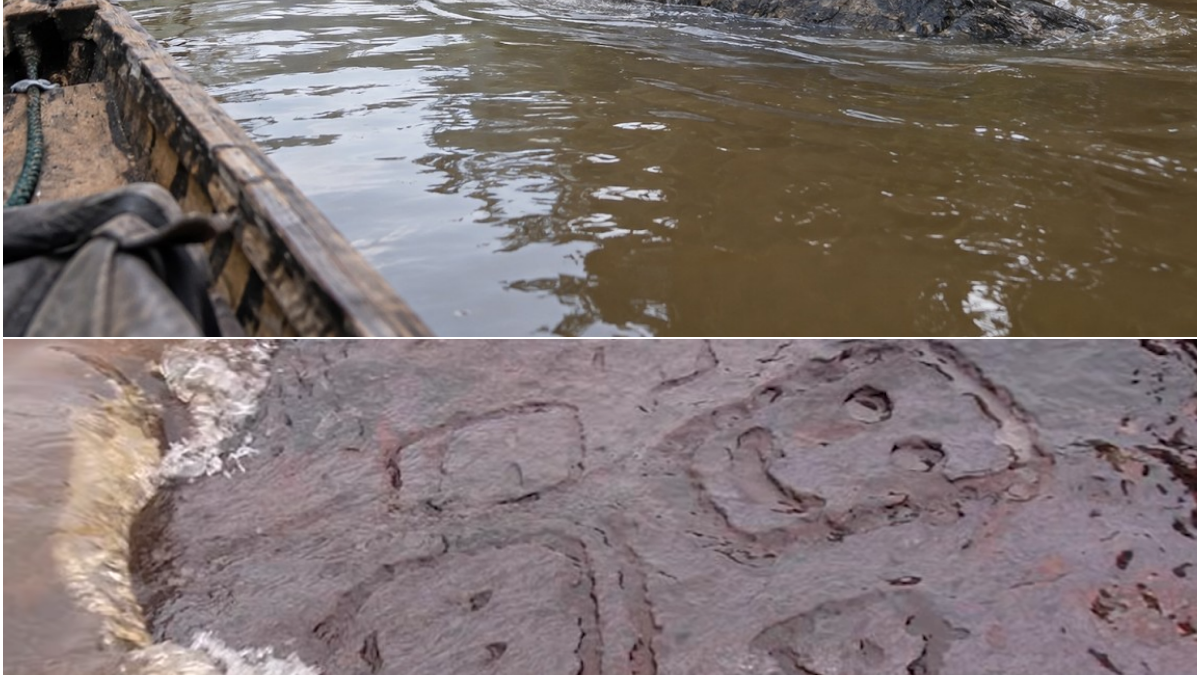
During a severe drought in 2023, water levels along Brazil’s Rio Negro fell dramatically. As the river pulled back, parts of the rock along its banks became exposed.
Then people noticed faces. Human faces carved into stone. Some had different expressions. Others appeared beside figures and marks that researchers were still studying.
The carvings had been seen during an earlier low water period, but the 2023 drought revealed more of the site.
The experience must have been extraordinary. For most of the year, the river covers the rock.
The water creates a boundary between the modern world and whatever is carved beneath its surface.
Then the river falls. The shoreline changes. Rocks that were normally hidden begin appearing. And suddenly there are human faces looking outward from stone.
Archaeologists believe the carvings are ancient, but their exact age and meaning have not been established.
That uncertainty matters. It is tempting to look at an ancient face and immediately decide what it represents.
A face can appear angry, calm, frightened, amused, or ceremonial depending on how light falls across the carving.
But the people who created these images are not there to explain them. The river has become part of the mystery because it repeatedly hides and reveals the site.
During high water, the carvings disappear beneath the surface. During drought, they return. It is almost as if the river controls when the ancient images can be seen.
The 2023 drought therefore did more than expose a stretch of rock. It revealed another fragment of the human history surrounding the Amazon.
And the discovery raises a larger question. How many other ancient places are hidden beneath rivers and lakes simply because modern people rarely see the ground beneath them?
The answer becomes even more complicated when the search moves from Brazil into Colombia. In Colombia’s Serrania de la Lindosa, enormous rock walls carry thousands of ancient paintings.
People, animals, symbols, and strange figures stretch across the stone. The scale is difficult to understand from a single photograph because the paintings continue across broad sections of rock.
This is not one isolated image. It is a massive gallery created in the rainforeSt.
Some researchers have suggested that several of the paintings may represent giant animals from the Ice Age, including a ground sloth.
If that interpretation is correct, the paintings could preserve observations made by people thousands of years ago.
The possibility is fascinating because it would mean the artists were recording animals that no longer exist in the same form.
But not every image is easy to identify. Some figures are difficult to interpret, and researchers continue studying when different paintings were made and exactly what the artists intended to represent.
The paintings therefore occupy an unusual position between evidence and mystery. They are unquestionably human made.
They are physically present. They cover the rock. But their meaning is not automatically preserved with them.
A person standing before the paintings can see the same figures that people saw generations ago, but the explanation behind those images is gone.
Perhaps an animal was important to a ritual. Perhaps it was part of a story.
Perhaps it represented an event. Perhaps the artists were recording creatures they encountered. Or perhaps several meanings existed at once.
The rainforest preserved the paintings, but it did not preserve the conversations that surrounded their creation.
That is one of the recurring patterns of Amazon archaeology. The physical evidence can survive while the explanation disappears.
In Brazil’s Amapa state, another ancient site demonstrates how deliberate some of these constructions were.
More than a hundred large stones stand in a circle near the rainforeSt. Researchers discovered that the site was used for burials and that some stones align with the sun at a solstice.
The arrangement tells us something important. The stones were not simply scattered across the landscape.
They were moved and positioned with purpose. Someone decided where each stone should stand. Someone understood the landscape well enough to organize the monument.
Someone knew that certain stones would align with the sun at a particular point in the year.
But the full meaning of the site remains uncertain. The stones have survived. The people who arranged them have not left behind a written explanation of what they intended.
Standing at the site today, it would be possible to see the massive stones and understand that planning was involved without knowing the complete reason for that planning.
Perhaps the people who built it had an elaborate explanation that would seem perfectly ordinary to them.
Perhaps the monument was connected to seasonal ceremonies. Perhaps the alignment served several purposes. What is certain is that considerable effort went into creating it.
More than a hundred large stones do not simply appear in a carefully arranged circle.
They had to be transported. They had to be positioned. The surrounding landscape had to be understood.
And then the monument remained for generations. From ground level, a person could walk nearby and fail to understand the larger pattern.
From above, the design becomes clearer. That difference between the ground and the sky is one of the reasons the Amazon has revealed so many surprises in recent decades.
For centuries, the rainforest canopy concealed enormous structures. Then modern technology began looking through the trees.
In Brazil’s Acre state, researchers discovered enormous circles, squares, and other geometric shapes cut into the earth.
These ancient human made structures had been hidden beneath the rainforest for centuries. From the ground, the forest could make them difficult to recognize.
Trees grow over old earthworks. Roots spread across walls. Leaves cover paths. The landscape changes until the original design becomes almost impossible to see.
But from above, the shapes begin to emerge. Researchers have studied hundreds of these structures.
Ceremonial use is one serious explanation, but the meaning of every site is not known.
The sheer number of structures changes the way the region can be understood. These were not isolated marks left accidentally in the soil.
They represent large scale modifications of the landscape. People were organizing space. They were building.
They were returning to particular places. And then, over time, the rainforest covered the evidence.
The idea is remarkable. A person can stand beneath the trees in Acre and feel surrounded by untouched wilderness while standing directly above something built by people centuries ago.
The forest creates an illusion of permanence. But the landscape underneath can tell a completely different story.
The trees are relatively recent compared with the ancient earthworks. They grew over structures created by earlier societies.
The jungle did not erase those places completely. It concealed them. The difference matters because concealment creates the impression that nothing was ever there.
Then laser mapping reveals the geometry. The shapes appear. And suddenly the forest becomes a historical landscape rather than an untouched one.
The same transformation happened in Ecuador’s Upano Valley. Archaeologists already knew there were ancient mounds in the region.
What they could not fully understand from the forest floor was how those structures connected.
Laser mapping changed that. The technology allowed researchers to see through the canopy and reconstruct the larger landscape.
What appeared were settlements linked by long roads, with thousands of raised platforms and areas shaped for farming.
People began building there roughly 2,000 years ago. That date is important because it changes the way the landscape is imagined.
This was not simply one isolated mound surrounded by foreSt. It was a connected inhabited landscape.
Roads linked settlements. Platforms formed organized spaces. Agricultural areas showed that people were shaping the environment to support their communities.
From ground level, the forest could hide the relationships between these structures. From above, the pattern became visible.
A person standing beneath the trees might think the landscape was mostly natural. But the laser map revealed evidence of planning on a much larger scale.
Imagine walking through the jungle and realizing that the ground beneath your feet once formed part of a neighborhood.
A road might be hidden beneath vegetation. A raised platform might appear to be an ordinary mound.
Another settlement could be only a short distance away. Without the larger map, the pieces would remain separate.
With the map, they become a network. Researchers can now see much more of that network, but many questions remain.
Who lived in the settlements? How were the communities organized? How did people travel between them?
How did farming work across the landscape? Why did the system eventually change? The technology reveals the physical structure but does not automatically reveal the thoughts and decisions of the people who created it.
The forest gives researchers the buildings. It does not give them every explanation. In the Bolivian Amazon, laser mapping produced another extraordinary discovery.
Researchers found centers associated with the Casarabi culture, including monumental structures, canals, and raised paths connecting settlements.
Again, the forest had hidden a complex human landscape. For centuries, the evidence had existed beneath the canopy.
People living in the region could encounter fragments of the old structures without necessarily seeing the complete system.
Then the lasers mapped the ground. The hidden centers became visible. The canals revealed deliberate control of water.
The raised paths demonstrated connections between places. The monumental structures showed that some locations had special importance.
The people who built these places lived in the region for centuries. Their settlements were real.
Their architecture was real. Their roads and canals were real. What remains uncertain is how the entire network functioned and why these centers eventually stopped being used.
That uncertainty is part of what makes the discovery so fascinating. Technology can reveal a vanished landscape without restoring every part of its story.
The forest kept the structures hidden long enough for later generations to forget how extensive they were.
Then a machine flying above the trees helped reveal them. It is difficult not to wonder how much more remains hidden.
The Amazon is often imagined as a place where human civilization becomes smaller as the forest becomes larger.
The discoveries from Acre, Ecuador, and Bolivia suggest another possibility. The forest may conceal evidence of societies that were much more organized and extensive than older assumptions allowed.
The jungle did not prevent people from building. People built within the jungle. The trees simply grew over the evidence.
Long before laser mapping, stories were already pointing toward hidden places. One of the oldest and most persistent legends is the lost city of Piti.
For centuries, stories have placed Piti somewhere east of the Andes in or near Peru’s rainforeSt.
Different versions describe it differently. Some connect it with a refuge associated with the Inca.
Other versions transform it into a city of gold. The story has attracted explorers and treasure seekers who believed that somewhere beyond the known routes there might be a forgotten settlement waiting to be found.
Expeditions searched the wider region. Ruins were discovered. Ancient settlements were documented. But none has confirmed the legendary city of Piti.
That leaves the story suspended between history and legend. Perhaps the original story came from a real place whose location has never been identified.
Perhaps different accounts of different settlements gradually became combined into one legendary city. Perhaps the golden version grew because stories become more dramatic when valuable treasures are added.
The Amazon and the Andes contain enough genuine ancient ruins to make the legend difficult to dismiss completely.
But genuine ruins do not automatically prove Piti existed exactly as described. That distinction matters.
A hidden ancient settlement is entirely plausible. A particular city matching every detail of a centuries old legend is another question.
The danger is that a compelling story can make people overlook the distance between evidence and imagination.
The jungle is full of real ruins. It does not follow that every legendary city is waiting somewhere beyond the next ridge.
And yet one explorer went into the Brazilian Amazon convinced that another lost city was waiting for him.
His name was Percy Faucet. In 1925, British explorer Percy Faucet entered the Brazilian Amazon with his son Jack and Jack’s friend Rimmel.
Faucet was searching for an ancient city he called Z. The expedition was not a casual journey.
The Amazon was difficult terrain, and the group was traveling into an environment where navigation, supplies, weather, and distance could all become serious challenges.
The three men sent a final message back. Then they continued into the foreSt. They were never seen again.
Searches followed. Stories emerged. Theories multiplied. But no confirmed explanation established exactly where the three men went or what happened to them.
The mystery became part of the larger legend surrounding the Amazon and the idea of hidden civilizations.
For years, people could argue that Faucet had simply been chasing an impossible dream. Then archaeology began changing the picture.
Research eventually demonstrated that complex ancient settlements really did exist in parts of the Amazon.
Large communities had modified the landscape. People had built roads. They had created agricultural systems.
They had constructed monumental structures. They had organized settlements on a scale that earlier assumptions had underestimated.
That does not prove Faucet found Z. It does not establish that the city he imagined existed exactly as he described it.
But it changes the question. Faucet was searching for complex human settlement in a region that many outsiders once imagined could not support large societies.
Modern archaeology has shown that the Amazon did contain complex societies and extensive settlements. The jungle was not empty.
It was simply difficult to see what had been built there. That makes Faucet’s story more complicated.
He may have been wrong about Z. He may have misunderstood evidence available to him.
He may have followed stories that had changed over generations. But the broader idea that the Amazon could contain substantial ancient settlements was not as impossible as people once assumed.
His disappearance remains unresolved. The forest kept that final chapter. And while the story of hidden cities belongs to the past, the Amazon continues to surprise researchers with discoveries in the present.
In Ecuador, in 2024, scientists identified a strange animal that initially looked like something from an entirely different branch of life.
It was a legless amphibian called the truncated seailian. At first glance, its body could easily be mistaken for a giant worm.
But it was not a worm. It belonged to the caecilians, a group of amphibians that spend much of their lives underground.
The discovery was especially unusual because the animal had effectively been waiting in a museum.
The specimen had been collected years earlier, but researchers had not initially recognized it as something new.
Later, scientists returned to the region where it had come from and investigated further. The result was the recognition of a species that had been overlooked.
The truncated seailian grows to about 19 inches long. Its body is pale gray. Its head is flattened, giving rise to the truncated part of its name.
And then there are the teeth. Caecilians can have curved, needlelike teeth that help them seize prey underground.
The animals can feed on creatures such as earthworms, moving through soil where sunlight rarely reaches.
That lifestyle explains part of the mystery. If an animal spends nearly its entire life underground, humans have very few opportunities to encounter it.
A forest can contain countless animals that people rarely see. Some are active at night.
Some live beneath roots. Some remain in water. Some spend their lives in soil. The truncated seailian belongs to the last group.
Scientists still have major questions about it. How does it reproduce? What is its full range?
How many individuals exist? The discovery demonstrates how little humans can know about animals living in environments that seem familiar.
The Amazon does not have to produce a giant unknown monster to surprise researchers. Sometimes the strange creature is small enough to remain unnoticed beneath the soil.
And sometimes it is not even entirely new to science. It can already be sitting inside a museum collection.
Then there is the strange little rodent discovered while scientists were exploring Peru’s Altoo region in 2024.
This animal lives partly in water. Yes, a mouse that swims. It has partially webbed feet and a coat that appears adapted to wet conditions.
Researchers believe it belongs to the genus Daptois, a group of semiaquatic rodents. Its diet probably includes aquatic insects.
The animal was observed in one small swampy section of forest, suggesting that it may be rare or unusually difficult to detect.
What makes the discovery especially interesting is the location. This was not some completely untouched corner of the Amazon where no people ever go.
People live and work nearby. The animal had apparently been moving through that environment without attracting enough attention to become well known.
That fact changes the meaning of the discovery. People often imagine that new species can only be found in places so remote that humans have barely reached them.
But the Amazon can hide unusual animals even near areas where people already live and work.
The animal may have been there for generations. It may have been moving through water while people passed nearby.
It may have been following its own routine while remaining almost completely unnoticed. Scientists still do not know whether it represents a completely new species or a rarely seen species that has simply avoided close study.
Either possibility is interesting. A creature can be unknown not because it is living on some unreachable island but because its behavior makes it exceptionally difficult to notice.
The semiaquatic lifestyle helps explain why. A small rodent moving through swampy water is not easy to spot.
Its habitat provides cover. Its body is adapted to the environment. And its activity may take place at times when few people are watching.
That brings the story back to the larger mystery of the Amazon. The jungle is not mysterious simply because people have invented stories about it.
It is mysterious because enormous amounts of information are genuinely difficult to access. Trees block the ground from view.
Rivers constantly reshape the landscape. Soil hides artifacts. Water covers ancient carvings. Animals occupy underground environments.
Dense vegetation conceals roads, mounds, canals, and settlements. And legends travel through generations long after the original context has disappeared.
One story speaks of the mapping guari. Another follows John Reed and Tatunka Nara toward the supposed city of Akor.
The Rio Negro reveals ancient faces during the severe drought of 2023. Serrania de la Lindosa preserves thousands of paintings.
Amapa contains a stone circle carefully arranged by people whose full intentions remain uncertain. Acre hides enormous geometric earthworks.
The Upano Valley contains ancient roads and settlements revealed by laser mapping. The Bolivian Amazon contains monumental Casarabi centers connected by raised paths and canals.
Piti survives as a legendary lost city somewhere east of the Andes. Percy Faucet disappeared while searching for Z in 1925.
And in 2024, scientists were still finding creatures that had escaped notice in Ecuador and Peru.
The pattern is difficult to ignore. Every time researchers find one hidden piece, the map becomes larger.
A forest that once appeared empty becomes filled with roads. A riverbank becomes an ancient gallery.
A hillside becomes a settlement. A patch of soil becomes the home of an amphibian nobody had properly identified.
A swamp becomes the habitat of a strange rodent. The discoveries do not make the Amazon less mysterious.
They change the kind of mystery it represents. The old image of the jungle suggests that secrets must be supernatural.
The real discoveries are stranger in a different way. Human beings built enormous landscapes and then the forest grew over them.
People created art that survived thousands of years while the meaning disappeared. Communities traveled along roads that modern visitors could not see.
Animals lived beneath the soil while scientists searched elsewhere. Stories of hidden cities may have grown from real places that were misunderstood or forgotten.
And explorers followed those stories into landscapes that were far less forgiving than any map could communicate.
The most remarkable part may be that none of this requires the Amazon to be something other than what it is.
It does not need a giant monster. It does not need a golden city. It does not need a supernatural explanation.
The forest is already enormous. The history beneath it is already deep. The people who lived there already built things that modern technology is only beginning to reveal.
And the animals already include creatures strange enough to seem invented. Perhaps that is why the Amazon continues to produce stories that sound impossible.
People look into a wall of trees and see only trees. Then a river falls, a laser passes overhead, a scientist examines an old museum specimen, or an archaeologist studies a strange carving.
Suddenly the landscape changes. The hidden face appears. The road appears. The city appears. The animal appears.
The story becomes real enough to demand another question. If so much of the Amazon has already been concealed in plain sight, what is still waiting for someone to notice it?
Disclaimer: This content may be created by Al for entertainment purposes. Any resemblance to real persons, events, or places is coincidental.








