JUST IN: The Only Woman Louisiana Ever Sent to the Electric Chair
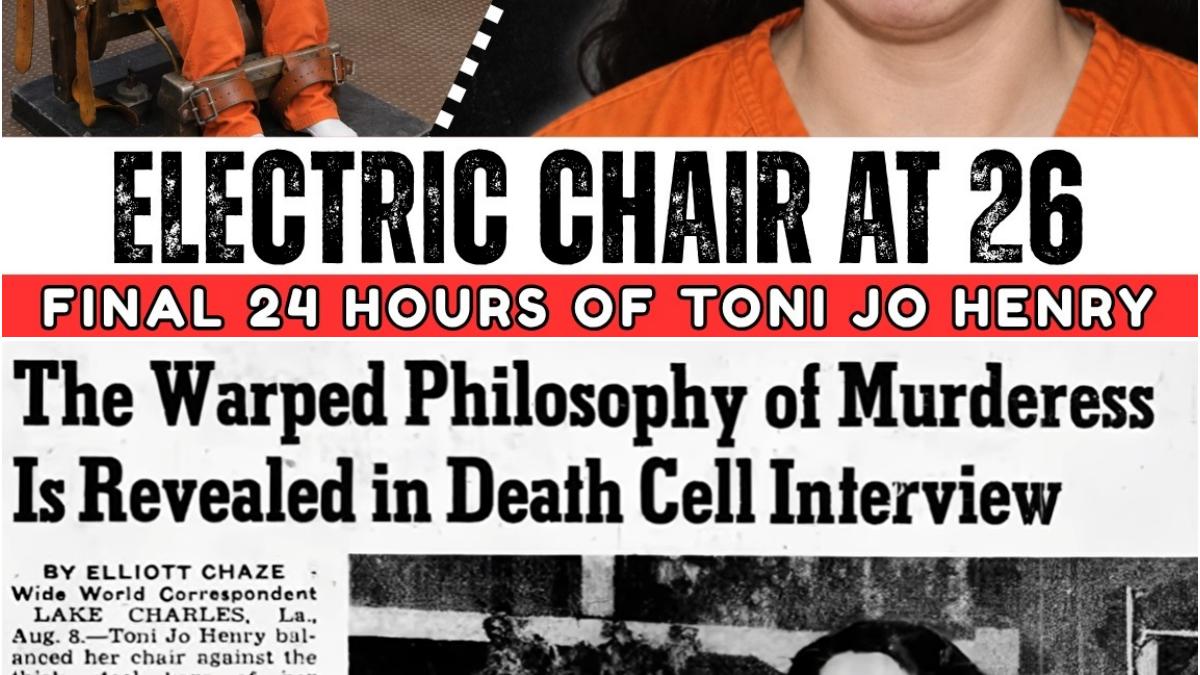
November 28th, 1942. Lake Charles, Louisiana.
Deep in the basement corridor of the Calcasieu Parish Courthouse, a portable electric chair sits waiting. It had been trucked in from Angola State Prison just one day earlier. The room is tight. The air is heavy. And outside, nearly 300 people crowd around the courthouse, desperate to witness something they will never forget.
But what made this execution different was the person walking toward that chair.
She wasn’t a gang leader. She wasn’t a career killer. When the deputy sheriff looked her in the eye and asked for her final words, she didn’t cry. She didn’t beg. She simply said three words that made everyone think she felt no remorse. I’ll tell you what she said.
Her name was Toni Jo Henry. And everything that brought her to that chair began with one man: a man she loved enough to risk everything for.
What could possibly make a woman choose a path that ended in the electric chair?
Before we get to the crime, you need to know the man who lost his life.
His name was Joseph P. Calloway, 43 years old, a salesman for a mail-order firm based out of Houston, Texas. By all accounts, he was an ordinary man living an ordinary life. No enemies. No trouble. Just a working man trying to get through the week like everybody else.
On the evening of February 14th, 1940 (Valentine’s Day), Calloway was doing a simple favor for a friend. He had picked up a brand-new Ford V8 coupe and was driving it from Houston all the way to Jennings, Louisiana, to deliver it personally. This was not a work assignment, not a paid job. Just one man helping another. That was the kind of person Joseph Calloway was.
Somewhere near Orange, Texas, he spotted two people standing by the road: a young woman and a young man, hitchhiking. Nothing about them raised any concern. He pulled over without hesitation and offered them a ride.
That decision (that single, generous act) would cost him everything.
He had absolutely no idea that the young woman now sitting in his passenger seat was carrying a loaded .32 caliber revolver. He had no idea that the car he was delivering had already become the centerpiece of a dangerous criminal plan. He had no idea that this evening would be his last.
Historical records contain limited information about Calloway’s immediate family, and nothing will be assumed here that the record does not confirm.
Joseph Calloway did everything right that night. And what happens next is impossible to believe.
Now, who was the woman in that passenger seat?
Her name at birth was Annie Beatrice McQuiston, born January 3rd, 1916, in Shreveport, Louisiana. She was the third of five children born to James Leslie McQuiston and Ella Beatrice McQuiston. From the outside, it looked like an ordinary Southern family. But Annie’s life was anything but ordinary.
When she was just six years old, her mother, Ella, died of tuberculosis. Six years old. Too young to fully understand death, but old enough to feel the ground disappear beneath her feet.
After her mother passed, Annie went to live with her grandmother. And by her own account, those were the only years she ever truly felt safe and loved.
But that did not last. When her father remarried, Annie was brought back to live with him and her stepmother. She resented every moment of it. She never stopped wanting to go back to her grandmother. That longing for safety, for love, for somewhere to belong, would follow her for the rest of her life.
At 13, she took a part-time job at a local macaroni factory, trying to help the family. She was fired when the manager discovered that tuberculosis had been in her household. She went home that day without a job, and with no good news to deliver.
Her father’s response was to beat her.
That night, Annie McQuiston made up her mind. She was never going back.
Court records and documented interviews confirm she left home permanently after that incident. She took to the streets, became a hustler, and reinvented herself entirely, changing her name to Toni Jo Hood.
By the age of 16, she was smoking, drinking, using cannabis, and moving through Shreveport’s criminal underworld. She was arrested multiple times, including once for assaulting a man, but avoided prison because of her age.
She eventually entered the brothel system in Shreveport’s red-light district. She later said of that life, “I was awful ashamed of the things I did there, but they wouldn’t let me quit. It’s that kind of a racket.”
She was petite and pretty, with jet-black hair, and became well known among clientele. She also became addicted to cocaine.
Law enforcement across Louisiana and South Texas had her name in their files: a pattern of escalating arrests. Yet not once did the system stop her with any real consequence.
Then, in 1939, everything changed.
In Austin, Texas, a customer walked into the brothel where Toni Jo was working. His name was Claude Henry, known on the streets as “Cowboy”: a prizefighter who had seen better days, a man with a criminal record and a pending murder charge. He was out on bail, awaiting a second trial for the shooting of a former San Antonio police officer named Arthur Sinclair.
By any measure, Claude Henry was not a safe choice. But Toni Jo did not want safe. She wanted someone who felt real.
And Claude did something that no man in her life had ever done before. He helped her get off cocaine.
They married on November 25th, 1939, in Louisiana. Toni Jo signed the certificate using her real birth name for the first time in years. They honeymooned in Southern California. For a brief moment, it seemed like her life had finally turned a corner.
It had not.
The honeymoon did not last long. While Toni Jo and Claude were still settling into married life, a telegram arrived. Claude was ordered to return to Texas for his second murder trial: the shooting of former San Antonio police officer Arthur Sinclair, a crime he had committed before he and Toni Jo ever met.
Toni Jo begged him not to go. She pleaded with him to run, to disappear with her, to start fresh somewhere no one knew their names.
Claude refused. He was convinced the shooting was self-defense. He was convinced the jury would see it his way. He was convinced he was coming home.
He was wrong.
In January 1940, Claude Henry was found guilty of murder. The sentence handed down by the court stopped Toni Jo cold: 50 years in the Texas State Penitentiary at Huntsville.
Fifty years. She was 23 years old. There was no version of that math that brought her husband back to her in any meaningful time.
Court records show that, from the moment that sentence was read aloud, Toni Jo made herself a promise. She would get Claude out, by whatever means necessary.
She relocated to Beaumont, Texas, placing herself as close to Huntsville as she could get. She began reaching back into the criminal networks she had known across Louisiana and South Texas, asking quiet questions about the prison layout, about weak points, about what a jailbreak would actually require.
People warned her. They told her it was impossible, that it could not be done. She did not listen to a single one of them. Instead, she got to work.
She needed four things: a fast car, enough cash, weapons, and someone who had been inside Huntsville and knew how it operated. She started looking for that person.
She had a plan. She had a motive. And she was willing to do whatever it took to see it through. And what it took is something no one saw coming.
That person came in the form of a man named Horace Finnon Burks. Most people called him “Arkie,” a nickname drawn from Arkansas, where he was from.
On paper, Arkie had very little going for him. He was an ex-convict. He was absent without leave from the United States Army, meaning the military was already looking for him. He had no steady income, no fixed address, and no clear direction in life.
But he had one thing Toni Jo desperately needed. He claimed to know the inside of the Texas State Penitentiary at Huntsville. He had served time there. He said he understood the layout, the routines, the rhythms of the place.
Court records describe him as a young man who was broke, ruthless, and easy to pull into someone else’s plan. Toni Jo pulled him in.
They built their operation piece by piece.
Step one: money. They needed funds to finance the escape. Claude had once mentioned a small bank in Camden, Arkansas, that he believed could be robbed successfully. That became their target. Rob the bank. Fund the breakout.
Step two: weapons. Toni Jo could not walk into a gun shop and buy firearms, so she went around the system entirely. She found two teenagers she had influence over and persuaded them to break into a local gun store. They came back with pistols and ammunition. Court records confirm this as the method used to arm themselves.
Step three: transportation. They needed a fast car, and they needed it without any paper trail connecting them to it. The solution: pose as hitchhikers, wait for the right vehicle to stop, and take it.
Step four: clothing. Toni Jo was thinking past the prison walls. When Claude walked out of Huntsville, he would need civilian clothes immediately. She planned to take them from whoever offered them a ride.
Arkie later claimed in court that he believed they were planning robbery and theft, nothing more. He said he never knew how far Toni Jo was truly prepared to go. That claim would sit at the center of both their trials.
By early February 1940, they were armed and in position near Orange, Texas. All they needed now was the right car to stop.
February 14th, 1940. Valentine’s Day.
While couples across America were exchanging cards and flowers, Joseph Calloway was doing something far simpler: keeping a promise to a friend.
He had picked up a brand-new Ford V8 coupe and was driving it from Houston along the main highway toward Jennings, Louisiana, to deliver it personally. No complicated agenda. No reason for worry. Just an open road and a straightforward errand.
Then, somewhere near Orange, Texas (a small town sitting right on the Louisiana border), he saw them. Two people standing on the roadside: a young woman and a young man, hitchhiking.
In 1940, this was not an unusual sight. People caught rides with strangers all the time. Calloway did what many decent people would have done. He slowed down, pulled over, and offered them a seat. Toni Jo and Arkie climbed in.
The three of them rode together through the evening. Conversation stayed light and surface-level, the kind of small talk you make with people you do not know. They passed through Lake Charles without incident. The road ahead stretched into open countryside: rice fields on both sides, flat land, almost no other vehicles in sight.
And then, the moment they cleared the last edges of Lake Charles, everything changed.
Toni Jo reached into her clothing and drew the .32 caliber revolver. Calloway was ordered to turn off the main road immediately and steer onto a remote country track. The car stopped.
At gunpoint, Toni Jo and Arkie stripped him of his outer clothing, his watch, and approximately $15 in cash. The clothes were not taken out of greed. Toni Jo wanted them for Claude: a change of civilian clothing, ready for the moment he walked out of Huntsville. Even standing over a man at gunpoint, her mind was still entirely fixed on her husband.
Then Calloway was forced into the trunk of his own car and locked inside.
Arkie took the wheel. Toni Jo directed him further down the track until she found what she was looking for: a barren rice field edged by haystacks. Remote. Completely isolated. No houses. No witnesses.
The car stopped. The trunk opened. Calloway was pulled out and marched barefoot across the field: stripped, exposed, walking across cold Louisiana farmland with no shoes and no way out.
Court records confirm precisely what happened next. Toni Jo ordered him to kneel. She told him to say his prayers. Then she raised the revolver and fired once: a single shot, directly to his head.
Joseph P. Calloway died instantly at the scene. He was 43 years old. He had done nothing to deserve what happened to him. He had simply been kind enough to stop.
Toni Jo and Arkie returned to the Ford and drove through the night toward Camden, Arkansas, heading for the bank: the next stage of a plan that was already soaked in blood.
They checked into a cheap hotel. Toni Jo slept.
Back in that rice field, Calloway’s body lay completely undiscovered. The Ford he was supposed to deliver never arrived in Jennings. Nobody yet knew why.
Joseph Calloway’s body would not be found for four days. And when it finally was, it was not investigators who led police to it. What happens next is impossible to believe.
In that cheap hotel room in Camden, Arkansas, Toni Jo slept. Arkie Burks did not.
He sat awake, replaying what he had watched happen in that rice field: the order to kneel, the instruction to pray, the single shot. Whatever he had agreed to when he joined Toni Jo’s plan, this was not it.
He later told the court that robbery was one thing, but what he witnessed out in that field was something else entirely, and he wanted no further part of it.
At some point during the night, he made his decision. He gathered Calloway’s clothing, took the Ford, and left. No confrontation. No note. He simply disappeared into the dark.
When Toni Jo woke up, the room was empty. No Arkie. No car. No plan. Nothing left but the few dollars remaining from what they had taken off Calloway the night before.
She counted it. It was just enough for a bus ticket back to Shreveport.
She boarded a Greyhound and headed south, back to the very city she had fled as a beaten, jobless 13-year-old.
In Shreveport, she reached out to an old contact, a woman connected to the brothel world she had once worked in, who directed her toward family. She arrived at the home of her Aunt Emma, traveling alone, visibly unsettled, carrying nothing.
Aunt Emma took one look at her niece and knew something was deeply wrong. She pressed for answers. Toni Jo held out for a while, but eventually the truth came out. She told her aunt that she had killed a man near Lake Charles.
What Aunt Emma did next would set the entire investigation in motion. Aunt Emma did not protect her niece. She picked up the phone.
Her first call was to her brother, a Louisiana state trooper. He was away on vacation and could not be reached immediately. So Emma turned to one of his colleagues instead: Sergeant Dave Walker.
Walker came to the house where Toni Jo was sheltering, sat down across from her, and began asking questions. He already knew that a man named Calloway and a Ford coupe had been reported missing. But at that point, no body had been recovered. No confirmed homicide was on the books. He was not walking into a known murder investigation. He was simply following a lead.
He did not expect what came next.
Toni Jo told him everything: the hitchhike near Orange, the robbery at gunpoint, the rice field outside Lake Charles, the single shot. She described the location of the body with calm, precise detail, as if she had memorized the coordinates.
Then she reached over and handed him the .32 caliber revolver. One spent round. Five live rounds still in the chamber.
Walker arrested her on the spot, but cautiously. With no confirmed body and no processed crime scene, he handed her over to Lake Charles police and let them take it from there.
Investigators drove her south to the location she had described. They found Joseph Calloway exactly where she said: barefoot in the rice field, a single gunshot wound to the head. The bullet recovered during his autopsy matched Sergeant Walker’s revolver without question.
Days later, the Ford coupe was located in Arkansas, abandoned, still containing Calloway’s stripped clothing, and cigarette butts with lipstick marks pressed into the tips.
Every piece of physical evidence had been handed to investigators by Toni Jo herself.
Toni Jo was charged. But there was still the matter of her accomplice.
She refused to name him. The press had already begun circling the case, and she was furious with how she was being covered. Newspapers were calling her a “sultry brunette,” writing more about her appearance than about the dead man in the rice field. She was openly annoyed. For the time being, she stayed silent about Arkie Burks.
But the evidence did not stay silent.
When investigators processed the abandoned Ford coupe recovered in Camden, Arkansas, they found more than Calloway’s stripped clothing in the back seat. The ashtray held cigarette butts bearing clear lipstick marks: physical confirmation that a woman had been present throughout the journey. Fingerprints inside the vehicle gave investigators additional material to work with.
And separately, military channels were already flagging Horace Finnon Burks as absent without leave from the United States Army, his name and description moving through both civilian and military networks at the same time.
Eventually, Toni Jo made a calculation. She was frustrated with the press. She was looking ahead to trial. And she realized that naming Arkie gave her something useful: a second person to point at when the time came to argue about who had actually pulled the trigger.
She cooperated with investigators and formally identified Horace Finnon Burks as her accomplice.
Law enforcement traced him through his AWOL status and prior criminal record. He was located and taken into custody.
He did not deny being present that night. His position was straightforward from the moment he was arrested. He was there? Yes. He drove the car? Yes. But he was firm: she had fired the shot.
The .32 caliber revolver was formally matched to the bullet pulled from Calloway’s skull at autopsy.
Both Toni Jo Henry and Horace “Arkie” Burks were charged with first-degree murder. They would face their trials separately.
On March 27th, 1940, Toni Jo Henry walked into the Calcasieu Parish Courthouse in Lake Charles for the first time as a defendant. Judge Hood presided. The charge was first-degree murder.
The press was already waiting. Reporters from across Louisiana had descended on the courthouse. Toni Jo was young, striking, and facing the death penalty, and the newspapers made sure their readers knew it. They gave her a nickname that spread fast: “Tiger.” Front pages across the state carried her picture. The coverage was relentless before a single witness had even taken the stand.
Her strategy in court was straightforward: point the finger at Arkie. She testified that Horace Burks was the one who had fired the fatal shot, not her. Arkie did not testify during this first trial, so the jury heard only one side of that particular argument.
They deliberated for six hours, longer than many expected. On March 29th, 1940, they came back with their verdict. Guilty. Sentence: death by hanging.
Toni Jo received the decision without any visible emotion.
Arkie Burks was later tried separately, convicted, and handed the same sentence.
Then Toni Jo appealed, and won. Her legal team successfully argued that the overwhelming press coverage, combined with conduct the presiding judge had permitted inside the courtroom, had made a genuinely fair trial impossible. A new trial was ordered.
The second trial opened in February 1941. And this time, something changed. Arkie Burks took the stand and testified against her directly. He told the jury that Toni Jo was the one who had ordered Calloway to kneel, that she had raised the revolver, that she had fired.
The jury deliberated for approximately one hour. Guilty again. Death sentence reimposed.
She appealed once more, and again secured a new trial.
The third trial began in January 1942, with Judge Pickrel presiding. The jury deliberated for under an hour. Guilty, for the third time.
This appeal was denied. The Louisiana Supreme Court upheld the conviction in full. Her attorneys then petitioned Governor Sam H. Jones directly for clemency. He refused, publicly and without hesitation.
There was one final legal challenge. While her cases had been moving through the courts, Louisiana had quietly changed its method of execution from hanging to electrocution. Her lawyers argued this change could not legally be applied to her existing sentence. The Louisiana Supreme Court disagreed. The challenge failed.
Louisiana’s portable electric chair, normally kept at Angola State Prison, would be brought to her.
From her first arrest in February 1940 to the morning of her execution in November 1942, Toni Jo Henry spent nearly three years held at the Lake Charles jail. Angola housed male prisoners. She stayed local, in the same parish where Joseph Calloway had died.
During those years, a Catholic priest named Father Wayne Richard, head of a local parish, began visiting her regularly. He baptized her into the Catholic faith. Those who witnessed their interactions described the friendship as genuine. He became her steadiest presence in the final chapter of her life.
Four days before her scheduled execution, on November 23rd, 1942, Claude Henry and an accomplice attempted a breakout from the Texas prison farm where he had been transferred. His goal was to reach Toni Jo one last time. The attempt was shut down quickly. He was recaptured in Beaumont, Texas: the same city where she had once relocated just to be near him.
On November 27th, she was allowed to telephone Claude from the chief jailer’s office. He was weeping. She was calm, bright, and composed.
She told him, “Get rid of that prison suit. Go out the front door. Go straight, and try to make something of your life.”
She was the one consoling him.
The following morning, November 28th, 1942, she was told her head would need to be shaved for the electrodes. She wept. She was then permitted to wear a brightly colored scarf to cover it. She chose a plain black dress (back from the cleaners that morning) and black pumps. Father Richard placed a crucifix in her hands.
A news cameraman photographed her in the condemned cell. She looked into his lens and said, “I’ve smiled twice, mister. Have you any idea how much talent is being wasted here today?”
At 12:05 in the afternoon, she was brought down to the basement corridor of the Calcasieu Parish Courthouse. Louisiana’s portable electric chair had arrived by truck from Angola the previous day.
Deputy Sheriff Henry Reid Jr. read her the death warrant and asked if she had any final words.
She said, “I think not.” Then, quietly: “No.”
She looked at Father Richard. He told her, “Keep smiling.” She did.
At 12:11, a leather mask was fastened over her face. The switch was thrown.
At 12:12 in the afternoon, she was certified dead by Dr. E. L. Clement and Dr. H. B. White. She was 26 years old: the sixth person electrocuted in Louisiana’s history, and the only woman.
Her final request was that the crucifix remain in her left hand at burial. It was honored.
Outside, nearly 300 people watched a sheet-covered stretcher carried to a waiting hearse.
On March 23rd, 1943, Horace “Arkie” Burks was executed in that same portable electric chair. Not a single relative came forward to claim his body. He was buried in an unmarked grave.
In her final months, Toni Jo had submitted a sworn statement attempting to take full responsibility for Calloway’s death, trying, at the very end, to clear Arkie. It changed nothing.
Claude Henry was eventually paroled from Huntsville, reportedly due to failing health. On July 15th, 1945 (less than three years after Toni Jo died trying to free him), he was shot and killed in a brawl with a café owner in Dallas, Texas.
The man she gave everything for, gone in a bar fight.
To this day, workers in the Calcasieu Parish Courthouse’s mortgage department say strange things still happen.
As one local news report put it: “Now, these hallways are where many of the courthouse workers come to take a breather from the workday. And a lot of times, they say they can hear an extra set of footsteps behind them. They hear voices, and sometimes they even smell burnt hair. Now, coincidentally (or maybe not), these hallways actually circle the courtroom where the Toni Jo trial took place.”
Doors lock on their own. Items go missing without explanation. They blame Toni Jo.
“It’s automatic,” one worker told a local reporter decades later.
Father Richard officiated her funeral and personally designed her headstone. She is buried at Orange Grove Cemetery in Lake Charles, Louisiana, crucifix in her left hand, exactly as she asked.
Joseph Calloway pulled over to help two strangers on Valentine’s Day. He never made it home.
Toni Jo Henry spent every resource she had (every contact, every plan, her own life) trying to free a man who died in a bar fight three years after she did.








