The Oxpecker’s Secret
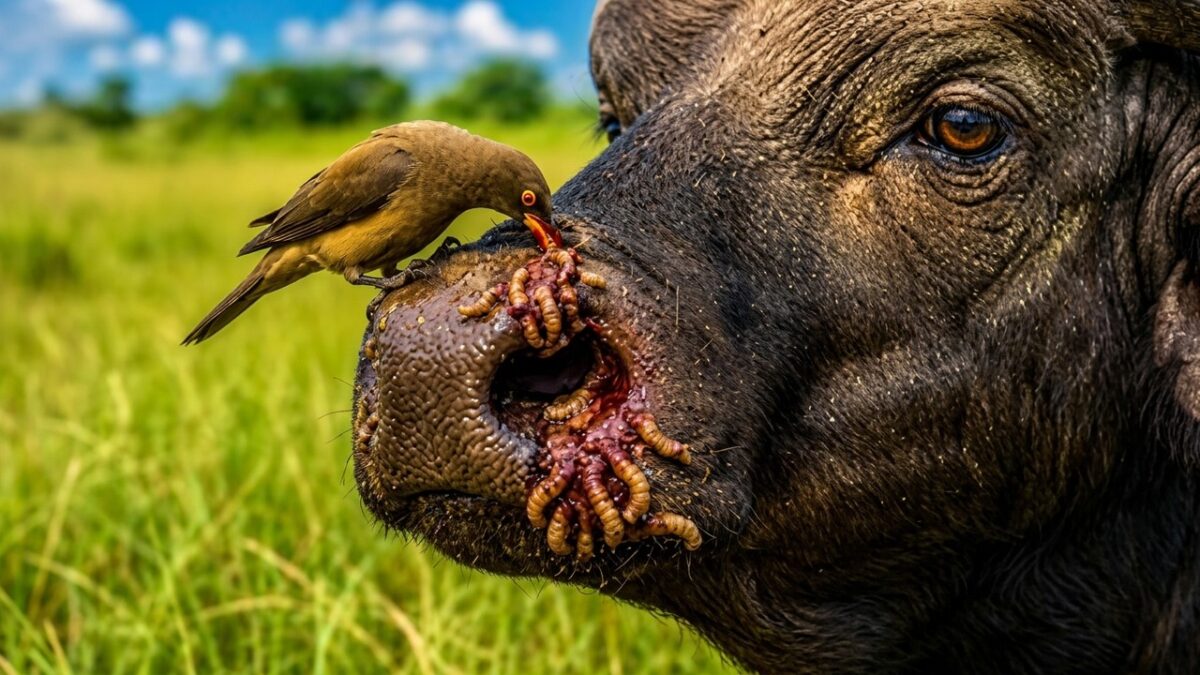
Many think this bird helps Africa’s largest animals. So why does it drink their blood? That’s the question that will guide us through this video. Come along—let’s solve this mystery together.
This time we’re not following the life of the oxpecker. We’re following the truth, and it’s more uncomfortable than most people realize. Picking ticks off a buffalo.
Pulling parasites from a rhino’s skin. Even sounding alarm calls for the giraffe. For decades, the textbook example of cooperation in the wild.
One bird, four giants, seemingly nothing but benefits. That’s how simple people long imagined it—until someone looked closer. Much closer.
But in the 1990s, researchers asked an uncomfortable question. Does this bird actually help, or does it just look that way? They watched more carefully, filmed longer, counted every single tick. And what they found no longer fit the old story.
The answer was clear. Oxpeckers don’t just randomly open a wound by chance—they seek it out deliberately. Some peck at the same spot for minutes at a time.
Not to help, but to drink. And that’s exactly where the real puzzle begins. Blood isn’t a random find.
It’s energy, concentrated protein. For a bird that hunts ticks all day, an open wound is almost a feast. More efficient than hunting individual ticks.
A single wound can provide food for days. If it hurts, why doesn’t the buffalo just shake it off? One jerk, one kick. The problem would be solved—but that almost never happens.
The buffalo tolerates it almost every time. That’s the truly strange part of this story. Ticks are more than just a nuisance.
They carry diseases that can weaken a buffalo for weeks. An oxpecker eats hundreds of ticks a day. That helps the buffalo.
So, on balance, the buffalo probably gains more from the oxpecker than it loses—just not always. But there’s something else that throws the equation off entirely.
When danger approaches, the oxpecker sounds the alarm, often before the buffalo itself notices anything. That’s why, in Swahili, it’s called askari wa kifaru—the rhino’s guardian. A parasite doesn’t normally warn its host of danger.
A true friend would do exactly that. But not every giant is treated the same. Rhinos tolerate more wound-feeding than buffalo.
Giraffes are visited less often than both. Zebras, almost never. The same bird, four different relationships—as if it had its own set of rules for each giant.
The latest research tells an evolving story. The relationship shifts depending on the host, the season, the tick infestation—even from bird to bird. Sometimes the benefit clearly outweighs the cost.
Sometimes the balance tips the other way. There’s no fixed answer. It seems to keep changing.
That’s what makes this story so remarkable. And then, there she is again. The same notch in her tail feathers.
The same female we’ve followed through her entire life. She was never the hero of this story, nor the villain. She simply survived on what these giant animals had to offer.
Maybe the real question was never whether she’s a helper or a parasite, but why nature made it this way—a symbiosis that somehow works.








