BREAKING: The Night ALI KHAMENEI Was ELIMINATED, 5000 MUSLIMS in TEHRAN Gave Their Lives to JESUS
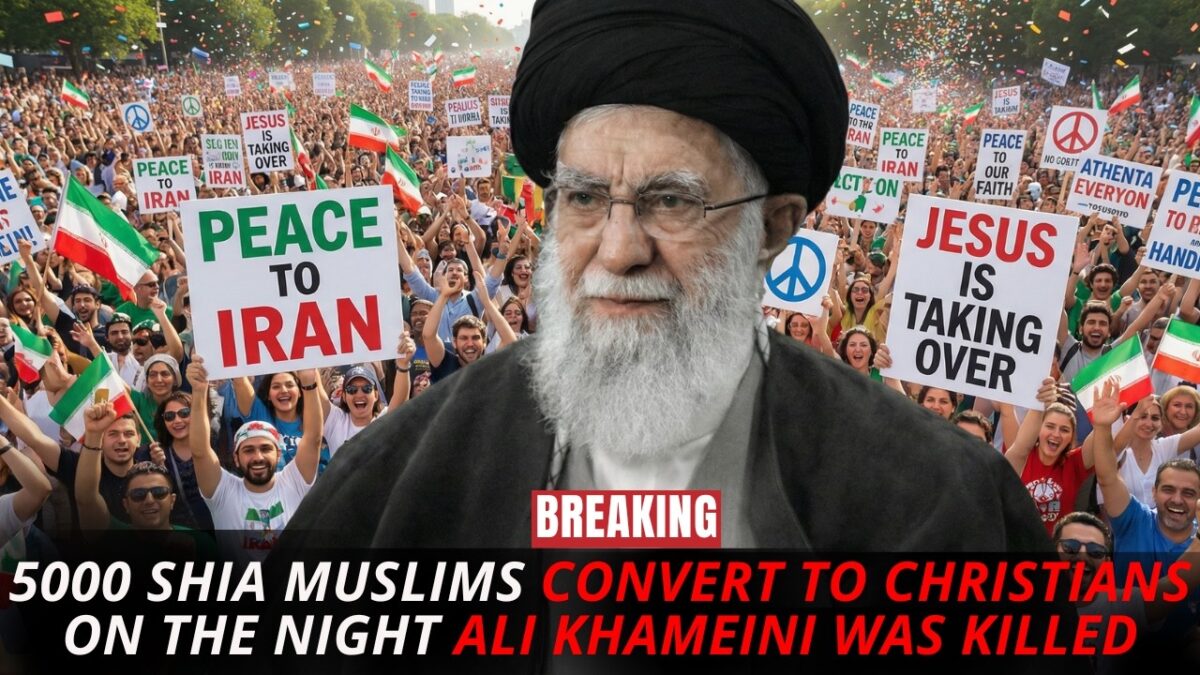
On February 28th, 2026, when the bombs fell on Tehran, something happened that no military strategist predicted. That no intelligence agency anticipated. And that no government on Earth could have prepared for.
While the most powerful armies in the world were busy eliminating the man who had ruled Iran with an iron fist for 37 years. While missiles were tearing through the night sky, and the streets of the Iranian capital were shaking beneath the weight of the most significant military operation the Middle East had seen in decades. Something else was happening, in the basements and rooftops and darkened apartments of this ancient city.
Something quieter than a bomb, but more powerful than any weapon ever built. Something no radar could detect, and no defense system could intercept.
In the same hours that Ali Khamenei, the Supreme Leader of the Islamic Republic of Iran, breathed his last breath, 5,000 Shia Muslims in the city he had controlled for a generation were kneeling before a completely different authority. And giving their lives to Jesus Christ.
I was there. I saw it with my own eyes. And what I am about to tell you will change the way you see Iran, the Middle East, and the unstoppable power of God. Forever.
My name is Reza Tehrani. And this is the story the world was too busy watching the explosions to notice.
I am 45 years old.
I was born in Tehran, and raised in the Narmak district on the eastern side of the city. In a neighborhood where the call to prayer echoed five times a day from the mosque on the corner of our street. Where every family knew every other family. And where being a good Shia Muslim was not a choice, but a way of breathing.
I grew up believing that Iran was God’s country. That the Islamic Republic was God’s government. And that Ayatollah Ali Khamenei was the closest thing to God’s voice on earth.
I believed all of it completely. The way a child believes in the safety of his father’s arms. Without question. Without hesitation. Without a single crack of doubt.
I was a journalist for 22 years. I worked for three different Persian-language newspapers in Tehran, covering politics, social affairs, and religion. I traveled to every corner of this country with a pen, a notebook, and eyes that were trained to see the truth.
And it was the truth that eventually broke everything I thought I knew.
I want to tell you about the night that changed Iran forever. Not just politically. Not just militarily. But spiritually, in a way that no bomb, no missile, and no government decree could ever manufacture, or reverse.
I want to tell you about the night of February 28th, 2026. The night the strikes began. The night the sky over Tehran turned orange with fire. The night the Supreme Leader of the Islamic Republic of Iran, Ayatollah Ali Khamenei, was eliminated in a joint military operation carried out by the United States and Israel.
I want to tell you what I saw. What I heard. What I felt. And what happened in the secret places of this city, while the world was watching the explosions on their television screens.
But before I tell you about that night, I need to tell you who I am. Because the man writing these words is not the same man who once prayed five times a day facing Mecca, and believed with his whole heart that the Islamic Republic was the will of God.
I remember the exact moment the strikes began.
It was early on Saturday morning, February 28th, 2026, just before dawn. The city was still dark, and most of Tehran was asleep.
I was sitting at the small desk in my apartment in the Punak district, in western Tehran, working on an article I had been writing for weeks. An article I knew I could never publish inside Iran. An article about the underground church movement that had been growing quietly beneath the surface of the Islamic Republic for years.
I heard the first explosion before I felt it.
A deep, hollow boom that seemed to come from everywhere at once, rattling the windows of my apartment and shaking the framed photograph of the Alborz Mountains that hung on my wall.
I stood up from my desk, walked to the window, and looked out at the Tehran skyline.
What I saw stopped my breath completely.
The sky to the south of the city was glowing. Not the orange glow of a sunrise. But the violent, angry glow of fire. The kind of fire that comes when something massive and irreversible has been set in motion.
Within minutes, my phone was exploding with messages. Friends. Former colleagues. Sources I had built over two decades of journalism. All of them sending the same panicked words.
The strikes had begun.
United States and Israeli forces had launched coordinated attacks, targeting military installations, nuclear facilities, and command centers across 24 provinces simultaneously.
The sound of air raid sirens began to fill the streets of Tehran, rising and falling in waves that sent people running from their homes into the streets in their nightclothes, looking up at the sky, their faces twisted in terror.
I grabbed my jacket, my notebook, and my phone, and went outside.
The journalist in me could not stay indoors. Even after everything the regime had done to me for telling the truth. Even after everything I had suffered for my faith. My instinct was still to go toward the story. Not away from it.
What I found in the streets of Punak that morning was a city in complete shock. Ordinary Iranians, standing in clusters on street corners. Some crying. Some silent. All of them looking at the burning horizon, with the same expression. The expression of a people who had always feared this moment, but never truly believed it would come.
The news about Khamenei came later that morning.
It came the way most shocking truths come. In fragments. Each fragment more staggering than the last.
First, it was the foreign reports. Donald Trump posted on his Truth Social platform that Khamenei had been killed in the strikes. That American intelligence and tracking systems had located him. And that he had been eliminated, along with several other senior leaders of the regime.
Benjamin Netanyahu followed shortly after, saying there were growing signs that Khamenei was no longer alive. That senior commanders of the Revolutionary Guard, and key figures in Iran’s nuclear program, had also been taken out in the same wave of attacks.
Iranian state media pushed back initially, with the Tasnim and Mehr agencies insisting that the Supreme Leader was steadfast and firm, and still commanding the field.
But by Sunday, March 1st, 2026, everything changed.
Iranian state media confirmed it. Ayatollah Ali Khamenei, the man who had ruled Iran with absolute authority since 1989, the man who controlled the military, the judiciary, the economy, and the spiritual life of 88 million people, was dead.
A 40-day mourning period was announced. And in that single announcement, the Islamic Republic admitted what the whole world had already begun to understand.
The throne had fallen.
I was standing in the street when I heard the confirmation. And I felt something pass through me that I cannot fully describe, even now.
It was not celebration. Not in that moment. It was more like the feeling you get when a very long, very heavy storm finally breaks. And the air changes. And you realize that the world you are standing in is fundamentally different from the world you were standing in just hours before.
The strikes did not stop with his death. The world needs to understand that clearly.
The bombs kept falling. US and Israeli forces continued their operations across Iran, through the night and into the following days. Trump made it plain that heavy and precise bombing would continue, uninterrupted, throughout the week, or for as long as necessary.
Iran was firing back, launching counterattacks that triggered air defense interceptions in Kuwait, Qatar, the United Arab Emirates, and Bahrain.
The region was on fire.
But something else was also on fire. Something no satellite could track, and no missile could target. Something burning in the hearts of thousands of Iranians, who had been waiting, in secret, for exactly this moment.
And that fire, the one burning in human souls across the broken and beautiful city of Tehran, was the fire nobody saw coming. The fire that would change everything.
To understand what happened on the night of February 28th, 2026, you need to understand what Iran was before that night.
You need to understand the cage.
Not a cage made of iron bars, that you can see and touch and measure with your hands. But the kind of cage that is built inside a person’s mind and soul, over decades of control, fear, and religious manipulation.
I spent 22 years as a journalist in this country. I saw things most Iranians never saw, because my press credentials took me into rooms and situations that ordinary citizens were never allowed to enter.
I attended government briefings where officials said one thing to the public, and something completely different behind closed doors. I visited prisons where political prisoners were held without charge or trial. I sat in courtrooms where verdicts were decided before the hearings began.
And I documented, quietly and carefully, the systematic destruction of human dignity that the Islamic Republic carried out every single day. In the name of God.
The Christians of Iran carried the heaviest burden of all under Khamenei’s rule.
I want to be very clear about this, because the world does not fully understand what it meant to be a Christian inside the Islamic Republic.
It was not simply a matter of being a religious minority, tolerated at the edges of society. It was a matter of survival.
Converting from Islam to Christianity was considered apostasy. And apostasy could be punished by death. Not imprisonment. Not fines. Death.
A man who left Islam and declared his faith in Jesus Christ could face a death sentence from an Islamic court. Women who converted faced imprisonment, forced psychiatric evaluation, and worse, depending on the political climate and the mood of the judge sitting behind the bench on any given day.
I knew this not from textbooks, but from the faces of the people I had interviewed. People who had lost fathers and brothers and sons.
The house churches of Tehran, Isfahan, Shiraz, Tabriz, and Mashhad lived under constant threat of raids and destruction.
The Ministry of Intelligence and the Revolutionary Guard ran dedicated units whose sole purpose was to infiltrate, identify, and dismantle underground Christian communities. Informants were planted inside house churches. Pastors were monitored through their phone calls and their movements.
When a raid happened, it happened fast. And it happened violently.
Revolutionary Guard agents in plain clothes would surround the building. Cut the power. Break down the door. And drag every person inside out into the street, regardless of age or health.
Bibles were confiscated and burned. Worship materials were destroyed. The people arrested were taken to detention centers, where they faced interrogation, beatings, and psychological torture designed to make them renounce their faith.
I covered two of these raids as a journalist, before I became a believer myself. And what I witnessed in the aftermath never left me.
Pastors received the harshest treatment of all.
I knew of a pastor from the Navvab district of Tehran. A quiet man named Dariush, who had led a house church of about 30 families for 6 years.
He was arrested in the winter of 2019, taken to Evin Prison in the northern hills of Tehran, and held for 14 months without a formal trial. His wife, Maryam, visited the prison every week. And she was turned away at the gate every single time.
When Dariush was finally released, he walked out of Evin a different man. His left hand had three broken fingers that had never been properly set. He had lost nearly 20 kg. He did not speak for 3 days after coming home.
But the Sunday after his release, he gathered his church in his living room. And he led worship, with his broken hand raised toward heaven.
That image, a broken man raising a broken hand to an unbreakable God, stayed with me long after I heard about it. It was one of the things that began to crack the walls inside my own heart.
The suffering of women under Khamenei’s rule was a different kind of violence. But no less devastating.
The hijab law in Iran was not just a dress code. It was a weapon of control, applied to every woman on Iranian soil, regardless of her personal beliefs, her ethnicity, or her religious background.
The morality police, known as the Gasht-e Ershad, patrolled the streets of every major Iranian city, with the authority to stop, detain, and punish any woman whose hijab was deemed improper.
Improper could mean a strand of hair showing beneath a headscarf. It could mean wearing the scarf too far back on the head. It could mean a coat that was too short, or trousers that were too tight.
The punishments ranged from verbal harassment and forced signing of repentance forms, to physical beatings carried out in the street in full public view, to arrest and detention in facilities where women were subjected to further abuse and humiliation.
I reported on the morality police as a journalist. And what I saw turned my stomach, every single time.
I watched a young woman named Shirin, perhaps 19 years old, being dragged by her headscarf across the pavement outside a shopping center in the Tajrish district of northern Tehran, by two female Gasht-e Ershad agents. While a crowd of shoppers stood watching, in helpless silence.
Shirin was screaming. Her knees were bleeding from being pulled across the rough concrete. Her crime was that her headscarf had slipped back far enough to show her forehead.
I raised my press credentials and tried to step forward to document what was happening. One of the male agents standing nearby grabbed my arm, and told me that if I took a single photograph, I would be arrested alongside her.
I put my camera away.
And I hated myself for it, for a long time afterward.
That shame, the shame of a journalist who put down his camera while a young woman was bleeding on the pavement, became one of the wounds that drove me toward the truth, at any cost.
The death of Mahsa Amini in September 2022 broke something open in the soul of Iran that the regime could never fully repair.
Mahsa was a 22-year-old Kurdish Iranian woman from the city of Saqqez, in Kurdistan Province. She was visiting Tehran with her family when the morality police stopped her outside the Haghani metro station, and arrested her for allegedly wearing her hijab improperly.
She was taken to a morality police detention center on Vozara Street. And within days, she was dead.
The official explanation was a heart condition. But eyewitnesses and many medical professionals described signs that she had been severely beaten.
The protests that erupted across Iran after her death were unlike anything the Islamic Republic had faced since its founding.
Women tore off their headscarves in the streets and burned them. Men stood beside them in solidarity. The slogan Woman, Life, Freedom echoed from Tehran to Zahedan to Ahvaz.
And the regime responded the way it always responded to dissent. With bullets. With arrests. With executions, carried out in the dark, so the morning news could pretend nothing had happened.
I covered the Mahsa Amini protests as an underground journalist. By that time, I had already lost my press credentials, for writing articles the regime did not approve of.
I moved through the streets of Tehran with a small camera hidden inside my jacket, documenting what I saw, and sending the footage through encrypted channels to contacts outside Iran.
I saw things during those weeks that I will carry in my memory until the day I leave this earth.
I saw a 16-year-old boy shot in the chest on Azadi Street, and left lying on the pavement while his friends screamed for help, and the security forces walked past him without stopping.
I saw a group of women in the Emirat district form a circle around a burning headscarf, hold hands, and weep together. Not from sadness. But from a fierce, blazing, terrifying joy. The joy that comes when human beings finally decide that they are no longer afraid.
And as I stood at the edge of that circle, watching those women, I felt something stir inside me that I did not yet have words for.
Something that felt like the first breath of wind, before a storm that would change everything.
That stirring, which I felt while watching those women burn their headscarves in 2022, was the beginning of something I could not explain. And could not ignore.
I had spent 22 years as a journalist, training myself to trust facts. To trust evidence. To trust what I could see, and verify, and document. I did not trust feelings. I did not trust experiences I could not explain rationally.
But what began moving inside me, in the weeks after Mahsa Amini’s death, was not something I could fact-check, or file away in a notebook.
It was deeper than journalism. It was deeper than politics. It was the kind of hunger that lives in the part of a person that no ideology, no career, and no amount of professional discipline can ever fully reach.
I had spent my entire life covering a government that claimed to represent God on earth. And the more I covered it, the more convinced I became that, if this was God’s government, then I wanted nothing to do with God.
But the hunger did not go away. It grew.
And it grew specifically in the direction of the one group of people I had seen suffer most consistently, and most brutally, under the Islamic Republic.
The Christians.
As a journalist, I had covered their arrests. Their trials. Their imprisonments. And, in some cases, their deaths.
I had stood outside a prison and watched families wait at the gate for news of loved ones, who had done nothing more than gather in a living room to sing songs about Jesus. I had read the court documents that sentenced Iranian men and women to years of imprisonment for possessing Bibles and running house churches.
And through all of it, through every raid, and every arrest, and every harsh sentence, I had noticed something that my journalistic training told me should not be possible.
These people were not broken. They were not defeated. They carried something inside them that the regime’s violence could not touch.
And I had spent years watching it, without understanding what it was.
My investigation into Christianity began the way all my investigations began. With a question I could not leave alone.
I started reading. Not devotionally, but analytically. The way a journalist reads a document he is trying to understand.
I obtained a Farsi translation of the New Testament, through a contact in the book trade who dealt in materials the regime had banned. I told myself I was reading it for research purposes. To understand the belief system of the people I had been covering for years.
I sat at my desk in my apartment in Punak, with the New Testament open beside my notebook, reading and taking notes, the way I would approach any important source material.
But something happened that I had not prepared for. And could not have anticipated.
The words did not stay on the page where I left them. They followed me.
I would close the book and go to bed, and find sentences from the Gospels still running through my mind in the darkness. I would wake up in the morning, and the words would still be there. Quiet and persistent. Like a conversation that had not finished.
It was the Gospel of John that broke through first.
I read the opening lines. In the beginning was the Word, and the Word was with God, and the Word was God. And something inside my chest tightened, in a way I had never felt before.
I kept reading.
I read about Jesus healing the blind man, in John chapter 9. I read the question the disciples asked, wanting to know who had sinned, to cause the man’s blindness. And I read Jesus answering that neither the man nor his parents had sinned. That this had happened so that the works of God might be displayed.
I put the book down, and stared at the wall of my apartment for a long time.
In 22 years of covering the Islamic Republic, I had never once heard a religious authority in Iran answer a question about suffering that way. Every mullah I had ever interviewed traced suffering back to sin. To disobedience. To God’s punishment.
But here was Jesus, saying something completely different. Here was Jesus, saying that suffering could be the doorway through which God’s glory entered the world.
I did not know what to do with that. But I could not put it down.
The supernatural encounter that changed everything happened on an ordinary Thursday night, in March 2023.
I had been reading the New Testament for several months by then. And praying. Privately. Desperately. The kind of prayer that has no structure, and no proper Arabic phrases. Just a broken man, talking into the darkness of his apartment, asking God to show Himself, if He was real.
I had fallen asleep at my desk, with the Farsi New Testament open in front of me.
Sometime in the early hours of the morning, I woke up suddenly. Completely. The way you wake when someone calls your name.
The room was dark, except for the light of the streetlamp coming through my window.
And then I saw Him.
A figure, standing at the far end of my room, near the bookshelf where I kept my journalism files and my reference books. A man dressed in white. Completely still. With a light around Him that was not coming from any source in the room.
I was not afraid. That was the thing that surprised me most.
Every rational instinct I had should have sent me scrambling for the light switch, or reaching for my phone. But I felt no fear at all. I felt only a deep, crushing, overwhelming sense of being known.
As if every year of my life, every story I had covered, everything I had witnessed and carried in silence, was visible to this figure. And was being held, with a tenderness I had no category for.
He spoke in Farsi. Not Arabic. Not the formal, classical language of religious ceremony. But plain, everyday Farsi. The language I thought in, and argued in, and wrote my articles in.
He said, “Reza, you have been looking for the truth your whole life. I am the truth. Follow Me.”
I opened my mouth to speak, and nothing came out.
He held out His hands toward me. And I saw the scars on His palms. Deep, and permanent.
I understood, with every part of my being, who was standing in my room.
I slid off my chair, onto my knees on the floor of my apartment. And I wept, in a way I had not wept since I was a small boy. Not from sadness. But from the collision of everything I had been searching for, with everything I had never dared to hope was real.
By the time I lifted my head from the floor, the figure was gone.
But the presence in the room did not leave. It stayed. Warm, and steady. Like a fire that had been lit, and was not going out.
I declared my faith publicly 3 weeks later. And the consequences came immediately, and without mercy.
My editor at the underground publication I was contributing to cut all contact with me within 24 hours. Two former colleagues I had worked alongside for over a decade stopped answering my calls.
My older brother, Farid, who lived with his family in another part of Tehran, came to my apartment in person. He told me I had lost my mind. And that if I did not retract my declaration publicly, he would have no choice but to report me to the authorities, to protect the rest of the family.
I looked at my brother, standing in my doorway. The brother I had grown up with. The brother who had taught me to ride a bicycle on the streets of Narmak when we were boys.
And I told him, quietly, that I understood his position. That I loved him. And that I was not going to retract anything.
He left without another word. And I did not see him again for over a year.
The regime’s response was not immediate. But it was thorough.
3 months after my public declaration, two men in plain clothes came to my apartment building and questioned my landlord about my activities, and my visitors.
A week after that, I was stopped on the Chamran Highway, at what appeared to be a routine traffic checkpoint. I was pulled out of the taxi I was traveling in, and taken to a facility near the Lavizan district. I was held there for 11 days.
During those 11 days, I was interrogated repeatedly about my connections to underground church networks, my sources for Christian materials, and the names of other converts I knew.
I gave them nothing.
Not because I was brave. I was terrified, every single moment of those 11 days. But because the presence I had felt in my apartment on that Thursday night in March 2023 was with me in that facility, too. Quiet, and unshakable. Like a hand on my shoulder in the dark. Steady, and real, and refusing to let go.
When I was released, I had two broken ribs, and a split lip that had begun to heal badly. And a clarity of purpose that 11 days of interrogation and abuse had somehow only sharpened, rather than destroyed.
I came out of that facility knowing exactly who I was. And exactly what I was called to do.
I found the underground church community in Tehran through a contact who had been watching my situation from a distance, and reached out carefully, through an encrypted messaging channel.
They became my family, in every sense of the word, after my biological family had withdrawn from me.
And through them, I began to understand the scale of what God was doing across Iran. Quietly. Invisibly. In the bedrooms, and basements, and rooftops, of a nation the world still thought of as one of the most locked-down Islamic states on Earth.
The underground church was not small. And it was not weak.
It was vast. And it was ready.
And on the night of February 28th, 2026, everything it had been preparing for finally arrived.
The underground church had been waiting for a moment like this for years.
Not waiting passively. Not waiting with folded hands and bowed heads in the corner of a room, hoping that someday things would get better. But waiting the way a runner waits at the starting line. Coiled, and ready. Every muscle prepared, for the moment the signal comes.
When the strikes began on the morning of February 28th, 2026, and the news of Khamenei’s elimination spread across Tehran like fire across dry grass, something activated inside the network of underground believers that I had become part of over the previous 3 years.
Phones lit up across the city. Encrypted messages flew through channels that the Ministry of Intelligence had never been able to fully penetrate, despite years of trying.
Pastors who had spent years operating in the shadows of the Islamic Republic suddenly found themselves standing at the edge of the most significant moment in the history of Christianity in Iran.
And every single one of them knew it.
I received a message at approximately 11:00 on the night of February 28th, 2026.
It came from a man I will call Sohrab. A pastor in his early 50s, who led one of the largest underground church networks in Tehran. A network that stretched across the Shahrak-e Gharb and Sattarkhan districts, in the western part of the city.
Sohrab’s message was four words long.
Brother, tonight is the night.
I read those four words, and felt every hair on my body stand on end.
I had been out in the streets of Punak all day, documenting the chaos of the strikes. I had watched Iranian families drag mattresses and blankets into stairwells and basements, as the air raid sirens continued to wail across the city. I had watched Revolutionary Guard vehicles racing through the streets with their lights flashing. I had watched state television broadcasting emergency announcements, telling citizens to remain calm, while the sky above Tehran told a completely different story.
And now, in the middle of all of it, Sohrab was telling me that tonight was the night.
I grabbed my jacket, and went out into the dark.
What was happening in the spiritual atmosphere of Tehran on the night of February 28th, 2026, was something no journalist’s notebook could fully capture. But I am going to try. Because the world deserves to know the truth, of what happened in this city while the bombs were still falling.
Across Tehran, in apartments and houses, from the wealthy northern districts of Elahieh and Zafaraniyeh, down to the working-class neighborhoods of Shahr-e Rey and Eslamshahr in the south, ordinary Shia Muslims were having encounters they could not explain. And could not ignore.
People who had gone to sleep that night terrified by the sound of explosions were waking up in the middle of the night, from dreams so vivid and so real that they sat up in bed, shaking, with tears running down their faces, and a warmth in their chests that had no natural explanation.
The dreams were remarkably consistent, across people who had no connection to each other, and no prior exposure to Christianity.
A figure in white. Scarred hands, held open. A voice, speaking in Farsi. Words of love, offered without condition. Without requirement. Without the exhausting demand for perfect performance that had defined their entire religious experience.
A woman named Nasrin, a 38-year-old schoolteacher from the Nazi Abad district in southern Tehran, told me her story 2 days after that night.
She said she had been huddled in the hallway of her apartment building, with her two children and her elderly mother, when the loudest explosion of the night shook the entire building and knocked the lights out.
Her children were screaming. Her mother was reciting prayers, in a trembling voice.
Nasrin said she pressed her children against her chest, closed her eyes, and prayed the most honest prayer she had ever prayed in her life.
She said she did not pray to Allah, or to any name she had been taught. She simply said, into the darkness, “If there is a God who actually loves us, please show me, right now. Because I have nothing left.”
She said that, within seconds of that prayer, a warmth filled the hallway so completely that her children stopped crying. Not because the explosions stopped. They did not. But because something had entered that hallway that was stronger than the fear. And every person in that dark corridor felt it, at the same time.
Nasrin said her mother, a deeply traditional Shia woman in her 70s, grabbed her arm in the darkness and whispered, “Did you feel that?”
Nasrin said yes.
And both women wept together, without fully understanding why.
The underground church leaders across Tehran had been given what I can only describe as a divine instinct that night. An instinct to open their doors wider than they had ever dared to open them before.
Normally, house church gatherings were kept deliberately small. No more than 15 or 20 people at a time. Because larger gatherings were easier for regime informants to detect and report.
But on the night of February 28th, 2026, pastors across the city made independent decisions, without coordinating with each other, to send word through their networks. Anyone who needed answers. Anyone who had experienced something they could not explain. Anyone who was hungry for something real. They were welcome to come.
The messages went out through encrypted WhatsApp groups. Through Telegram channels. Through word of mouth, passed quietly between neighbors in darkened apartment buildings, while the city shook around them.
And the people came.
They came in ones and twos, and in small groups. Moving through streets lit by the glow of distant fires. Navigating past Revolutionary Guard checkpoints. Climbing the stairs of buildings with no power. Knocking on doors they had never knocked on before. Drawn by something they could not name. But could not resist.
By midnight on February 28th, 2026, gathering points across Tehran were overflowing.
I was present at one of these gatherings, held in a large basement apartment in the Tehranpars district, in eastern Tehran. A space that normally hosted a house church of about 40 regular members.
By midnight, there were over 200 people packed into that basement. Sitting on the floor. Standing against the walls. Some still wearing their coats and shoes, because there was no room to take them off.
The air was thick with body heat, and the smell of candles, because the power in that part of the district had been cut by the strikes. People were crying quietly. People were asking questions, in urgent whispers.
Sohrab moved through the crowd with two younger men beside him, stopping to kneel next to individuals. Listening to their stories. Praying with them. Explaining, in simple and direct language, who Jesus was, what He had done, and what it meant to give your life to Him.
I sat in the corner, with my notebook open. And I wrote down everything I saw.
The moment the first group of new believers was baptized that night is something I will carry with me for the rest of my life.
There was no river. No baptismal pool. No formal church, with stained glass windows and an organ playing in the background.
There was a large plastic storage container that someone had filled with water from the building’s rooftop tank, before the pressure dropped. It sat in the center of the basement floor, surrounded by people holding candles, and phones with their flashlights on, casting a warm, unsteady light across the faces of people who had walked into that basement as Shia Muslims. And who were about to walk out as followers of Jesus Christ.
Sohrab stood in the water, in his trousers and his shirt, and called the first person forward.
A young man of about 25. A university student named Kamran, who told me later that he had seen Jesus in a dream three times in the past month, and had been searching desperately for someone to explain what was happening to him.
Kamran stepped into that plastic container of water.
Sohrab placed one hand on his back, and one hand on his chest. And he said, in a clear, strong voice that everyone in the basement could hear:
“Kamran, I baptize you in the name of the Father, and of the Son, and of the Holy Spirit.”
He lowered Kamran back into the water. And brought him up.
And the sound that came out of Kamran’s mouth when he surfaced was not a word. And it was not a cry. It was something between the two. A sound that came from a place deeper than language.
Every person in that basement heard it. And understood it. Because many of them were about to make the same sound themselves.
Through that night, across Tehran, and in cities including Isfahan, Shiraz, Tabriz, Mashhad, and Karaj, underground church networks reported an unprecedented wave of conversions.
People were being baptized in bathtubs. In rooftop water tanks. In the small fountains that many traditional Iranian homes keep in their central courtyards. Pastors were praying with new believers on rooftops, while the distant sound of explosions continued to roll across the city from the south.
By the time the first light of dawn began to appear over the Alborz Mountains, to the north of Tehran, on the morning of March 1st, 2026, the number of Shia Muslims who had given their lives to Jesus Christ on that single night had reached 5,000.
5,000 souls. In one night. In one broken, burning, trembling city.
While the bombs fell, and the sirens wailed, and the regime scrambled to hold together the pieces of a world that was coming apart at the seams, 5,000 people knelt before a different throne. And gave everything they had to a King the Islamic Republic had spent 40 years trying to erase from Iranian soil.
And He had come back anyway.
Not with an army. Not with a political movement. He had come back through dreams. Through darkness. Through the terrified prayers of ordinary people, who had nothing left to lose, and everything to gain.
The morning of March 1st, 2026, arrived over Tehran like no morning I had ever seen in this city.
I had watched many dawns break over the rooftops and minarets of this capital, in my 45 years. Dawns that came after long nights of political crisis. Dawns that came after protests, and crackdowns, and funerals. Dawns that carried the weight of a nation that had been ground down by decades of misrule and fear.
But the dawn that broke on March 1st, 2026, was different from all of them.
The sky was still streaked with smoke from the previous night’s strikes. The sound of distant explosions still rolled across the city from the south and the west, because the strikes had not stopped. The United States and Israeli forces were still hitting targets across Iran, still working through the list of military installations and command centers and weapons facilities that had taken years of intelligence work to compile.
Iran was still firing back, launching missiles toward US military assets in Kuwait, Qatar, the United Arab Emirates, and Bahrain. And the entire region was holding its breath, waiting to see how far the fire would spread.
But in the streets of Tehran, something was happening that had nothing to do with missiles, or military strategy, or geopolitical calculation. Something that no defense system in the world had been designed to stop.
People were coming out of their homes.
Not running. Not fleeing. Not looking for shelter from the strikes, the way they had the night before.
They were coming out deliberately. Purposefully. With an energy in their bodies, and an expression on their faces, that I recognized immediately. Because I had felt it myself, 3 years earlier, on the night Jesus stood in my apartment and called me by name.
They were coming out full.
Full of something that had no business being present in a city under bombardment. Something that made no logical sense, given the circumstances. Something the regime had spent 40 years trying to stamp out of the Iranian soul, with all the tools of religious authoritarianism at its disposal.
They were coming out with joy. Raw, uncontrollable, physically visible joy, that spilled out of them as they moved through the smoke-tinged streets of Tehran. They looked at each other, grabbed each other’s hands, and wept and laughed at the same time. In the way that only happens when something locked deep inside a human being finally breaks free.
I was standing on Resalat Highway, in eastern Tehran, when I first saw it.
I stood there for a long moment, just watching. Because, as a journalist, my instinct was always to observe before I moved.
A group of about 30 people had gathered at the intersection near the Resalat metro station. Some of them I recognized from the gathering in the Tehranpars basement the night before. The others were clearly neighbors, who had seen them come out, and followed. Out of curiosity. Or out of that same unnamed pull that had been drawing people, all night, toward something they did not yet have words for.
The group was singing.
Not revolutionary songs. Not political chants. Not the mourning hymns of Shia Islam that I had grown up hearing at Muharram ceremonies.
They were singing worship songs, in Farsi. Songs about the love of Jesus. Songs about freedom, and redemption, and the goodness of a God who sees His people, and does not look away.
They were singing in the open street, while the sound of air raid sirens drifted in from other parts of the city. And they did not stop. They did not lower their voices. They did not look over their shoulders for the morality police, or the Revolutionary Guard.
They just sang.
The scenes multiplying across Tehran that morning were being captured on phones, and sent out through encrypted channels, faster than any government information department could track or suppress.
In the Shahrak-e Gharb district, in the west of the city, a crowd of several hundred people had gathered in the open space near Aram Park, and were holding an open-air prayer meeting that would have been unthinkable 24 hours earlier.
In the Vanak Square area, in the north of Tehran, a group of new believers was standing on the steps of a closed government building, holding handwritten signs that said, in Farsi: Jesus is Lord. Iran belongs to the King of Kings.
In the working-class neighborhood of Shahr-e Rey, in the south, where poverty and conservative religious sentiment had always made evangelism particularly dangerous, a house church pastor named Bahram, who had been operating underground for 11 years, walked out of his front door at 7 in the morning. He stood on his doorstep, and began preaching the gospel of Jesus Christ, in a loud, clear voice, to whoever would stop to listen.
Within 20 minutes, he had an audience of over 100 people, standing in the street in front of his house.
Nobody arrested him. Nobody came to drag him away.
The regime’s enforcement apparatus, which had spent decades keeping exactly this kind of thing from happening, was overwhelmed and disoriented. By the scale of the night’s events. And by the death of the man who had been its ultimate authority, and its organizational center, for 37 years.
The news of the mass conversions began spreading through the Iranian diaspora around the world within hours of dawn breaking over Tehran.
Iranians in Los Angeles, London, Toronto, Stockholm, Dubai, and Sydney woke up to messages flooding their phones, from family members and friends still inside Iran. Messages that described, in breathless and often tearful language, what had happened during the night of February 28th, and into the early hours of March 1st.
Many of these messages were voice notes. And I later listened to dozens of them, through contacts in the diaspora community.
What struck me most about those voice notes was not what the people were saying. But how they sounded, while they were saying it.
These were people calling from a city that was still under bombardment. A city where missiles were still falling, and sirens were still wailing. And they sounded more alive than I had ever heard Iranians sound, in my entire career as a journalist.
One woman’s voice note, which circulated widely through diaspora WhatsApp groups, began with the words:
“I don’t know how to explain this to you. But something happened here last night that I have never seen in my life. People are not afraid anymore. Something broke. Something really broke.”
International Christian organizations that had been monitoring the underground church movement in Iran for years responded to the emerging reports with a mixture of shock, and a deep, settled recognition. What they were hearing was consistent with patterns they had been tracking for over a decade.
Open Doors, which had consistently ranked Iran among the most dangerous countries in the world for Christians, released a statement through its regional coordinators, confirming that their networks inside Iran were reporting an extraordinary surge in conversion activity, centered on the night of February 28th, 2026.
Mission organizations that operated Farsi-language satellite television and online ministry platforms reported that their prayer lines and response channels had been overwhelmed through the night, with calls and messages from Iranians inside the country who had experienced dreams and visions, and were asking how to follow Jesus.
One ministry director based in the Netherlands told a Christian news outlet that, in 15 years of ministry to Iran, he had never seen anything like what was being reported from the ground. He said the numbers coming in from their network contacts suggested that what had happened in Tehran alone, on the night of February 28th, represented the single largest documented movement of Iranians to Christian faith, in a single night, in recorded history.
The regime moved quickly to suppress the story. But quickly was not fast enough.
State television ran emergency broadcasts through the morning of March 1st, focused entirely on the military situation. They showed footage of Iranian missile launches, and made strong declarations about the nation’s readiness to defend itself against American and Israeli aggression.
There was no mention on state television of what was happening in the streets. No acknowledgment of the gatherings. The singing. The open-air prayer meetings. The baptisms that had taken place, through the night, in basements and on rooftops across the city.
The Ministry of Intelligence issued internal directives to its field units, to identify and document participants in unauthorized religious gatherings, and to begin making arrests as soon as operational capacity allowed.
But the regime faced a problem it had never faced before, at this scale.
The movement was too large. Too decentralized. Too spontaneous. And too deeply rooted in personal, supernatural experience, to be dismantled by the tools that had always worked against organized political opposition.
You can arrest a protest leader. You can shut down a political party. You can raid a house church, and drag the pastor to Evin Prison.
But you cannot arrest 5,000 people at once.
And you cannot interrogate a dream.
It was in the middle of documenting all of this, moving through the streets of Tehran with my notebook and my phone, talking to new believers, and watching the city transform before my eyes, that I thought of Fatima.
I thought of the testimony she had given at a Christian convention in Turkey, in January 2025. I thought of the words she had said on camera, looking directly into the lens, without flinching. The niece of the Supreme Leader, declaring that Jesus Christ had told her that, by the year 2026, His name would be on the lips of the Iranian nation.
I thought of the ridicule that had followed that declaration. Iranian state media calling her delusional. The regime dismissing her words as the fantasy of a woman who had been manipulated by Western intelligence.
And I stood there, on the smoke-filled streets of Tehran, on the morning of March 1st, 2026. With joy rising around me like a tide. With new believers singing in the open air, while missiles flew overhead.
And I understood, with every fiber of my being, that what Fatima had seen had not been a fantasy.
It had been a preview. And the preview had just become reality.
Standing on those smoke-filled streets, watching joy break out like a flood across a city still under bombardment, I felt the full weight of everything that had led to this moment settle on my shoulders. Like a mantle.
Not a burden. Not a weight that crushed. But the kind of weight that comes when you realize you are standing inside a moment that history will talk about for generations.
I had spent 22 years as a journalist, chasing stories. And I had found many important ones. I had documented corruption, and cruelty, and the systematic destruction of human dignity, under one of the most repressive governments on earth.
But nothing I had ever written, nothing I had ever witnessed, nothing I had ever documented in any notebook, or published in any article, came close to the magnitude of what I was watching unfold in the streets of this city that morning.
This was not a political story. This was not a military story.
This was the story of heaven moving on earth. And I was standing in the middle of it, with my pen in my hand, and tears running down my face.
The prophetic picture that came into focus on the morning of March 1st, 2026, was one that those of us inside the underground church had been piecing together for years. From multiple sources. Multiple testimonies. Multiple supernatural encounters, all pointing in the same direction.
Fatima’s declaration at the Christian convention in Turkey, in January 2025, was the most public and the most dramatic of these prophetic signposts. But it was not the only one.
Pastors inside Iran’s underground church network had been receiving visions and prophetic words about a coming breakthrough in Iran, for years before Fatima ever sat in front of that camera.
Sohrab, the pastor who had led the gathering in the Tehranpars basement the night before, told me he had received a specific vision in 2023. In it, he saw the streets of Tehran filled with people worshiping Jesus openly. In the vision, the sky above the city was dark with smoke, and yet bright, with a light that came from within the crowd of worshipers.
He said that when he walked out onto the streets of Tehran on the morning of March 1st, 2026, and saw what was happening around him, he stopped walking. And stood completely still, for almost 5 minutes. Because he was looking at the exact image he had seen in his vision, 3 years earlier. Down to the smoke in the sky, and the light on the faces of the people in the streets.
The death of Khamenei was not simply the removal of a political leader.
It was the removal of the spiritual capstone of a system built on the claim that God Himself had authorized the Islamic Republic to rule Iran, and to define the boundaries of Iranian religious life.
For 37 years, Khamenei had been the living embodiment of that claim. He was the Vali-e Faqih. The Supreme Jurist. The man whose authority over Iranian life was presented not as a political arrangement, but as a divine mandate.
Every law that punished apostasy. Every raid on a house church. Every woman beaten by the morality police. Every journalist imprisoned for telling the truth. Every execution carried out in the name of Islamic justice. All of it flowed from a system whose ultimate legitimacy rested on the claim that its Supreme Leader spoke for God.
When that leader was eliminated on the night of February 28th, 2026, the theological foundation of that entire system cracked. In a way that no political transition, or military defeat, could ever have achieved on its own.
And into that crack, like water finding its level, like light finding a gap in a wall, the gospel of Jesus Christ poured. With a force, and a speed, that left the remnants of the regime utterly unprepared.
The regime’s panic in the days following February 28th was visible, and unmistakable, to anyone watching closely.
The Islamic Revolutionary Guard Corps, which had always been the iron fist of the system, was fractured and disoriented, by the loss of its supreme commander and by the ongoing strikes that continued to degrade its military infrastructure.
The Assembly of Experts, the body constitutionally responsible for selecting a new Supreme Leader, was in emergency session behind closed doors, with no clear consensus candidate, and no clear timeline.
Different factions within the regime were already maneuvering against each other, making public statements that contradicted each other, and revealing the depth of the power vacuum that Khamenei’s elimination had created.
In the middle of all that internal chaos, the reports of mass conversions and open-air worship gatherings landing on the desks of Ministry of Intelligence officials must have felt like the ground opening beneath their feet.
They had prepared for the possibility of Khamenei’s death. They had prepared for political instability, and military escalation.
Nobody had prepared for 5,000 people being baptized in one night. And then singing about it in the streets the next morning.
What this moment means for Iran must be understood, not just in the context of Iranian history, but in the context of the entire Middle East.
Iran is not a small, or peripheral, nation. It is one of the oldest civilizations on Earth. A nation of 88 million people. A nation that has historically been a center of culture, scholarship, philosophy, and spiritual depth.
It sits at the geographic heart of the Islamic world. And for decades, it has been the primary state sponsor and theological engine of political Islam across the region, funding and directing proxy forces in Iraq, Syria, Lebanon, Yemen, and Gaza.
What happens spiritually in Iran does not stay in Iran.
The vision that Jesus showed Fatima, in the desert outside Isfahan, the vision of lights spreading from Iran across Iraq and Afghanistan and Syria and beyond, was not poetic metaphor. It was a strategic spiritual reality.
When the church in Iran rises, the reverberations will be felt in Baghdad and Damascus. In Kabul and Beirut. In every place where Iranian influence has reached. Every place where people have been living under the shadow of the same spiritual darkness that held Iran captive for decades.
I want to speak now directly to every Iranian who is watching or listening to these words.
Whether you are inside Iran, or in the diaspora. Whether you are a new believer who found Jesus on the night of February 28th, 2026, or a secret believer who has been hiding your faith for years. Or someone who has never believed in anything, but who felt something stir inside you when you heard about what happened in Tehran that night.
I want to speak to you as a man who spent 45 years inside this culture. Who grew up in the same streets. Who prayed in the same mosques. Who carried the same questions, and the same emptiness, that many of you carry right now.
What happened on the night of February 28th, 2026, was not a political event dressed in religious clothing. It was not a reaction to military strikes. It was not a psychological response to the death of a leader.
It was God, making good on a promise He made before any of us were born. The promise that no nation on earth is beyond His reach. And that no soul is too far gone for His love to find.
To the secret believers still inside Iran.
The ones who received Jesus on the night of February 28th, in a basement in Tehranpars, or on a rooftop in Shahrak-e Gharb, or in a darkened hallway in Nazi Abad. The ones who have been hiding their faith for months, or years, behind the performance of Islamic ritual, because the cost of declaring it openly has always felt too high.
I want to say this to you directly.
The night has been long. I know how long it has been, because I lived inside it. I know the loneliness of believing in secret. I know the weight of praying with your eyes open, so nobody sees your lips moving. I know what it has cost to love Jesus, in a country that made loving Jesus a crime.
But I also know what happened on the morning after the longest night. And I am telling you that the morning has come.
The system that made your faith a crime is broken at its foundation. The man who sat at the top of that system is gone.
And the God who called you by name, in a dream, or in a vision, or through a verse on a scrap of paper, is not finished.
He has only just begun.
To the remnants of the Islamic Republic.
To the officials, and commanders, and clerics, who are reading intelligence reports about what happened on the night of February 28th, 2026, and trying to calculate how to suppress it, contain it, and push it back underground.
I want to say to you what I said in that interrogation room near Lavizan, 3 years ago, when your agents asked me to give them names, and I refused.
You are not fighting flesh and blood. You are not fighting a foreign-funded political movement that can be dismantled by arresting its leaders. You are not fighting a Western conspiracy that can be exposed and neutralized by your propaganda apparatus.
You are fighting the living God.
And the living God conquered the most powerful weapon your system, or any system, has ever deployed against Him. Death itself. 2,000 years ago, on a hill outside Jerusalem.
If that could not stop Him, then your missiles, and your interrogation rooms, and your execution orders, will not stop Him now.
The throne of the Ayatollah has fallen.
The throne of the King of Kings stands forever.
I am Reza Tehrani.
I am 45 years old. I was born in the Narmak district of Tehran. Raised in the faith of my fathers. Trained as a journalist, to chase the truth wherever it led. And found by Jesus Christ, in my apartment in Punak, on a Thursday night in March 2023, when I had nothing left to offer Him but my brokenness.
I have been beaten for His name. I have lost my career, my family connections, and, for a time, my freedom, for His name.
And I would do all of it again, without hesitation. Because what I found on the other side of all that loss is worth more than everything I gave up, combined.
On the night of February 28th, 2026, 5,000 of my fellow Iranians found the same thing I found. And tomorrow, it will be more. And the day after that, more still.
Fatima stood in front of a camera in Turkey, in January 2025, and told the world that Jesus had said His name would be on the lips of Iran by 2026.
She was right.
His name is on our lips. His name is in our streets. His name is rising, from the basements, and the rooftops, and the open squares of a nation that is finally, after decades of darkness, beginning to breathe free.
If these words have reached your heart today, write in the comments: Iran belongs to the King of Kings.
Let it be a declaration. Let it be a prayer. Let it be a prophecy that echoes from Tehran to the ends of the earth.
The fire has started. And nothing on this earth will put it out.








