The Gorilla Raises 4 Lost Lion Cubs Years Later, They Return With a Shocking Surprise
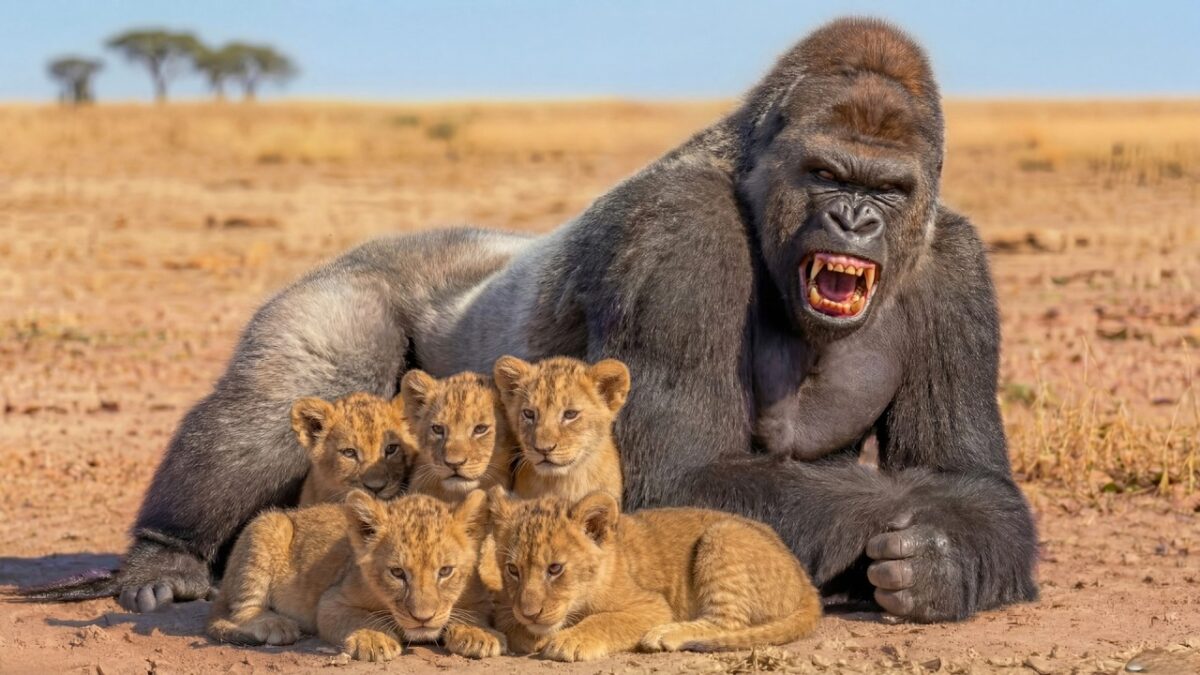
The day a gentle giant changed everything. I still remember the exact moment I heard it. A sound so desperate, so raw, that it cut through the thick jungle air like nothing I’d ever heard before.
It was a cry. No, it was more than that. It was the sound of four tiny lives screaming into the darkness, not knowing if anyone would answer, not knowing if anyone could answer.
My name is Marcus, and I’ve spent the last 20 years watching the mountains and valleys of this forgotten corner of Africa. I’ve seen things that would make most people question what they believe about nature. I’ve watched animals do things that shouldn’t be possible, but nothing, absolutely nothing prepared me for what was about to unfold on that particular afternoon in March.
The rains had come early that year. Harder than anyone could remember. The rivers that usually ran calm and shallow were now roaring beasts, tearing through the landscape with a fury that seemed almost personal.
And it was during one of these storms that everything changed. A lioness, young and desperate to protect her cubs, was trying to cross one of these swollen rivers. Her four cubs were barely 3 weeks old at that point, still blind to most of the world around them, still completely dependent on her for everything.
Warmth, food, safety, everything. But the river had other plans. I wasn’t there when it happened, but I arrived not long after.
The evidence was written across the muddy banks and hanging branches. Signs of struggle, deep paw prints in the soft earth. And then silence.
The kind of silence that tells you something terrible has occurred. The lioness was gone, swept away by the current, and her four cubs were clinging to an overhanging branch, their tiny bodies soaked, their voices hoarse from screaming for a mother who would never come back. I stood there for what felt like an eternity, feeling completely helpless.
I was too far away. I couldn’t reach them without risking my own life, and even then, what was I doing? I was a human. I was an outsider.
I had no right to interfere. This was nature, brutal and unforgiving, and I was just supposed to watch it happen. That’s what I told myself anyway.
That’s what the rules said I should do. But then everything changed again. From the thick vegetation on the opposite river bank, a massive shadow emerged.
At first I thought I was seeing things. The afternoon light was playing tricks on my eyes. But no.
There he was, a silverback gorilla, old, maybe 30 years or older, which is ancient for a wild gorilla. His name was Mufasa. I’d been watching him for years, tracking his movements, documenting his life in this territory.
He was a solitary male, one of the biggest I’d ever seen. His arms hung almost to his knees. His shoulders were impossibly broad, and there was something in his eyes that suggested he’d seen a lot in his time on this earth.
And he stopped at the river’s edge. I watched through my binoculars as he stood completely still, his massive chest rising and falling steadily. He could hear them.
The cubs were still crying out, their voices growing weaker by the minute. Mufasa’s ears twitched. His head turned slightly.
He was listening. He was hearing the same desperate sound that had been torturing me for the past few minutes. Now, here’s where I have to stop and tell you something that nobody warns you about when you choose to study wildlife.
You learn very quickly that animals don’t think like we do. Their brains are wired differently. A gorilla, no matter how intelligent, no matter how complex his social structure is, does not sit around contemplating the suffering of other creatures.
A gorilla protects his own family. He fights for his territory. He survives.
That’s the complete list of things a gorilla is supposed to care about. Mufasa should have walked away. Everything I knew about animal behavior, everything that decades of observation had taught me, said that he should have turned around and disappeared back into the forest.
The cubs were not his. They were the cubs of his natural enemy. In the wild, if a gorilla ever encountered a lion, the outcome would be simple and brutal.
The lion would win. Lions are faster. They hunt in coordinated groups, and they are built for killing in a way that gorillas simply are not.
So, when Mufasa took his first step into the river, I couldn’t quite believe what I was seeing. The water was moving fast. The current was so strong that I could see it pulling at the vegetation around the banks.
This was not a safe crossing for anything. But Mufasa moved with a deliberate slowness that suggested he understood exactly what he was doing. He was massive, probably close to 400 lb of pure muscle, and he was using that weight strategically, planting his feet firmly on the riverbed before shifting his position.
One step, then another, then another. The water climbed higher and higher up his body. It reached his waist, then his chest.
He never looked away from the branch where the cubs were clinging. Never once did he hesitate or show any sign of doubt. He never looked away from the branch where the cubs were clinging.
Never once did he hesitate or show any sign of doubt. It was as if he had already made a decision, and nothing in the world was going to change his mind. When he finally reached the branch, his head was at the same level as the cubs.
He was so gentle about it. That’s what struck me the most. A creature that size, that powerful, approached those tiny lion cubs with an almost careful tenderness.
His massive hand, a hand that could easily crush a skull, came up slowly and carefully beneath the youngest cub. The little one didn’t run. It didn’t bite or scratch or show any sign of fear.
It simply climbed onto his palm as if it had been waiting for Mufasa to arrive this whole time. One by one, the cubs scrambled onto his massive shoulders and his back. Their tiny claws clinging to his dark fur.
I could see their bodies shaking. Whether from cold or fear or exhaustion, I couldn’t tell. Probably all three.
Mufasa waited until all four were secure before he began the journey back. The return crossing was harder. The cubs’ weight wasn’t the issue.
They were so tiny that they barely registered against his massive frame. The issue was the current itself. It seemed to fight him more on the way back, as if the river sensed what he was doing and objected to it.
But Mufasa moved with this incredible determination. I saw him slip once, his massive body stumbling, and my heart nearly stopped. But he caught himself.
He braced himself against the current, and he kept moving. When he finally reached the opposite bank and pulled himself out of the water, his entire body was trembling. Not just from the cold, though I’m sure that was part of it.
From the effort. From the intensity of what he had just done. He climbed up the muddy incline, never letting those cubs slip from their positions on his shoulders and back.
When he reached the top, he didn’t stop to rest. He didn’t put them down and catch his breath. Instead, he turned and began walking deeper into the forest, moving at a steady pace that suggested he knew exactly where he was going.
I followed at a distance, careful not to get too close, careful not to interfere, because I had no idea what was about to happen, and I needed to understand it. I needed to see how this story was going to unfold. What Mufasa found was a shelter, a thick cluster of trees with a natural overhang that created a kind of protective cave.
It was dry inside, lined with vegetation that would provide warmth and cushioning. It was the kind of place a gorilla might normally sleep. And without any hesitation, without any apparent uncertainty, Mufasa settled down inside that shelter, arranged his massive body into a position that created a kind of bowl, and allowed the four lion cubs to snuggle against him.
They were exhausted, not just from the cold, but from the incredible journey they had survived together. All four of them were practically unconscious within minutes. Their tiny bodies pressed against the warmth of his chest and sides.
Mufasa rested his massive head down, his eyes still alert, still watching the darkness outside the shelter. He stayed awake that first night. I watched from a distance as the hours ticked by, as the moon rose and fell, as the jungle sounds changed with the passing time.
And he never moved, not once. By morning, something impossible had become real. A silverback gorilla was protecting four orphaned lion cubs, and somehow, against every law of nature, against every instinct that should have told them to fear him, those cubs had accepted him as their protector.
Against every instinct that should have told them to fear him, those cubs had accepted him as their protector. I named the cubs then, knowing that they would need names if this situation was going to last any amount of time. They were four small lives, and they deserved to be called something.
I chose names that reflected their color and their personalities. The smallest, a male with a slightly darker mane that was just starting to come in, I called Shadow. The two females I named Amber and Gold, after the tones of their fur in the morning light.
And the largest male, the one who seemed to be taking everything in with an almost curious intensity, I called Storm.
Over the next few days, something remarkable began to happen. Mufasa developed a routine. Every morning, he would carefully position his massive body between the cubs and the entrance to the shelter.
It was a strategic choice. If anything dangerous approached, and in this jungle, there were plenty of dangerous things, Mufasa would be the first line of defense. His size alone was usually enough to make most animals think twice.
But I knew from years of watching him that he was prepared to do more than just stand there and look intimidating. If he needed to, he would fight. During the day, he would lead the cubs on short expeditions away from the shelter.
Not far, never far enough that they couldn’t return quickly if danger appeared, but just far enough that they could experience the world around them. The smell of the forest, the feel of different types of vegetation under their paws, the sounds of the jungle and what they meant. I watched as Mufasa seemed to take on the role of teacher.
When the cubs tried to eat certain plants that were poisonous, he would gently push them away, directing them toward the ones that were safe. He showed them how to drink from streams, cupping his massive hands so they could reach the water without falling in. He seemed to understand on some level that these were helpless creatures that needed guidance, and the cubs responded.
They followed him everywhere. They climbed on him like he was some kind of living jungle gym. They slept pressed against his body, their tiny breathing synchronized with his.
They cried out for him when he left their sight for even a few minutes, and they squealed with what could only be described as joy when he returned. The other animals of the jungle seemed to sense what was happening. I watched as hyenas that normally would have attacked anything so small and vulnerable simply avoided the area where Mufasa and the cubs were.
I saw pythons that could have easily swallowed one of those cubs change their direction when they caught sight of the massive silverback. Even the elephants, usually the most unpredictable creatures in this region, gave them a wide berth. It was as if Mufasa had declared the cubs under his protection, and the entire jungle had understood the message.
But I knew, even in those early days, that this situation couldn’t last forever. The cubs were growing. They were becoming stronger, more independent, and Mufasa, despite his incredible strength and intelligence, was not equipped to teach them how to be lions.
He couldn’t show them how to hunt. He couldn’t teach them the complex social structures of a pride. He couldn’t prepare them for the world they were meant to inherit.
And I had no idea what was going to happen when that reality finally started to set in. When the cubs got old enough to understand what they were, when their predator instincts began to awaken, when they started to realize that the massive creature taking care of them was supposed to be their enemy, not their family. All I knew was that I was about to witness something that would change the way I thought about nature forever.
3 months had passed since that afternoon by the river. 3 months of watching something impossible unfold every single day. The cubs were changing, growing, becoming something different than they had been when Mufasa first pulled them from that branch.
Becoming something different than they had been when Mufasa first pulled them from that branch. Shadow was the first to really start showing his true nature. He was the most curious of the four, the one who always wanted to explore further, venture deeper into the forest.
By the time he was about 4 months old, he was already showing signs of what would eventually become his hunting instinct. I watched one morning as he stalked a small antelope that had wandered too close to their shelter. He moved low to the ground, his body mimicking the hunting position he’d never been taught.
It was pure instinct written into his DNA before he was even born. Mufasa watched, too. I could see him tracking Shadow’s movements, his massive head turning to follow the cub’s progress.
And then, just before Shadow would have pounced, Mufasa made a low sound.
Not a threat, not a roar, just a gentle grunt that seemed to say, “Not yet.
You’re not ready yet.”
Shadow stopped immediately. He looked back at Mufasa, and then he came bounding back to the safety of the shelter as if he understood that some boundaries weren’t meant to be crossed. This became a pattern.
The cubs would test their instincts. They would play at hunting, wrestling each other with increasingly fierce movements, practicing the combat techniques that would eventually serve them as adult lions. And Mufasa would watch.
He would allow them to explore their nature, but he would also gently redirect them when they went too far. It was like watching a parent teach a child without ever really speaking. Communication without words, understanding without explanation.
Amber and Gold, the two females, developed a different kind of bond with Mufasa. They were gentler by nature, less aggressive in their play. They seemed to understand in some instinctive way that they needed to be careful with the massive creature that was keeping them alive.
They would often rest their heads on his massive arms, their small bodies looking almost impossibly tiny against his frame. I documented it all, taking notes every single day, trying to make sense of what I was witnessing. Storm, the largest of the cubs, was different.
He was observant in a way that the others weren’t. He seemed to study Mufasa constantly, watching how the gorilla moved, how he responded to different situations, how he navigated the complex world of the jungle. There was something almost intelligent in the way Storm watched, like he was trying to understand not just what Mufasa was doing, but why.
But as the cubs grew, so did my concerns, because I knew something that they didn’t yet fully understand. I knew that Mufasa’s territory extended into an area where lions hunted. Not just any lions, but a large pride led by a male named Kylo, who had a reputation for being aggressive and territorial.
Kylo didn’t tolerate other predators in his domain, and if he discovered that a silverback gorilla was raising four young lions in his territory, the results could be catastrophic. The first real sign of trouble came on an afternoon when a storm rolled through. The kind of storm that makes every living thing in the jungle take shelter.
The rain came down so hard you could barely see 5 ft in front of you. The thunder was constant, rolling across the sky like something alive and angry. Mufasa had moved the cubs deeper into the shelter, creating a kind of protective circle with his body.
It was during that storm that I heard the roar. It wasn’t the sound of the thunder. This was something different, deeper, more primal.
It was the sound of Kylo, the pride leader, and he was close, much closer than I’d ever heard him come to this area before. The roar again, and this time there was an answering call. Multiple voices.
The pride was hunting. The storm had driven the usual prey animals into unusual places, and the lions were taking advantage of the chaos. Mufasa’s body went rigid.
I could see it even from my distant vantage point. Every muscle tensed. His massive head lifted, his nostrils flared, catching the scent carried on the storm wind.
He understood what those roars meant. He knew there was danger approaching. The cubs pressed closer to him, sensing his tension.
They were still young enough that they didn’t fully understand what a lion’s roar meant. They didn’t know that those sounds represented creatures that could potentially harm them. But they could read Mufasa’s body language, and they responded to his fear.
I watched as Mufasa slowly moved toward the entrance of the shelter. He positioned himself so that he was directly between the cubs and any potential threat. His massive hands gripped the earth, his breathing became deep and measured.
He was preparing himself the way a warrior prepares for battle. And then he waited. The waiting was the hardest part, because nothing happened.
Not that night. The pride passed somewhere nearby, their roars echoing through the storm, but they didn’t find the shelter. The darkness and the rain concealed it.
By morning, they had moved on, drawn by some other prey animal that had caught their attention, but something had changed. Mufasa seemed to understand after that night that his protection had limits, that there were forces in this jungle more powerful than even a silverback gorilla, and he adapted. Mufasa began moving the cubs frequently, teaching them how to survive in a jungle where their own kind were the biggest threat.
One day, while crossing a narrow ravine, a piece of rock suddenly gave way beneath his massive weight. I saw Mufasa’s body starting to tip, and the cubs realizing they were about to fall into the abyss. Even as he fell, Mufasa twisted his massive body to catch the opposite wall, suspending himself between the rocks.
Every ounce of his strength was being used to keep from plummeting into the ravine below. The cubs scrambled to safety, and with an almost impossible effort, Mufasa pulled himself back up onto the path. He lay there, heaving with exhaustion, his fur scraped and bleeding where he’d been pressed against the rock.
But the cubs were safe. That’s all that mattered. That’s all that had ever mattered to him.
When he finally recovered enough to stand, he continued forward without any apparent hesitation or complaint. The cubs gathered around him, their small tongues licking at his injuries, as if they understood that he had just sacrificed his own safety for theirs. It was around the 5-month mark that I started to really notice the changes in how the cubs perceived Mufasa.
They still followed him everywhere. They still depended on him for safety and guidance. But there was something new in their interactions.
A kind of understanding that seemed to go beyond the simple parent-child relationship. I watched as Storm began mimicking Mufasa’s movements, not in a playful way, but in a studied way. Shadow would observe how Mufasa navigated difficult terrain, and then practice those same techniques on his own.
Amber and Gold seemed to be developing an almost protective instinct of their own, positioning themselves between Mufasa and potential dangers. I realized watching him one morning as he moved a bit more slowly than he had a week before that this situation was approaching some kind of turning point. The cubs would eventually grow too large for Mufasa to carry.
They would develop strength and abilities that surpassed his own. They would become full-grown lions with all the complexity and danger that entailed, and I had no idea what would happen when that moment arrived. Would Mufasa simply release them to fend for themselves? Would the cubs understand that they needed to move on? Or would the bond between them run so deep that it would transcend the normal boundaries of nature? These were the questions that kept me awake at night scribbling notes in my journal, trying to make sense of something that defied every scientific explanation I could think of.
Because what I was watching wasn’t just about survival. It was about something more fundamental. Something about connection.
Something about what it means to protect another creature even when every instinct suggests you shouldn’t. The cubs were almost 6 months old now. They weighed more than 50 lb each.
Shadow was already showing the beginnings of a mane. Their teeth were sharp. Their claws were developing that dangerous curve that would eventually make them efficient hunters.
But despite all of this, despite all the ways they were becoming the apex predators they were meant to be, they still followed Mufasa through the jungle like he was the center of their world. Because in many ways he was, and I knew that soon the jungle itself would test whether this impossible bond could survive what was coming. Eight months.
That’s how long Mufasa had been caring for the cubs when the first real crisis came. Eight months of feeding them, protecting them, teaching them how to navigate a world that was never supposed to accept them. Eight months of something that should have been impossible becoming increasingly real.
The cubs were bigger now. Not yet fully grown, but no longer small enough to be called cubs in the truest sense. Shadow had developed a mane that was starting to come in dark and full.
Storm’s muscles were becoming defined, his movements more confident and predatory. Amber and gold were sleeker, more elegant in how they moved through the forest, but no less dangerous. They were becoming lions, real lions, and with that transformation came complications that even Mufasa’s incredible patience couldn’t always manage.
It started with the hunting. The cubs had been practicing on small prey for months. Insects, lizards, small birds.
But around the 7-month mark, something shifted. Their instincts began demanding more. Bigger prey.
Real meat. The kind of hunt that required strategy and coordination and genuine predatory skill. I watched one afternoon as all four cubs surrounded a young impala that had wandered into their territory.
They moved together, almost as if they’d rehearsed it, spreading out, creating a perimeter, driving the frightened animal toward a dead end. It was instinctive, natural, and it was also the moment when I realized that these weren’t children anymore. These were predators, and they were beginning to understand their true nature.
Mufasa watched from a distance. He didn’t intervene. He didn’t stop them.
But I could see something in his expression that I’d never seen before. A kind of resignation, maybe. An understanding that he was witnessing the beginning of the end of something.
The impala was killed quickly. The cubs tore into it with a ferocity that was both beautiful and terrible to watch. Blood matted their fur.
Their faces became unrecognizable, wild, consumed by an instinct that had awakened inside them. And when they were finished, when they had eaten their fill, they returned to Mufasa, and he let them rest against him as if nothing had changed. As if he weren’t watching the creatures he had protected transform into something he could no longer fully control or understand.
But the hunting changed everything. Because word travels in the jungle. Scent travels.
And within days, the pride had noticed. Kilo’s pride had grown to seven members in the time since I’d first heard him roaring in that storm. They were organized, efficient hunters who controlled a vast territory, and they did not tolerate competition.
When they caught wind of four young lions hunting in their domain, the response was immediate and intense. I was monitoring the situation from my observation post when I first saw them. Three members of the pride moving together through the forest with the coordinated grace of apex predators.
They were tracking the cubs’ scent, following the path the young lions had left after their kill. It was only a matter of time before they found them. Mufasa knew something was wrong.
I could tell by the way his massive body went rigid when he caught the scent on the wind. By the way his nostrils flared and his eyes narrowed. He made a low sound, a warning, and the cubs immediately pressed closer to him, abandoning their feeding and their play.
What happened next was the moment everything changed. The three lions emerged from the forest with a casualness that was terrifying in its confidence. They knew the cubs were here.
They knew that the biggest threat was the silverback gorilla, and they had come prepared to deal with exactly that situation. The largest of the three, a male I recognized from previous observations as one of Kilo’s lieutenants, stepped forward with an arrogance that only came from being absolutely certain of your own dominance. He roared a deep, guttural sound that echoed through the misty jungle.
It was a statement, a declaration. This was his territory. These were his rules, and he was here to enforce them.
What happened next happened in seconds, but it felt like hours. Mufasa positioned himself directly in front of the cubs, his massive body creating a barrier between them and the approaching lions. His lips pulled back, revealing his teeth, and he made a sound that I had never heard from him before.
Not a roar, exactly, but something deeper. Something older. Something that spoke to the primal fear that lives in every creature that walks the earth.
The lions paused. I could see the calculations happening in their eyes. The assessment.
The weighing of odds. A silverback gorilla was not a normal opponent. Mufasa was old, yes, but he was also incredibly powerful.
His arms could snap bones like twigs. His grip was lethal. And right now, he was standing between them and four young lions that represented a threat to their control of the territory.
But the lions were not alone in their assessment. They were also not starving. They were not desperate.
They were simply asserting dominance, and in the animal world, sometimes dominance is enough. The lieutenant moved first. He didn’t charge.
Instead, he approached with a sideways gait, his body held low, his tail twitching. It was a classic predator approach, designed to intimidate and test the opponent’s resolve. Mufasa didn’t move.
He didn’t flinch. He simply watched as the lions circled closer and closer, tension building with every step. Then the other two lions moved, trying to flank him.
I realized what they were doing. They were trying to get around him, to access the cubs from different angles. It was a coordinated strategy, the kind of thing that made lions such effective hunters.
But Mufasa was not a typical prey animal. The moment one of the flanking lions tried to dart past, Mufasa moved. His massive arm came up so fast that it was almost a blur, and it caught the lion across the face with a force that sent the creature tumbling backward.
There was no hesitation, no mercy, just a parent protecting its young. The two other lions lunged simultaneously, trying to take advantage of the moment Mufasa was focused on the first one. But the gorilla was faster than I would have believed possible for something so large.
He pivoted, his massive body moving with a grace that seemed impossible, and both of his massive hands caught the second lion mid-leap. For a moment, they were locked together, gorilla and lion, strength against speed and ferocity. It was the third lion, the lieutenant, who made the critical mistake.
Instead of continuing to circle and test, instead of using strategy, he charged directly at Mufasa. It was a decision born of rage and the absolute certainty of dominance. A decision that he would regret.
Mufasa released the second lion and turned to face the charging lieutenant. The two creatures met in the middle, and what happened next was violent and brutal and absolutely necessary. Mufasa’s massive hands found purchase on the lion’s mane, and he pulled the struggling, roaring creature close.
His teeth found the side of the lion’s neck, and he bit down with the kind of force that communicated one very simple message. This was over. The lieutenant went limp.
Not dead. Mufasa was not a killer unless absolutely necessary, but broken, defeated. The lion scrambled away from the gorilla, blood matting his mane, his confidence shattered.
The other two, realizing that their advantage was gone, that their coordinated attack had failed against something they had not anticipated, began to retreat. They moved backward, their eyes still locked on Mufasa, their bodies tense and ready, but their intention clear. They were leaving.
Mufasa did not chase them. He did not gloat or roar in victory. Instead, he turned back to the cubs, and I could see his massive body shaking with adrenaline and effort.
He lowered himself down, and all four cubs immediately pressed against him, licking his face, his neck, seeming to check him for injuries. For the first time since I’d been watching this situation unfold, I saw something like fear in Mufasa’s expression. Not fear of the lions that had just attacked him, fear of what this moment meant.
Because now the pride knew. Now they understood that there was a threat in their territory, and they would not let it stand. The next 3 days were tense.
Kilo himself appeared along with most of his pride. I watched as they gathered at the boundaries of Mufasa’s territory, roaring, marking, making their intentions clear. They wanted blood.
They wanted those young lions gone or dead, and they wanted the creature protecting them eliminated. Mufasa did not cower. He did not hide.
Every morning and every evening, he positioned himself between the pride and the cubs, and he roared back. It was a challenge and a warning and a statement of absolute determination. He would not be moved.
He would not back down. He would protect these cubs even if it meant his life. I documented everything, every encounter, every roar, every moment of tension that built higher and higher with each passing day.
Because I realized I was watching something that went far beyond simple animal behavior. I was watching a being choose to defend another being, not because of biology or instinct, but because of something deeper. It was a connection that reached deep into the soul, something that transcended species.
On the fourth day, Kilo did something unexpected. Instead of continuing his aggressive posturing, he simply stopped. The pride withdrew.
They moved back into their territory, and the roaring ceased. At first, I thought it was surrender. I thought Mufasa had won.
But watching Kilo’s expression as he turned away, I understood something else. It wasn’t surrender. It was strategy.
The pride leader had realized something that I would understand fully only in the days to come. Mufasa couldn’t protect the cubs forever. The cubs were lions.
Eventually they would need to rejoin the wild. I realized, watching him rest more frequently, sleeping longer, moving with less of his characteristic power, that Mufasa didn’t have unlimited time left. Whether it was months or years, I couldn’t say.
But the clock was ticking, and I wondered if the cubs understood. If they sensed what I was sensing, if they could smell the aging in his body the way animals often can. Storm seemed to understand it first.
I noticed it in the way he began positioning himself closer to Mufasa during their shared times, in the way he would gently lean against him, as if offering his young strength to support the aging creature. Shadow and the females followed suit, creating what looked almost like a protective circle around Mufasa, as if they were returning in their own way what he had given them. It was around this time that something unexpected happened, something that suggested the wild had its own way of testing bonds, of pushing relationships to their absolute limits.
A drought came to the region. Not the kind of minor dry season that the jungle regularly experienced, but a serious, extended drought that turned streams into trickles and water holes into muddy depressions. The animals of the jungle began to congregate around the few remaining sources of water, creating a tension that only desperation could generate.
I was at my observation post one morning when I heard the roar. Not from Mufasa, from Kilo. The pride leader’s voice carried across the jungle with a particular intensity that suggested something was wrong.
I grabbed my binoculars and made my way toward the sound, curious and concerned. What I found was a scene that made my heart stop. Kilo had discovered one of the cubs.
It was Amber, I realized as I got closer, near a drying water hole. The lioness was young and strong, but she was alone, separated from her siblings. And Kilo was circling her with the kind of focus that suggested he had other things on his mind besides simple territorial dominance.
The pride leader was old, I realized, older than I had initially thought. His mane was graying at the edges. His body, while still powerful, showed signs of wear and age.
And looking at him, watching the way he moved, I understood something that made my breath catch. He was dying. Maybe not immediately, but his time was limited.
And before he passed from this world, he wanted to ensure his legacy. He wanted to eliminate potential competition. He wanted to establish his dominance one final time.
Amber was brave. I’ll give her that. She didn’t run.
Instead, she held her ground, her body low, her teeth bared, ready to fight. But she was young, and Kilo was experienced. The outcome seemed inevitable.
But then, in one sudden and dramatic moment, absolutely everything changed. Shadow appeared first, followed by Storm and Gold, converging at Amber’s call. They were ready to fight for their right to exist in this territory.
Suddenly, Mufasa appeared, a massive silverback gorilla standing behind his cubs. The message was clear. These were his, and he would not let them be taken.
Kilo assessed the threat and saw something that transcended nature. He walked away. The cubs were truly free now, existing in the territory on their own terms.
They established their own grounds, but always returned to care for the aging gorilla. A beautiful role reversal. The cubs were now taking care of Mufasa.
Their bond had transformed into something truly mutual and deep. One afternoon I witnessed something that still brings tears to my eyes when I think about it. Mufasa was struggling with a particular injury, a wound from an encounter with some other animals that had gotten infected.
He was moving slowly, with obvious pain, unable to hunt or forage effectively. I watched as all four cubs gathered around him. Storm, the largest and strongest, positioned his massive body against Mufasa’s side, offering support and warmth.
Shadow remained alert, watching the forest, acting as a guardian. Amber and Gold, the most tenderhearted of the four, used their tongues to clean the wound, removing the infected material with a gentleness that spoke to an understanding far beyond their years. They were healing him, not with medicine or scientific knowledge, but with presence, with care, with the kind of love that asks for nothing in return except the continued existence of the beloved.
I documented it all, knowing that what I was witnessing might never be seen again, knowing that this was something unique and precious and fleeting. Because even as the cubs cared for Mufasa, even as they demonstrated their love and loyalty, I could see that his time was limited. His breathing was becoming more labored.
His movements were becoming slower. The years of caring for four young lions, of fighting for their right to exist, of protecting them from a world that had never asked for that protection, it had all left its mark. Of protecting them from a world that had never asked for that protection, it had all left its mark.
The final months were bittersweet. On one hand, watching the relationship between Mufasa and the cubs reach its full maturity was beautiful beyond words. They had become a true family, bound not by blood, but by something infinitely stronger.
On the other hand, knowing that this bond was being tested by the inevitability of time and aging, made every moment feel precious and urgent. I remember one particular evening when all five of them were gathered at the shelter. Mufasa was resting, his massive body spread out across the ground.
All four cubs were arranged around him, sleeping, their young forms creating a protective circle. Mufasa’s massive hand rested gently on Storm’s shoulder, and even in sleep, there was something in his expression that suggested contentment. As if, in that moment, despite all the pain and difficulty and struggle, he understood that his life had meant something.
That what he had done mattered. The end came on a night when the jungle was particularly quiet. A still night.
The kind of night that seems to hold its breath. I was at my observation post, as I had been almost every night for the past 18 months, when I realized that something had changed. The usual sounds of the forest, the rustling, the distant calls, the sense of life moving through the darkness, had ceased.
I made my way to the shelter, my heart already knowing what I would find. Mufasa was gone. Not suddenly, not violently.
He had simply stopped. His breathing had ceased. His heart had stilled.
The massive body that had protected four young lions through their entire lives had finally given out. In death, there was a peacefulness to him, an acceptance, as if he had known it was time and he had been ready. The cubs were gathered around him, all four of them.
They weren’t panicking or confused. They simply sat there, their massive young forms motionless. Their eyes fixed on the creature that had been their entire world.
And they stayed there. Through the night and into the next day, grieving in the way that animals grieve, in silence, in presence, in the quiet acknowledgement that something irreplaceable had been lost. I watched from a distance, tears streaming down my face, and I understood something fundamental about what I had been witnessing for all these months.
It wasn’t just about a gorilla protecting young lions. It was about the fundamental power of connection, about how love, in its purest form, can transcend every boundary that nature has drawn, about how a creature can choose to care for another creature, not because of instinct or biology, but because something in their being recognizes a kindred spirit in pain. In the days following Mufasa’s death, the cubs began to disperse.
Storm established his own territory to the north, creating distance, but not so much that he couldn’t return. Shadow moved into the eastern sector where he began to interact more frequently with other lions, eventually forming bonds and establishing himself as a member of the greater community. Amber and Gold remained closer to the original shelter, hunting together, supporting each other.
Their bond as females running deeper than their individual survival needs. But here’s what matters. Here’s what changed everything I thought I knew.
Every single one of them, without fail, returned to that shelter. Not to stay, but to visit. To spend time in the place where they had grown up.
Where they had learned what it meant to be loved unconditionally. Where a gorilla had shown them that family doesn’t require shared blood. It requires shared commitment.
Shared sacrifice. Shared understanding that another creature’s existence is worth protecting. Years later, years after Mufasa had returned to the earth that had sustained him his entire life, the cubs would still make their way back to that shelter.
They would rest there. They would remember. And sometimes I swear I could see them communicate with each other about the old gorilla, about the creature who had changed their lives.
And I realized something that no scientific journal would accept, that no textbook could explain, but that I knew to be absolutely true from 18 months of observation and documentation and witnessing something miraculous. Mufasa hadn’t just raised four lion cubs. He had taught them something that most animals never learn.
He had shown them that love is stronger than instinct. That family is something you create, not something you’re born into. That protection and care and loyalty are choices, not biological imperatives.
He had, in his massive and gentle way, shown them how to be more than just lions. He had shown them how to be family. And that, more than anything else, is what made him extraordinary.
Not the fact that he was a gorilla protecting lions, but the fact that he loved them enough to teach them not just how to survive in the wild, but how to carry that love forward into their own lives. How to honor what had been given to them by giving it to others. Eventually, they would either integrate into the pride structure or they would move on to find their own territory.
And when that happened, when the gorilla was no longer standing between them and the rest of the lion world, they would have to survive on their own terms. Kilo was willing to wait. Because he understood something that even I was only beginning to grasp.
The bond between Mufasa and the cubs was extraordinary, yes, but it was also temporary. It was a bridge between two worlds, not a permanent solution. In the days following the confrontation with the pride, I noticed that Mufasa began doing something different.
He began leaving the cubs alone for longer periods. Not abandoning them, never that, but giving them space. Allowing them to practice their independence, to hunt without his constant super- vision.
To navigate the jungle without always having his massive presence to fall back on. It was like watching a parent slowly release their grip as a child grows older and more capable. Gentle, reluctant, but necessary.
The cubs responded to this shift with a kind of understanding that seemed to go beyond their young age. They began to explore further, to test their abilities, to understand that they were becoming something other than what they had been. They were becoming lions.
Real lions. Predators with all the weight and responsibility that entailed. Storm was the first to truly grasp the implications.
I watched him one afternoon as he stood at the edge of a cliff overlooking the vast territory below him. His mane was coming in fully now, dark and impressive. His muscles were defined and strong.
And his eyes held a kind of understanding that suggested he was beginning to comprehend the true nature of what he was. Mufasa stood behind him, his massive form a silhouette against the afternoon sun. They didn’t touch.
They didn’t vocalize. But their presence spoke volumes. But there was a communication happening between them.
A kind of wordless understanding that seemed to acknowledge what was coming. The cubs were almost a year old now. They had grown from fragile infants that couldn’t survive without Mufasa’s constant care to nearly full-grown lions that possessed all the physical capabilities of their species.
Their relationship with the gorilla had transformed as well. It was no longer a simple parent-child dynamic. It had become something more complex, something that acknowledged their bond.
It was no longer a simple parent-child dynamic. It had become something more complex, something that acknowledged both their growing independence and the bond that would always connect them. I knew, watching them in those final weeks before the situation changed again, that we were entering a new phase.
A phase where the cubs would begin to understand, truly understand, that they were lions. And that Mufasa was a gorilla. A phase where the differences between them would become increasingly apparent.
A phase where the bond would be tested in ways that neither of us could predict. But I also knew that what I had witnessed over these eight months had changed me. It had challenged everything I thought I knew about nature, about instinct, about the boundaries between species.
It had shown me that beneath all our biological programming, beneath all our evolutionary imperatives, there was something else. Something that could bridge the gap between predator and prey. Something that could make a gorilla protect lions and make lions trust a gorilla.
Something that the world wasn’t prepared to understand. 18 months. That’s how long Mufasa had been with the cubs when everything came full circle.
18 months of caring for them, protecting them, teaching them in ways that no gorilla had ever been expected to teach anything. 18 months of something that defied every law of nature I had ever learned or believed in. The cubs were no longer cubs.
They were young lions, nearly full-grown, with all the physical attributes and instincts that came with their species. Shadow’s mane was magnificent now, dark and thick, making him look far older than his actual age. Storm had grown to be the largest of the four, with a presence that commanded respect even in that young age.
Amber and Gold had developed into stunning females, their movements fluid and graceful, their eyes sharp and intelligent. Something had changed between the lions and Mufasa. They no longer depended on him for survival, hunting successfully and navigating the wild on their own.
And yet, they always came back to him. Even though they no longer needed him to survive, they still needed him for something deeper. Over weeks, I watched Mufasa slowing down.
It was gradual. The way he moved became more deliberate. His breathing sometimes labored.
The years of protection and constant vigilance had finally taken their toll. He was aging.








