Sold to Pay Her Father’s Debt — The Alpha King Bought Her, Then Asked Why She Wasn’t Afraid
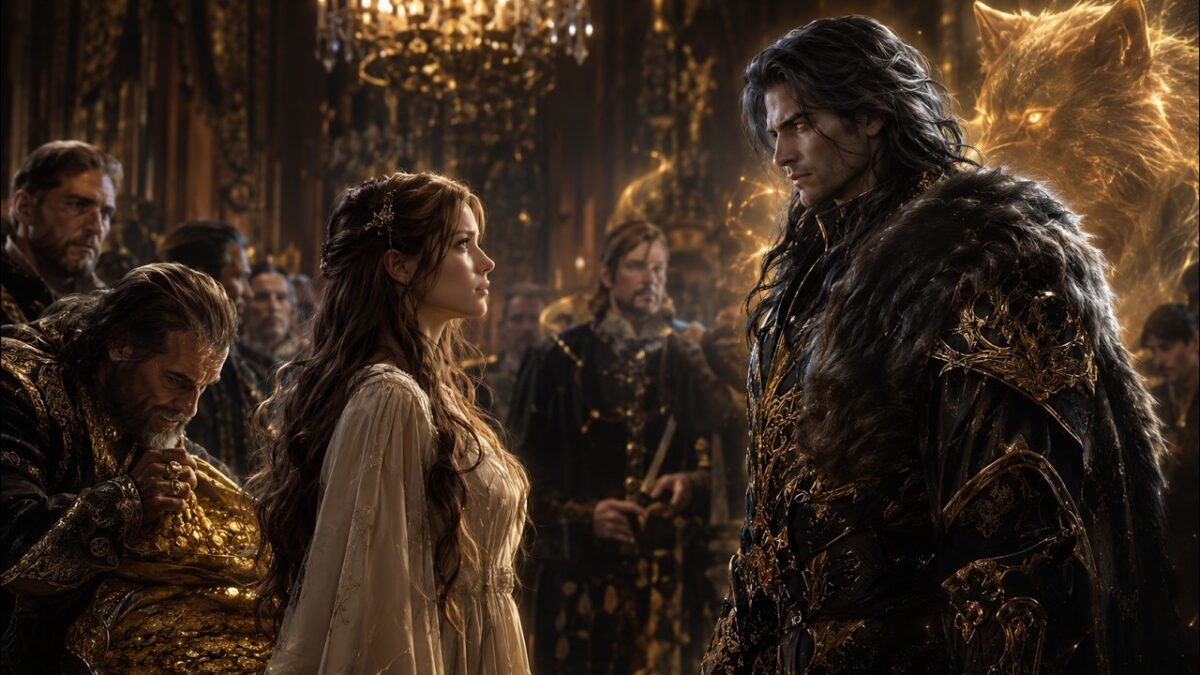
My father sold me on a Tuesday, which felt like the kind of detail that should not matter, and yet was the only thing I could hold on to while three of the king’s men loaded me into a cart like a sack of millet.
I was 23 years old: old enough to know exactly what was being done, young enough to still be surprised that it was my own father doing it. He did not look at me when the coins changed hands. He looked at the coins. I have thought about that a great deal since: how a man can spend 23 years feeding you, and then, at the end, find the silver more interesting than your face.
The debt was 400 gold marks. I knew the number because I had kept his books for six years, the same six years he spent borrowing against a harvest that never came. I knew, better than the men loading me, exactly how much I was worth on paper. I was worth 400 marks and a signature. And the signature was the part that stung.
They told me I was being delivered to the Iron Fortress, to the Alpha King himself. They said it the way you say a thing meant to frighten. And I waited to be frightened, the way you wait for rain you have been promised. It did not come. I had used up my fear somewhere around the third creditor’s visit the winter before, and had not been able to find more since.
So I sat in the cart with my hands folded and watched the pines close over the road, and I thought, Well, at least it is somewhere I have never been.
That is the thing no one tells you about losing everything. It is very quiet afterward. There is nothing left to protect. And the not protecting feels almost like rest.
The fortress was gray stone, the color of a storm that had not decided yet. It rose out of the forest the way a fact rises out of an argument: sudden, and not interested in your feelings about it.
The men walked me through a gate, across a yard where wolves the size of ponies watched me with too much intelligence, and into a hall so large that the fire at the far end looked like something happening in a different country.
And there, on a throne carved to look like a wolf mid-stride, sat the most powerful man alive.
I knew him by the way the room was arranged around him. Everyone in that hall stood at angles that accounted for where he was, the way iron filings account for a magnet. He was big in the way the fortress was big: not for show, simply because that was the size the thing needed to be. Dark hair. A jaw that looked like it had been set in a decision years ago and never released. He wore no crown. He did not need one. The crown would have been redundant.
He was reading a ledger when they brought me in. He did not stop reading when they brought me in.
“The Aldermoor debt,” said the man at my shoulder, and pushed a paper toward the throne.
The king turned a page. “Set it there.”
“My lord, the girl—”
“I heard you.” He still did not look up. “Set it there.”
I stood in the center of the hall while the Alpha King of the Iron Territories finished his accounting. I will tell you that I did not find it insulting. I found it almost restful. After a month of being looked at by men who wanted something, here, finally, was a man who wanted nothing from me at all. I was a line item. I could work with a line item.
Then he closed the ledger, and he looked up, and his whole body went wrong.
I want to be precise about this, because it is the first thing I ever truly noticed about him, and everything after followed from it. He had been a man entirely at his ease, a man who had read the same ledgers a thousand times and would read them a thousand more. And then his eyes found me, and something passed over him that he very clearly had not authorized.
His hand closed on the arm of the throne. His shoulders dropped a quarter inch, the way a man’s shoulders drop when he has been hit somewhere padded enough not to show.
And then (this is the part I have never told anyone) he stood up. Halfway. He came halfway out of the throne toward a debtor’s daughter in a travel-stained dress. And then he caught himself and sat back down, with the careful deliberation of a man pretending he had only meant to shift his weight.
The whole hall saw it. I saw the whole hall see it. He saw me see the whole hall see it.
“Leave us,” he said to the room, in a voice that suggested he had wanted to say it considerably sooner.
The hall emptied. It emptied fast. Whatever these people had learned about the moods of their king, they had learned to respect the ones they could not read, and this was plainly one of those.
When the doors closed, it was only the two of us, and the wolf throne, and 400 marks of paper between us on the floor.
“You are Aldermoor’s daughter,” he said.
“I was. I am told I am now yours.” I let that sit. “Congratulations on the purchase. I should warn you, the asset depreciates.”
He stared at me. I have replayed this moment more times than I will admit, because I did not yet know him, and so I could not yet know that what was happening on his face was a man discovering that the worst thing that had ever happened to his composure had just walked in wearing someone else’s cloak.
“You are not afraid.” He set the closed ledger aside without looking at it. It was not a question. It was closer to an accusation, as though I had broken a rule he had spent considerable money to enforce.
“No,” I agreed.
“Everyone is afraid.”
“I expect they have more to lose.”
And there it was: the first time I made the Alpha King of the Iron Territories lose an argument with himself. His jaw moved. The word he had been about to say did not come. He looked, for one entirely unguarded instant, like a man who had prepared for a fight and arrived to find the other party had simply gone home.
“Why,” he said at last, very carefully, “are you not afraid?”
No one had ever asked me that. People had asked me to be afraid. People had counted on it. But no one in 23 years had looked at the absence of it in me and wanted to understand where it had gone.
“Because I have already lost the things fear is for,” I said. “You cannot threaten a person with the weather once they are already standing in the rain.”
He was quiet for a long moment. The fire spoke to itself at the end of the hall.
“What is your name?” he said. “Your given name. Not the debt.”
And that (the distinction he drew, the debt set apart from the name, as though the two could ever have been the same thing to anyone but me) was the moment I understood I had badly misjudged what kind of trouble I was in.
“Wren,” I said.
“Wren.” He said it the way you set down something you’ve been carrying too long, and did not realize the weight of until your hands were empty. “I am Asmund.”
I knew his name. Everyone knew his name. But he offered it as though it were a thing he was not certain I would accept, and I filed that away, because a king who is uncertain whether you will accept his name is a king with a problem he has not told anyone about.
He had a problem he had not told anyone about. It took me a great while to learn its shape.
This is the story of how I learned it.
They gave me a room.
This was the first surprise. I had expected a cell, or a kitchen, or a pallet near the kitchen. Instead, a woman named Bridget, who ran the fortress with the iron calm of someone who had buried three kings and was not impressed by the fourth, walked me up a stair and opened a door onto a chamber with a window, a bed, a hearth already lit, and a chair.
“There has been a mistake,” I said. “I am the debt. The Aldermoor debt. I keep books, or I scrub them. I do not mind which.”
Bridget looked at me with the particular weariness of a woman who has been given an instruction she does not understand and has decided not to fight it. “The king says you are a guest of the fortress until your situation is settled.”
“My situation is settled. I was purchased.”
“The king,” said Bridget, in the tone of a woman quoting scripture she finds personally suspect, “says the word purchased is not to be used.”
I sat on the edge of the bed after she left and tried to make the pieces fit, and they would not. A man does not pay 400 marks for a woman and then forbid the word for what he has done, unless the 400 marks had not been for the woman at all.
I did not sleep. I sat in the chair by the window. The chair felt important, somehow: a chair, in a room, for a person whose entire value had been a number. And I watched the moon come up over the black line of the pines, and I thought about a man halfway out of his throne, catching himself.
I have made it this far telling you the parts I understood at the time. What comes next is the part I am still not certain I have the words for: the part where I started to learn what the king was really buying when he bought debts.
Now, let me tell you about the ledger.
The ledger lived in the great hall, and the king consulted it like other men consult their own conscience: often, and not always happily.
I learned this because, three days into being a guest of the fortress who was not permitted to scrub anything, I got bored. And a bored woman who has kept books for six years will eventually walk toward the books.
He was not there. I told myself I was only looking.
I opened the ledger to the last page and found my own name. Aldermoor, 400. And beside it, in a hand pressed hard enough to nearly tear the page: Paid.
Not collected. Not owed. Paid.
And below mine, a column of others I did not know. The Tolliver debt, paid. The Mead Hall arrears, paid. A widow’s tithe, in a village I had never heard of, paid. Page after page, going back years, of debts that other men had used to bleed and own and ruin people, and the Alpha King had simply bought them and marked them paid. And, I saw, looking closer, freed the people attached to them. Every one recorded in the same hard hand: Released to her own keeping. Released to his own keeping. Released.
“You read quickly.”
I did not jump. I am rather proud of that. I turned, and he was standing three paces away (always three paces, I would come to learn, when one would have done), watching me with an expression that was trying very hard to be displeasure, and arriving instead at something closer to dread.
“You free them,” I said. “All of them. You buy the debt, and then you free the person.”
“It is an efficient use of capital.”
“It is the least efficient use of capital I have ever seen, and I have watched my father set fire to a barn for the insurance.” I closed the ledger. “Why?”
His hand found the back of the nearest chair. I was learning to watch his hands. They told the truth before his face caught up to it.
“There was a woman,” he said.
He did not go on for a moment. The fire filled the silence the way it always did.
“Before. There was a woman the pack would have called my Luna, in time. Her family carried a debt to a lord three territories east. I was strong enough to win any fight in the world by then, and I thought that meant I had time. I went to settle it the slow way, the honorable way, through the courts.” His jaw did the thing. “The lord called the debt while I was away. He took her in lieu. She did not survive his keeping.”
I have been told a great many secrets in my life, mostly by men who wanted credit for telling them. This was the first one I was ever given that the giver plainly wished he could take back the moment it left him.
“So now you buy the debts first,” I said quietly. “Before the slow way can fail.”
“Now I buy them first.”
“And you made the word purchased forbidden, because you cannot stand to be a man who purchased a woman.”
He looked at me then with something I can only call relief: the relief of a man who has carried a thing alone so long that being understood feels almost like an injury.
“Yes,” he said.
I should tell you that I did not soften toward him because his pain was beautiful. His pain was not beautiful. It was just true. And I had spent a long time among people whose feelings were performances, and a true thing in a hall full of iron is a difficult thing to walk away from.
“You should have told me,” I said. “I have spent three days insulting the asset appreciation of a transaction that was apparently an act of mercy.”
The corner of his mouth moved. It was the first time I had seen it try. “You called it the least efficient use of capital you had ever seen.”
“It is. Mercy usually is.” I set my hand on the ledger, on the page with my name and the word paid beside it. “It is also the only line in this book I am glad to be on.”
His court did not share my gladness.
I learned the antagonist’s name at supper, the way you learn the name of a draft in a house: by the cold coming off her. Lady Sigrun of the Eastern Holdings sat at the king’s right hand, and had, I gathered, expected to sit considerably closer than that, for considerably longer than this. She was beautiful in the way a blade is beautiful, which is to say the beauty was not the point of it.
“The debtor’s daughter,” she said, when Bridget sat me too near the head of the table. “How novel. We are collecting them now.”
“We are forgiving them, I am told,” I said. “Though I confess the bookkeeping is unusual.”
“You keep books.” She smiled. “How useful. A king should always know the value of the things he keeps.”
It was Sigrun who had arranged my purchase. I did not know it that night, but I felt the shape of it: the particular satisfaction with which she watched me, the way you watch a stone you have set rolling.
She had bought my father’s debt through a factor and steered it to the king’s table on purpose, expecting one of two outcomes. Either he would refuse a ruined debtor’s daughter and prove to the Eastern lords that his soft new habit had limits, or he would take me, and she would have her proof that the king had lost his judgment entirely, and the Eastern Holdings could begin to discuss, quietly, who might rule better.
She had not accounted for the third outcome, which was that he would come halfway out of his throne. Neither, to be fair, had he.
The trouble began in earnest the morning Sigrun brought a healer’s complaint before the hall.
A child in the lower village had taken a fever, she said, and the king’s new guest (the debtor’s girl, who had been seen carrying herbs from the stillroom) had dosed it wrongly, and now the child was worse. The village was frightened. Was this the sort of stray the king meant to keep? One who poisoned children?
It was a clean piece of work, I will give her that. I had been in the stillroom. Bridget had set me to it when she discovered I knew yarrow from hemlock, and I had sent feverfew down to the village the day before. If the child worsened, the herbs would be blamed, and the herbs had my hands on them.
“I will see the child,” I said, before the king could speak.
The hall turned. One does not volunteer oneself into an accusation.
“If I dosed it wrongly, I will know how, and I will fix it. If I did not, you will all watch me not be afraid of finding out.”
Asmund’s hand was on the arm of the throne. He started to rise, to send a guard, to send himself, to do the thing his wolf wanted, which was to put himself between me and the room. And I caught his eye and gave him the smallest shake of my head. Because a king who rises to defend the accused has confessed she means something to him, and I was not ready to spend that coin on Sigrun’s behalf.
He sat back down. It cost him. I watched it cost him, and I watched him let it, and that was the first time I understood that this man could be trusted with restraint, which is rarer in the powerful than courage.
The child had not been poisoned. The child had measles, which feverfew does nothing for and nothing against, and which I diagnosed by the simple act of looking at it, which Sigrun’s informant had neglected to do.
I stayed two days in the village. I brought the fever down with cool cloths and willow bark and the boring competence that is the actual substance of healing. And when I came back up the hill, the story had already run ahead of me: that the debtor’s daughter had walked into an accusation and walked out of it with a saved child, and had not once looked frightened.
The king met me at the gate, in front of the yard, in front of the wolves and the warriors, and a window I was fairly sure had Sigrun behind it.
“You should not have gone alone,” he said.
“I am not yours to keep from going places.” I was tired, and I let it come out sharper than I meant. “The ledger says paid. Paid means I belong to myself.”
Something moved through his face. He looked at me for a long moment in the cold, three paces away, his breath clouding between us in the space he would not close.
“Yes,” he said. “It does.”
And then, very low, so the yard could not hear it, though the yard strained to: “I find I do not like the things I cannot keep from going places. I am aware this is my failing, and not yours.”
I went up to my room and sat in the chair that should not have been there, and I did not sleep again. And this time, it was not the moon’s fault.
Sigrun’s second move was not clean. The frightened lose their craft.
Three nights later, a fire took the stillroom: the stillroom where I worked, in the hour I was known to work in it. And I was inside when the bar came down across the door from the outside.
I want to be fair to her, even now. I do not think she meant to kill me. I think she meant to frighten me into running, to make the king’s strange mercy look like a danger he had brought inside his own walls. But intent is a poor comfort when the smoke is climbing the walls, and the door will not move, and the heat is a hand against the wood you cannot put your own hand near.
I did not scream. I have wondered since whether I should have. Instead, I went to the window, which was barred for the herbs, and I wrapped my cloak around my arm, and I broke the glass, and I started working the lead. And I cut my palm to the bone on the third bar, and kept working it, because a cut palm is a problem for later, and the smoke was a problem for now.
Asmund came through the door. Not through the bar: through the door. He tore it off the frame, bar and hinges and the stone the hinges were set in. And I learned later that no man in three generations had done such a thing without shifting, and that he had not shifted. That he had simply decided the door would open, and made the world agree.
He came through the smoke and he found me at the window, with my hand running red down the lead. And his face was a thing I will not try to describe, except to say that I have never, before or since, been looked at as though my continued existence were the only fact in the world that mattered.
He did not touch me. Even then. He stood an arm’s length off in the smoke, shaking, and he held out his hand, palm up, the way you offer your hand to a horse that has been beaten.
“Come away from the glass,” he said. “Wren, please.”
I put my bleeding hand in his. It was the first time we had touched. I felt the shudder go through him at the contact, the great frame of him going still and then unstill. And I thought, with the strange clarity of someone who has been breathing smoke: Oh. There it is. There is the thing the whole court has been waiting to see.
We came out into the yard together, and the yard saw it: his hand around my unhurt one; the blood; the way he would not let go, even when Bridget came running with cloths; the way he stood between me and the smoke and the watching windows, and did not once perform it. It was not for the court. That was the thing they could all see. It was simply where his body had decided to be.
Sigrun made the mistake of being in the yard. The frightened cannot stay away from the thing they have done. They have to watch it land.
“Thank the moon you were unharmed,” she said. And she nearly sold it.
“The bar came down from the outside,” I said. I did not raise my voice. I had learned, in a long, hard year, that the quiet sentence carries furthest in a frightened room. “A fire is an accident. A bar across the door is a decision. I am only a healer’s apprentice, my lady, but I can tell the difference between the two. And so, I think, can the king.”
The yard went very still. I felt Asmund’s hand tighten on mine. Not a grip; a question. I gave him the answer by not letting go.
“Search her rooms,” the king said. He did not shout it. He has never once, in all the time I have known him, needed to shout. “And the factor who carried the Aldermoor debt to my table: bring me the chain of it. All of it.”
They found the letters. Sigrun had been as careful with her correspondence as she had been careless with the door, which is to say, not at all, once she was afraid. Instructions to the factor. Payments to the village informant. A draft of the accusation in her own hand.
The Eastern lords she had been writing to discovered, all at once, that they had never met her, had no idea what she meant, and were frankly appalled. She was stripped of her holdings and sent east, to a convent on the coast that takes noblewomen the way the sea takes stones: quietly, and with no expectation of return.
I am told she keeps the convent’s books now. I am told she is very good at it. I find I can wish her well from this distance, which surprised me, until I remembered that I am on the page that says paid, and a person on that page can afford to be generous.
He came to my room the night the holdings were settled. He stood in the doorway. He did not come in. The door open behind him; three paces becoming the width of a threshold he would not cross without leave.
“Your hand,” he said.
“Bridget sewed it. I will have a scar across the palm. I am told it will ache before rain.” I held it up. “A useful thing in a healer. Now I will know when to bring the washing in.”
He almost smiled. Then the almost failed, and what was under it came up instead. And I watched the Alpha King of the Iron Territories arrive, at last, at the end of a fight he had been losing since the day a debtor’s daughter walked into his hall and declined to be afraid.
“I told myself I bought the debt for the same reason I buy them all,” he said. “I told myself that for a month. I am not a man who lies easily, and I have never lied to myself so badly in my life.”
His hand was on the doorframe.
“My wolf knew you in the hall before I had read your name. He came halfway out of the throne. I have spent 20 years keeping that animal on a leash, and he broke it for a woman in a travel cloak who told me her asset depreciates.”
He stopped. The next word would not come the easy way, so he made it come the hard way, which is the only way that has ever counted.
“I do not want you on the ledger as paid. I want you off the ledger entirely. I want you at the other end of the table, in the chair that has been empty. I am asking. You owe me nothing. You have never owed me anything. The ledger says so, in my own hand. So I am only asking.”
There is a kind of silence that is not empty. This was that kind.
“You are not as cold as you think you are,” I said. “I knew it the first day. You came halfway out of your throne.”
“I am aware. The entire hall is aware. I have had to live among them since.”
“Asmund.”
I had not used his name before. I watched it land on him the way his had landed on me: a thing set down.
“Close the door. Or leave it open. But come here, either way.”
He crossed the three paces. He had never crossed them before.
I will not tell you about the kiss, except this: it was the first thing in 23 years that I did not weigh, count, or enter on any page. It cost nothing, and it was worth everything, which is the opposite of every other transaction of my life. And somewhere in it, I understood that I had not been bought at all. I had been found. There is a great difference, and I had simply never been on the right side of it to feel it before.
When we came apart, he rested his forehead against mine and breathed out, long and unsteady: a king setting down a crown that had been too heavy for too long.
“The chair,” I said. “It has been empty a while.”
“Eleven years.”
“That is a long time to leave a place set.”
“I know.” His hand found my unhurt one again. “I think I always knew someone would come for it. I only thought I would have to buy her free first.” He huffed something that was nearly a laugh. “I did not expect her to audit me.”
The pack did not simply accept it, and I will not pretend they did, because that is not how iron works.
There were lords who muttered that the king had taken a debtor’s daughter to wife and weakened the line. There were old families who sat further down the table than they liked, and let everyone know it. The East was quiet for a season, in the way a wound is quiet before you learn whether it will heal or fester.
But the village remembered who had walked into an accusation and come out of it carrying their child. The stillroom was rebuilt, larger. And a king who frees debtors, it turns out, has more friends among the freed than the lords had ever bothered to count.
When the muttering rose, it was a Tolliver, and a Mead Hall man, and a widow from a village I had never heard of who rose to answer it. All of them on the page that says paid. All of them his, by the only bond that holds: the one freely given.
It is a year later now, as I tell you this. The chair is not empty.
I sit at the other end of the long table, and I keep the ledger, because it turns out a king who buys debts to free people needs someone who can actually do the arithmetic. And his hand, while devastating in its honesty, cannot add.
There is a new page at the front of the book now. I made him write it. At the top, in his hard-pressed hand, it says: Owed to Wren. And then the column is blank. And it will stay blank, because the entire point of us is that there is nothing on it, and never will be.
A letter came last week from my father. He had heard his daughter was Luna of the Iron Territories, and he wondered, he wrote, whether old debts between family might be (he used the word) reconsidered.
I read it twice. Then I entered it in the ledger under a heading of my own invention, which Asmund pretends to disapprove of and has not made me remove: Declined, with the king’s compliments.
I keep that chair he set for me eleven years before he knew my name. And some nights I catch him looking at it, with me in it, with the particular expression of a man who has stopped being able to remember what the room looked like empty.
He does not say anything. He does not need to. I learned to read him from his hands a long time ago, in a hall that smelled of smoke and iron, on the day I told the most powerful man alive that I was not afraid, and was, for the first time in my life, telling the truth.
So tell me: did you see it coming? The moment in the hall when he stood up halfway and sat back down? Or did you, like me, mistake it for the beginning of something to be afraid of?
Stay, and tell me where you are listening from tonight, and whether anyone has ever come halfway out of a throne for you. And if this was the kind of story you would sit by a fire for, the door is open. Come back. I will leave the chair.








