She Signed Up to Serve a Town Nobody Else Would — Someone Else Was Writing Prescriptions Under Her Name
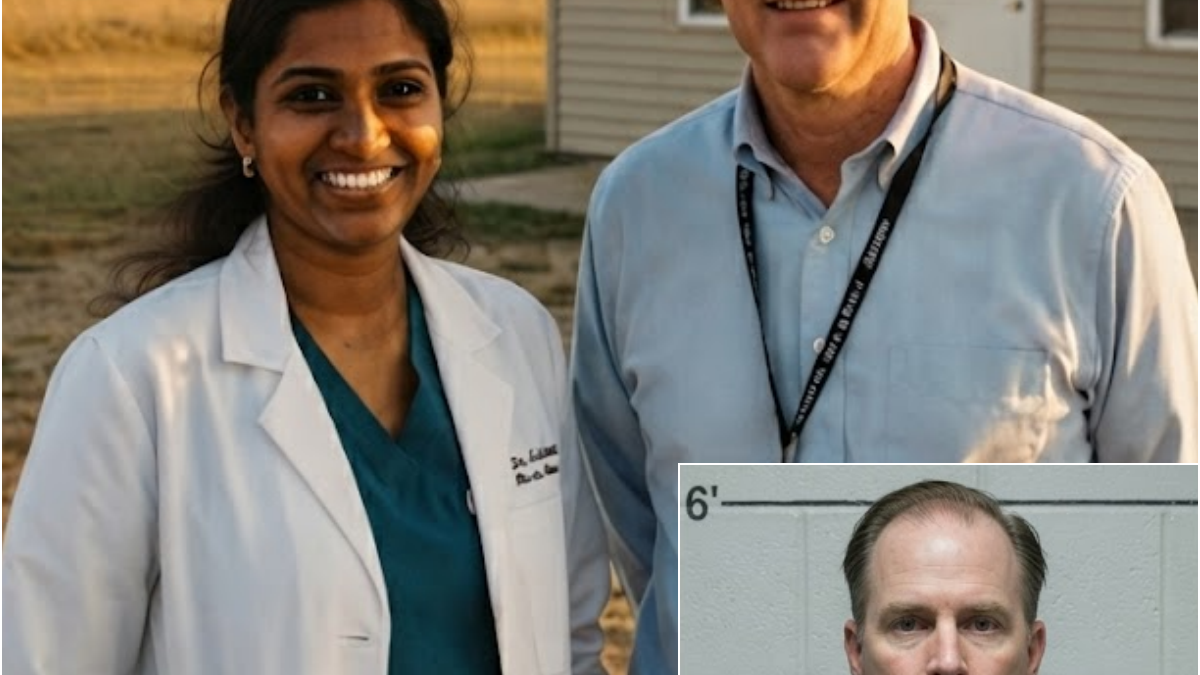
There is a particular kind of trust built into rural American medicine that most people never think about until they need it: the trust that the one doctor in town, the only one for forty miles in any direction, is exactly who the prescription pad says she is, and that every controlled substance leaving that clinic under her DEA registration number left it because she decided it should. It is a trust that depends entirely on nobody else having reason, or opportunity, to write under that number without her knowing.
This is a story about a doctor who came to a town in western Kansas because almost nobody else would, and who very nearly lost everything she had built there because someone she saw every day understood the gap between her trust and her attention better than she did.
Dr. Anisha Krishnan came to the United States in 2015 on a J-1 exchange visitor visa, the standard pathway for foreign medical graduates completing US residency training, after finishing medical school in Chennai and matching into an internal medicine residency program in Kansas City. The J-1 visa carries a well-known condition that catches many foreign physicians off guard the first time they hear it explained in full: it requires most participants to return to their home country for at least two years after finishing training, unless they can secure one of a limited set of waivers, the most common of which is the Conrad 30 program, under which each US state may sponsor up to thirty foreign physicians a year for a waiver in exchange for a three-year commitment to practice in a federally designated medically underserved area.
Anisha applied for and received a Conrad 30 waiver through the state of Kansas in 2018, the year she finished residency, and the placement that came with it was Larned, a town of roughly four thousand people in Pawnee County, whose previous full-time physician had retired eleven months earlier without anyone stepping in to replace him. She signed a three-year contract with the Pawnee County Community Health Clinic, a small nonprofit practice funded through a mix of federal rural health grants and whatever the local hospital board could contribute, and moved into a rented house six blocks from the clinic in August 2018, twenty-nine years old, the only physician most of her patients would see for anything short of a genuine emergency.
The work was, by any honest account, exhausting and undercompensated relative to what she could have earned in a city, and also, by her own repeated description to colleagues and later to investigators, the most meaningful three years of her career. She delivered babies she had no formal obstetric training to deliver because the nearest hospital with an OB unit was ninety minutes away in bad weather. She managed diabetes, hypertension, and chronic pain in a population that was older, poorer, and had less consistent access to specialists than almost any patient population she’d trained on in Kansas City. And because Pawnee County, like much of rural Kansas, sat inside a region hit hard by the broader opioid crisis, she managed a significant caseload of patients on long-term opioid therapy for legitimate chronic pain, prescribing carefully, documenting extensively, and checking the state’s prescription drug monitoring database before every renewal, a discipline several colleagues later testified she was unusually rigorous about compared to physicians in similar rural solo practices.
The clinic employed, alongside Anisha, a nurse, a part-time lab technician, and a single administrative and office manager named Todd Wysocki, who had worked there for nine years before Anisha arrived and who handled everything from scheduling to insurance billing to the physical stocking and inventory of the small supply of medications the clinic dispensed directly to patients who couldn’t easily reach the pharmacy in the county seat, twenty-two miles away. Wysocki had, by every account available to investigators later, been reliable and well liked in the role for most of that tenure, and Anisha, in her own later statements, described trusting him completely with the clinic’s back-office operations because she genuinely had neither the time nor, frankly, the administrative aptitude to manage them herself alongside a patient load that regularly ran past sixty visits a week.
What neither Anisha nor anyone else at the clinic understood until federal investigators explained it to her, in an interview room in Wichita in March 2022, was that Wysocki’s role gave him something close to unsupervised access to the clinic’s electronic health record system’s prescribing module during the roughly forty-minute windows, several times a week, when Anisha was out doing home visits to homebound elderly patients — visits Wysocki himself scheduled onto her calendar, and during which the clinic’s single shared workstation, logged into her prescriber credentials for efficiency because she was often called back to the front desk mid-visit to approve a routine refill by phone, sat unattended.
Beginning in late 2019, according to the EHR audit trail investigators eventually reconstructed, Wysocki began entering electronic prescriptions for oxycodone and hydrocodone under Anisha’s DEA number and electronic signature authorization, written to a rotating list of patient names — some real patients of the clinic who were not, in fact, the ones receiving the pills, and several names investigators later determined did not correspond to any real patient at all, invented identities built around stolen Social Security numbers Wysocki purchased through a contact he’d made years earlier, unrelated to the clinic, doing part-time bookkeeping work for a used-car dealership with looser hiring standards than it should have had. He filled these prescriptions at three different pharmacies across two counties, rotating locations specifically to avoid the kind of single-pharmacy volume flag that most prescription monitoring systems are built to catch, and sold the diverted pills through a distribution network that, by the time federal agents finally traced it, extended into at least two neighboring counties.
The scheme surfaced not because anyone at the clinic noticed anything wrong, but because Kansas’s state prescription drug monitoring program flagged Anisha’s own prescribing volume, in aggregate across all patients under her DEA number, as statistically anomalous for a single rural solo practitioner in an automated quarterly review in January 2022 — a flag that, under standard protocol, triggered a referral to the DEA’s Diversion Control Division rather than to Anisha directly, meaning she had no idea the review was happening at all until agents showed up at the clinic on a Tuesday morning in February with a subpoena for eighteen months of prescribing records.
The eleven weeks that followed were, in Anisha’s own later account, the worst of her life, worse in some ways than anything the actual medicine of rural practice had ever asked of her. She was informally but unmistakably a target of the investigation for most of that period — her DEA registration was administratively suspended pending review, which meant she could not prescribe any controlled substance to any patient, a devastating practical problem in a town where dozens of chronic pain patients had no other physician within reasonable driving distance and where several went into documented withdrawal crises during the suspension that a locum physician, flown in twice a week by the clinic’s parent health system, could only partially manage. Her Conrad 30 waiver status, tied contractually to continuous, unblemished service at the clinic, was placed under review by the state health department, raising the real possibility that a federal diversion case, if it went the wrong way, could not only end her medical career in the United States but trigger removal proceedings and a permanent bar on any future US visa petition, since a federal controlled-substance trafficking conviction falls squarely within the aggravated felony categories that carry no discretionary relief at all.
She hired an attorney in Wichita, on money borrowed from her parents in Chennai, who advised her, correctly, that her strongest defense was also her most vulnerable one: that she had trusted her office manager with credential access she should have guarded more carefully, a fact that was true and that, stated in a courtroom, sounded uncomfortably close to an admission of the exact negligence federal prosecutors needed to make a case that she’d known, or should have known, what was happening under her own registration number.
During those eleven weeks, Anisha kept a private journal, portions of which she later shared, with some reluctance, with a reporter from a Kansas health-policy publication doing a longer piece on rural physician shortages and the Conrad 30 program more broadly. One entry, written the night the DEA suspension notice arrived, described lying awake calculating, almost mechanically, every version of her future that had just become unavailable to her: no green card petition possible while any federal investigation remained open, no return to India that wouldn’t read, to any future US consular officer, as a tacit admission of guilt, and no way to explain to the eleven patients she saw that week, several of whom had known her literally since before their own children were born, why the only doctor in town could no longer write them a prescription for medication they had taken safely and consistently for years. She continued seeing patients throughout the suspension for everything outside the controlled-substance category, driving the same rotation of home visits, because stopping, she told the reporter later, felt like the one thing that was still entirely hers to decide.
The locum physicians the health system flew in twice weekly during the suspension were competent but unfamiliar with a patient population that rural medicine depends on continuity to serve well, and at least three patients, according to clinic records reviewed later by the state health department as part of an unrelated quality assurance review, experienced documented gaps in pain management severe enough to require emergency department visits in the county seat — a consequence Anisha has said, without prompting, she still thinks about more than she thinks about her own legal exposure during that period, because those patients had done nothing wrong and paid a real price for a scheme they had no part in and no way to see coming.
What actually broke the case open was a detail the DEA’s own forensic audit had initially treated as background noise: the EHR system’s login logs showed that a significant cluster of the suspicious prescriptions had been entered from the clinic’s front-desk workstation at times when Anisha’s own cell phone location data — subpoenaed separately, over her attorney’s initial and unsuccessful objection, as part of the broader investigation — placed her definitively elsewhere, driving between the homes of two specific homebound patients whose addresses she visited on a fixed weekly rotation Wysocki himself had built into the scheduling system years earlier. Cross-referenced against nine months of GPS data and the clinic’s own home-visit sign-in sheets, which patients or their family members filled out by hand when Anisha arrived, the pattern showed, with a precision that left almost no room for alternative explanation, that every single flagged prescription had been entered during a window when she was physically somewhere else, and that those windows correlated, with equal precision, to shifts when Wysocki was alone at the clinic’s front desk.
Federal agents executed a search warrant on Wysocki’s home in April 2022 and recovered a laptop containing a spreadsheet — kept, investigators later suggested in court filings, out of the same instinct for orderly recordkeeping that had made him a competent office manager for nine years — tracking every diverted prescription against the pharmacy where it was filled, the buyer who ultimately received it, and the running profit margin, totaling just over $340,000 in proceeds across roughly two and a half years, none of which had ever passed through Anisha’s hands or benefited her in any traceable way. He was arrested the same day and charged with conspiracy to distribute controlled substances, aggravated identity theft for the stolen Social Security numbers used to invent patient identities, and healthcare fraud.
Anisha’s own DEA registration was reinstated in full in June 2022, and the state health department, after reviewing the completed federal case file, confirmed her Conrad 30 waiver remained in good standing, crediting the suspension period against her three-year service commitment rather than requiring her to restart it, a decision the clinic’s board fought for on her behalf in a way she has said, since, that she did not expect and has not stopped being grateful for.
Wysocki pleaded guilty in January 2023 to all three counts rather than proceed to trial, after his own attorney reviewed the spreadsheet evidence and concluded there was no credible path to acquittal. He was sentenced in April 2023 to eleven years in federal prison and ordered to pay restitution covering both the diverted medication’s street value and the cost of Anisha’s suspended-practice locum coverage, a sum the clinic’s insurer had initially fronted and later recovered in part through the restitution order. He offered no public statement at sentencing beyond a brief, largely unspecific apology his own attorney read into the record.
Anisha completed her three-year Conrad 30 commitment in August 2023, five months later than originally scheduled because of the suspension period, and chose, when the contract ended, to sign a second three-year term at the same clinic rather than move to a position in a larger city that would have paid her nearly twice as much — a decision she has explained, when asked, in terms that have nothing to do with the waiver or the visa math and everything to do with the fact that she delivered, by her own count, forty-one of the town’s children into the world personally, and did not feel finished.
We like to imagine that the threats to a doctor’s career come from the outside: a bad outcome, a malpractice claim, a patient who complains unfairly. It is a much harder thing to sit with how rarely that turns out to be true, and how often the greater danger sits quietly inside the same small office, filling in the gaps a good doctor leaves open because she is too busy, and too trusting, to imagine that anyone would use them the way Todd Wysocki did.








