She Paid $40,000 to Marry a Stranger Who’d Won the Green Card Lottery — She Wasn’t His Only Wife
There is a narrow, little-known provision buried inside the Diversity Visa lottery’s regulations, a program that excludes nationals of countries like India entirely, on the theory that a country already sending enormous numbers of immigrants through other channels doesn’t need an additional lottery pathway. The provision is called cross-chargeability, and it allows the spouse of a lottery winner to be “charged” against the winner’s own country of birth rather than their own — meaning an Indian national married to someone born in an eligible country can, through that marriage alone, ride into the same lottery-won visa their spouse received, regardless of India’s own exclusion.
It exists to keep genuine international couples from being separated by an accident of birthplace. It has also become, for a specific and growing category of broker operating between India and its immigration-hopeful population, a product to be sold — a marriage arranged not for love or even convenience, but purely as a vehicle, priced, marketed, and, in at least one documented case, sold simultaneously to more than one buyer by the same man.
Priyanka Solanki was born in Surat, Gujarat, in 1992, the daughter of a textile trader whose business had struggled through the years following a major regional flood in 2006 that damaged the family’s warehouse beyond what their insurance fully covered. She completed a degree in commerce, worked for several years as an accountant at a mid-sized trading firm in Surat, and remained unmarried into her late twenties by choice, focused, she later told investigators, on rebuilding her family’s finances rather than on the marriage prospects her extended family had begun, with increasing frequency, to raise at every family gathering. Her younger brother, in a statement given after the case became public, described her as “the one who actually read the loan documents when our father couldn’t bring himself to,” a role that had, over the years, made her the family’s de facto financial decision-maker well before any of them expected a daughter to occupy that position.
In 2021, a distant cousin mentioned a marriage broker operating out of Ahmedabad, a man who specialized, the cousin explained, in arranging matches specifically designed to move quickly toward US immigration — not the traditional NRI-groom matches this genre usually centers on, but something the cousin described, somewhat vaguely, as “a lottery thing, through Nepal.” The broker, a man named Ashok Trivedi, ran his operation through a modest office and an extensive WhatsApp-based referral network, presenting himself to prospective clients as a specialized immigration facilitator with particular expertise in cross-chargeability marriages — matches between Indian nationals and DV lottery winners from eligible countries, most commonly Nepal and Bangladesh, structured to move the Indian spouse into the United States through the winner’s own lottery-derived visa. Priyanka’s own research into the arrangement, conducted independently before her first meeting with Trivedi, confirmed that the underlying legal mechanism was genuine — a detail she would later tell investigators had made her considerably less cautious than she might otherwise have been, since the legitimacy of cross-chargeability itself was never actually in question, only what Trivedi was quietly doing with it.
Trivedi’s pitch to Priyanka, delivered over several meetings through late 2021, centered on a specific candidate: a Nepali man named Bishal Gurung, thirty-four, who had, according to Trivedi’s documentation, won a DV lottery slot in the most recent cycle and needed a spouse to complete his own petition before the visa’s own tight annual processing window closed. Trivedi described the arrangement’s total cost — $40,000, covering what he characterized as “matching fees, documentation preparation, and expediting services” — as standard for this specific and specialized immigration pathway, a fee Priyanka’s family, after some hesitation, agreed to cover through a combination of savings and a loan against a small property they owned.
Priyanka and Bishal exchanged photographs and a handful of video calls through early 2022, calls that Priyanka later described to investigators as brief, somewhat stilted, and conducted with Trivedi present or immediately available throughout, a detail she did not find alarming at the time given her understanding that this was, by its nature, a transactional rather than romantic arrangement — an understanding she had, from the outset, been entirely candid with her own family about, a point her attorney would later stress repeatedly: Priyanka was not the victim of a romance scam. She entered the arrangement with clear eyes about its transactional nature. What she did not know, and could not reasonably have discovered on her own, was the specific scope of what Trivedi and Bishal were actually running.
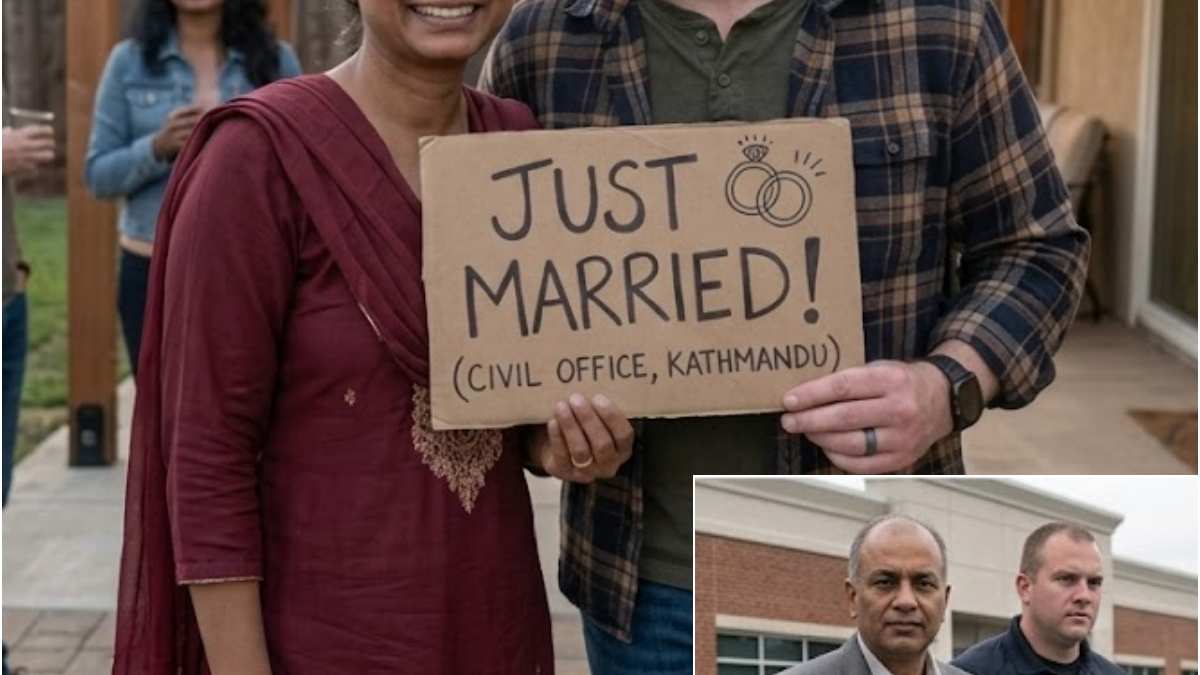
Priyanka and Bishal married in a brief civil ceremony in Kathmandu in April 2022, a trip Trivedi organized and accompanied them on, and the marriage-based cross-chargeability petition, supported by the ceremony’s documentation and a modest but carefully curated set of photographs meant to establish the marriage’s apparent legitimacy, was filed that same month. What neither Priyanka nor, investigators would eventually establish, any of Trivedi’s other clients knew at the time was that Bishal Gurung’s DV lottery win supported, in principle, a visa for himself and one derivative spouse — a single cross-chargeability slot, structurally incapable of supporting more than one such marriage regardless of how many separate petitions might be filed claiming it.
Trivedi, investigators later determined, had run this exact arrangement — the same Nepali lottery winner, the same brief Kathmandu ceremony format, the same $40,000 fee — with at least two other Indian women in the same visa cycle, in 2022 and early 2023, each unaware of the others’ existence, each believing herself to be Bishal’s sole and legitimate spouse for purposes of the petition, each paying the same fee to the same broker for what was, structurally, an impossibility Trivedi had never disclosed to any of them: only one of the three marriages could ever actually result in a valid visa, and Trivedi, it would later emerge, had no functional way to determine or control which one, having simply filed all three petitions in parallel and allowed the immigration system’s own processing timeline to determine, essentially by chance, whichever petition happened to reach adjudication first with the least apparent complication.
Priyanka’s petition, as it happened, was the one that processed first, approved in late 2023 without USCIS’s initial review flagging the underlying multiple-marriage structure, a gap that reflected less any failure of scrutiny than the simple reality that each petition, reviewed independently and without cross-referencing against Bishal’s other simultaneous filings — a cross-reference the system had no automatic mechanism to perform, since each petition originated from a different beneficiary’s file — appeared, on its own individual merits, entirely ordinary.
Priyanka landed in the United States in January 2024, settling, per the arrangement’s own terms, in a small apartment in Ohio that Trivedi’s network had arranged, expecting to build, over the following two-year conditional residency period, whatever version of a functional cohabiting marriage the arrangement’s transactional origins would allow — a low bar, but one she had, by her own account, genuinely intended to meet, given how much her own family had invested in the outcome.
The second and third petitions, filed on behalf of the two other women, began encountering delays in early 2024 as USCIS officers, processing them in the ordinary course, started identifying inconsistencies between the underlying lottery documentation each petition cited — the same winning confirmation number, appearing across multiple, ostensibly unrelated filings, a red flag automated fraud-detection screening eventually caught in March 2024, nine months after Priyanka’s own petition had already cleared.
USCIS’s fraud detection unit referred the case to Homeland Security Investigations in April 2024, and the resulting investigation, moving through the summer and fall of that year, uncovered the full scope of Trivedi’s operation — not merely the three parallel Bishal Gurung petitions, but a broader pattern spanning at least eleven separate cross-chargeability arrangements over three years, involving four different Nepali and Bangladeshi lottery winners Trivedi had recruited specifically for their willingness to participate in multiple simultaneous marriages in exchange for a portion of each $40,000 fee.
Priyanka was interviewed by HSI agents in July 2024, and the interview marked the first moment she learned that her marriage to Bishal Gurung had never been, in any functional sense, the singular arrangement she’d understood it to be — that two other women, unknown to her, had paid the same broker the same fee for what turned out to be, structurally, a claim on the same single visa slot her own petition had happened to fill first.
Trivedi was arrested in September 2024, and Bishal Gurung separately in October, both charged in the U.S. District Court for the District of Nebraska, where the fraud investigation’s coordinating office was based, with conspiracy to commit marriage fraud and visa fraud. Trivedi’s trial opened in March 2025. The prosecution’s case rested on the parallel filing pattern itself, financial records establishing the identical $40,000 fee structure across all documented arrangements, and testimony from Priyanka and one of the two other women, who traveled from India specifically to testify about the arrangement’s terms as each had separately understood them.
Priyanka herself was not charged, a determination HSI reached relatively early in the investigation given the absence of any evidence she had known about the parallel marriages or the underlying single-slot structure at the time her own petition was filed — her cooperation with investigators, offered without hesitation once the scope of the scheme became clear to her, was treated throughout as that of a defrauded party rather than a knowing participant, a distinction her attorney noted was “not automatic in cases like this one, and I think it’s worth saying plainly that it should have been.”
The jury convicted Trivedi on all counts in April 2025. He was sentenced that July to seven years in federal prison and ordered to pay restitution to all eleven documented clients, a sum his seized assets could satisfy only partially. Bishal Gurung, whose own culpability the prosecution characterized as somewhat lesser given his more limited role as Trivedi’s recruited participant rather than the scheme’s architect, pleaded guilty separately and was sentenced to eighteen months.
Priyanka’s own marriage-based conditional status, technically valid on its own terms despite the surrounding fraud she had no part in, was reviewed by USCIS following the criminal case’s resolution and, in a decision issued in late 2025, preserved on humanitarian grounds specific to her documented status as a defrauded party rather than a co-conspirator — a resolution her attorney described as “the system working correctly for once, though it took a federal indictment of someone else entirely to get there.” She has since divorced Bishal Gurung, a formality neither party contested, and remains in Ohio, rebuilding, she has said in the single interview she agreed to give about the case, “not the life I thought I was paying for, but a life that at least, now, is entirely and only mine to decide what happens in.”
The two other women whose petitions were displaced by Priyanka’s earlier processing have not received any comparable immigration relief; both remain in India, their $40,000 fees included in Trivedi’s restitution order but, given the scale of his seized assets relative to eleven separate victims, unlikely to ever be meaningfully recovered.
We built a narrow legal doorway to keep genuine couples from being separated by the accident of where each partner happened to be born. What Ashok Trivedi understood, correctly and cynically, is that a doorway built for love travels just as easily when what’s actually moving through it is a fee, a spreadsheet, and however many simultaneous claims on the same single visa a broker calculates he can quietly get away with filing before anyone thinks to check.








