She Married Him With No Conditions on Her Green Card — Investigators Said That Almost Made the Murder Easier to Hide
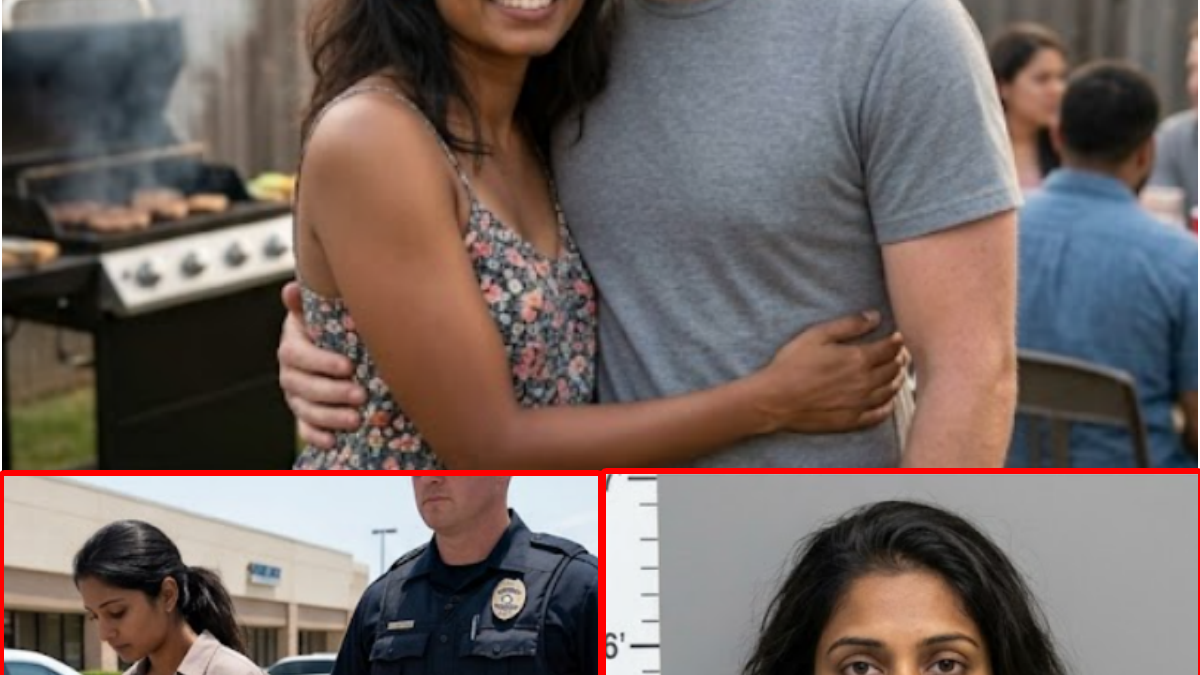
Look at this detail, because it’s the one that actually matters here, more than the poison, more than the debt. Most of the marriages that end up in a story like this one carry a built-in timer — a conditional green card, a two-year window, a joint petition that forces two people to keep proving, on paper, that the marriage is real. Kavya Nair’s marriage had already passed that mark before she ever set foot in the country. She arrived with an IR-1 visa, unconditional from day one, a full ten-year green card requiring nothing further from either of them.
I bring this up first because the investigators in this case kept coming back to it too — not as a motive, but as an explanation for how long everything took to unravel. Nobody was checking on this marriage. There was no bureaucratic reason left for anyone to look closely at it at all.
Kavya Nair was born in Kochi, Kerala, in 1990, the daughter of a marine engineer and a pharmacist, and grew up with an unusually international childhood by the standards of her extended family — her father’s work took the family briefly to Singapore and back twice before she turned twelve, and she’d developed, by her own account, an early fluency in moving between places that made the idea of eventually marrying and relocating abroad feel less like an uprooting than a continuation of something she already knew how to do.
She met David Whitfield in 2016, not through family introduction but through a mutual friend from her Singapore years, a college classmate who had moved to Texas and hosted a small gathering David attended. He was a real estate agent in Austin, divorced once already in his mid-thirties, and the relationship that followed developed slowly and, by every account from friends on both sides, genuinely — visits back and forth over nearly three years, a small wedding in Kochi in 2019 that both families attended without apparent reservation, and a decision, given David’s already-established career and Kavya’s own growing hesitation about how quickly to relocate, to build the marriage first and pursue the immigrant visa only once they were confident the distance itself hadn’t been carrying more of the relationship than either wanted to admit.
By the time Kavya’s immigrant petition was filed in 2021, the marriage was already two years and eight months old, past the threshold that determines which visa category applies — a marriage of at least two years’ standing at the time a spousal immigrant visa is issued qualifies for IR-1 status, immediate and unconditional, rather than the CR-1 category and its attached two-year conditional period that applies to newer marriages. Kavya landed in Austin in March 2022, thirty-one years old, with a green card that would not expire, functionally, for a decade, and that carried no requirement that anyone ever check back in on whether the marriage itself was still intact.
The trouble, when it started, had nothing to do with immigration status at all. David’s real estate business, strong through the pandemic-era housing boom, had slowed considerably by 2023, and alongside it, a gambling habit he had kept carefully hidden from Kavya throughout their long-distance courtship — sports betting, expanded aggressively once mobile betting apps became legal in enough neighboring states to make it functionally accessible from Texas regardless of the state’s own restrictions — had deepened into something considerably more serious than either his business slowdown or his marriage could comfortably absorb.
Kavya discovered the scale of it in June 2023, going through what she’d assumed was routine paperwork related to refinancing their jointly owned house and finding, instead, a second mortgage David had taken out against the property eight months earlier, using a signature on the loan documents that was, unmistakably, not her own, despite the form listing it as hers. He had forged it, borrowing $140,000 against a house she co-owned, without her knowledge or consent, to cover gambling losses that had, by then, reached nearly $200,000 total.
The confrontation that followed, in late June 2023, was the first of several over the following months, none of which resolved anything, according to Kavya’s later account to investigators. David alternated, she said, between remorse and a specific, recurring threat — that if she pushed the matter legally, tried to remove her name from the property or report the forgery, he would go to immigration authorities himself and claim their marriage had been fraudulent from the start, entered into solely to secure her green card, a claim that, even against an unconditional IR-1 visa already years old, could still, if credibly investigated, expose her to a fraud finding and retroactive rescission of her status — a threat with real if uncertain legal teeth, and one Kavya, without her own independent legal counsel at the time, had no easy way to fully evaluate or dismiss.
David Whitfield died on the night of October 14th, 2023, at the couple’s Austin home, after what Kavya initially described to responding paramedics as an accidental overdose — he had been prescribed oxycodone eighteen months earlier for a back injury sustained on a property showing, a prescription he had, by Kavya’s account, been misusing with increasing frequency as the gambling debt and the fights over it had escalated through the summer. The initial toxicology screen, run as a matter of standard procedure, found an oxycodone concentration consistent with, though somewhat elevated for, a man with his documented history of both a legitimate prescription and a pattern of self-medicating beyond it. The Travis County medical examiner’s office, in its initial finding, classified the death as an accidental overdose, a conclusion that, given David’s known prescription history and Kavya’s own account of his escalating misuse, drew no immediate scrutiny from anyone.
It might have stayed that way indefinitely if not for David’s mother, Carol Whitfield, who had grown increasingly suspicious over the two months following her son’s death, driven less by any specific evidence than by a mother’s accumulated unease — the forged mortgage documents, which she’d learned about only after his death while helping settle his estate, and a pattern of what she described to detectives as “too many convenient explanations arriving too easily.” She hired a private investigator in December 2023, who uncovered nothing conclusive on his own but who did surface, and pass along to Travis County Sheriff’s detectives, banking records showing that Kavya had withdrawn $4,000 in cash across three transactions in the ten days before David’s death — a sum neither explained by any documented household expense nor, notably, ever mentioned in Kavya’s initial statements to police.
Detective Renee Alvarez of the Travis County Sheriff’s Office reopened the case in January 2024, requesting a more detailed forensic toxicology analysis than the initial screen had performed — specifically, an examination of the oxycodone metabolite ratios that can, in a sufficiently detailed test, distinguish a single large ingested dose from a pattern of gradual, chronic misuse building toward an eventual overdose. The results, returned in March 2024, indicated a metabolite pattern more consistent with the former: a substantial quantity ingested within a narrow window shortly before death, not the gradually escalating pattern David’s known history would otherwise have predicted.
The $4,000 in cash withdrawals, combined with a pharmacy investigation subpoenaed that spring, traced to an unrelated, separately prescribed oxycodone supply obtained under a different patient’s name — a coworker of Kavya’s from the property management firm where she’d found work after arriving in Austin, a woman named Priya Suresh who told investigators, once confronted, that Kavya had asked to “borrow a few of her extra pills” in early October 2023, claiming her own back pain had flared, a request Priya said she’d agreed to without much thought at the time and had never connected, until detectives raised it, to anything more significant.
Cell tower and banking data together established that Kavya had purchased the additional pills from Priya using a portion of the withdrawn cash on October 9th, five days before David’s death — a purchase that, combined with the metabolite analysis suggesting a single large ingested dose rather than chronic buildup, gave prosecutors what they needed to move from a suspicious death to a homicide charge.
Kavya was arrested on May 14th, 2024, at the property management office where she still worked, and charged with murder.
The trial opened at the Travis County District Court in February 2025. The prosecution’s case rested on three elements laid end to end: the forged mortgage and the financial motive it established, the unexplained cash withdrawals traced to an off-books pill purchase from a coworker, and the metabolite analysis suggesting a single administered dose rather than the accidental pattern the initial, less detailed screening had assumed.
Kavya’s attorney did not dispute the forged mortgage or the gambling debt, both independently corroborated and largely undisputed even by David’s own family. He argued instead that the additional pills, whatever their origin, had been obtained for Kavya’s own legitimate use — she did, in fact, have a documented history of intermittent back pain herself, treated previously with over-the-counter medication — and that the metabolite evidence, while suggestive, fell short of conclusively excluding the possibility that David himself had simply taken an unusually large dose on a night investigators agreed had followed a particularly severe argument about the mortgage, one witnessed partially by a neighbor who heard raised voices through a shared wall.
The jury did not find the alternative persuasive enough against the combined weight of the financial motive, the concealed cash purchase, and the specialized toxicology finding. They deliberated for four days and convicted Kavya of murder. She was sentenced in April 2025 to thirty-two years in prison.
Her unconditional IR-1 green card, untouched by any of the usual conditional-residency mechanisms that complicate so many other cases in this pattern, did not need to be revoked through any special immigration fraud process at all — a murder conviction alone was sufficient grounds for removal proceedings under standard deportability provisions governing aggravated felonies, initiated automatically once her sentence was finalized, with no bar-specific analysis of the marriage’s authenticity required, because by then, nobody needed the marriage’s authenticity established or disproven to reach the same practical outcome.
Priya Suresh, the coworker whose pills ended up at the center of the prosecution’s case, was not criminally charged, having cooperated fully once approached and having had, investigators concluded, no knowledge of what the pills were actually intended for at the time she handed them over. She left the property management firm in mid-2024, unable, she told a local reporter who briefly covered the case, “to sit at the desk across from where all of it started, even after everyone told me none of it was my fault.”
Carol Whitfield, David’s mother, attended every day of the trial and gave a brief statement to reporters after the sentencing, saying only that she wished the forged mortgage documents had reached her two months earlier than they did — “not because it would have saved him. Because I might have asked the right question in time instead of after.”
I keep thinking about the ten years stamped on that unconditional green card, sitting in a drawer somewhere in that Austin house for the entire eighteen months this took to unravel, a document that had already, permanently and by design, stopped requiring anyone to check.








