She Flew to Ohio to Join Her Husband on a Spousal Visa — Six Weeks Later, Police Told Her She Was a Suspect in His Murder
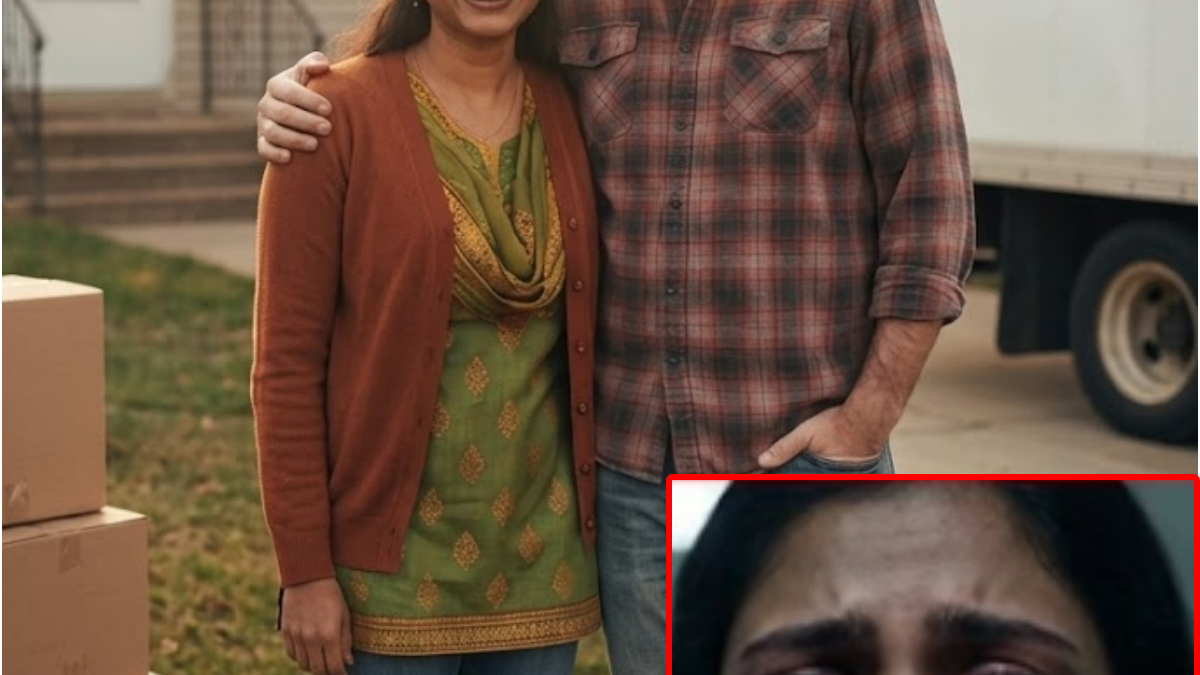
Radhika Menon buried her husband before she had a green card, before she had a driver’s license, before she’d learned the name of a single street in the town she’d just moved to. For eleven days, police believed she’d killed him for the life insurance. She hadn’t even known the policy existed.
She arrived in Dayton, Ohio, in March 2024, on a K-3 visa — the category built for spouses of US citizens who need to enter the country while their immigrant petition is still pending, faster than waiting abroad for the full green card process to clear, but legally provisional in a way most people never think about until something goes wrong. Radhika’s marriage to Brian Halloway, a forty-one-year-old auto-parts distributor she’d met through a mutual cousin’s wedding in Kochi eighteen months earlier, was real, documented, and by every account from people who knew them, happy. It didn’t matter. Six weeks after she landed, Brian was dead, and for eleven days, she was the only suspect anyone in the Montgomery County Sheriff’s Office seriously considered.
“New wife, new visa, brand new insurance policy naming her the sole beneficiary,” Detective Rosalind Fairweather said later. “On paper, that’s the whole story. It’s the easiest theory in the world to believe.”
It was also wrong.
Brian Halloway ran a mid-sized distribution business supplying replacement auto parts to independent repair shops across three counties, a company he’d inherited from his father and grown modestly over fifteen years. He had one full-time business partner, a man named Curtis Vance, who’d bought into the company in 2019 and handled the financial and logistics side while Brian managed sales and supplier relationships.
Radhika met Brian in October 2022. They married in Kochi in June 2023, in a small ceremony her family still describes as one of the happiest days of her adult life. The K-3 petition moved through consular processing over the following months, and she landed at Dayton International Airport on March 9th, 2024, with two suitcases and a stack of documents she’d been told to keep in a folder and never let out of her sight.
She had, at that point, been in the country for exactly forty-three days when Brian didn’t come home.
Those forty-three days had been, by Radhika’s own description, a strange and specific kind of disorientation that nobody had fully warned her about. She’d left behind a career as a high school chemistry teacher in Kerala, a role she’d held for six years, and had not yet started the paperwork process for an American teaching credential, which meant her days were filled with the small, disorienting tasks of building a life from nothing — learning which grocery store carried the spices she needed, figuring out the bus routes in a town with almost no functioning public transit, calling her mother in Kochi every evening at exactly the hour that lined up with breakfast time back home. Brian had taken two weeks off work to help her settle in, driven her to get a Social Security card application filed, and taught her, in the driveway of their small rented house, the basics of driving on the opposite side of the road from what she’d learned in India. Neighbors who spoke to investigators afterward described the couple, without exception, as visibly, almost conspicuously happy — the kind of newly married couple who still held hands walking to the mailbox.
He’d left for the warehouse on the evening of April 21st, 2024, to meet Curtis Vance about a supplier contract renewal — a routine after-hours meeting, the kind the two men had done a dozen times before. Radhika waited up until eleven, called his phone four times, and called the warehouse’s after-hours line once, getting no answer. She called the police at 12:40 a.m.
Brian’s body was found the next morning by a delivery driver, in the warehouse’s loading bay, dead from a single gunshot wound. There was no sign of forced entry. The warehouse’s security footage, investigators soon learned, had a gap — a full ninety minutes, beginning at 8:52 p.m., during which the system’s DVR had simply stopped recording, a detail the sheriff’s office initially treated as a coincidental equipment failure.
Detective Fairweather’s first read on the case, by her own later account, was straightforward. “New immigrant spouse, husband found dead within two months of her arrival, and within four days we learn there’s a $400,000 life insurance policy naming her as sole beneficiary, taken out three weeks before he died,” she said. “I’ve worked cases with far less circumstantial weight than that.”
Radhika was brought in for questioning on April 24th. She told detectives, accurately, that she’d had no idea the policy existed. She did not yet have a functioning grasp of American insurance products, an American bank account in her own name, or, in the detective’s own later admission, enough English-language fluency under interrogation stress to explain herself as clearly as an anxious, grieving, newly arrived widow needed to in that room.
“I remember being asked the same question four different ways,” Radhika said later. “Each time, I understood it a little less, not more.”
The interrogation itself, reviewed later by Radhika’s attorney through a formal records request, ran just under three hours, conducted without an interpreter present despite Radhika’s own request for one partway through, on the department’s initial judgment that her spoken English was “sufficient for the purposes of the interview” — a judgment her attorney would later characterize, in a formal complaint filed with the county, as a serious procedural failure that nearly cost an innocent woman both her freedom and her immigration status simultaneously. Radhika described, months later, sitting in that room trying to translate not just the detectives’ words but the entire logic of an American police interview in her head before she could answer, a half-second delay each time that, she believes, likely read to the detectives as evasiveness rather than what it actually was.
She was not arrested. She was also not cleared. For eleven days, her attorney — retained through an emergency referral from a South Asian community legal aid organization in Cincinnati — fought to keep her out of a formal charge while investigators finished processing the scene, and her own immigration status hung directly on the outcome. A pending K-3 case, her attorney told her plainly, does not survive a murder charge. If charged, her spousal petition would be administratively frozen, and even an eventual acquittal years later would leave her with no petitioning spouse alive to complete it and no independent path back to status at all.
“She was facing the possibility of losing her husband, her freedom, and her legal right to stay in the country that was now the only place she had anything left, all inside the same two weeks,” her attorney, Meenu Pillai, said. “I don’t think people outside immigration law fully understand how a single accusation can do that much damage before a single piece of evidence is even tested.”
What actually broke the case, and it broke fast once investigators looked in the right direction, was the ninety-minute gap in the warehouse security footage.
A digital forensics specialist brought in from the Ohio Bureau of Criminal Investigation determined, within a week, that the DVR hadn’t malfunctioned. It had been remotely accessed and its recording deliberately paused, using an administrator login that only two people held: Brian, and Curtis Vance.
Brian was dead. That left one person who could have used it.
“Once we had that, the entire theory of the case shifted overnight,” Fairweather said. “Because now we’re not looking at means and opportunity in the abstract. We’re looking at a specific person who had the only other key to that system, and who used it at almost exactly the time of death.”
Financial records, subpoenaed the same week, showed why Vance might have needed ninety minutes of missing footage. He had been quietly diverting company funds through inflated supplier invoices for nearly two years, a scheme that had grown, by early 2024, to just over $290,000 — and Brian, according to text messages recovered from his phone, had discovered a discrepancy in the March supplier reconciliation and scheduled the April 21st meeting specifically to confront Vance about it.
“He wasn’t meeting his business partner about a contract renewal,” the county prosecutor, Daniel Osei, said at Vance’s arraignment. “He was meeting the man who was about to lose everything if that conversation went the way it should have.”
Gunshot residue testing on a jacket recovered from Vance’s car, combined with cell tower data placing his phone at the warehouse during the exact ninety-minute recording gap he had no other explanation for, closed the case within three weeks of Brian’s death.
Vance’s own financial records told a story his defense would later struggle to soften. The diverted funds had gone, in large part, toward a second mortgage payment on a lake house in Michigan he’d purchased in 2022 without his own wife’s full knowledge, and toward a series of increasingly aggressive stock options trades that had, by early 2024, lost nearly $80,000 of the diverted total outright. Investigators found, on a laptop seized from his home office, a draft resignation letter dated April 19th, two days before Brian’s death, that Vance had written and never sent — an attempt, prosecutors argued at trial, to quietly extract himself from the partnership before the reconciliation discrepancy could be traced back to him, an exit that the April 21st confrontation made impossible to execute cleanly.
“He was already trying to leave,” Osei told the jury. “The tragedy of this case is that leaving would have worked. He didn’t have to do what he did. He chose to, because leaving meant admitting what he’d taken, and killing Brian Halloway felt, to him, like the faster way out.”
Curtis Vance was arrested on May 14th, 2024, and charged with first-degree murder, embezzlement, and evidence tampering. He pleaded not guilty, and his attorney argued at trial that the financial discrepancies predated any confrontation and that the security system gap had a technical explanation the defense’s own expert witness could not, in the end, actually produce. The jury deliberated six hours.
He was convicted on all counts in March 2025 and sentenced to life in prison with the possibility of parole after twenty-five years.
Radhika Menon was formally cleared within days of Vance’s arrest, a clearance that arrived, her attorney has since pointed out publicly, only because the digital evidence happened to be unusually clean and unusually fast to develop. “If that DVR system hadn’t logged the administrator access the way it did,” Pillai said, “I don’t know how long she would have carried that suspicion. Weeks. Maybe longer. And every one of those weeks would have been a week her legal status in this country was actively unraveling for something she had nothing to do with.”
The $400,000 life insurance policy Brian had taken out — the detail that made her the department’s first and, for eleven days, only real suspect — was, investigators eventually confirmed, something he’d arranged quietly and without telling her at all, a gesture of the kind new husbands sometimes make and rarely announce, meant to protect a wife he’d brought across an ocean into a life he assumed, reasonably, they’d have decades to build together.
Her K-3 case, frozen during the investigation, was reopened once she was formally cleared, and USCIS, after reviewing the circumstances, allowed her petition to proceed on humanitarian grounds tied to Brian’s death rather than requiring her to restart the process from nothing, a determination that took federal officials four more months to finalize.
“There is a version of this story where the department got it right the first time, purely by luck, because the technology happened to log something Vance didn’t think to erase,” Detective Fairweather said, in the same interview where she first admitted how quickly she’d settled on Radhika as the obvious suspect. “I don’t like how comfortable I was with that first theory. I think about that more than I think about the parts of the case we got right.”
Radhika still lives in Dayton. She works, as of this year, at the same community legal aid organization that connected her with Meenu Pillai during those eleven days, helping other recently arrived spouses navigate exactly the kind of documentation gap that made her, however briefly, the most convenient explanation for a crime someone else had already planned to commit before she ever landed in the country.
She kept the insurance payout. She has said, when asked, that she has not spent a cent of it, and does not know yet if she ever will.
Radhika’s mother flew from Kochi in the third week of the investigation, the earliest her own visitor visa could be processed, and stayed for four months, sleeping in the same small rented house Radhika and Brian had unpacked together in March. It was, Radhika has said, the only reason she got through the eleven days at all — someone in the house who spoke the same first language, who understood without explanation exactly what it meant to build an entire life around one relationship and then watch it become a crime scene inside of two months. Her mother returned to Kerala in September 2024, once Radhika’s status had stabilized and the criminal case against Vance was fully underway, and the two now speak, Radhika says, at the same hour every evening they always did, though the conversation has changed in ways neither of them has fully found language for yet.








