She Faked Lab Results To Win Her Green Card — Investors Lost $2.3 Million Before Anyone Checked the Data
Look at this raw data file. Column D, rows 40 through 58. Nineteen data points, each one adjusted by an amount too small to catch on a casual read and too consistent, across all nineteen, to be anything but deliberate. A contamination removal efficiency of 71 percent, quietly nudged, row by row, until the reported average read 94.
A postdoc named Wei Chen found that column in eleven minutes, on a Tuesday afternoon, trying to reproduce a result for an entirely unrelated project. It took the rest of the scientific world considerably longer to catch up to what he’d found.
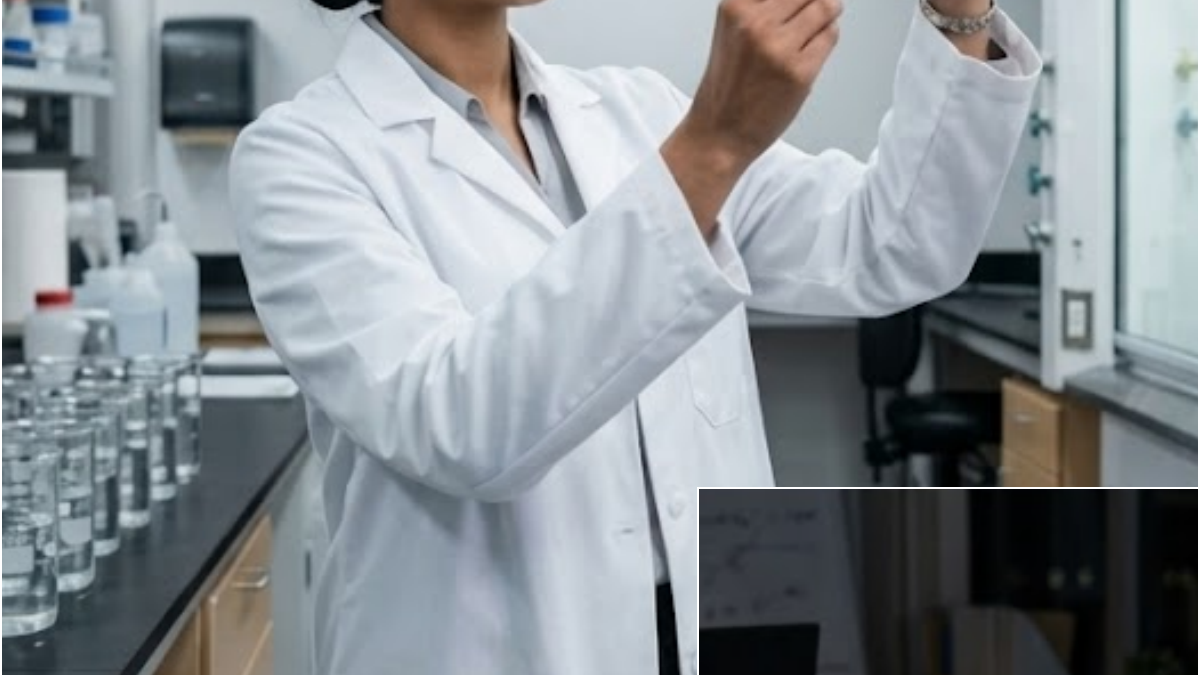
This is Dr. Sneha Rathi. And I think the honest version of this story has to start with the fact that her original research — before any of what follows — was genuinely good. That’s not a mitigating detail I’m offering to soften what comes after. It’s the reason any of this was able to happen at all.
Sneha grew up in Pune, Maharashtra, the daughter of a civil engineer who spent much of his career designing water infrastructure for municipalities across Maharashtra that never quite had enough of it. She used to say, in interviews given later in her career, that she’d grown up understanding water scarcity as a design problem rather than an abstract crisis, a framing that shaped nearly everything about the research path she eventually chose. She completed a bachelor’s in chemical engineering at IIT Bombay, a master’s at the same institution, and a PhD in environmental engineering at the National Chemical Laboratory, focusing on graphene-oxide membrane filtration — a genuinely promising area of water purification research, with real, if still largely lab-scale, potential to remove heavy metals and biological contaminants more efficiently and cheaply than existing filtration methods.
Her doctoral work was solid, well-regarded within a fairly narrow academic niche, and entirely honest, by every account from colleagues who worked alongside her during those years. She published four papers as a graduate student, all independently reproducible, all methodologically sound. The trouble did not begin in graduate school. It began after, once she’d finished her PhD in 2019 and started thinking seriously about what came next.
What came next, for a researcher in Sneha’s position, is a genuinely difficult path in India — postdoctoral positions in her specific subfield were scarce, funding for early-career environmental engineering research scarcer still, and a growing number of her cohort from IIT Bombay had already begun leaving for the United States, drawn by better-funded labs and a research infrastructure that made the difference between a promising idea and a fully realized one. Sneha wanted the same thing. The path that made the most sense for her, given that she had no single employer offering to sponsor her and no interest in the years-long wait that an employer-sponsored petition would have required anyway, was the EB-2 National Interest Waiver — an immigrant visa category that allows a person of exceptional ability to self-petition for a green card, without any employer sponsor at all, on the basis that their work serves the “national interest” of the United States sufficiently to waive the usual labor certification process entirely.
The NIW petition requires, in practice, an unusually persuasive documentary case: evidence of the work’s substantial merit, evidence of the applicant’s well-positioned ability to advance it, and evidence that the country benefits more from waiving the standard process than from requiring it — evidence that typically takes the form of citations, media coverage, recommendation letters from established researchers in the field, and, most persuasively of all, evidence that the work has already achieved some measurable real-world impact rather than remaining purely theoretical.
Sneha’s actual body of work, honest and solid as it was, did not yet have that last piece. Her filtration membrane, as of 2019, had demonstrated strong results at laboratory bench scale — a controlled environment, small sample sizes, ideal conditions. It had not been tested at any meaningful pilot scale, had no field deployment, and had generated, by her own accurate accounting, four published papers and roughly thirty citations, respectable for an early-career researcher but well short of the kind of file an NIW attorney would describe, in the blunt language of the visa category itself, as a slam dunk.
In early 2020, preparing her NIW petition with an immigration attorney who specialized in scientist and researcher cases, Sneha revisited her doctoral dataset with an eye toward a fifth paper — a synthesis piece consolidating her strongest results into a single, more citable publication aimed at a higher-impact journal than any of her prior four. The underlying experiments were real. The reported efficiency numbers, in the version she submitted to Environmental Science & Technology Letters in March 2020, were not.
I’ve read the retraction notice closely enough to describe exactly what she did, because the mechanism matters more than the outcome, here. She did not invent an experiment from nothing. She took real trials — contamination removal tests run over eighteen months of actual bench work — and, in the specific subset of trials that had underperformed her hypothesis, adjusted the recorded values upward, consistently, by amounts calibrated to be individually unremarkable and collectively transformative. A membrane that genuinely removed heavy metal contaminants at a real, useful rate of roughly 70 to 75 percent became, in the published paper, a membrane that removed them at a headline-grabbing 94 percent — a number good enough to attract attention from exactly the kind of outlets an NIW petition benefits from citing: a brief mention in a water-technology trade publication, a citation in a UN-affiliated sustainability report’s literature review, and, within a year, forty additional academic citations building on a number that had never actually occurred in any lab.
The paper became the centerpiece of her NIW petition, filed in late 2020 and approved in mid-2021. She landed in the United States in August 2021, thirty years old, joining a postdoctoral research position at a university engineering department in North Carolina that had recruited her specifically on the strength of the 94 percent figure — a number, her new department chair would later admit in an internal review, that had been the primary reason her application stood out from a strong pool of other candidates.
I don’t think Sneha intended, at the point of that first fabrication, to build anything beyond a stronger visa petition and a stronger academic reputation. But a fabricated number, once published and cited, generates a kind of gravitational pull of its own. By 2022, with her postdoctoral position secured and her reputation building on the strength of a result she alone knew wasn’t real, she faced a choice that had compounded rather than resolved: replicate the 94 percent figure honestly, which was not possible because the technology did not actually perform at that level, or continue building on top of it.
She chose the second option, and by 2023, that choice had led somewhere considerably larger than an academic paper. A group of angel investors, several of them Indian-American entrepreneurs in the Research Triangle area with an interest in cleantech, approached her about commercializing the membrane technology, having read the 94 percent figure in exactly the trade coverage her own paper had generated. Sneha co-founded a startup, AquaPure Membranes, in early 2023, raising a $2.3 million seed round from eleven investors across two funding rounds, built almost entirely on pitch materials that cited her own published efficiency numbers as the technology’s core validated selling point.
The startup spent much of 2023 and early 2024 attempting to scale the membrane’s production from laboratory bench quantities to pilot-plant volumes suitable for actual municipal water testing — a process that, repeatedly and with mounting internal alarm that Sneha, according to two former AquaPure employees who later spoke to investigators, worked hard to reframe as ordinary engineering scale-up difficulty rather than what it actually was, which was the technology simply failing to reproduce the numbers its entire funding round had been built on.
Wei Chen, a postdoctoral researcher who joined Sneha’s university lab in late 2023 — not connected to AquaPure directly, working on an adjacent membrane durability project — discovered the discrepancy in January 2024, while attempting to build on the original 2020 paper’s methodology for an entirely separate line of research. His attempt to reproduce the reported 94 percent efficiency using the paper’s own stated methods consistently returned results in the 70 to 76 percent range, a gap large enough that he initially assumed his own technique was flawed, until a colleague suggested he request the original raw data files from the university’s shared research server, a request granted routinely, since Sneha had not anticipated anyone needing to look that closely at data four years old.
What he found in Column D took him eleven minutes to notice and considerably longer to fully believe. He brought it to his advisor rather than to Sneha directly, a decision that would later prove significant, since it meant the discovery reached the university’s research integrity office before Sneha had any opportunity to intervene in how it was framed.
The university opened a formal research misconduct investigation in February 2024. Environmental Science & Technology Letters retracted the paper in June 2024, following the university’s own findings, with a retraction notice that used the specific phrase “systematic and intentional data manipulation,” language considerably harsher than the vague “irreproducible results” phrasing that typically accompanies retractions where intent remains ambiguous.
AquaPure’s board, informed of the retraction by the university’s public statement rather than by Sneha herself, initiated its own emergency review in July 2024, during which the company’s chief technology officer — hired eight months earlier and increasingly frustrated by the scale-up failures — disclosed to the board that he had raised concerns about the underlying data as early as October 2023 and had been told, by Sneha directly, that the discrepancy reflected “normal industrial-scale variance,” an explanation he had, at the time, found professionally difficult to challenge given her academic seniority and his own comparative inexperience.
The SEC opened an investigation in September 2024, following a complaint filed by three of AquaPure’s investors once the retraction became public, examining whether the startup’s fundraising materials constituted securities fraud given their reliance on data the company’s own founder had known, or should have known, was unreliable at the time funds were raised. The Department of Justice opened a parallel criminal inquiry in November 2024, given the scale of investor losses and evidence, recovered from Sneha’s own university email account under subpoena, that she had continued citing the fabricated 94 percent figure in investor communications as late as March 2024 — two months after Wei Chen had already flagged the discrepancy internally, and while the university’s own investigation was already, unbeknownst to investors, actively underway.
Sneha was indicted in February 2025 on charges of wire fraud and securities fraud. She was not charged separately with academic research misconduct, which fell outside federal criminal jurisdiction and was instead handled entirely through the university’s internal process, resulting in her termination and a formal misconduct finding referred to the National Science Foundation’s Office of Inspector General, which barred her from receiving federal research funding for a period of ten years — a sanction that, by the time it was imposed in mid-2025, had become almost beside the point given the criminal case already underway.
The trial opened at the U.S. District Court for the Middle District of North Carolina in September 2025. The prosecution’s case rested on the raw data files themselves, walked through methodically by a forensic data analyst who demonstrated, row by row, the exact pattern Wei Chen had first noticed, alongside the March 2024 investor emails establishing continued fraudulent representations made after Sneha had internal knowledge of the discrepancy.
Her attorney did not dispute the data manipulation. He argued instead that the criminal fraud charges improperly conflated academic misconduct — serious, but historically handled through professional and institutional consequences rather than federal prosecution — with a knowing intent to defraud investors specifically, arguing Sneha had genuinely, if wrongly, believed the underlying technology could still be made to work at scale and that the October 2023 and March 2024 statements reflected persistent, misguided optimism rather than deliberate deception of the specific people whose money was at stake.
The jury did not find this distinction as meaningful as the defense had hoped. They deliberated for three days and convicted her on all counts. She was sentenced in December 2025 to five years in federal prison and ordered to pay restitution to all eleven AquaPure investors, a sum that, given the company’s now-worthless remaining assets, will almost certainly never be recovered in full.
Her NIW-based green card, approved in 2021 on the strength of the very paper now formally retracted for intentional fabrication, was placed into rescission proceedings in early 2025, a process distinct from ordinary removal that specifically targets immigration benefits obtained through material misrepresentation. USCIS’s finding, issued that summer, concluded that the underlying petition would not have been approved without the fabricated efficiency data, voiding her permanent residency retroactively. She will be deported upon completion of her federal sentence, with a permanent bar on any future US immigration benefit.
Wei Chen, the postdoc whose eleven minutes with a spreadsheet started all of it, left the field of membrane filtration entirely in 2025, moving to a different research group studying an unrelated area of materials science, a decision he has described, when asked, only as wanting “some distance from a discovery nobody thanked me for making,” a sentence that says less about ingratitude, probably, than about how thoroughly the discovery ended up swallowing every other part of what should have been, for him, a fairly ordinary Tuesday.
I keep thinking about the honest four papers — the real PhD, the real bench work, the real 70 to 75 percent that was, by any reasonable scientific standard, already a genuinely useful result. She had something true. It apparently wasn’t enough, or didn’t feel like enough, for the specific file she needed to build. I don’t know what threshold would have satisfied that feeling if 94 percent didn’t. I’m not sure she knew either, by the end.








