She Couldn’t Escape Her Husband Over Her Visa — He Was Arrested 3 Times, She Was Murdered Anyway
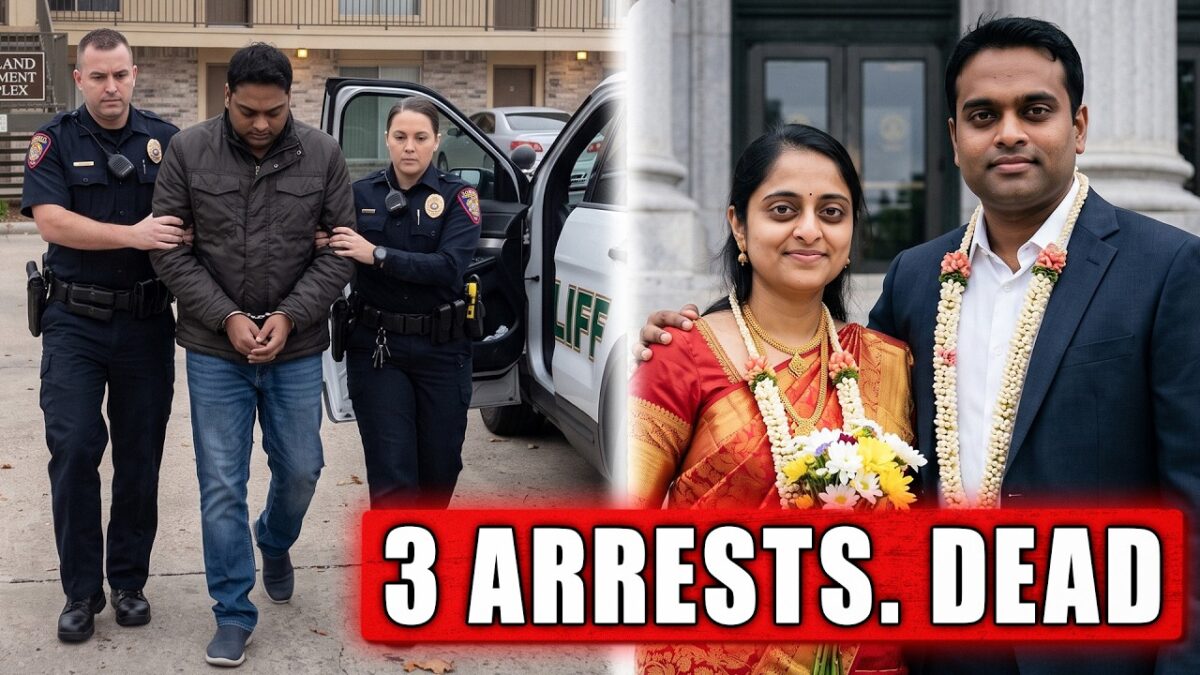
Look at this photograph. April 2nd, 2022. The Harris County Courthouse.
Sneha Bhargava smiling next to her new husband.
He posted it that afternoon, captioned, “Found my person.”
211 people liked it. Now look at this footage. January 14th, 2025.
A Ring doorbell camera. Same woman. Car keys in one hand, a cardboard box in the other.
She says she’ll be back before 9:00. She never comes back. By then, police had arrested her husband three times.
Two protective orders were on file against him. An immigration waiver built on his own violence was still open at USCIS. Three days later, a fisherman pulls her body from a creek off FM 518.
And detectives find something in her husband’s truck he can never explain away. Houston, Texas. March 14th, 2022.
George Bush Intercontinental Airport, Terminal D. Sneha Bhargava was 25 years old when she landed in America for the first time. She carried two suitcases, a folder of visa paperwork, a photograph of a man she had met only once before.
His name was Rajiv Bhargava. 32 years old. Born and raised in Pearland, Texas.
A suburb 15 miles south of downtown Houston. An American citizen. Second generation.
His parents had immigrated from Gujarat in the early 1980s. He had never once set foot in India. The introduction happened the way it happens for thousands of families every year.
A family friend in Surat, Gujarat had a cousin in Houston. That cousin knew Rajiv’s mother from a temple fundraiser. Within 6 weeks, phone calls turned into video calls.
Video calls turned into a proposal neither had fully asked for and both had quietly hoped for anyway. Sneha had grown up above her father’s tailoring shop on Ring Road, Surat. Two rooms.
A tin roof that rattled every monsoon. She studied commerce at a local college. She dreamed specifically of working in international logistics.
America looked from 4,000 miles away like the fastest route to that life. She flew in on a K-1 visa. A fiance visa.
Under US immigration law, the marriage has to happen within 90 days of arrival. Miss that window and the visa holder is expected to leave the country. They married 19 days later.
April 2nd, 2022. The Harris County Civil Courthouse, 201 Caroline Street. 11 guests.
A judge named Patricia Quon performed the ceremony in under 4 minutes. For a while, it looked exactly like the story families tell each other at weddings. Rajiv worked as an insurance underwriter at a mid-sized firm off Highway 288.
He cleared close to $90,000 a year. Three nights a week, he picked Sneha up from English classes at Houston Community College. He posted a photo from the courthouse steps on Facebook.
The caption read, “Found my person.”
211 people liked it. Nobody in that photo could see the apartment on Broadway Street at 11:00 at night after the front door was locked.
By February of 2023, 10 months after the wedding, Sneha held her green card. Conditional. Valid 2 years.
A card that expires unless specific paperwork gets filed before that date. Nobody explained that part to her. Not in detail.
Not yet. She sent money home that first year, small amounts. $200 one month, $300 the next.
She learned to drive on the wide, flat access roads that cut through Pearland. She took a part-time job answering phones at a dental office 2 miles from the apartment. She also learned, slowly and quietly, that Rajiv checked her phone every night before bed.
That he decided which of her paychecks she was allowed to keep and which went straight into his account. That when she disagreed with him about money, about how often she called her mother in Surat, about almost anything, his voice changed first. Everything else changed after.
None of that made it into a photograph. None of it made it onto Facebook. Her mother called every Sunday at 9:00 in the morning, Houston time.
Sneha always said some version of the same thing. That everything was good. That he took care of her.
She believed it, too. That was the part almost nobody understood later. The apartment sat in a two-story complex on Broadway Street, unit 214, half a mile from a Kroger.
Rajiv’s parents lived 11 minutes away near Pearland’s Southdown neighborhood. They came for Sunday dinner most weeks. They liked Sneha.
They told friends at temple their son had married well. Rajiv’s mother, Kamala, had her own opinions about how a household should run. A wife managed the kitchen.
A husband managed the money. Nobody in that family had ever called it control. They called it tradition.
At Houston Community College, Sneha made one real friend. Priyanka Solanki, 28, also from Gujarat, married 4 years earlier to a man in Sugar Land. They sat together in the same evening English class every Tuesday and Thursday.
Priyanka would later remember the exact week Sneha stopped wearing short sleeves, even in the Texas heat. At the time, neither of them thought much of it. In September of 2022, 6 months after she landed at that airport with two suitcases and a stranger’s photograph, Sneha Bhargava still believed she had made the right decision.
She had no way of knowing what the next 28 months were going to cost her. Rajiv Bhargava had never lived anywhere but Pearland, Texas. He grew up the only son in a house where his father managed every bank account.
His mother never once questioned it. Kamala Bhargava called it respect. People outside that house might have used a different word.
Rajiv absorbed the lesson early. A household runs on one signature, his. At the insurance firm off Highway 288, he had spent 6 years watching a senior underwriter title go to someone else, year after year.
Before Sneha, there had been one serious relationship, a woman named Ashley Ruiz from his own office back in 2019. It ended after 14 months. Neither Rajiv nor his family ever explained why in any real detail to anyone.
What nobody outside the marriage saw was how carefully, once the wedding was over, Rajiv began narrowing Sneha’s world, one ordinary decision at a time. It started with the joint bank account that spring of 2022. Reasonable enough on paper, she had no credit history in America yet.
With her application still pending and no legal right to work at all, whatever she needed came from an allowance transferred a little at a time from an account with only his name on the checks.
In June, it continued with the phone. He’d asked to see it once saying he was worried about fishing scams targeting new immigrants. After that, checking it became routine.
Every night. No exceptions. Her work permit, the EAD card tied to her pending green card application, finally arrived in September of 20 22, 5 months after they filed.
It let her take the job at the dental office. It did not let her keep what she earned there. The paycheck went straight into the joint account.
The same allowance came back out still decided entirely by him. Her I-485 itself was still pending through all of it. No green card yet.
Every part of her legal existence in the United States ran directly through him. His signature, his sponsorship, his patience. He knew it.
He never said it out loud. He didn’t need to. The first time he put his hands on her was October 15th, a Saturday, inside apartment 214 on Broadway Street.
It started over $60. Her father’s tailoring shop in Surat had a bad month and she’d asked to send extra money home. He said no.
She asked again. He grabbed her wrist hard enough to leave a mark and shoved her back against the kitchen counter. It lasted maybe 11 seconds.
No call to police, no visit to urgent care. She wore a long-sleeve kurta to English class that Tuesday in 90° heat and told Priyanka she was cold from the air conditioning at work. Sneha told herself several things that week.
That he’d been under pressure at work. That every marriage had a bad week somewhere in its first year. That her mother, back in Surat, had endured worse from a husband who never once raised a hand and had still called her own marriage a good one.
She believed mostly that it wouldn’t happen again. For 4 days after, Rajiv was gentler than he had been in months. He brought home her favorite mango kulfi from a shop on Hillcroft.
He apologized without ever quite naming what he was apologizing for. This pattern, the incident then the sudden softness after, would repeat so consistently over the next 2 years that a prosecutor would later put a clinical name to it in a courtroom. In October of 2022, Sneha had no name for it at all.
She just knew the kulfi tasted the same as always and for a few days, so did he. It happened again on December 3rd. It happened a third time on January 21st, 2023.
4 days later, the senior underwriter title went to someone else again, the second year running. Rajiv told his parents it didn’t matter. He told Sneha nothing at all.
He just came home later that week and quieter than usual. Each time the apartment door stayed closed. Each time nobody outside it heard a thing.
By February, when her conditional green card finally arrived in the mail, Sneha understood something she hadn’t fully understood in October. The card had her photograph on it, her name spelled correctly, an expiration date 2 years out. It also had his name attached to every reason it existed at all.
She put it in a drawer and didn’t tell anyone how she felt looking at it. The first outside call came from Diane Kessler in unit 212, one wall over. March 11th, 2023, a Saturday just after 10:00 at night, Diane heard shouting, then something heavy hit a wall.
She called 911 without knocking, without asking Sneha anything first. Pearland PD arrived 9 minutes later. An officer photographed a bruise forming on Sneha’s forearm for the report.
Sneha told him it was nothing. That she’d bumped into a door. She declined to press charges.
The photo stayed in the file anyway.
By July, a cashier at the Kroger on Broadway noticed the same kind of mark higher up when Sneha reached for her wallet. The cashier asked if she was okay. Sneha said she was fine and asked for a receipt.
Neither of those two moments led anywhere. Both of them would matter later.
On September 16th, 2023, Sneha made the call herself. Her father’s tailoring shop had lost its main supplier that week. The argument over money escalated faster than the ones before it.
Officers arrived at apartment 214 and arrested Rajiv on the spot. Assault causing bodily injury to a family member, a class A misdemeanor under Texas law. He was booked into the Brazoria County Jail that night.
Bond was set at $2,000. His parents posted it the next morning. He was home by lunch.
A magistrate issued an emergency protective order at the same hearing. 20 days, no contact. It lasted 16.
On October 2nd, Rajiv showed up at the dental office where Sneha worked asking the front desk to see her. A coordinator named Monica Reyes recognized him from a photo Sneha had once shown her. She called the office manager who called the police.
A second arrest followed. This one for violating the order itself. Bond, again, release again, within 2 days.
For months after that, nothing reached a police report. That didn’t mean nothing happened. It meant it happened quietly enough that no one outside apartment 214 heard it.
The pattern held through the winter. An incident, then a few gentler days after. Kulfi from Hillcroft.
An apology with no real subject. Sneha still went to English class on Tuesdays. Sunday calls to her mother in Surat kept the same rhythm they always had.
Mostly she still said everything was fine. Twice more that year, Pearland PD logged welfare checks at the apartment after Priyanka couldn’t reach her for a day or two. Each time, Sneha answered the door herself and said she was fine.
Each time the officer noted it and left.
The next call came from across the street. April 13th, 2024. A Saturday afternoon.
A neighbor named Marcus Webb unloading groceries two spots over saw Rajiv grab Sneha by the throat in the parking lot outside their building in daylight in view of Broadway Street. Webb called 911 while it was still happening. Under Texas law strangulation elevates a domestic assault charge from misdemeanor to a third-degree felony.
This time, bond was set at $15,000. Rajiv’s family posted it four days later. A legal aid attorney named Rosa Delgado from a domestic violence clinic off Richmond Avenue met with Sneha that same month.
Rosa explained something Sneha hadn’t fully understood before. Rajiv would never agree to jointly file the paperwork that was supposed to make her green card permanent. He didn’t have to.
Given everything already sitting in a file somewhere the March report two arrests now a felony charge Sneha could file alone. She didn’t need his signature. She didn’t even need to be divorced from him first.
In June, a civil court granted her a full protective order, valid 2 years, no contact, no calls, no showing up at her workplace again. This one didn’t expire in 20 days. She kept renewing her lease on paper.
She stopped sleeping there most nights.
By November, 90 days out from her green card’s expiration, Rosa helped her file form I-751 with a waiver based on abuse. Police reports, photographs, both protective orders. Rajiv’s name wasn’t on a single page of it.
His felony trial for the parking lot that April afternoon was scheduled for January 15th, 2025. Sneha moved most of her belongings to Priyanka Solanki’s spare room in Sugar Land the first week of December. She told her mother finally some of what had actually happened over the past 2 years.
She told her it was almost over. She had 6 weeks left to live. Priyanka Solanki’s Ring doorbell caught Sneha leaving at 7:34 p.m.
on January 14th, 2025. In the recording, she’s holding her car keys and a single cardboard box. She tells Priyanka off camera that she’s driving to the Broadway Street apartment for the last of her things.
She says she’ll be back before 9:00. She was driving a silver 2016 Honda Civic, plate HYX-4471. By 8:50, Priyanka had texted her twice with no reply.
By 9:40, she’d called four times. Sneha’s voicemail picked up every time. The same recorded greeting, cheerful, recorded months earlier in a different version of her life.
At 11:52 p.m., Priyanka called the Fort Bend County Sheriff’s non-emergency line. A deputy took basic information. An adult missing less than 5 hours with no confirmed sign of harm didn’t meet the threshold for an immediate active search.
The deputy logged it as a missing person’s report and told Priyanka to call back if she heard anything. Priyanka didn’t sleep that night. She sat on her own front steps until sunrise watching the street.
The next morning, January 15th, a Brazoria County courtroom convened for the state of Texas versus Rajiv Bhargava, the felony assault case from the parking lot outside apartment 214 the previous April. The complaining witness didn’t appear. The prosecutor asked for a continuance.
The judge granted it over defense objection and reset the trial for March. Nobody in that courtroom yet knew why Sneha Bhargava hadn’t shown up. Rosa Delgado did.
She’d expected to see Sneha in the gallery that morning there to support the case. When Sneha never texted back that morning either, Rosa called the Sheriff’s office herself. She said the words that changed how the report was handled.
Pending felony domestic violence case, active protective order, respondent out on bond. By that afternoon, the missing person’s case was reassigned to an actual detective, Sergeant Elaine Cho, Criminal Investigations Division. Cho’s first move was the car.
Sneha’s Civic wasn’t at the Broadway Street apartment. It wasn’t at Priyanka’s house in Sugar Land either. It wasn’t in the lot at the dental office where she used to work.
It was found the following morning, January 16th, at the gravel turnout by the Clear Creek Nature Park boat ramp off FM 518, 6 miles from the apartment she’d said she was driving to. Nowhere near any route between the two addresses that made sense. The doors were unlocked.
Her purse was still on the passenger seat. Her phone was not. Divers from the sheriff’s office searched the creek that afternoon and found nothing.
A search team walked the banks for half a mile in both directions before losing light.
On January 17th, a man fishing a bend in the creek roughly 400 yards downstream called 911 at 7:14 a.m. Sneha Bhargava was pronounced dead at the scene. She was 27 years old.
The medical examiner would later place the time of death sometime during the night of January 14th. The same night she’d told Priyanka she’d be back by 9:00. Priyanka was the one who called Sarat.
It was almost 10:00 at night in Texas, close to 9:00 in the morning there. Sneha’s mother didn’t fully understand the English words at first. Priyanka had to say it twice, more simply the second time.
By that evening, word had reached the temple community in Pearland. Kamala Bhargava told a neighbor she couldn’t believe it. That Sneha had seemed fine the last time she’d seen her months earlier.
Nobody corrected her. A deputy drove to Rajiv’s address that same evening for a standard notification. He was still legally her husband.
Next of kin on paper, regardless of the protective order between them. Rajiv answered the door and said he’d been home alone all night on the 14th. He said he hadn’t spoken to Sneha in weeks.
Both statements went into the incident report exactly as he gave them. Unverified. Rajiv Bhargava was not arrested that day.
Not that week. For the first 72 hours of the investigation, he was, on paper, exactly what he’d always been. A defendant out on bond waiting for a trial that had just been postponed.
Because the one person who could testify against him had disappeared and was now gone for good. Sergeant Elaine Cho, Fort Bend County Sheriff’s Office, started with the file that already existed. Two years of it.
A March 2023 bruise photograph. Two arrests. A felony charge for strangulation with an eyewitness.
Two protective orders. An I-751 waiver filed that November that laid out the entire pattern in Rosa Delgado’s own handwriting. None of it proved anything about January 14th.
All of it told Cho exactly where to look. The medical examiner’s report came back on January 20th. Cause of death was drowning.
But there was bruising on Sneha’s neck consistent with manual strangulation inflicted before she entered the water. Not identical to the April 2024 injuries. But the same mechanism.
The same hands in the examiner’s professional opinion. Cho interviewed Priyanka Solanki on January 19th and Rosa Delgado the day after. Both gave formal recorded statements.
The Ring doorbell timestamp. The drive to the apartment that never happened. The trial that had just been postponed.
The waiver application sitting on file at USCIS with Rajiv’s name nowhere on it. Diane Kessler and Marcus Webb gave statements, too. Repeating what they’d already told two different patrol officers on two different nights over a year apart.
Cho subpoenaed cell tower records for both phones on January 22nd. Sneha’s phone had gone dark at 8:07 p.m. on the 14th, pinging last off a tower half a mile from Clear Creek Nature Park.
Rajiv’s phone showed something stranger. It never left his apartment’s tower coverage all night, according to the data. Except for an 11-minute gap around 8:00 p.m.
when it registered no activity at all. No calls, no data, nothing. Phones left on a nightstand don’t usually go silent for exactly 11 minutes.
The footage came next. A Valero station on FM 518, half a mile from the boat ramp, kept 60 days of recordings. On the night of the 14th at 8:11 p.m., its lot camera caught a dark blue Ford F-150 passing on the access road.
Rajiv drove a 2019 F-150, dark blue. Detectives couldn’t read the plate. They didn’t need to.
Combined with the cell gap and the tower data, it was enough for a search warrant. They executed it on January 26th at Rajiv’s apartment and his truck. In the truck bed, under a tarp, they found a woman’s iPhone, cracked screen, powered off.
Sneha’s mother later confirmed the case, a yellow marigold pattern Sneha had bought for it in Surat before she ever left India. A receipt in the truck’s console showed tarp and a roll of contractor bags purchased at a Home Depot on Broadway that same afternoon, hours before Sneha ever left Priyanka’s house. Rajiv Bhargava was brought in for questioning that same afternoon.
He waived his rights and talked for 40 minutes. He said he’d been home all night on the 14th, then said he might have gone for a short drive. He couldn’t remember exactly.
He said he’d never been to Clear Creek Nature Park in his life. Then, shown a still frame from the Valero camera, said maybe he’d driven past it once or twice. He said he had no idea how Sneha’s phone ended up in his truck.
Cho asked him directly why the trial on the 15th mattered so much to him. He didn’t answer that question at all. Rajeev Bhargava was arrested on January 27th, 2025 and charged with murder.
He was still out on the $15,000 bond from the felony assault case when it happened. Under Texas law, picking up a new felony charge while already free on bond for another one is its own separate ground for denying bail outright. At the arraignment 2 days later, the judge did exactly that.
This time, his parents couldn’t post one even if they’d wanted to. A Fort Bend County Grand Jury formally indicted him on February 11th, 2025 on the murder charge and separately on the still pending felony assault count from April of the previous year. Word reached the Pearland Temple community within a day.
Kamala Bhargava stopped attending Sunday services for a while. The neighbor she’d once told that Sneha had seemed fine never brought the comment up again. Neither did she.
Rosa Delgado heard the news at her office off Richmond Avenue the same afternoon she’d been planning to call Sneha’s I-751 case worker with an update. She made a different call instead.
Jury selection began September 8th, 2025 at the Fort Bend County District Court in Richmond, Texas. Rajeev Bhargava pleaded not guilty. His attorney’s strategy was simple.
No one saw the murder itself. No witness, no confession. Just a truck on a gas station camera, a phone in a truck bed, and a receipt.
The prosecution built the case in a different order. They started with the pattern, not the night. In her opening statement, the assistant district attorney told the jury they wouldn’t hear a confession.
They would hear 2 years of warnings nobody acted on fast enough. And then one night that finished what those warnings predicted. Diane Kessler testified about March 11th, 2023.
The shouting, the wall, the photograph an officer took of a bruise Sneha never wanted anyone to see. Marcus Webb testified about the parking lot. April 13th, 2024.
What he saw in broad daylight from two spaces away. Rosa Delgado testified about the I-751 waiver. The paperwork Rajiv would never sign.
The paperwork Sneha didn’t need his signature for at all. The medical examiner testified about the bruising on Sneha’s neck, and how closely it matched the injuries from the year before. Sergeant Elaine Cho walked the jury through the cell tower gap.
11 minutes unaccounted for. Precisely when a truck like his passed a camera a half mile from where his wife’s car turned up abandoned. On cross-examination, the defense pushed Marcus Webb on distance and lighting.
Trying to raise doubt about exactly what he could have seen from two parking spaces away. Webb didn’t waver. He said he’d relived that afternoon enough times to know precisely what he saw.
The defense called no witnesses of its own.
Closing arguments came on September 19th. The jury deliberated for 2 days.
On September 22nd, 2025, they returned a verdict. Guilty of murder. Two weeks later, the same court sentenced Rajiv Bhargava to 45 years in the Texas Department of Criminal Justice.
The separate felony assault charge from the parking lot the year before was folded into sentencing rather than tried on its own. Under Texas law, murder is a 3G offense. He’ll have to serve half his sentence or 30 years, whichever is shorter, before he can even be considered for parole.
That means 22 and 1/2 years. He’ll be a little past 58 the first time a parole board hears his name.
At the sentencing hearing, Sneha’s mother spoke by video link from Surat through an interpreter. She said she had raised her daughter to believe America meant safety. She said nobody had explained to her in the two years of phone calls in between that safety could come with an expiration date attached.
Priyanka Solanki sat in the gallery for all 11 days of trial. She hadn’t missed a single one.
The prosecution entered one more exhibit before resting its case, the photo from the courthouse steps, April 2nd, 2022, captioned “Found my person.”
Exhibit 14, 211 people had liked it once. 12 jurors saw it differently. Sneha Bhargava’s I-751 waiver was still listed as pending at USCIS on the day the verdict came in.
It closed a few weeks later, administratively, the way immigration files close when the applicant has died. No one at USCIS needed to rule on whether the marriage had been real, whether the abuse had been credible enough, whether she deserved to stay. She had already answered all of it in police reports, in courtrooms, in a waiver application built entirely out of other people’s paperwork about her.
Six separate contacts with law enforcement in 22 months, three arrests, two protective orders, a felony charge already filed before she died. Rosa Delgado kept a copy of the waiver application in her own office long after the case closed. She said later that she still wasn’t sure whether to call it a legal document or an obituary.
Every system meant to catch this in advance did, in fact, catch it on paper, in a file, in a case number. None of it arrived in time to stop the one night it needed to. Snaha Bhargava came to Texas believing a green card would be the hardest part of her story.
It turned out to be the paperwork nobody ever finished reading.








