Older Sister Found Dead On Wedding Night Why Did The Groom And Her Sister Flee At 3 AM
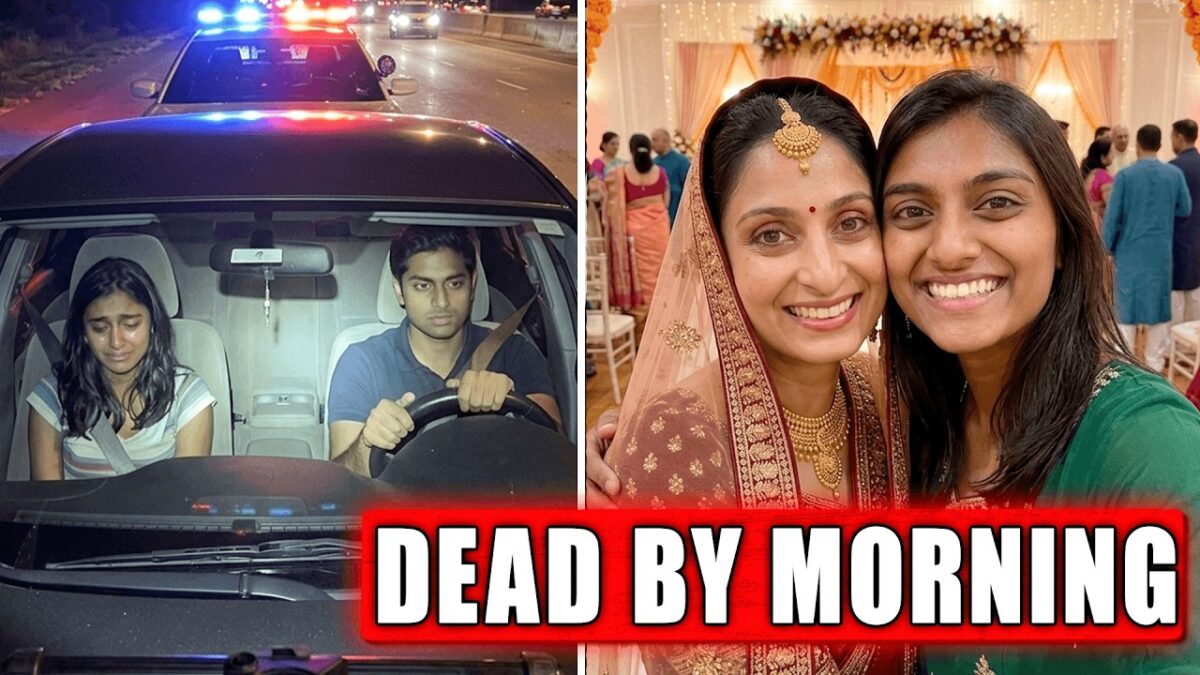
Look at this photo. Two sisters, arms around each other at some family party years back. Nothing about it looks off.
Mera’s the older one, 29, steady and beautiful. Dia’s the younger one, 25, always a little louder, a little more restless. The one who colored outside the lines while her sister stayed neatly inside them.
Then Meera got married. Big wedding, 300 guests, 2 days straight. By morning, police cars lined the street.
She was dead. Her husband was missing. So was her sister.
A neighbor’s doorbell camera had already caught the two of them slipping out together at 3:47 a.m., suitcases in hand, hours before anyone in that house even knew something was wrong. Mera Ralph turned 29 the quiet way. No party, no fuss, nothing that would have made a stranger look twice.
In the small brick house on Cypress Lane, a modest street in a heavily Indian-American suburb outside Edison, New Jersey, birthdays were never loud affairs to begin with, and hers least of all. There was a home-cooked dinner, a call from her grandmother in Chandigar, and her mother telling her, as she did every year, that 29 was still young, that there was no rush. Everyone in that house knew exactly what kind of rush was being talked around without being named.
She had grown up being told gently but constantly that she was the one who set the tone. First daughter, first to walk, first to read, first to bring home report cards good enough to make the aunties go quiet with something that was half pride and half suspicion. As if a child that steady had to be hiding something.
By the time she finished her accounting degree at a state school 20 minutes from home, she had absorbed the lesson so thoroughly she no longer noticed she was performing it. She was simply the daughter who didn’t cause problems. It is worth asking looking back whether anyone ever checked in on what that cost her.
Her sister Dia was a different animal entirely, four years younger and built, it seemed from a completely different set of instructions. where Meera folded her opinions up neatly and put them away. Dia let hers spill everywhere.
Over dinner, over group chats, over long phone calls with friends their mother didn’t love. She switched majors twice. She once dyed a chunk of her hair a color her father called, without irony, inappropriate.
None of it was rebellion. Not really. Call it restlessness instead.
The kind that grows in a younger sibling who has spent years watching an older one absorb the whole family’s expectations and has quietly decided there ought to be some room left over for something of her own. Their parents, Anneil and Sunnita Ralph, had come to the United States in the late 1990s with two suitcases and a job offer in pharmaceutical logistics that Anneil chased all the way from Delhi. They built the kind of life immigrant parents build when they’re terrified of failing twice.
once for leaving and again for not making the leaving worth it. The house on Cypress Lane was paid off by the time Meera turned 25. And a framed photo of both girls high school graduations hung in the hallway where anyone coming through the front door would see at first.
That photo mattered to them more than either daughter probably realized. The community around them was close in the way these enclaves usually are. Warm, watchful, occasionally suffocating, sometimes all three in the same afternoon.
Everyone knew everyone. Families that had come over around the same time stayed tangled together for decades. Their kids growing up side by side at temple on Sundays, at Dwali parties that rotated houses every year, at weddings so big and so loud that the bride’s family and the groom’s family had usually known each other since before either child was born.
It was at one of those weddings in the fall of 2022 that talk turned seriously toward Meera and a young man named Rohan Verma. The Verma and Ralph families had circled each other’s social orbit for over a decade by then. Rohan’s parents ran a pharmacy chain across three counties and Rohan himself, 28, worked operations for the family business while chipping away at an MBA part-time.
On paper, he was exactly what a family like the Rouse had been quietly hoping for. Reliable. well regarded.
People kept using those two words as if they’d agreed on a script beforehand. Meera liked him well enough. That was the phrase she used, even in her own head, well enough.
And somehow it felt like it was supposed to be sufficient. She wasn’t the romantic type. Not in the way some of her American-born friends were.
She’d grown up watching her own parents arranged marriage settle over three decades into something that looked a great deal like love, even though it hadn’t started as one. So she assumed hers would follow the same math. Comfort now, affection later, if it came at all.
What she didn’t know standing in that crowded reception hall was that Rohan Verma and her own younger sister had already met each other years earlier, long before any of this had a name. Rohan grew up two towns over in a house that smelled permanently of his mother’s cardamom tea and his father’s ambition, which is its own kind of inheritance. The Vermas had come from Mumbai a few years after the rouse and Rajesh Verma had built an entire pharmacy chain out of one struggling storefront in a strip mall.
By the time Rohan turned 25, it stretched across three counties. Rohan was the only son, and the weight that came with that particular position isn’t something outsiders tend to understand. It wasn’t cruelty exactly.
It was closer to gravity, a pull that dragged every decision back toward the family name, whether Rohan wanted it there or not. He and Dia had known each other since they were kids. Their families crossed paths constantly at the same temple, the same summer camps, the same circuit of Diwali parties passed from house to house.
For most of their childhood, Rohan was just Meera’s friend’s little sister’s friend, one name in a community small enough that everyone eventually knew everyone twice over. That changed in the summer of 2017 when Rohan was 22 and Dia was 18. He’d come home from his second year of college restless, halfformed, unsure what he actually wanted from a life his father had already sketched out for him.
Dia, fresh out of high school and about to leave for her freshman year, turned out to be the only person in either family’s orbit who asked him a real question instead of the usual scripted ones about his grades and his future at the pharmacy. It started as something neither of them bothered to name. A conversation at a cousin’s engagement party that ran two hours passed when either of them meant to leave.
Late night texts about nothing much. Songs, fights with parents, half-formed plans for lives that felt at 18 and 22 entirely unwritten. For most of a year, they didn’t call it anything at all.
By the time they did, it had already become the kind of secret big enough to rearrange what a person thinks is possible and what isn’t. They were careful. And in a community that size, they had to be.
Carelessness didn’t stay contained to the two people involved. It bled into parents’ reputations, into siblings marriage prospects, into the whole delicate social ledger every immigrant family keeps, whether they’ll admit it or not. So they met at friends apartments, at coffee shops 40 minutes away where nobody would recognize them.
And in the long stretches when Dia was off at school in Pennsylvania, they made do with phone calls after midnight. Neither of them had a plan. That in hindsight is the failure that actually mattered.
They were young enough to believe time would eventually clear a path for them on its own. That Rohan would finish his MBA, become something more than his father’s son, and somehow find a way to make the case to two families who had never once considered them a possibility. They told themselves there was no rush.
They were wrong about that. The rush arrived from a direction neither of them was watching. Roughly 8 months before that fall reception, Rajes Verma had started making quiet inquiries about a match for his son.
The kind fathers in that world make through aunties and family friends rather than dating apps. Collecting names the way a broker collects leads. Meera’s name kept coming up.
A good accountant’s job. A calm temperament or so people said. A family with an unblenmished reputation stretching back 25 years.
It took Rohan weeks to fully grasp what his father was arranging, and by then, the machinery was already moving faster than he had the nerve to stop. He kept telling himself in the weeks that followed that he’d find some way to say something to his father, to Meera, to anyone before it went too far. He kept finding reasons to wait for one more dinner, one more conversation, one more excuse.
Dia, meanwhile, watched the engagement take shape from a distance that grew more unbearable by the week. stuck between a sister she loved without any complication and a relationship she’d never found the nerve to bring into daylight. She said nothing when the family started discussing dates.
She said nothing when Meera came home glowing from her first dinner alone with Rohan. The ring showed up not long after that, small and traditional, picked out by Rajes Verma’s wife because Rohan hadn’t bothered to offer an opinion either way. And still neither of them said a word.
The engagement moved fast once it was official. These things tend to in a community that’s been waiting for an excuse to celebrate. Within 2 months, the Ralph and Verma families had settled on a date.
Saturday, October 28th, 2023. Within four, Sunnita had turned her dining room into something resembling a small event planning office. Fabric swatches everywhere, a binder fat with caterer quotes, a guest list pushing 300 that somehow kept growing every time she opened the file.
Meera moved through all of it with the same steadiness she brought to everything. Invitations picked out, fittings sat through for a langa in deep red and gold her mother had been dreaming about since before Meera was even born. If she ever felt a flicker of doubt, she folded it up and put it wherever no one, least of all her mother, would ever find it.
Dia watched from close enough that she couldn’t look away and far enough that nobody thought to ask how she was actually doing. She addressed envelopes. She sat next to her sister at fittings, weighing in on jewelry, on the exact shade of the wedding meny, on which cousins could be trusted not to embarrass anyone at the reception.
Every one of those small, ordinary, sisterly gestures cost her something nobody else in that family had any way of measuring. Rohan kept telling himself there was still time, that somewhere between the engagement and the wedding day, some version of events would present itself where he could finally tell someone, anyone, the truth. He never told his father.
He never told Meera. In late September 2023, 4 weeks before the wedding, he found himself alone with Dia for about 10 minutes in the Vermas’s backyard. Both of them pretending to check on a fire pit that didn’t need checking.
Neither one said the thing that actually needed saying. What they agreed on instead was smaller and a good deal more dangerous. After the wedding, once the ceremony was done and the obligation to both families had been technically discharged, they’d leave.
Not right away, not dramatically. Quietly, within days, somewhere far enough that the fallout couldn’t easily follow. Ohio, maybe, where a cousin of Rohanss had once mentioned decent logistics jobs.
less a plan than the rough shape of an exit. Both of them knew it. Neither said so out loud.
The weeks after that had the strange texture of a countdown only two people could see. Meera kept preparing for a marriage she genuinely believed was just beginning. Dia kept preparing in parallel for an ending she still hadn’t found words for, not even to herself.
Without quite admitting why, she started tucking small amounts of cash from her part-time job into a shoe box at the back of her closet. The wedding on Saturday, October 28th, 2023 unfolded the way weddings in that community always do. Enormous, warm, exhausting by sheer scale.
Nearly 300 guests packed into a banquet hall 40 minutes from Cypress Lane. Four separate ceremonies spread across two days. A sanit the night before with dancing that ran well past midnight, and a wedding day itself that started before sunrise and didn’t let up until a reception well after 10 at night.
left both families horseo from talking and dancing in roughly equal measure. Meera moved through the day in red and gold, the way she’d moved through her whole life, graceful, dutiful, giving no hint of the private uncertainty she’d tucked away months earlier. If anything, people who looked closely that evening thought she seemed more at peace than she’d been in weeks.
Rohan smiled for photos. Their parents cried the specific kind of tears reserved for nights exactly like this one.
By the time the last guests cleared out of the row house, where the smaller family circle had gathered afterward for a quieter tail end of the celebration, it was well past 1:00 in the morning. Anneil and Sunito went up to bed around 1:30. The house settled floor by floor into something close to silence.
And somewhere below, in a home suddenly emptied of 300 people and reduced to its ordinary walls, two people who had waited months for exactly this quiet began carefully to move. Sunnita woke a little before 8 on the morning of October 29th. There was still a house full of leftover food to deal with, chairs to have collected, relatives asleep in every spare room.
She moved through the kitchen without waking anyone, and put the kettle on. By 9:00, something felt off in that faint way you can’t quite name at first. Neither daughter had come downstairs yet.
On any other morning, that would have meant nothing. on this one. With a house full of guests and a wedding breakfast to organize, the silence upstairs sat a little wrong.
She checked Mera’s room first since it was closest to the stairs. The bed was empty, still made on Rohan’s side. The blanket on Mirror’s thrown back the way you leave it when you get up in the night, meaning to come right back.
Sonita figured her daughter had already gone down, and she’d simply missed her in the kitchen. Next, she opened Dia’s door at the far end of the hall. The desk chair had been knocked on its side.
A half-packed suitcase sat open near the closet. Its contents spilled across the floor and Meera was on the floor near the dresser. Not moving, Sunnita screamed once, then again.
Anil came running from down the hall, still half-dressed. He knelt beside his daughter. He tried to wake her.
Nothing. He called 911 himself. 9:04 a.m.
The recording of that call would later be entered into evidence. a man’s voice coming apart in real time while a dispatcher tried calmly again and again to pin down an address. Police and an ambulance made it to Cypress Lane in 11 minutes.
By 9:20, the same street that had been lined with wedding cars hours earlier was lined instead with patrol vehicles, their lights turning silently against the brick of the neighboring houses. Paramedics confirmed within minutes what the family already feared. There was nothing left to do for her.
Officers sealed off the second floor while relatives who’d stayed the night gathered downstairs, half still in wedding clothes, unable to fully process what they were being told. Detective Marcus Whitfield of the local major crimes unit got there shortly before 10 and started walking the house room by room before anyone had thought to mention who else might have been inside it overnight. It didn’t take him long to notice who was missing.
Meera’s husband, married less than 12 hours earlier, was nowhere in the house. Neither was her younger sister. In a home still crowded with relatives, that absence was the first thing that struck Whitfield as genuinely strange, and he hadn’t even finished his first pass through the rooms yet.
Family members, still in shock, could offer only pieces. Someone remembered Rohan saying good night around 1:00 in the morning. Nobody had seen Dia since roughly the same hour.
Neither car sat in the driveway, and when relatives tried both their phones, every call went straight to voicemail. By 11, with detectives still working the upstairs bedroom in a corner’s van parked at the curb where a car decorated in Maragolds had sat 12 hours earlier, Woodfield made two calls. One to the Vermas’s house across town, asking if anyone there had heard from Rohan, the other to dispatch, asking that patrol units watch for his car, a gray 2019 Honda Accord, across the surrounding counties.
Neither call got him anywhere that morning. Rajes Verma told Whitfield in a conversation that lasted under 2 minutes that his son hadn’t called or come home and that he didn’t understand what the detective was even asking. That was the moment both families first understood that whatever had happened in that house overnight might not be a tragedy standing alone.
By early afternoon on the 29th, what had started as a death investigation inside one bedroom had widened into a search for two people who’d vanished sometime after 1:00 a.m. somewhere in the gap between a wedding reception and the discovery of a body, and hadn’t been seen or heard from since. Woodfield had worked major crimes for 11 years, long enough to know the first 6 hours after a disappearance matter more than almost anything that comes after.
By 1 that afternoon, less than 4 hours after Anneil’s call, he’d already pulled doorbell and security footage from every house on Cypress Lane and the two streets next to it. The footage that mattered turned up three houses down from a retired school teacher who’d put in a Ring camera the previous spring after a run of package thefts. Her camera happened to catch a clean view of the row driveway and the sidewalk out front.
At 3:47 a.m. on the 29th, it showed a young woman and young man moving fast from the row front door toward a gray sedan at the curb, each hauling at least one large suitcase. The time stamp put Rohan and Dia leaving the property together alone well before dawn.
Woodfield had that footage in the case file within the hour. Two things stood out to him immediately. First, the timing.
Whatever had happened to Meera had happened at the latest, sometime before 3:47 that morning. Second, the way they left. Not the unhurried pace of two people slipping out on some family errand.
The fast, stumbling pace of people trying hard not to be seen. Back inside the house, a preliminary look from the medical examiner’s office had already put time of death somewhere between 2 and 3:30 a.m. consistent with a fall and a single blow to the head, most likely against the edge of a heavy piece of furniture.
No weapon, no sign the injury had happened more than once. Reading those notes that afternoon, Woodfield didn’t see a planned attack. He saw something that had gone wrong fast in a room where at least one heavy object, an overturned suitcase, it would turn out, had been exactly in the way.
By early evening, a second piece of footage turned up. This time from a gas station on Route 27, about 9 mi from the house. Cameras mounted over the pumps caught the same gray accord pulling in at 4:15 that morning.
Rohan fumbled twice with a credit card before it went through, while Dia sat in the passenger seat, visibly crying, face turned toward the window. Neither of them said a word to the attendant beyond what it took to pay. Woodfield had a formal alert out on the vehicle by 6 p.m.
on the 29th, naming both Rohan and Dia as persons of interest in an active death investigation. It went out across three states given how close the New Jersey border sits to New York and Pennsylvania and how quickly a car can slip across either line from Edison.
That evening, investigators went back to Anneil and Sunnita, who’d by then learned from relatives what nobody had quite said out loud yet, that their younger daughter and their brand new son-in-law appeared to have been together alone in the room where Meera died. Sunnita, according to Whitfield’s notes, said only that she didn’t understand and then asked him to leave the room. The break came just after 1:00 a.m.
on October 30th, nearly 22 hours after the couple was first seen leaving the house. A state trooper on Interstate 80, roughly 60 mi west of the Row House, ran the plate on a gray accord during a routine pass, and got an immediate hit against the alert. He called for backup before making the stop.
Rohan’s car came to rest on the shoulder near mile marker 298 at 1:14 a.m. Both of them went into custody without a struggle. Neither resisted.
According to the arresting troopers report, Dia was already crying before the card fully stopped, and Rohan, asked to step out, said only that he understood why they’d been pulled over. They were driven separately to the county police department where Woodfield had already been notified and was waiting by the time both arrived for questioning just under 18 hours after Meera’s body had been found in her sister’s bedroom. Rohan’s interrogation started at 2:40 a.m.
on the 30th, less than 90 minutes after his arrest on I80. He waved his right to an attorney for the first hour, and it was in that hour that the full sequence of the night finally came out. He told Woodfield that he and Dia had been together for years, since well before his engagement to Meera, and that they’d planned to leave once the wedding obligations to both families were technically fulfilled.
He said he’d gone to Dia’s room sometime after 1:30 a.m. to help her pack, and that Meera turned up unannounced around 2:00 a.m. after realizing he wasn’t in bed.
He said she reacted with shock and anger, that she tried to leave the room to wake their parents, and that in the attempt to stop her, a struggle broke out between all three of them. He said Meera pulled away, tripped over a suitcase by the closet, and hit her head on the corner of a dresser going down. He kept insisting no one had meant for her to get hurt.
Dia’s interview, run separately by a second detective, starting at 3:15 a.m., matched Rohan’s version almost point for point. She told investigators the two of them panicked once they realized Meera wasn’t breathing and that instead of calling for help, they grabbed the bags they’d already packed and left, believing, in her own words that there was nothing left to do for her sister and that staying would only finish off what was left of both families. Prosecutors led by assistant district attorney Ranata Cole never pursued a murder charge against either of them based on the physical evidence and how closely both accounts matched the medical examiner’s findings.
The autopsy entered into the record during pre-trial hearings confirmed a single blunt force injury consistent with a fall. No defensive wounds anywhere on Meera’s body, no weapon of any kind. Instead, both Rohan and Dia were charged with manslaughter in Meera’s death, plus failure to report a death and tampering with evidence on the argument that fleeing the scene instead of calling 911 amounted to an attempt to obstruct the investigation.
Word of the arrest reached the wider community within days. moving through the same network of temple gatherings and family phone calls that had once celebrated the engagement. Several relatives who’d been at the wedding later told local reporters they still struggled to square the quiet, dutiful family they’d known for years with what the arrest report described.
The case worked its way through the county courthouse over the next 10 months. Both defendants ultimately took plea deals rather than go to a full jury trial. An effort, their attorneys later told the press, to spare both families a long public airing of the whole thing.
In August 2024, Rohan pleaded guilty to manslaughter and evidence tampering and got 9 years in state prison. Dia pleaded guilty to the lesser charge of hindering apprehension and failure to report and got three years with credit for time already served. At sentencing, Judge Patricia Alvarez told them both that whatever happened in that bedroom might well have been, as the evidence suggested, an accident born of panic rather than intent.
But the decision to leave a dying woman without calling for help, she said, had been made with a clear head and made twice. First through silence and then through flight. Anneil and Sunnita didn’t attend either sentencing.
What stays unresolved in the end isn’t the sequence of events inside that bedroom. Both defendants ultimately admitted to nearly the same version of it. What stays unresolved is the question that’s hung over this case since the morning it first went public.
Two people waited years rather than risk everything by telling the truth once. And then in the space of a single night, they chose instead to risk everything twice over by staying silent.








