Mom & Daughter Vanished—25 Days Later Mom Was Found WEARING HER DAUGHTER’S CLOTHES
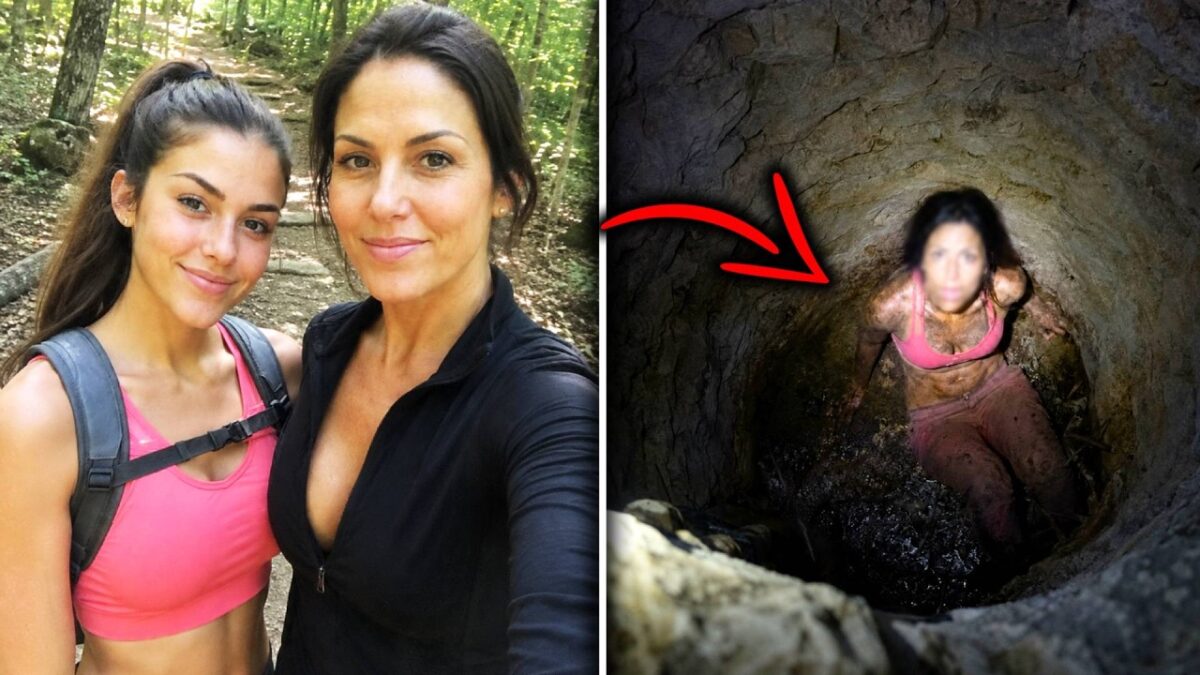
That evening, Heather Veains and her 18-year-old daughter Amy were supposed to return to their cozy little house in the Ozarks. They never made it back.
The next day, a massive search began, but the woods left almost no trace. 25 days passed. Then, in one of the abandoned quaries near the town of Jasper, they found Heather.
She was at the bottom of a dry well, alive, but exhausted and traumatized. However, the woman’s condition and the first details uncovered immediately raised questions for investigators that had no easy answers. She was wearing a bright hoodie and jeans that belonged to her missing daughter.
But Amy herself was nowhere to be found. The girl was still missing and now the main task of the investigation was to find out what had actually happened in the woods and whether her daughter was still alive. Some names and details in this story have been changed for the purpose of anonymity and confidentiality.
Not all photos were taken at the scene. The morning in the town of Jasper began for Heather Veins with a trip to the Ozark National Forest. Around 7:30, her SUV pulled out of a residential area and headed toward the forest.
At the wheel was 40-year-old Heather, the head of the analytics department at a large financial firm in Little Rock. In the passenger seat was her 18-year-old daughter, Amy, who had just graduated from high school. According to her colleagues, Heather had barely left her office for the past 6 months.
She was completely focused on preparing and finalizing a complex annual report. Her work was taking up more and more of her time, and tension and estrangement were gradually growing between her and her daughter. Amy felt abandoned just as she was on the threshold of adulthood.
Realizing she was losing touch with her child, Heather decided to put all her urgent tasks on hold and planned a week-long trip to a cozy rental cottage near a forest. The owner of the rental house later described their arrival to investigators. According to him, the tension between the mother and daughter was palpable from the very first moments.
They barely spoke and their movement seemed abrupt and reserved. At 10:15 a.m., surveillance cameras at a small gas station at the entrance to the highway captured Amy buying two bottles of water while Heather paid for gas. During questioning, the gas station cashier recalled that the young woman was wearing light colored hiking pants and a dark t-shirt and was carrying a small gray backpack.
After stopping, the women set out on a hike in the Boston Mountains, specifically to the well-known and popular tourist trail, the Whitaker Point Trail. According to their schedule, they were supposed to return to the cabin no later than 6:00 p.m. that same day to prepare dinner and contact their families.
However, the women did not get in touch at either 6:00 p.m. or 8:00 p.m. Both of their cell phones were out of range, which was initially considered typical for remote areas of the national park where cell tower coverage is unreliable.
Heather’s concerned ex-husband, Amy’s father, tried to call them more than 10 times throughout the evening. Realizing that the situation was unusual, at 9:30 p.m. he called the local Newton County Sheriff’s Office and reported the two women missing.
An official search and rescue operation began on July 18th at 6:15 a.m. In the parking lot at the start of the Whitaker Point Trail, police found Heather Wayne’s locked car. Inside on the back seat were jackets, travel bags containing essential clothing, and documents.
No signs of broken windows or forced entry were found. This supported the theory that the women had indeed set out on the trail on foot, taking only the bare essentials with them. Specialized teams of rangers, K9 handlers with search dogs, and more than 40 local volunteers were immediately brought in to assist with the search.
They combed through a forested area characterized by dense thicket, deep ravines, and steep rocky cliffs. At 11:40 a.m., the first turning point in the operation occurred. Half a mile from the main trail, near a rocky cliff, the dog handlers found Amy’s abandoned gray backpack and an empty plastic water bottle.
Inside the backpack were sunscreen and the girl student ID. No traces of blood, signs of a struggle, or disturbed soil were found nearby. On July 19th, a helicopter equipped with thermal imaging technology was brought in to assist with the search.
They surveyed more than 20 square miles around the Boston Mountains range, but the dense forest canopy made it impossible to conduct a detailed aerial survey of the ground. The weather took a turn for the worse. After lunch, heavy rain began, completely washing away any possible shoe prints and complicating the work of the search dogs.
Heather’s sisters, her colleagues at the financial firm, and Amy’s father were in a state of deep shock and despair. All of her loved ones gathered at the task force headquarters in the town of Jasper, their hearts pounding with the worst possible fears. In comments to local media, Amy’s father noted that she was a very obedient girl and would never have gone deep into the forest on her own, especially in conditions of limited visibility.
On July 20th, investigators interviewed hikers who had been on the Whitaker Point Trail on July 18th. One of the witnesses, a man from Fagatville, reported that he had seen women matching the description around 100 p.m. near the overlook.
According to him, they looked tired but were heading toward the trails exit. This was the last confirmed account of their possible whereabouts. The search operation continued for several more days with additional personnel combing dry stream beds and remote mountain ravines.
However, no new leads, personal items, or biological traces were found. It seemed as though the two women had simply vanished without a trace into the remote Ozark woods, leaving investigators and their shocked family facing a terrifying uncertainty. More than 3 weeks have passed since Heather and Amy veins vanished without a trace on the forest trails.
The active phase of the search and rescue operation in the Ozark National Forest area had long since been officially concluded. Extensive ground searches, helicopters, K9 units, and dozens of volunteers yielded no results. The only item found that might be relevant to the investigation was a backpack discovered earlier.
The regional sheriff’s office reclassified the case as an investigation into unexplained circumstances. The missing person’s friends and family were completely exhausted, and the girl’s father and Heather’s sisters had almost lost all hope of seeing their loved ones alive. The remote Ozark forest remained silent, and the community of Jasper gradually returned to its normal rhythm of life.
considering this tragedy yet another fatal mystery of the mountainous region. However, on August 13th, 2020, at 2:15 p.m., the situation changed dramatically. A local 52-year-old hunter, while patrolling hunting grounds near an abandoned limestone quarry a few miles from the town of Jasper, noticed unnatural disturbances in the underbrush.
This area was off the beaten path of official tourist routes and was considered dangerous due to numerous technical pits and abandoned industrial structures from the previous century. As he passed a halfruined concrete foundation, the man noticed a deep, dry well, the opening of which was partially hidden by dry ferns and branches. Approaching the edge and shining his flashlight into the well, the hunter discovered a motionless body at the bottom about 15 ft deep.
At first, he thought it was a dead wild animal or long abandoned belongings. But a few seconds later, he heard a faint intermittent moan. At the bottom of the well lay an extremely exhausted, injured woman who was in a semic-conscious state and barely responded to calls from above.
The man immediately climbed to higher ground to get a cell phone signal and at 2:35 p.m. reported the discovery to the Newton County Emergency Services Hotline. A rescue team and paramedics arrived on the scene at 300 p.m.
The operation to extract the victim took more than 40 minutes due to the risk of the inner walls of the abandoned well collapsing. When the woman was hoisted to the surface using special lifting equipment, paramedics diagnosed her with severe dehydration, profound hypothermia, multiple bruises, abrasions on her face and limbs, and suspected closed fractures. The woman was in a state of severe shock, trembling, and able only to mumble incomprehensible fragments of words.
Investigators who arrived with the rescue team immediately identified her using photographs from missing person’s files. She was 40-year-old Heather Veains, who had been missing for 25 days. The woman was alive, but on the brink of death.
She was immediately loaded into an ambulance and at 4:15 p.m. transported under medical supervision to Fagatville Central Hospital. It was during the initial medical examination in the Fagetville Hospital’s emergency room that investigators and doctors encountered the first startling detail which completely changed their perception of the incident.
As they removed Heather’s dirty and torn clothing to perform emergency procedures and examinations, medical staff and detectives noticed a glaring discrepancy. According to documents and witness statements from July 17th, the day Heather Wnes went missing, she had been wearing a dark sports jacket, classic blue jeans, and dark hiking boots. However, she was found in the well wearing a completely different outfit.
The 40-year-old woman was wearing a bright baggy hoodie with a distinctive logo and low-rise jeans. The very same clothes that according to her father’s description and gas station surveillance footage, her 18-year-old daughter, Amy Wnes, had been wearing on the day of the hike. Heather was wearing a pair of sneakers that were too small for her, which severely deformed her feet and belonged to the girl.
None of the 40-year-old woman’s personal belongings were found at the scene or on her person. At 5:45 p.m., a task force of detectives from the county sheriff’s office arrived at the hospital to conduct initial investigative procedures. Doctors prohibited a full interrogation due to the patients extremely severe physical and psychological condition, but added that the discovered circumstances were anomalous.
It was impossible for a person to survive 25 days in a dry well without access to food or a regular source of water without outside help or having been elsewhere for most of that time. The news of Heather’s discovery instantly sent shock waves through the city and the press. Her relatives, who rushed to the clinic in Fagetville, were just as stunned as the police.
Amy’s father confirmed to investigators that the recovered items undoubtedly belonged to his daughter. However, the main question remained unanswered. Where was the 18-year-old girl herself? And why was her mother found at the bottom of an abandoned quarry shaft wearing her clothes? Detectives examined the walls of the shaft and the surrounding area of the abandoned quarry, but found no traces of Amy herself or any of her other personal belongings.
A preliminary analysis of the crime scene revealed that Heather had no means of communication or navigation with her. From the very beginning, the whole situation seemed like a eerie and illogical puzzle. The detectives faced a difficult task to piece together the chronology of events for all 25 days since the women’s disappearance near the Whitaker Point Trail.
The investigation urgently needed to obtain a statement from Heather herself to understand why she had ended up alone in the well, where her child was, and why she was wearing her missing daughter’s clothes. On August 14th, 2020, at 10:15 a.m., detectives from the Newton County Sheriff’s Office received official authorization from medical staff at Fagetville Central Hospital to conduct the first brief interview with Heather Veins. The woman was in a private intensive care unit under roundthe-clock supervision by medical staff and a police patrol.
According to the investigating officer on duty in the room, the patients condition remained extremely unstable. Heather flinched at the slightest rustle behind the door. Her breathing was rapid and labored and her entire body was covered in numerous dark bruises, abrasions, and caked over scratches.
When asked to recount the events of the past few weeks, the woman was unable to utter a word for a long time. She simply trembled and clutched the edges of her hospital blanket. When Heather finally began to speak, her account was confused, disjointed, and lacked a clear chronological sequence.
According to the interrogation report compiled by the detective, the woman claimed that on July 17th while taking a walk near the Whitaker Point Trail, she and her daughter were suddenly attacked by a tall, unknown man whose face was completely hidden beneath a thick dark mask. According to Heather, the asalent leaped out of the underbrush, threatened them with a weapon, tied their hands, and using force dragged them deep into the woods away from the marked hiking trail. The victim further stated that the asalent then placed them in the locked cargo area of a vehicle and drove them to an unknown windowless room where he held them for an extended period in complete darkness and isolation.
Regarding her daughter’s clothing, Heather explained to investigators only that the asalant had forced her to change clothes while they were being held captive, after which he separated them. According to the woman, just a few days ago, the attacker forcibly took her to an abandoned quarry and threw her into the bottom of a dry well, leaving her to die. While 18-year-old Amy is still in the criminal’s hands, and her life is in mortal danger.
Heather wept, broke into sobs, and begged the detectives to rescue her child immediately, but she was unable to provide any specific details about the attacker, a description of his car, or the exact location where they were being held. At 200 p.m. that same day, the county sheriff’s office announced the launch of a large-scale special operation to search for the unknown kidnapper throughout the Ozark region.
All patrol units were placed on high alert. The police launched a comprehensive sweep of the highways, paying particular attention to surveillance cameras located at retail stores, gas stations, and intersections along the strategic US65 highway, which crosses the state from north to south through Jasper. Investigators seized hundreds of hours of video footage from July 17th through August 13th, hoping to identify suspicious vehicles or individuals matching Heather’s description.
At the same time, task forces began going doortodoor among local residents in the Jasper area, as well as at farms and remote hunting cabins. They checked individuals with criminal records, those previously convicted of violent crimes or kidnapping, who lived in Newton and Washington counties. News of a possible armed masked asalent abducting tourists right off popular trails spread instantly through the press and social media.
Panic gripped the community. Local residents locked their doors on mass, canceled tours, and tourists began rushing to leave hotels and campgrounds. People feared that a dangerous serial killer was on the loose in the Ozark forests.
However, after just 5 days of intensive investigative work and searches, the investigation hit a dead end. None of the government or private surveillance cameras along US65 captured a vehicle traveling during the critical time frames with suspicious cargo or passengers. Interviews with more than 50 local residents, hunters, and forestry workers yielded no confirmation of the presence of strangers or unusual vehicles in the Whitaker Point area on July 17th.
No witness heard screams or gunshots on the day the women disappeared. In addition, K9 teams with search dogs re-examined the section of the trail where, according to Heather, the attack took place. The dogs detected no biological traces or scent of an outsider and found no signs of a struggle, bodies being dragged, or damaged to vegetation on the soft ground beneath the trees.
Everything appeared completely undisturbed, which directly contradicted the rescued woman’s testimony. By 400 p.m. on August 18th, the investigative team began to have serious doubts about the veracity of the victim’s testimony.
Experienced detectives noted numerous inconsistencies in her account. Heather showed no signs of prolonged starvation, which would have been expected after 25 days in captivity, and her injuries required a more detailed analysis. The first official note expressing skepticism about the kidnapping story appeared in the case file.
The police began a detailed examination of two opposing hypotheses. Is Heather really telling the truth about an unknown masked asalent? And are law enforcement officials dealing with an elusive criminal? Or did the woman perhaps fabricate the kidnapping story from start to finish? And is she carefully hiding something from the investigation? On August 19th, 2020, at 9:00 a.m., the Newton County Sheriff’s Office investigation team completely shifted the focus of the investigation, concentrating on a detailed examination of the Waines’s family life and the events leading up to their trip to the national park. Detectives obtained a search warrant to seize electronic devices, personal documents, and storage media from Heather’s home in Little Rock.
During a search of 18-year-old Amy’s room, forensic investigators discovered the girl’s paper diary and also seized her laptop, which contained access to private correspondents on social media and messaging apps with close friends from the past few months. An analysis of these records gave investigators a completely new understanding of the relationship between mother and daughter. According to the case file, in the weeks leading up to her disappearance, Heather and Amy had been embroiled in intense, protracted conflicts.
In her diary, the girl described her mother as a doineering person who tried to completely control her every move, her choice of school, and her circle of friends. The last entry in the diary dated July 16th, 2020 explicitly mentioned that Amy categorically did not want to go to the Ozark forest and feared another outburst of anger from her mother. In correspondence with a friend, the girl noted that her mother had insisted on this trip in no uncertain terms, threatening to cut off her financial support while she was in college.
On August 20th at 2:30 p.m., investigators received an official response from two leading insurance companies in the state of Arkansas. It turned out that in May 2020, Heather Baines had taken out comprehensive life insurance policies for herself and her 18-year-old daughter. In the event of Amy’s tragic death, the insurance payout would have totaled over $500,000, and Heather was listed as the sole beneficiary and recipient of the funds.
For investigators, this fact became the first substantial material motive, pointing to the possible premeditated and financially motivated nature of the events in the forest. In parallel with the document analysis, forensic medical experts from the regional bureau in Fagetville completed an extensive medical examination of Heather veins. The official conclusion of the medical examiners and forensic scientists involved in the case significantly contradicted the theory of a violent abduction and captivity.
All bruises, abrasions, and scrapes on the woman’s body were superficial. The experts noted in their report that such injuries were not consistent with a fall from a great height or prolonged physical violence by an armed asalent. The nature of the injuries suggested that they could have been self-inflicted with a blunt object or sustained as a result of a controlled fall from a low height, for example, during a deliberate descent onto the soft bottom of a dry well.
Furthermore, repeated toxicological and biochemical analyses of Heather’s blood taken on the day she was found, August 13th, showed no signs of critical organ failure, which inevitably occurs after 25 days of starvation. Her hydration levels and blood sugar levels indicated that she had had regular access to drinking water and food for at least the last week before she was found at the bottom of a dry well near an abandoned quarry. This definitively confirmed the investigator’s assumption that the story about her abduction and prolonged confinement in a dark room without food was entirely fabricated.
On August 21st at 300 p.m., detectives conducted a second official interrogation of Heather in her hospital room, which was recorded on video. The woman’s behavior during the conversation raised even more suspicions among law enforcement officials. Heather categorically avoided giving specific answers to direct questions about the chronology of events, got confused about dates and time frames, and constantly changed the details of her description of the alleged asalants appearance.
When investigators presented facts about Amy’s discovered diary, family conflicts, and the insurance policies that had been taken out, the woman pointedly turned her back toward the wall, began complaining of a sudden headache, and refused to continue the conversation without a private attorney present. A panel of expert psychiatrists, after reviewing the video recording of the interrogation, noted in its preliminary report that Heather’s behavior was consistent with a demonstrative defense strategy aimed at stalling the investigation and avoiding criminal liability. None of her reactions displayed the genuine, heartfelt despair of a mother who had truly lost a child and was eager to help the investigation find her.
All the evidence gathered, financial documents, medical reports, and entries from the girl’s diary, finally convinced the task force that no unknown masked asalant actually existed. The police concluded that Heather Wnes had staged her own abduction and played the role of the victim in order to divert suspicion from herself regarding a much more serious crime. The main and most disturbing question for the investigation remained.
What exactly did the 40-year-old mother do to her 18-year-old daughter during their hike in the remote Boston Mountains forest on July 17th? On August 22nd, 2020 at 10:00 a.m., an official press conference was held at the Newton County Sheriff’s Office during which the leadership of the investigative team announced a radical change in the main line of inquiry. The evidence gathered, financial documents, transcripts of private recordings, and the conclusions of forensic medical experts allowed law enforcement to put forward a new official version of events. According to the investigation, on July 17th, during a walk near the Whitaker Point Trail, another violent argument broke out between the mother and her daughter.
In a fit of rage fueled by a long-standing animosity and a selfish motive to collect insurance money, 40-year-old Heather Veains did something horrific to her 18-year-old daughter Amy. Next, as investigators believed, in order to completely divert any suspicion from herself and establish an alibi, Heather devised a cold and cynical plan. She deliberately stripped her daughter of her brightly colored clothes, a hoodie, jeans, and shoes.
put those items on herself and hid or destroyed her own clothes and personal belongings in the woods. For several weeks, the woman hid in remote corners of the forest or in abandoned buildings in the Ozark region where she had pre-prepared supplies of food and water. And when time began to run out, she climbed into an abandoned quarry on her own and descended to the soft bottom of a dry well, feigning the role of a helpless victim of an attack by an unknown maniac.
This version of events was corroborated by another important piece of evidence discovered by forensic scientists during a detailed analysis of biological samples at the Arkansas State Laboratory. During an examination of Heather’s right hand, a microscopic hair belonging to her daughter Amy with dried traces of blood was found under the nail of her index finger. However, forensic scientists could not provide a 100% guarantee that the biological material was indeed from the missing girl as the sample had partially degraded due to prolonged exposure to the external environment.
Despite the lack of complete certainty regarding the origin of the blood for the investigation and the public, this fact became a decisive element in the chain of evidence pointing to the mother’s guilt. This version of events seemed to investigators, local residents, and the public to be entirely logical, indisputable, and the only possible explanation. The press immediately blew the case up into a massive scandal.
Headlines in regional and national newspapers were filled with accusations against Heather Veains, calling her the monster from Ozark and a cruel, calculating killer of her own child. Public outrage reached a fever pitch. Close relatives, including Amy’s father and Heather’s own sisters, completely turned their backs on her, deeply distraught and shocked by the revealed facts.
In his official statements to the police, the girl’s father noted that he no longer wished to see his ex-wife and demanded the harshest punishment provided for by state law. On August 23rd at 2:30 p.m., another intense interrogation of Heather Wnes took place in a special temporary detention facility in Fagatville. She was officially informed that her status had changed from victim to prime suspect in the case of kidnapping and probable murder.
During the hourslong conversation, Heather categorically denied any involvement in the crime. She repeated her previous testimony about an unknown masked asalent, wept bitterly, fell to her knees, begged the detectives to believe her, and insisted relentlessly that Amy was still alive and in danger. When the investigators began applying psychological pressure, demanding that she pinpoint the exact spot in the woods where she had done something horrific to her daughter and where her body lay.
Heather’s behavior changed. She suddenly withdrew into herself, became withdrawn, refused to answer follow-up questions, covered her face with her hands, and continued to defend herself, repeating that she had not committed any crime against her own child. This reaction only heightened the investigators frustration as they perceived it as yet another attempt to drag out the proceedings and avoid punishment.
However, certain doubts began to arise among the forensic experts and forensic psychiatrists who were observing the interrogation through a one-way mirror. An independent forensic psychologist noted in his report that Heather’s behavior showed signs of a genuine profound psychological breakdown in a person who found herself in a hopeless situation and was unable to prove her innocence. None of the pieces of evidence, including the hair under her fingernail and the insurance policies, provided a direct answer to the question, where exactly did the crime take place, and where are the physical remains of Amy’s body? The entire investigation had reached a psychological and legal impass.
On the one hand, the public and most investigators were convinced of the mother’s guilt, viewing her as a calculating criminal. On the other hand, the lack of direct evidence led some experts to wonder, is Heather really capable of such a horrific and premeditated crime against her own child? Or is the investigation making a fatal, irreparable mistake by succumbing to public pressure and accusing a completely innocent person who herself became a victim of a monster? After 40-year-old Heather Baines herself came under suspicion, the investigation effectively split into two parallel and mutually exclusive theories. The first was almost self-evident and the most convenient for most investigators.
Heather was hiding the truth about Amy’s disappearance, and the convoluted story about an unknown masked asalant was entirely fabricated to divert suspicion of a serious crime away from herself. The second version remained far less convincing. Heather could indeed have been the victim of a brutal attack, and 18-year-old Amy was still somewhere in the hands of an unknown person.
The problem was that there was almost no physical evidence to support the second version, and public pressure demanded that the case be closed immediately. But on August 24th, 2020, one of the detectives, while methodically reviewing the case files from the first days of the search, noticed a detail that had previously seemed completely insignificant. Among the hundreds of hours of surveillance footage along US65, was a short clip from a small gas station near Jasper.
in it. On the morning of July 18th, the day after the women went missing, an old dark pickup truck appeared in the frame. It was driving toward the unpaved forest roads.
The video quality was very poor. It was impossible to make out the license plate, and the vehicle model itself was too common in this rural area to immediately identify the owner. Therefore, at first, this video footage was not given much attention.
But during a second detailed review with the footage zoomed in, a detective noticed one specific detail. The pickup truck had a severely damaged and dented left rear fender with traces of rust. The police immediately checked local vehicles that had similar characteristic damage.
There turned out to be several such vehicles in the area, and investigators began checking them one by one. One of these vehicles was owned by 52-year-old Frank Slater. His name caused the detectives to stop immediately and pull up his criminal records.
Slater already had a criminal record for violent crimes and kidnapping. He had been released from prison about a month before Heather and Amy went missing. After his release, the man had almost no contact with anyone, behaved reclusively, and lived on a remote semi-abandoned farm near Jasper.
At first glance, this seemed to be exactly the solid lead the investigation had been searching for in vain. But a serious procedural problem arose. During the initial questioning, Slater stated that on the morning after the women’s disappearance, he had remained on his property and had not driven anywhere, and his words were partially corroborated.
One of the local residents had indeed seen him near the fence that day. Furthermore, the camera footage itself did not clearly show who exactly was behind the wheel of the pickup truck. This was woefully insufficient to obtain an arrest warrant.
Therefore, the police began surveilling Slater discreetly. It turned out that his farm was located just a few miles from a dirt road leading to the wooded areas near Whitaker Point. This did not prove anything yet, but then investigators found another inconsistency.
Slayer claimed that after his release, he had hardly ever left the farm area. However, footage from other remote cameras showed his pickup truck on the road, leading directly to the area where the girls disappeared. The time of the recording was very close to the period when Heather and Amy were last seen alive on July 17th.
The police now had official grounds to obtain a search warrant for the property. On August 25th, at 7:00 a.m., the task force arrived at the farm. The property greeted them with an eerie silence.
The house looked almost abandoned. The windows were partially boarded up. Old rusty trailers stood in the yard, and tall, wild grass almost completely concealed the ground around the building.
At first, investigators found nothing inside the house that directly linked Slater to the women’s disappearance. The rooms were littered with old tools, dirty clothes, and household items. But in one of the rooms, on the wooden floor, the detectives noticed fresh traces of wet dirt.
They stood out sharply against the thick layer of dust all around, as if someone had recently come in from the street several times. On the table, the detectives also found a package of medication purchased shortly before the women’s disappearance. But what piqued the investigator’s interest most was the massive metal door at the back of the house.
It bore deep, fresh scratches that looked much newer than anything else around it. The door led to a deep semibl-like room. When they opened it with some effort, the investigators saw an almost empty cold room, an old dirty mattress, an overturned chair, and an empty plastic water bottle.
nothing that on its own could conclusively prove that a person had been held there. While one of the detectives was examining the floor, the other noticed a small object right up against the wall in a crack between the bricks, a bright rubber hair clip. He carefully bagged it as evidence.
Later, it was shown to the family, and Heather immediately recognized the hair clip. It undoubtedly belonged to Amy. It was the first item found during the search that could be directly linked to the missing girl.
The investigators continued their search. On the concrete wall of the basement, they noticed uneven scratches at a height that a person could reach with their hands while standing next to the wall. Nearby lay a small scrap of fabric whose color matched that of Amy’s bright hoodie, the very same one in which Heather was found 25 days later.
Now, the investigators were faced with a question that completely changed the direction of the entire case. If Heather really had staged her own abduction, why were her daughter’s belongings in the basement of a stranger’s farm? But the answer was not yet clear. Perhaps Heather had an accomplice.
Perhaps the items had been left there on purpose. Or perhaps her story about an attacker was finally receiving real confirmation. The detectives searched the area around the house.
A few dozen meters from the farm stood an old barn where under a tarp they found a pickup truck with a damaged left rear fender. In the bed of the truck lay some old tools and a few of Heather’s belongings. But Amy wasn’t among them.
They already knew that Slater had been hiding important facts that his car had been in the right area and that the girl’s belongings had ended up in his basement. But they still didn’t know the most important thing. Where was Amy and how much time did the police have left to find her alive? On August 25th, 2020, at 11:30 a.m., a task force of detectives and special operations unit officers expanded the search area beyond the boundaries of Frank Slater’s residence.
A large-scale sweep of the farm revealed that 300 yd from the main house, amid dense brush and windfall, there was another semi underground structure. It was an abandoned concrete vegetable storage bunker built in the middle of the last century. Its wooden roof was covered with dirt and completely camouflaged by dry branches and last year’s leaves.
And the massive metal door was secured with a heavy industrial bolt and a sliding lock. The special forces used specialized tools to pry open the heavy locking mechanisms. At 12:15 a.m., the bunker’s metal door creaked open with a loud screech.
A blast of thick, damp air wafted out from inside, carrying a pungent smell of mold and rot. When the detectives shown their flashlights into the dark, windowless basement, they noticed an exhausted, semiuncious figure in the corner on the concrete floor. The woman was chained by a thick metal chain attached to the bone of her right leg to an iron pipe embedded in the wall.
It was 18-year-old Amy Veins. The girl was in a state of extreme physical exhaustion and deep psychological shock. She was wearing nothing but a dirty oversized t-shirt that didn’t belong to her and a pair of worn out sweatpants that her abductor had left her.
Medical examiners would later find numerous bruises on her body, rope marks on her wrists, and deep abrasions. The girl was trembling, staring unblinkingly at a single point, crying, and at first showing no reaction whatsoever to the investigator’s calls, trying to shield her face with her hands from the bright light of the flashlights. According to the detectives who were the first to enter the bunker, in the opening minutes, the girl pleaded in quiet, broken sounds not to hurt her, mistaking the law enforcement officers for her abuser.
Rescue workers used hydraulic cutters to sever the chain, and at 12:40 a.m., Amy was carried out of the underground shelter on a stretcher. The medical team immediately began administering first aid and hooked her up to an IV. While the rescue operation was underway, a police unit apprehended 52-year-old Frank Slater.
The asalent was cornered at the far end of his property as he attempted to flee on foot into the Ozark forest. During his arrest, the man did not offer armed resistance, but refused to make any statements, invoking his right to remain silent. By order of the district attorney, Slater was immediately formally charged with the armed kidnapping of two people, unlawful imprisonment, infliction of serious bodily injury, and torture.
Given his prior convictions for violent crimes, and the extreme brutality of the offense, the prosecution announced that it would seek the maximum sentence for him, life imprisonment, without the possibility of parole. At 1:30 p.m. that same day, the leadership of the Newton County Sheriff’s Office held an emergency press briefing.
The sheriff publicly announced that all suspicions against 40-year-old Heather Baines had been completely cleared. Police officials acknowledged that the investigation had made a serious mistake by yielding to circumstantial evidence and public pressure. On behalf of the entire department, the sheriff publicly apologized to Heather for the baseless accusations and media harassment, noting that the mother was just as much a victim of the brutal criminal as her daughter, and that her testimony about the masked asalent had been true from the very beginning.
Evidence found in the bunker and basement fully reconstructed the chronology of the crime. Slater attacked the women on the trail, forcibly took them to his farm, and locked them in the basement. Later, he forced Heather to put on her daughter’s clothes to confuse search parties, separated the women by moving Amy to an underground bunker, and drove Heather away, and threw her into a dry well, hoping she would die and be unable to testify.
At 300 p.m. Amy Veins was transported by special vehicle to Fagatville Central Hospital where her mother was still in the intensive care unit. It was there under the supervision of doctors and psychologists that their first emotional reunion took place after 39 days of separate captivity and uncertainty.
When Heather saw her daughter alive in a special wheelchair, she, despite her own injuries, leaped out of bed and fell to her knees before her. The women embraced for a long time, weeping and unable to utter a word through their tears and despair. The medical and psychological staff present during this reunion noted in their reports that it was one of the most difficult and at the same time most poignant moments in the clinic’s entire history.
Mother and daughter had gone through a living hell, enduring abuse, isolation, physical pain, and the threat of death. However, the doctors emphasized that an extremely long and difficult road to recovery lay ahead for the family. While Heather and Amy’s physical condition had gradually stabilized thanks to intensive care, the 18-year-old girl was suffering from deep and severe psychological trauma.
She reacted with panic whenever a door closed and she was afraid of the dark and the voices of unfamiliar men. Psychiatrists noted that it would take Amy months and possibly years of specialized rehabilitation to overcome the effects of her prolonged stay in the underground bunker as the shadow of the horror she had endured in the Ozark forests remained with her. Several months had passed since the underground bunker on a remote farm near Jasper had revealed its chilling secret to investigators.
In December 2020, the final hearing in the Frank Slater case began at the Fagatville County Courthouse. The trial attracted enormous public and media attention. The courtroom was packed to capacity.
Journalists, local residents, and the Waynees family had gathered to hear the final verdict. The prosecution had built an irrefutable case. Prosecutors presented the court with more than 50 pieces of physical evidence, including cut metal chains, surveillance footage from a long US65, a pickup truck with a damaged left rear fender seized from a barn, as well as the results of biological and fingerprint analyses.
Experts found clear fingerprints belonging to Slater on the basement door and on the metal bolt of the underground bunker and microscopic fibers from Amy Bain’s bright hoodie on his workclo. 52-year-old Frank Slater behaved aloof and indifferent throughout the trial. He sat next to his attorney in a dark prison jumpsuit, avoided eye contact with those present in the courtroom, and declined to exercise his right to a final statement.
The jury reached a unanimous verdict after just 2 hours of deliberation. On December 15th, 2020, at 2:30 p.m., the presiding judge announced the verdict. Frank Slater was found guilty on all counts, including the armed abduction of two people, torture, and causing serious bodily harm.
He was sentenced to life imprisonment in an Arkansas maximum security correctional facility without the right to parole or a retrial. The aftermath of the tragedy completely changed Heather’s worldview and life priorities. Upon returning to Little Rock in early 2021, she decided to resign from her position as head of the analytics department, an exhausting job to which she had devoted more than 15 years of her life, and which had been the main cause of her long-standing estrangement from her daughter.
She realized that her career and endless reports had lost all value in an instant when she found herself at the bottom of a dry well, not knowing if her child was alive. She devoted all her time to her family and to organizing a long-term rehabilitation program for 18-year-old Amy. They decided to sell their house in Little Rock and bought a small, cozy home in a quiet suburb far from the media spotlight.
Amy Veain’s psychological recovery was a slow process that required immense patience. According to reports from specialists at the Fagetville Rehabilitation Center, she underwent intensive psychotherapy for 6 months. The horror she experienced in the underground bunker left deep scars.
For a long time, Amy could not be in closed rooms, insisted on leaving the light on in the hallway all night, and reacted sharply to any sudden metallic sounds or footsteps behind the door. However, it was her mother’s support that proved to be the decisive factor in helping the girl gradually return to a normal life. Heather was by her side around the clock.
She attended every therapy session with her daughter, took walks with her in quiet city parks, and learned a new how to listen to and understand her child. The tragedy they had endured completely shattered the barrier of misunderstanding and control that had existed between them for years. The old resentments, disagreements over college choices, and feelings of worthlessness that had poisoned Amy’s life before that fateful trip were gone forever.
In their place came deep affection, boundless trust, and a clear understanding of the value of every day spent together. In the spring of 2021, Amy took her first major step toward rebuilding her life. She reapplied and submitted an application to the humanities department at a local university, choosing child psychology as her major.
In a conversation with a psychologist, she noted that her past experiences had given her a deep understanding of others pain and that she aspired to devote herself to helping children facing difficult life circumstances. Amy’s father, Heather’s ex-husband, who suffered severe emotional trauma during the investigation and trial and apologized to his ex-wife for his initial distrust, has restored a warm, friendly relationship with the family. The case of the disappearance and rescue of a mother and daughter in the Ozark forest has been included in training manuals for young investigators and forensic scientists in the state of Arkansas as an example of how important it is to avoid jumping to conclusions and not to succumb to public pressure.
The abandoned limestone quarry and underground bunker on Slater’s farm were by order of local authorities completely dismantled and filled in with soil to permanently erase all physical traces of that terrible tragedy from the region. A year had passed since those events. In late summer of 2021, Heather and Amy set out on a short trip to the ocean coast for the first time in a long while.
They sat on the shore watching the sunset and talked about Amy’s future studies and their new plans for life. The shadow of that hellish past no longer held power over their present. They had both endured mortal danger, isolation, and human cruelty.
But they had managed to preserve what mattered most, their love for one another and the ability to cherish every moment of life.








