She Married Henry Flagler After He Bought a Law. Then They Dug Her Up at 3 A.M.: Mary Lily
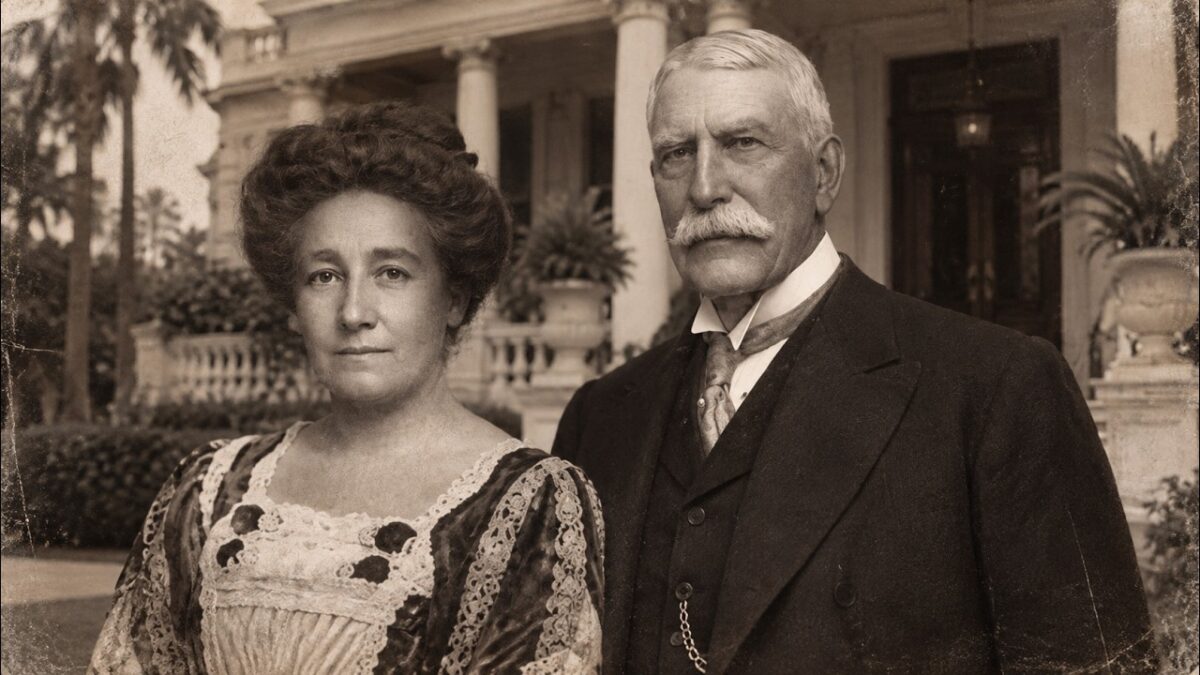
3:00 in the morning, a cemetery in North Carolina, four of the best doctors in America, standing over an open grave, ordered there by her own family. She had married Henry Flagler, co-founder of Standard Oil, builder of Florida’s East Coast. his third wife, the richest widow in America.
She had $2 million in jewelry before 25 and a law rewritten just to marry her. Not one sentence in this whole story is written in her own words. What those doctors found has never been released.
Tonight, we ask why anyone would want it kept that way. Good evening and welcome back to Crown Files. This is where we tell the stories of women who stood close to power and paid a private price for it.
There is a portrait that still hangs in Palm Beach, Florida. It hangs inside a marble hall in a house built as a wedding gift by one of the richest men in American history. Her name was Mary Lily Keenan.
For 16 years, she was married to the co-founder of Standard Oil. For the 70 years after that, she became something else entirely, an argument other people kept having without her. In the summer of 1901, the Florida legislature quietly rewrote its own divorce law.
In the entire history of the state, only one man would ever use it. 10 days after his divorce became final, Henry Flaggler married Mary Lily Keenan at her family’s home in North Carolina. She was 34, he was 71.
The law that made the wedding possible did not survive the decade that followed it. Historians have spent a 100red years deciding what to make of Henry Flaggler. The railway, the hotels, the fortune he left behind.
Very few of them have spent much time on the young woman who stood beside him for all of it. One biographer tried decades later to tell the fuller story. His publisher withdrew the book before a single reader ever opened it.
Tonight we tell the story that no one, not the newspapers in 1901, not the lawyers in 1917, not the publisher in 1987, ever let her finish for herself. For 10 winters, the same three people rode the same private railway car south from New York down to Palm Beach. One was a man in his 60s, already one of the richest men in the country.
Beside him sat his wife, growing quieter every year, forgetting names, losing the thread of her own sentences midcon conversation. And across from them both sat a young woman from North Carolina, invited every winter to keep them company. The same porter learned to expect her at the same platform.
The same trunk was loaded each December and unloaded each spring. She had no title for what she was. She was not his mistress by any account that survives.
She was not family. Officially, she was a companion to Mrs. Flaggler. Unofficially, everyone in that railway car understood something else was happening, long before anyone said so out loud.
Her name was Mary Lily Keenan, and in 1891, she was 23 years old. To understand how she came to be sitting in that car at all, you have to go back further. Back to a modest brick house in Wilmington, North Carolina, where William Rand Keenan Senior, a former Confederate officer turned life insurance agent, and his wife Mary Hargrave Keenan raised a daughter who grew up playing piano well enough that people called her, without much exaggeration, the reigning bell of the state.
She was educated at Peace College in Raleigh at a time when the university just across town would not admit a woman at all. Accounts differ on exactly how she met Henry Flaggler. Some place it at a party in Newport, Rhode Island.
Others describe a Caribbean cruise arranged by family friends, the Pemrook Joneses of Wilmington, on which a niece of Flaggler’s own wife happened to be a guest. What the accounts agree on is the outcome. Within a year, Mary Lily and a female companion were riding south with the Flaglers each winter and would keep doing it every year for the next decade.
Her family did not approve at first. Flaggler was 61. He was married.
Whatever was happening on those winter trips, it looked to a respectable North Carolina family like exactly what it appeared to be. Then the gifts began arriving. First small, then not small at all.
By the time the suspicion had hardened into something the Keenans might have acted on, Flaggler had given Mary Lily close to $2 million in jewelry and standard oil stock. The family’s objections did not exactly disappear. They simply stopped being spoken aloud.
What passed between the three of them in that railway car. What Mary Lily said, what she was told, what she understood about her own position was never written down. Not by her, not by anyone else present.
The only record left is the pattern itself. the same three names, the same private car 10 Decembers in a row. During those same 10 years, Ida Alice Shaws Flagler, Henry’s second wife, was declining into a mental illness her doctors could not name and could not stop.
She grew suspicious of servants. She grew afraid of rooms she had slept in for years. Flaggler, by most accounts, did not abandon her cheaply.
He continued to fund her care for the rest of her life, long after the law had let him walk away from the marriage itself. By some accounts, the arrangement he made for her was generous enough that money was never quite the family’s complaint, only the manner of the parting. Eventually, she was committed to an asylum where she lived out her remaining decades, never divorced in her own understanding of the world, no matter what a Florida courtroom decided on paper.
And in the spring of 1901, a Florida courtroom did decide. The state legislature quietly amended its own divorce statute that season to allow a marriage to end on the grounds of incurable insanity. In the whole recorded history of Florida, only one man is known to have used the law before it was taken off the books.
Two months after it passed, Henry Flaggler’s divorce from Ida Alice became final. The law itself did not last much longer than the marriage it ended. Newspapers well beyond Florida picked up the story of the state’s new insanity divorce statute, and public opinion did not need much help concluding who it had really been written for.
Within a few years, lawmakers quietly took it off the books. By then, it had already done what it was written to do. 10 days later at Liberty Hall, the Keenan family’s home in eastern North Carolina, Mary Lily Keenan became his third wife.
Liberty Hall stood on land the Keenan family had held for generations, a working plantation turned family seat, well known in that corner of North Carolina, but nothing at all like what was waiting for her in Florida. It was a small wedding by the standards of the fortune involved. Family, a few friends, no reporters permitted, passed the gate.
She wore white. According to the accounts that survive, Flaggler gave her a check for $1 million and $3 million in bonds that same morning, as though the ceremony itself required collateral before it could proceed. Not everyone approved.
In North Carolina, a Goldsboro newspaper editor sat down that week and wrote what a great many people in polite society were thinking and had not said to Flaggler’s face. A man who would thus cast off an aged wife, blameless herself, is simply beyond execration. The editor was writing about Flaggler, but it was Mary Lily who would spend the rest of her life answering for it.
in drawing rooms, in society columns, in the particular kind of silence that follows a woman into every room she enters afterward. She had done nothing that the law had not already made legal. It would not matter.
She was 34 years old on her wedding day. For 10 years, she had ridden in someone else’s railway car in a seat that had no name. Now finally she had a seat of her own, bought in the end by a law written for exactly one man on earth and struck down before anyone else could ever use it.
What she did not know standing in that room at Liberty Hall in her white dress was what her new husband was already planning to build her. A house larger than anything Palm Beach had ever seen with its own name, its own architects, its own place in the newspapers within the year. She did not know how many winters she would spend inside it, or how many of them would pass without the one thing that might have quieted the whispers for good, a child.
When the small party at Liberty Hall broke up, the newlyweds did not linger in North Carolina. They went south toward the coast Flaggler had spent 20 years building toward a winter house that was as of that afternoon still 6 months from finished, its marble floors barely laid, and she did not know one more thing. Somewhere inside that house, on a staircase cut from imported marble, something would one day happen that decided the whole rest of her life, years before anyone thought to ask her what she wanted it to look like.
The house was finished on the 6th of February, 1902. Mary Lily walked into it for the first time as its mistress rather than its subject. She passed through a marble entrance hall under a domed ceiling painted with a mural of the Oracle of Delelfi into a grand hall large enough to have swallowed the house she grew up in several times over.
Somewhere between 55 and 75 rooms, depending on which account you consult, spread out behind her. The New York Herald had already told the country what to think of it before she ever crossed the threshold. more wonderful than any palace in Europe, grander and more magnificent than any other private dwelling in the world.
Newspapers of the era loved the numbers almost as much as the architecture. A grand hall reported at well over 4,000 square ft, tall enough that its domed ceiling needed its own painted mythology just to fill the space above her head. Flaggler had named it White Hall after the palaces of Europe.
he wanted it to answer to. He called it a wedding present. Palm Beach, which had barely existed as a resort before Flaggler built the railway that reached it, called it something closer to a coronation.
The architects were Carrer and Hastings, the same firm already responsible for the grand hotels Flaggler had built up and down the coast. men who had built their reputation designing spaces meant to announce a fortune before a single word needed to be spoken. The same railway car that had carried her south for 10 winters as a guest now carried her south each winter as its mistress.
The same porter loaded the same trunk. Only the meaning of the destination had changed. For 11 winters, Whiteall stood at the center of a social season.
The wealthy of America built their calendars around. Mary Lily hosted alongside her husband and by most accounts did it well. The girl who had once been an insurance agent’s daughter in Wilmington now welcomed guests whose own fortunes rivaled hers.
She was also by several accounts more than a hostess. She took an active interest in Flaggler’s business affairs and inherited from him a habit of quiet, steady giving, money toward hospitals, churches, and schools across the coastline he had built, much of which continued in her name long after he was gone. A portrait of her was painted during these years.
It is the same portrait that still hangs today in the house she once ruled, with a second copy kept, of all places, at a university in North Carolina that would not, in her own girlhood, have allowed her through its doors. Today, that house is a museum. Visitors walk the same marble floors, stand beneath the same painted dome, and read placards that explain in careful language who built it and why.
Very few of those placards say much at all about what happened to the woman it was built for, once the house itself stopped being the story. What the money and the marble never quite bought her was the other thing. 11 winters at Whiteall came and went, and Mary Lily Keenan Flaggler never had a child, not with Flaggler, and as it would turn out, not afterward either.
And no matter how many guests filled that hall each season, Palm Beach never entirely let go of the story of how she had arrived there in the first place. A divorce law rewritten for one man, a wedding 10 days after it took effect. It was the kind of story a certain type of guest never tired of retelling quietly once she had left the room.
She had spent 10 years being talked about in that railway car before she ever had a name for what she was to Flaggler. Now she had a name, Mrs. Henry Flaggler, mistress of the grandest private house in America, and found over 11 winters that a name was not quite the same thing as belonging. On the 15th of January 1913, Henry Flagler fell.
It happened on the marble staircase at Whiteall, the same staircase Mary Lily had walked down every winter for 11 years. dressed for dinners that ran late into the night. He was 82 years old.
He did not die that day. He lingered for 5 months, attended by physicians, while the largest private fortune in Florida waited to learn which direction his recovery or his decline would take. 5 months is a long time to wait inside a house built for celebration.
The routines that had filled White Hall’s calendar every winter for a decade went quiet one by one. What remained was a household organized entirely around one man’s slow decline, and a wife, whose position in it, for the first time since her wedding day, had no precedent left to follow. It took the second direction.
Henry Flaggler died in May of 1913, 83 by most counts, inside the house he had built as a wedding gift for a woman he had waited a decade to marry and would now leave behind in it alone. Ida Alice, the wife the 1901 law had allowed him to leave, outlived him by 17 years. She remained under care in the asylum until 1930, long after the marble palace built partly to answer the scandal of her committ had already passed into someone else’s hands entirely.
Mary Lily inherited the overwhelming share of what he left. Some of it went under the terms of the will to Flaggler’s own surviving sisters. But the greater share, the house, the railway holdings, an estate the newspapers of the day struggled even to estimate somewhere north of $und00 million spread across hotels, real estate, and 30 uninterrupted years of standard oil dividends came to her.
At 45 years old, after more than two decades spent as another family’s companion, then another man’s wife, she became, by any measure the country had, the richest woman in America. The estate took time to settle. Surveys of property, valuations of railway stock, lawyers arguing over what a fortune that size was worth on paper versus what it was worth in practice.
None of that slowed the newspapers, who had already decided what to call her, the richest widow in America, a phrase that would follow her into every headline for the rest of her life. None of it would matter in the end to the four physicians who would one day open her coffin by lamplight in a cemetery 400 m to the north. But that story belongs to a different summer, still years away.
For now, in the spring of 1913, Mary Lily Kenan Flaggler stood in a house with 70 rooms, or 55, depending on who was still counting. For the first time since she was 23 years old, there was no one left in it with the standing to tell her what to do with any of them. It would not stay that way for long.
Within 3 years, an old friend from her college days in Raleigh would reappear in her life. A man she had known before Flaggler, before Whiteall, before any of it. And for the first time in her adult life, the choice of what came next would, at least on paper, be entirely her own.
His name was Robert Worth Bingham, and Mary Lily had known him before any of it. before Flaggler, before Whiteall, before the 11 Winters and the Marble Staircase and the Hundred Million. They had been close as young people in North Carolina in the years before either of their lives had taken the shape the newspapers would later report.
He had gone on to become a lawyer, then briefly the interim mayor of Louisville, Kentucky, sent in to clean up a stolen election. People had started calling him Judge Bingham by then, a title he kept for the rest of his life, whether or not it remained technically accurate. By most accounts, Bingham had recently lost his own wife in an automobile accident.
Mary Lily had recently lost her husband. Two people who had known each other young, meeting again in their late 40s, each carrying a version of the same kind of absence. It was not on its face an unreasonable thing to happen.
It is in fact one of the oldest stories in the world. The childhood friend who reappears exactly when grief has made the world feel unbearably large. Bingham was not, in the way the word usually gets used, an obvious opportunist.
He came from a respected North Carolina family of his own. no fortune on the scale of the Kenans or the Flaglers, but a name that opened doors and a law degree. He had studied at the University of North Carolina and at the University of Virginia before settling into Kentucky law and eventually Kentucky politics.
His record of public service had up to this point mostly cost him money rather than made him any. What followed happened quickly, quickly at least, by the standards of a courtship conducted almost entirely in the shadow of a hund00 million estate, watched by a press that had never fully stopped watching her. Mary Lily began in ways both public and private to underwrite Robert Bingham’s life.
She paid off a debt of roughly $1 million that he had been carrying. She settled an annual salary on him of $50,000, a figure that alone would have placed him among the wealthiest men in Kentucky, before he had done anything at all to earn it. She transferred to him something close to $700,000 in standard oil stock, the same stock, in fact, that had paid for the marble in White Hall’s Grand Hall.
It was a pattern she knew well by now. Once a man had bought her belonging with $2 million in jewelry before she had even understood what she was being offered. Now she was the one doing the buying, settling debts, arranging salaries, transferring stock, as though love, in her experience of it, had never once arrived without an invoice attached.
If anyone close to her noticed the symmetry, no record of it survives. There is no letter, no diary entry, nothing in her own hand explaining why she chose Robert Bingham specifically out of whatever choices a woman of 48 with $100 million might have had. There rarely is anywhere in this story the record keeps what other people decided about her.
It has never once kept what she decided about herself. On the 16th of November 1916, in a private ceremony in New York, Mary Lily Keenan Flagler became Mary Lily Keenan Flaggler Bingham. There was no White Hall this time, no 75 rooms, no orchestra season built around the date.
After 11 winters as the hostess of the grandest private house in America, she married the second time in a room small enough that almost no one outside it ever learned exactly what it looked like. The wedding still made the papers, of course. Everything about her did by now, but the coverage was brief, almost polite compared to the frenzy that had followed her first.
For a few months afterward, by every surface account, the marriage looked ordinary. The couple was seen together in Louisville and in New York. They settled, when they were in Kentucky, into a house on Glen View Avenue outside the city, a comfortable, respectable address, considerably smaller than the one she had left behind in Florida.
She kept up her correspondence with family back in North Carolina. If anything underneath it had already begun to go wrong, nothing about it had yet reached the newspapers that had never quite stopped watching her. Here is the detail that changes how everything after this has to be understood.
Before the wedding took place, not after, not as part of some later negotiation, but before, Robert Worth Bingham signed away every legal claim he might otherwise have had to what remained of the Flaggler fortune.
He did this in writing, “While both of them still had every reason to expect a long and ordinary marriage ahead of them, it is worth sitting with what that actually means.”
The man newspapers would spend the next century describing as a fortune hunter had at the one moment when the law would have made fortune hunting simplest voluntarily closed that door himself. He walked into the marriage with no legal path to a single dollar of the hundred million she had inherited. It would be simple to look at what came later and decide this marriage too was purchased.
that Bingham saw a widow with a $100 million fortune and did what ambitious men in his position had always done. The waiver makes that reading harder to hold on to, not easier. Whatever moved through those 8 months of marriage, ambition, obligation, something closer to love, or some combination no single word quite covers, it did not move through the machinery of inheritance law.
By the time anyone thought to ask what Robert Bingham actually stood to gain by marrying her, the honest legal answer was nothing at all. Whatever was coming, whatever would eventually make him one of the wealthiest newspaper publishers in the American South could not arrive through marriage law. It would have to arrive some other way.
8 months into that marriage, it did. 8 months is not very long. It is not long enough.
Most doctors would say for a healthy woman of 49 to go from hosting a small wedding in New York to lying unconscious in a Louisville bathtub. Not long enough for a maid to be standing over her trying to decide whether to call for help. But that is exactly how long it took.
8 months from a private ceremony where almost nothing was reported to a scene almost no one has ever fully explained. To understand what happened in those eight months, you first have to understand what a Kentucky summer and a certain kind of doctor had already begun doing to Mary Lily Keenan Flagler Bingham. It happened in a house 400 m from the marble one she had left behind.
And it happened in particular in eight specific days near the end of those 8 months. days that would matter more than the 10 years before Whiteall and the 11 winters inside it combined. If Bingham could claim nothing by law, then whatever happened in those 8 days had to come from somewhere else entirely, from her, from a choice only she had the power to make.
The question that matters now is not whether Robert Bingham wanted the money. It is what changed. in the space of eight days in June of 1917 that made a woman who had spent her whole adult life having decisions made for her decide at last to make one of her own and what that decision would end up costing her.
For a while, nothing about the spring of 1917 looked like an ending. Mary Lily kept up her correspondence. She and Robert Bingham were seen at the usual places, doing the usual things.
A couple of their standing did in Louisville and in New York. Whatever had passed between them in private, whatever kind of marriage it actually was. Underneath the surface, everyone else was permitted to see.
It had not yet announced itself to anyone watching from outside. The country that spring had other things to think about. In April, the United States had entered a war in Europe, and newspapers that might once have tracked her every appearance were for once occupied elsewhere.
For a woman who had spent her entire adult life being observed, this was itself a kind of rare season, a few quiet months where nothing about her made the papers at all. Then sometime that spring, Mary Lily began complaining of pain in her chest. By summer, Louisville was locked in a heatwave that sat over the city for weeks without lifting.
The kind of heat that kept curtains drawn and made even a large house feel smaller than it was. for a heart condition or what looked from the outside like one. The doctor Robert Bingham brought in to treat her was an unusual choice.
He was not a cardiologist. He had no particular training in heart disease at all. His name was Ravage and his specialty, as far as the record shows, was skin conditions.
What he did bring to Mary Lily’s bedside, and what he began administering with increasing regularity as the Kentucky summer deepened was morphine. By June, the injections were routine. A shot for the chest pain, a shot to help her rest, a shot because the last one seemed to be wearing off.
So apparently was the effect they were having on her. None of this happened in a hospital. From the first complaints of chest pain that spring to the final seizure in July, Mary Lily Keenan Flagler Bingham was treated entirely at home by one doctor with one drug.
It was in the middle of that same June while the injections were becoming a daily fact of her life that Mary Lily signed a codil to her will. The scene, as it survives in the record, is a small one. An attorney named Dave Davies, another old friend of Robert Binghams, brought in specifically to oversee the signing, sat with her while she wrote it out.
The document itself was brief, and its intent was unmistakable. I give and bequath to my husband RW Bingham $5 million to be absolutely his. By the accounts that survive, Mary Lily was in what witnesses later described as a dazed morphine-heavy state when she put her name to it.
Davies was there in his professional capacity as a witness is required to be. He was also by those same accounts a friend of the man for whose benefit the document existed. Whether that made the signing more official or simply less independent is a question the record does not resolve.
And the record by this point in Mary Lily’s life rarely did. what she understood in that moment, what she actually intended, what she might have said if anyone outside that room had asked her plainly what she wanted. None of it was ever written down.
The signature was this finally is the answer to the question the last chapter left open. 8 days, that is how long passed between the codicil and the end. On the 12th of July, a maid opened the door to Mary Lily’s bathroom and found her slumped unconscious over the side of the tub.
The heat outside had not broken. The dermatologist and his morphine were still, as far as anyone recorded, the whole of her medical care. She had 15 days left, though no one in the house yet knew to count them that way.
As her condition worsened through the middle of July, Robert Bingham was not silent about it. He gave statements to the press describing his wife’s decline in the language of a heart ailment. The same explanation the death certificate would eventually make official.
Whether he believed that explanation himself is not a question anyone has ever been able to answer. The end when it came came quickly. On the morning of the 27th of July 1917, a seizure took her.
The convulsions that followed did not stop. By 10 3 that afternoon, a time recorded with a precision the rest of that summer had rarely received. Mary Lily Keenan Flagler Bingham was dead at the age of 50.
The doctors who signed her death certificate gave the cause as edema of the brain with myocarditis, a heart condition listed as a contributing factor. It was the same organ a skin doctor had been treating informally with morphine for most of that summer. Kentucky papers covered her death with the gravity due a public figure of her standing.
Further away in New York, in Chicago, the item ran shorter, a paragraph noting only that the richest woman in America had died, with little explanation of why she had been living in Louisville at all. It would not be the first time in Mary Lily’s life that an institution meant to protect someone had been quietly repurposed instead. A law meant to prevent cruelty had once been rewritten for exactly one man.
Now a doctor meant to treat her heart had never by training been qualified to examine one. Her will, the one everyone already knew about, was filed in the Florida courts within days. It confirmed what the newspapers had long assumed.
an estate worth somewhere near $150 million, left overwhelmingly to her own family. It was a month later that Robert Bingham filed something else entirely. This time in a Kentucky courtroom, the codil from June, the one naming him for $5 million.
The one nobody outside a single room in Louisville had known existed until he was the one who produced it. Her body was returned to Wilmington, North Carolina, and buried in the Keenan family plot at Oakdale Cemetery beside the generations of Kenans who had come before her. The service, by most accounts, was quiet.
Family, a handful of friends, nothing like the scale of attention that had followed her through most of her adult life. In those first days, grief and shock seemed to have crowded out any harder questions. Robert Bingham inherited exactly what the codicil said he would.
News of that codicil did not stay quiet for long. It was, after all, the kind of detail newspapers built entire columns around. the richest woman in America, dead eight months into a second marriage, having secretly signed away $5 million to her husband while gravely ill, according to everyone who had seen her in those final weeks.
That quiet did not last. Within weeks, Mary Lily’s own family began asking a question no death certificate had answered. They were the brother and sisters who had watched the jewelry arrive in 1891 and the divorce law pass in 1901 and the marble palace rise in 1902.
Now they were watching a $5 million codil appear signed 8 days before her death kept secret for a month afterward. If a dermatologist’s morphine and a weak heart were really the whole story, why did anyone need more than the paper the doctors had already signed? They decided they needed more. Whatever it would take to get it, and whatever it would end up costing them, in the end simply to have asked belonged to a different kind of knight altogether.
A different kind of knight indeed. Getting permission to open a grave is not simple in any state, in any era. It requires a court order, a documented reason, and a family willing to have their own suspicions made a matter of public record before a judge even agrees to consider them.
The Keenans got their order. Whatever they told the court to secure it, it worked. It happened at 3:00 in the morning on the 18th of September, 1917, nearly 2 months after the funeral, after the flowers had gone, after the ground above her had had time to settle into something that looked, to any ordinary visitor, like simply another family plot.
Armed men stood in a ring around the grave at Oakdale Cemetery that night. Inside that ring, working by lamplight, four physicians did something almost no family in America ever asks to have done to someone they loved. They opened Mary Lily Keenan Flagler Bingham’s coffin, and began to look for the truth her death certificate had not contained.
The men brought in for the task were not local doctors, and they had not been chosen at random. They had been assembled from four different cities for their expertise. Charles Norris was among them.
A man who would within a matter of years become New York City’s first chief medical examiner and whose entire career would be built on exactly this kind of work. Alexander Gettler stood beside him already becoming known as one of the founding minds of American toxicology. The man who would help invent the science of finding poison in a body decades after the fact.
Ludvig Hectune and William George Macllum completed the team. Pathologists brought in specifically because their names on a report would mean something. They worked through the night.
By the time the sky began to lighten over Wilmington, they had what they had come for. samples taken from organs that had spent nearly 2 months in North Carolina ground packed for the journey north to New York, where the real analysis would happen. What they found, according to the account that survives from their own professional record, was substantial.
Enormous amounts of morphine, evidence of adrenaline injected into a body that had no obvious medical reason to need it. Traces of heavy metals, arsenic among them, possibly mercury as well, though the exact findings on that point were never confirmed beyond dispute. And then, having gone to the trouble of digging up the richest woman in America in the middle of the night, having assembled four of the finest medical mines the country could produce, having found, by their own account, enough to raise real questions.
The doctors did something almost as strange as the exumation itself. They said nothing. It is worth asking why.
Four men who had crossed state lines, dug through the record for a case with no living witness left to help them, and worked through a September night by lamplight. Their careers, in every other instance, were built on the belief that what a body could tell you mattered. In this one case, they chose silence instead.
Perhaps the family asked them to. Perhaps the findings were genuinely inconclusive and silence was simply honesty. Perhaps by then everyone involved understood that the answer, whatever it was, could no longer help the one person who might have wanted it known.
The full toxicological results, everything those four men actually concluded in writing after a night spent taking a dead woman’s body apart by lamplight, were never released to the public. Not in 1917. Not in the 70 years afterward, while a biographer built an entire book around trying to guess at them.
Not today. more than a century later with every one of the people in that graveyard long since dead themselves. So, here is where the two questions this story has been asking finally meet each other.
What actually happened in those 8 days in June when a dazed woman signed her husband’s name onto $5 million? And what did four doctors find in September digging through what remained of her? The honest answer to both is the same. And it is not an answer at all. Nobody alive today knows.
And the people who came closest to knowing, the four men with the lamplight, and the family that forced them to dig, are the ones who decided in the end that the world would not know either. That decision belonged more than to anyone else to Graham Keenan married to Mary Lily’s sister Sarah and the man who had pushed hardest for the exumation in the first place. It was Graham, not Robert Bingham, who wanted the coffin opened.
It was Graham who took the codicil to court afterward, arguing on behalf of the family that Bingham had exercised undue influence over a woman who was by the time she signed his name onto her fortune in no condition to understand what she was signing. The $5 million was never the whole of what was at stake. The rest of the estate, the greater share of it by every account, passed to Mary Lily’s younger brother, William Rand Keenan Jr., an engineer who would go on to manage the family’s holdings for decades and live to the age of 93.
The Kodil fight was never really about whether the Keenans would be provided for. It was about whether Robert Bingham deserved $5 million he had signed away every legal right to before the wedding. It was in its way the same argument the family might have made 40 years earlier if anyone had thought to make it that a decision made inside someone else’s power should not be allowed to stand as though it had been made freely.
In 1901 no one had made that argument on her behalf. In 1917, finally, someone did. It came too late to change anything.
The court ruled against the Keenans. They appealed, and then came the one moment when they might have pushed the entire matter into a Kentucky appellet courtroom. Witnesses could have been cross-examined under oath.
The sealed findings might finally have become part of the public record. The question that had justified digging up their own daughter and sister in the middle of the night might for good have been answered in the open. The Keenan family chose not to.
They withdrew the appeal. Whatever they knew by then, whatever those four doctors had told them quietly about what they had actually found in September of 1917, the family decided it was not worth pursuing any further. Robert Bingham kept his $5 million.
Within a year, he used it to buy a newspaper, the first piece of what would grow into one of the most powerful publishing empires in the American South. Historians have spent the century since offering theories for what actually killed Mary Lily Keenan Flagler Bingham, and none of them has ever been able to close the case. Some have argued for deliberate poisoning that a man who could not legally inherit through marriage found another way to be paid for the marriage anyway.
Others have pointed to something closer to negligence, a dermatologist with no business treating a heart. administering morphine to a dying woman with no one in the house qualified to stop him. Robert Bingham’s own son decades later offered a third explanation under oath during his father’s confirmation hearing for a position in Washington that Mary Lily had quietly been a chronic alcoholic and had died of nothing more sinister than her own long illness.
And a fourth possibility sits quietly behind all the others. The simplest one, and perhaps the hardest to accept, precisely because it explains nothing at all, that a 50-year-old woman’s heart, weakened by grief and heat and a summer of morphine, simply failed, the way hearts sometimes do, for no reason anyone needs to have arranged. No one has ever been able to prove which of the four is true.
Four of the finest medical minds in the country tried at 3:00 in the morning in a cemetery in North Carolina with armed men standing guard around them. They had the body, they had the training, they had by their own account real findings, and even they in the end said nothing at all. Robert Bingham did not wait long to use the money.
Within a year of her death, he bought the Louisville Courier Journal and the Louisville Times, the first pieces of a newspaper empire that would within two decades make him one of the most powerful men in the American South. The $5 million a dazed woman had signed over to him in June of 1917 became the foundation of almost everything that came afterward, the papers and the political influence he built on top of them. By the early 1930s, his newspapers had made him one of the most influential political voices in the American South.
Influential enough that when Franklin Roosevelt went looking for friends in the region during his first campaign for president, Robert Bingham was one of the men he turned to. The London Ambassadorship, when it came in 1933, was payment for that support. Her name surfaced briefly during that confirmation, a single footnote in a much larger conversation about a much more powerful man.
Then it went quiet again for almost 50 years. It did not stay quiet forever. In the mid 1980s, a journalist named David Leon Chandler set out to write the fullest account of the Flaggler and Bingham families that had ever been attempted.
a book that promised, among other things, to finally examine in detail what had happened in the summer of 1917. McMillan agreed to publish it. Advanced copies were printed and sent out for review.
Then Barry Bingham, Senior, responded. He was Robert Bingham’s son, by then, an old man himself, still guarding a family name and a fortune built on $5 million he had not been alive to see change hands. His own granddaughter, Sally Bingham, would later describe exactly what he sent the publisher, an 18-in high stack of legal documents.
McMillan pulled the book from its schedule entirely. The official explanation offered to the public afterward was brief, almost polite, serious, substantive disagreements with the author was all the statement said. Sally Bingham did not stay quiet about what she believed that meant.
She wrote about it herself in her own name in a major literary journal. The first member of that family in 70 years to publicly suggest that something about Mary Lily Keenan’s death was still worth being afraid of three generations after it happened. The family did not stay unified for long after that.
Within a year of the book’s cancellation, the Binghams sold the entire company. the newspapers, the television stations, everything Robert Bingham had spent 70 years building, ending in a single afternoon, a publishing empire that had started with $5 million, belonging to a woman almost none of the buyers had ever heard of. Mary Lily’s own will, meanwhile, had gone on quietly doing something no lawsuit or biography ever managed to do.
It endowed professorships at the University of North Carolina, funded in part in the name of the Keenan family, at the very institution that would not have admitted a woman like her as a student in her own lifetime on any terms at all. Her money bought that university a seat at its own table decades before a woman like her would ever have been allowed one of her own. She could fund a university.
She could buy a law written for exactly one man. She could purchase a husband’s silence and it would turn out 70 years later his son’s silence too. What she never once managed, not in 1901, not in 1917, not in 1987, was to make any of it carry a single sentence in her own words.
The findings from that September night in 1917 have never been released. Not to the family who paid to have her dug up in the first place. Not to the biographer who tried to buy them back with a book contract 70 years later.
Not to anyone at all in the more than a hundred years since four doctors closed a coffin at dawn and walked away without saying what they had found. They still haven’t been. Somewhere in Palm Beach today, inside a museum that was once a wedding gift, a private railway car sits preserved behind a velvet rope.
The same model that once carried a 23-year-old South each winter in a seat that had no name for what she actually was. It is not running anymore. It never will again.








