Man risks life to save lion from killer bees, you won’t believe what happens next!
Mwamba: The King and the Swarm
Beneath the relentless Tanzanian sun, the savannah stretches endlessly, an ocean of gold and dust. Acacia trees, the land like sentinels, their gnarled arms casting precious pools of shade upon the dry earth. In this vast, shimmering wilderness, silence reigns, but is not peace.
It is suspense. From the horizon emerges a figure, majestic, deliberate, Wamba, scarred by time and crowned by a man faded with age, he is no longer the swift warrior of his youth, but his presence still commands reverence. He is known by many names, but to those who know the rhythm of these lands, he is simply the silent king.
With each heavy step, the earth seems to remember him. Alone he searches not for prey but for respit from the heat, from age, from the burden of rule. At last he finds shade beneath an ancient acacia.
There he collapses with a sigh, unaware that fate has led him to a hidden danger. Buried beneath the roots, a nest of African wild bees lies in wait. Beneath the cracked bark of the acacia, the ground stirs.
At first, it is subtle, just a tremble, a rustle like dry leaves caught in a breeze. But then, from the shadowed hollow where Mwamba’s great body rests, comes the first sting. Sharp, precise.
A warning, he flinches. Another sting, then another. Within seconds, the earth seems to explode beneath him.
A swarm rises, furious, unified, relentless. These are not ordinary bees. They are apis maleiferous scutilada Africanized bees feared across the continent for their aggression.
They do not merely defend. They attack with purpose. Even large predators, even kings are not safe from their wrath.
Womba does not flee. He remains where he lies, disoriented. Centuries of instinct whisper run, but age has dulled his reactions and pride perhaps roots him to the spot.
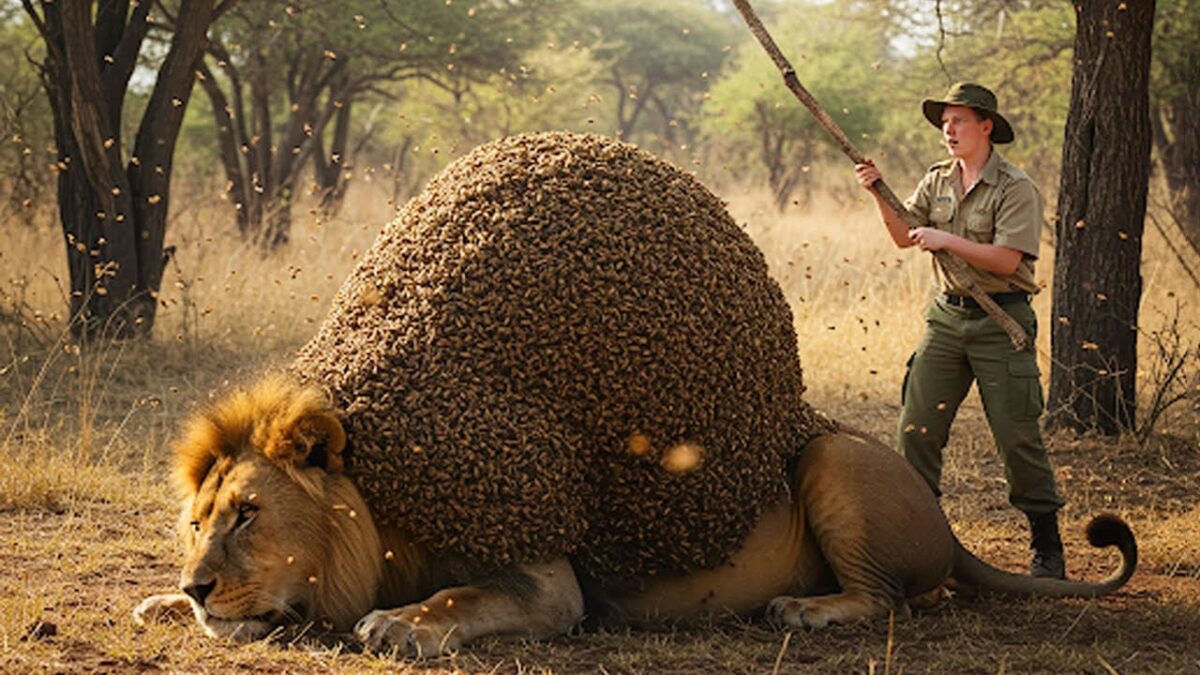
The swarm envelopes him. Thousands of bodies crawling, stinging, clinging. His mane becomes a shroud.
His golden eyes swell shut. His great frame trembles with involuntary spasms. But he does not roar.
There is no sound. Only the furious hum of wings, the violent rhythm of nature asserting its dominance. And so the savannah watches as its king suffers, not beneath tooth or claw, but beneath a storm of wings no larger than a fingernail.
Across the sweltering plane, where miragages blur the horizon, and dust clings to every breeze, a lone vehicle hums gently through the grass. Inside, Elias scans the land with seasoned eyes. Young yet shaped by the rhythms of the wild.
He is a ranger not just by duty but by devotion. He slows. Something isn’t right.
Far ahead a form stirs in the grass too large for an antelope. Too erratic for calm grazing. He lifts his binoculars.
The glass revealing a sight he can scarcely comprehend. At first it appears Mamba is under siege, perhaps by younger lions challenging a weakened king. But as the wind shifts and sunlight glints off a mass in motion, Elias sees the truth.
Not predators, not rivals, but bees. Thousands of them. A living cloak of black and gold, writhing and pulsing, has engulfed the lion’s body.
The great man, once a crown of pride, now teames with fury. Elias’s heart races. This is no ordinary incident.
The swarm could kill the lion in minutes. He knows that. And yet in the heart of chaos, Mamba lies motionless, fighting not with tooth and claw, but with breath and will.
Elias brings the jeep to a halt. Dust swirling around the tires. The engine idles, but his thoughts are anything but still.
He reaches behind his seat and retrieves two things. A small canister of smoldering smoke and an old carved staff gifted him years ago by Masai elders. a symbol of protection, of courage.
He knows the risk. He’s seen what these bees can do. But something deeper calls him forward.
He steps out of the vehicle and into the heart of swarm. The bees are furious. Tiny bodies darting, stingers ready.
They surround him instantly, drawn to the heat, the movement, the trespass. But Elias does not swat or panic. He begins a slow, deliberate dance.
Guided not by science, but by tradition. He waves the smoke gently in smooth circular motions. His movements, calm and reverent, are those of the old ways.
In the culture of the Masai, smoke is not just a tool. It is an offering, a language the bees understand, and they begin to yield. Through the thick hum, a swollen eye blinks.
Mwamba sees him not as a threat, but as something else, a presence, a protector. The lion does not move. He simply watches.
Bit by bit, the fury begins to fade. The smoke, rich and earthy, coils through the acacia cenadair, weaving a calming veil over the chaos. The bees, so relentless only moments before, begin to withdraw, their frenzy dullled by the ancient rhythm of ash and ember.
They lift, not all at once, but in pockets like a storm that has finally spent itself. And beneath it all, Mwomba remains. His chest rises and falls in ragged heaves.
His body, though battered and swollen, lies still, twitching from pain, yes, but no longer writhing in panic. The once gleaming eyes are now half-litted, caked with dust and venom. Yet there is life in him still.
Elias kneels beside him, not as a ranger, but as a witness. He speaks gently, not in command, but in comfort. Words that mean little to a lion, yet carry the weight of solidarity.
“You’re not alone,” he murmurs.
With one hand, he reaches for the radio, his voice firm, but low.
“This is Elias.
Emergency. I’ve got a lion. Severe be attack.
Son of fast.”
And then he waits. Not once does he turn away. Not for the bees.
Not for the heat. His gaze remains fixed on the broken king before him. A ranger beside a lion.
Two souls caught in a moment of stillness. Not foes, not legend and man, just life holding on. The rumble of tires announces their arrival.
Two veterinary trucks racing across the savannah, guided by Elias’s coordinates. Within minutes, the professionals descend, each movement precise, practiced, and urgent. They sedate Mwomba gently, respectfully, as if understanding that even in this broken state, he is still a king.
With swift hands and quiet voices, they set to work. Dozens of stings pepper his golden hide. Angry welts raised across his flank, his ears his swollen face.
A young vet gently cleans around his eyes, now nearly sealed shut, while another inserts an intravenous line, delivering life saving fluids drop by drop. Their work is quiet, reverent. This is no ordinary patient.
When Mwomba is stable, they carefully lift him onto a stretcher and place him inside a specially modified crate. From there, he is taken to a secluded recovery enclosure nestled deep within the reserve, a place few animals ever see. Here, beneath the shade of thickaces and with constant care, Mwamba is given the rarest gift the wild can offer.
Time to heal.
Days pass, then weeks. The swelling fades. His breath grows steady.
His eyes, those ancient eyes, open once more with clarity. And finally, one morning, the gate is opened. Moamba steps forward, slow but certain, back into the world that nearly claimed him.
One week later, the plains once again stretch out in tranquil silence, golden under the fading afternoon sun. Elias has returned to his outpost. The hum of distant cicada is the only sound accompanying his thoughts.
He sits alone, gazing across the savannah, wondering if he will ever see the line again. And then movement, a rustle in the tall grass, deliberate and calm. From the shimmering veil of heat, Mwamba emerges.
No longer frail, no longer broken, he stands tall, though slower than before. His mane rustling in the warm breeze like a weathered crown. The scars remain, etched into his skin, silent testimony to his survival.
Elias doesn’t move. Womba doesn’t growl. He doesn’t roar.
He simply watches, his amber eyes fixed on a man who once walked into a storm of stingers to stand by his side. And then he turns with quiet dignity. The lion begins to walk away, disappearing back into the sea of grass.
But before the wild swallows him whole, he glances back over his shoulder just once. A look not of fear nor dominance, but remembrance. In the heart of the savannah, where beauty and brutality live side by side, a lion and a man crossed an invisible line, one drawn not by instinct, but by trust.
Wombascars are not signs of weakness, but of resilience. Elias’s courage was not born of fearlessness, but of compassion. This was not merely a tale of survival.
It was a moment of surrender between claw and hand, between venom and smoke, between fear and faith. Because out here, every life tells a story. And some stories are meant to be remembered.








