This Bird Found Something Hidden in a Sloth’s Fur
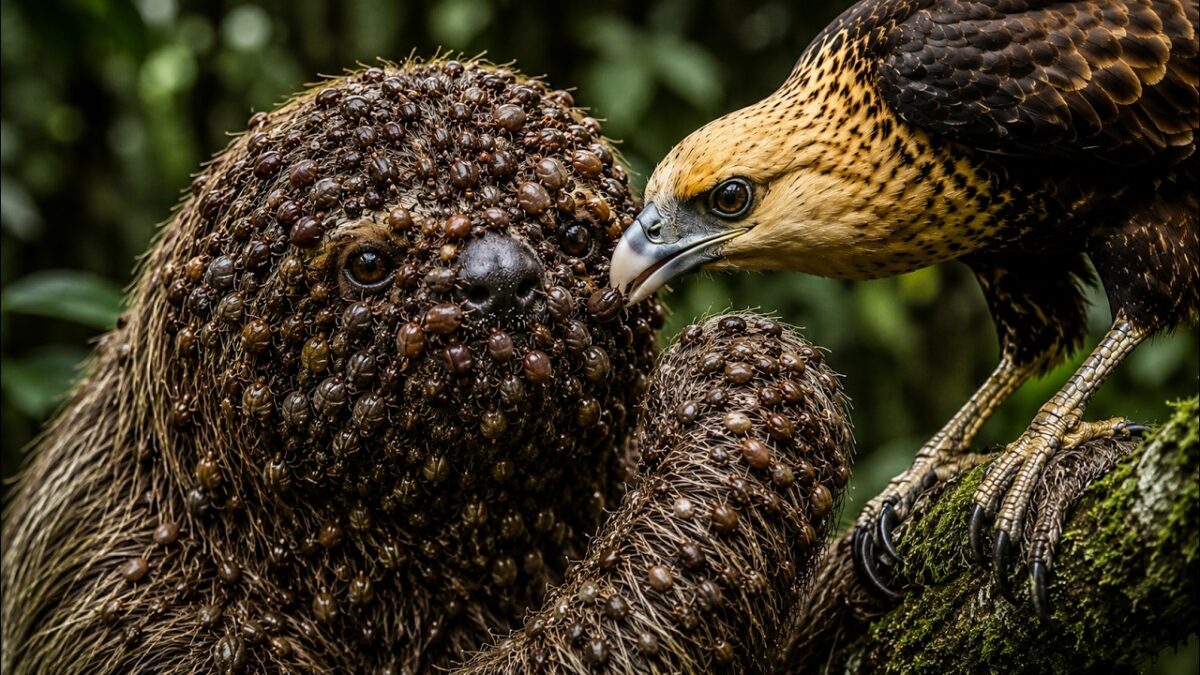
The Sloth’s Hidden Buffet
At first glance, this looks like a quiet rainforest moment. A sloth hangs almost motionless in the trees, and a small bird edges closer along its fur. But look again.
The bird is not resting beside the sloth. It is searching. Hidden in the thick coat around the neck, beneath the jaw, and near the base of the ear, hard ticks are attached to the skin.
Some are still small and flat. Others have already swollen after feeding. And for a bird that normally has to search leaf by leaf for tiny prey, that changes everything.
Earlier that morning, the forest was wet from recent rain. Small birds had been moving through branches, bark, moss, and leaf litter looking for insects one piece at a time. Food was there, but it was scattered.
Every beetle, every larva, every small invertebrate had to be found separately. Then the sloth appeared. It moved slowly into view and settled into a comfortable hanging position.
Its limbs locked around the branch. Its body almost disappearing into the green and brown of the canopy. Sloths are masters of stillness.
Their lives are built around conserving energy. Their metabolism is slow. Their movements are deliberate.
And in many situations, remaining calm is cheaper than reacting. That stillness is part of why this scene works. A sloth’s fur is more than a coat.
It can become its own tiny habitat. Moisture lingers in it. Algae can grow in it.
Small invertebrates may live among it. And in places where the skin is folded or thin, external parasites such as ticks can remain attached for long periods. So, while the forest sees one slow mammal resting, A bird may see something very different, concentrated food.
At first, the bird does not go straight to the sloth’s face. It tests the safer areas first. It lands lightly near the shoulder, tilts its head, and begins searching the outer fur.
One small exposed tick is partly visible along the lower neck. The bird grips it with the tip of its bill and pulls. The parasite comes free quickly.
In one fast motion, it is swallowed. That first success changes the entire interaction. Now the bird knows the sloth is worth investigating.
A second bird may even move closer, ready to exploit the same opportunity. But neither bird is helping in the way people often imagine. This is not a rescue.
It is a feeding opportunity. And the sloth? For the moment, it tolerates the contact. Not because it invited the birds, not because the birds are its partners, but because the disturbance is small, and reacting may not be worth the energy.
A sloth survives partly by staying quiet, conserving motion, and avoiding unnecessary effort. The birds work the outer edges first. They pick smaller ticks from exposed areas of the shoulder and neck.
They pause when the skin twitches. They wait when the sloth shifts. Then they resume.
But the best prize is not on the outer fur. It is deeper, near the ear base, inside a protected fold of skin. One larger tick stands out from the rest.
It is darker, swollen, and firmly attached. That means more food, but it also means more risk. To reach it, the bird has to move closer to the sloth’s face, where one head movement could end the attempt instantly.
The focal bird edges upward. Step by step, it climbs over the sloth’s coarse fur, using balance and timing more than force. It leans toward the ear.
Its bill closes around the swollen tick. It pulls once. Nothing.
The tick holds fast. The bird changes angle and tries again. Still attached.
Hard ticks anchor themselves with specialized mouth parts, and those hidden in protected folds can be difficult to remove cleanly. So, the bird tries a third time. This time, the tick begins to loosen, and that is exactly when the sloth reacts.
One ear flicks. The neck shifts. The skin tightens under the bird’s feet.
For a fraction of a second, the bird loses balance. The tick tears free. For one instant, the bird has won.
Then it slips. The tick drops from the bill, bounces down the fur, and disappears into the tangle of moss, bark, and damp leaves below. If another bird was watching, it lunges in immediately.
Competition begins the moment the prize is loose. But the sloth is already moving, lifting slightly, changing posture, making the feeding site unstable. And just like that, the biggest reward is gone.
That moment tells us something important. In nature, the richest reward is often found in the riskiest place. For the bird, the deep fold near the ear held the best food.
For the sloth, that same place was one of the hardest areas to clear on its own. After losing the large tick, the birds change strategy. They stop pushing so close to the ear and go back to the safer edges of the body.
Smaller exposed ticks, tiny insects disturbed by the sloth’s movement, easier prey, smaller payoff, lower risk. That trade-off matters. And it also reveals the real lesson of this interaction.
The sloth is not hiring cleaners. The birds are not acting as tiny doctors. What we are seeing is opportunism.
The birds feed because the sloth creates access to food. The sloth may receive a little incidental relief when a few ticks are removed, but only a small fraction of the parasite load disappears. Most of the ticks remain, especially those hidden around the ear base, neck folds, and other protected areas.
Still, even that limited contact tells a bigger story.








