He Sought Asylum to Escape Persecution — Then Helped Forge Evidence for 40 Other Claims
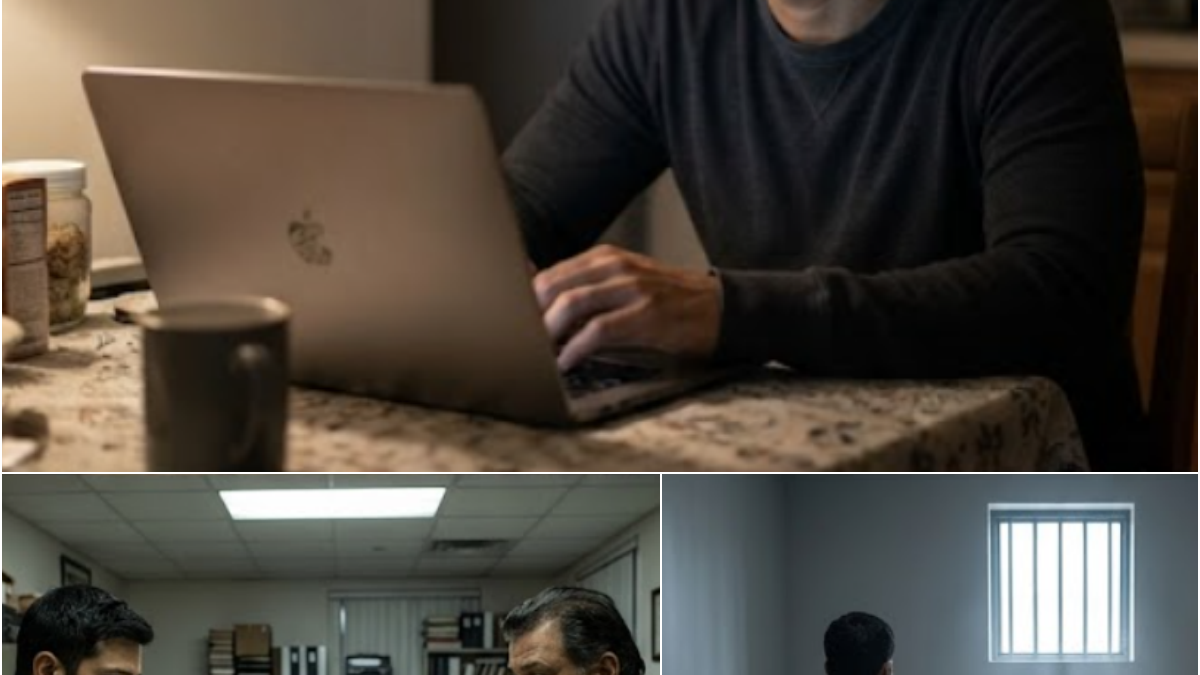
Look at this folder. Forty-one names. Forty of them are other people’s asylum files. The forty-first is his own, filed four years earlier, and it’s the one that started all of it — because once you’ve learned exactly what a convincing persecution narrative looks like on paper, from the inside, it turns out to be a difficult thing to stop noticing you know.
This is Arjun Malhotra. I want to be careful with this one, because the instinct with a story like this is to decide quickly whether he’s a predator or a victim of an impossible system, and I don’t think either label survives contact with everything he actually did.
Arjun grew up in a mid-sized town in Uttar Pradesh, the son of a government schoolteacher, in a household that was, by his own later account, not unkind to him so much as entirely unprepared for who he was. He understood, from adolescence, that he was gay, in a place and a decade where that understanding came with almost no language to describe it safely to anyone around him. He left for Lucknow at eighteen, ostensibly for college, actually for the anonymity a larger city offered, and spent his twenties working an unremarkable series of jobs in hospitality and retail, building, quietly, a small circle of friends who understood him in ways his family never fully did and, he came to believe by his late twenties, never fully would.
In 2015, an incident occurred that would become the core of his eventual asylum claim — a violent assault outside a private gathering in Lucknow, targeting him and two other men, an event Arjun reported to police and which, by his account, was met with open contempt rather than investigation, the responding officers reportedly more interested in the nature of the gathering than in the assault itself. He did not press the matter further. Two years later, in 2017, a second, less severe incident occurred, and Arjun, by then convinced that formal channels offered him nothing, began quietly researching what options existed to leave the country entirely.
He entered the United States on a B-2 tourist visa in 2018, ostensibly to visit a cousin in New Jersey, and filed for asylum within the one-year window US law requires, based on persecution on account of his sexual orientation — a well-established basis for asylum claims, and one that immigration attorneys handling LGBTQ cases from India, Uganda, Russia, and a handful of other countries had by then built substantial expertise around.
Arjun’s actual claim, the attorney who eventually prepared it would later testify, was fundamentally sound — the 2015 assault was real, corroborated eventually by a police report he’d managed to obtain years after the fact and by a statement from one of the two other men assaulted alongside him, who had since resettled in Canada under a similar claim. What was not entirely sound, and what would eventually become the thread investigators pulled to unravel everything that followed, was a second supporting document Arjun submitted alongside his own petition in 2019: a letter, purportedly from a Lucknow-based LGBTQ support organization, describing a pattern of “ongoing threats” against him personally that continued after his departure — threats that, according to Arjun’s later admission to federal investigators, had not actually occurred in the specific, escalating form the letter described. The underlying fear was real. The specific letter describing it was not.
The letter had been written not by any organization in Lucknow, but by a man named Devraj Bhatt, an immigration consultant — unlicensed as an attorney, operating instead as what the industry calls a “notario,” a term that in most US states carries none of the legal authority its Spanish-language cognate implies in Latin America, but that plenty of immigrants, including many South Asian applicants navigating a system without adequate access to affordable legal counsel, mistake for something more official than it is. Bhatt had been referred to Arjun by another asylum applicant Arjun had met at a support group in Jersey City, and had charged him $1,800 to prepare “supplementary corroborating materials,” a service Bhatt described, at the time, as standard practice for strengthening a claim that might otherwise be found credible but insufficiently documented.
Arjun’s asylum claim was granted in 2020. He does not appear, from any evidence investigators later assembled, to have known at the time precisely how fabricated the supplementary letter was — he understood it as “help,” in the way a person desperate enough for a specific outcome will often choose not to examine too closely the mechanics of help that arrives exactly when needed. This is, more or less, where the ordinary version of this story would end: a genuine claim, a slightly embellished file, a successful outcome, and a life that continues from there without incident.
It is not where Arjun’s story ended.
In 2021, a year after his own asylum grant, Bhatt approached Arjun with an offer. Bhatt’s consulting business had grown substantially, handling a growing volume of South Asian asylum cases — many involving genuine claims of religious, political, or sexuality-based persecution that were, in Bhatt’s assessment, frequently undocumented well enough on their own to succeed, and in need of exactly the kind of “supplementary materials” he had provided for Arjun. Bhatt needed someone who understood the LGBTQ asylum narrative specifically, someone who could write persuasively and credibly about experiences he had actually lived, to help draft similar supporting letters for other applicants claiming persecution on the same basis. He offered Arjun $400 per file.
Arjun said yes. I think it’s worth sitting, for a moment, on why. By his own later account, he did not think of what he was doing as fraud, exactly — he believed, and seems to have genuinely believed for a long time, that most of the underlying claims were real, that the applicants had, in fact, suffered real persecution, and that what he was doing amounted to helping people tell a true story more effectively in a system that too often rejected true stories for lacking sufficiently specific documentation. He was not entirely wrong about the underlying unfairness of that system. He was also, over the following three years, engaged in something that had stopped resembling advocacy in any legally meaningful sense.
Between 2021 and 2024, Arjun drafted supporting letters, personal statements, and — in at least six cases investigators later documented — entirely fabricated “witness corroboration letters” attributed to organizations and individuals in India who had never written them, for forty separate asylum applicants, almost all connected to Bhatt’s consulting business, almost all South Asian, and roughly a third of them citing sexual-orientation-based persecution claims where the underlying facts, once investigators dug into them, ranged from substantially true but under-documented to, in at least nine cases, entirely invented from the outset — applicants who were not gay at all, coached by Bhatt to construct a persecution narrative wholesale because it represented, in the current asylum landscape, one of the more sympathetically received categories of claim.
Arjun maintained, throughout his later cooperation with investigators, that he had not known which of the forty were genuine and which were fabricated from nothing — that Bhatt handled client intake and told him only the narrative details to write around, never the underlying truth of any individual case. Investigators found this plausible for some files and considerably less plausible for others, particularly a handful where the details Arjun had written bore suspicious structural similarity to his own original 2015 assault, reused, with minor variations, across at least five different applicants’ files.
The scheme unraveled not through any single applicant’s case being rejected, but through an unrelated USCIS fraud detection initiative launched in 2023, which used natural language analysis software to flag asylum applications with unusually similar phrasing patterns across ostensibly unconnected cases — a tool built originally to catch large-scale, centrally produced fraud mills rather than the more individualized, freelance-adjacent operation Bhatt and Arjun had built, but effective against it regardless, because Arjun’s writing, however varied he tried to make it, retained identifiable stylistic fingerprints across dozens of supposedly independent personal narratives.
Twelve flagged files were referred to USCIS’s fraud detection unit in late 2023. By early 2024, the unit had identified Bhatt’s consulting business as the common thread across all twelve, and by summer 2024, a joint investigation involving USCIS, ICE’s Homeland Security Investigations unit, and the Department of Justice had expanded the scope to the full forty files, interviewing applicants directly — several of whom, upon learning their own approved asylum status might now be subject to review and potential revocation, cooperated extensively, describing exactly what Bhatt had asked them to say and, in several cases, naming Arjun specifically as the person who had actually written their supporting materials.
Arjun was interviewed by HSI agents in September 2024. He cooperated fully, provided a detailed account of his three years of work for Bhatt, and — in a decision his eventual attorney would describe as both his best and most costly move — voluntarily disclosed the embellished 2019 letter in his own original file, a disclosure investigators would almost certainly have found on their own eventually, but one that nonetheless placed his own, originally legitimate asylum grant into the same jeopardy as the forty files he’d helped fabricate.
Both men were indicted in December 2024 — Bhatt on charges of immigration fraud, conspiracy, and unauthorized practice of immigration law across dozens of counts; Arjun on charges of conspiracy to commit immigration fraud, tied specifically to the documented fabrications in roughly two dozen of the forty files where his authorship could be firmly established. Bhatt’s trial and Arjun’s were severed and heard separately at the U.S. District Court for the District of New Jersey in the spring of 2025.
Arjun pleaded guilty in March 2025 rather than proceed to trial, a decision his attorney negotiated in exchange for continued cooperation against Bhatt, whose own trial that June relied heavily on Arjun’s testimony describing, file by file, which supporting letters were genuine embellishments of real events and which had been constructed entirely from Bhatt’s own coaching of applicants with no underlying claim at all. Bhatt was convicted on the majority of counts and sentenced in September 2025 to twelve years in federal prison.
Arjun was sentenced in July 2025, ahead of Bhatt’s trial, to two years in federal prison, a sentence his attorney characterized as reflecting both the seriousness of what he’d done and the mitigating weight of his cooperation. More consequentially, his own original 2020 asylum grant was formally revoked in a parallel civil proceeding once his own disclosed fabrication became part of the public record — a revocation that would have occurred, USCIS’s counsel noted in the proceeding, even if the underlying 2015 persecution claim was substantially true, because federal law treats any materially false statement in support of an asylum application as grounds for revocation regardless of whether the core claim would otherwise have succeeded on its own.
Of the forty applicants whose files Arjun had helped fabricate or embellish, USCIS’s review, completed by late 2025, revoked asylum status entirely in seventeen cases, found the underlying claims sufficiently independently credible to preserve status despite the fraudulent supplementary materials in fourteen cases, and left nine cases still pending further review as of this writing. Several of the seventeen whose status was revoked have filed new claims on narrower, independently documentable grounds, a process their attorneys describe as starting over from a position considerably worse than where they began, now carrying a formal fraud finding attached permanently to their immigration record.
Arjun will complete his sentence and be deported to India upon release, to a persecution risk that his own original case, whatever its embellishments, plausibly still describes accurately — a fact his attorney raised, without much expectation of it mattering, in a final sentencing memo that asked the court to consider whether removing him to the exact circumstances his 2015 claim had described amounted to its own kind of injustice, layered awkwardly on top of the one he had, by then, admitted to causing several dozen other people.
The judge did not address the argument directly in her sentencing remarks. She addressed, instead, the forty files, and the fact that whatever unfairness Arjun believed he was correcting, he had done so by making every one of those forty claims — the true ones included — permanently harder for anyone to trust.
I keep thinking about the five files that reused pieces of his own 2015 assault, rewritten just enough each time to seem original. That’s the detail I can’t get past. Not the money. Not even the fabrication, exactly. The fact that the one true, terrible thing that had actually happened to him became, eventually, a kind of template — a story he no longer told because it was his, but because it worked.








