Gorilla raises abandoned lion cub, the ending will leave you speechless
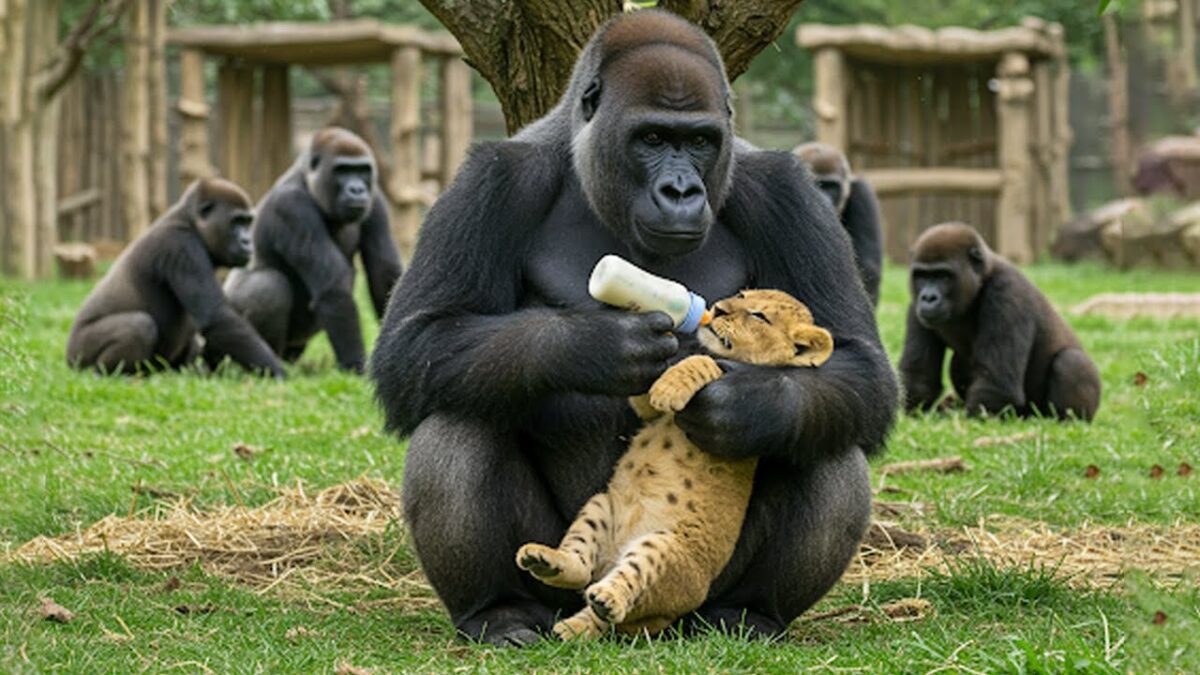
Ada: The Gorilla Who Mothered a Lion
When a gorilla with no child of her own meets an abandoned lion cub, something miraculous unfolds. Their bond defies nature, and the ending will leave you speechless. In the early hush of dawn where golden light dances across the acacia strewn plains of East Africa, the circle of life unfolds with brutal honesty.
Near a shallow riverbank, still glossed with due, the silence is broken by a terrible roar. Then a thundering stampede, a lionist, proud and fierce, has made a miscalculated advance on a herd of wild buffalo. The herd does not scatter.
They retaliate. Dust clouds rise, horns strike, and in the fray, the lioness is gored. Her flank torn and bleeding.
She flees into the long grass, dragging her wounded body with desperate strength. But in the chaos, something is left behind. A lion cub no more than a week old, eyes barely open.
Its small body quivers with instinctual fear. It lets out a tiny muing cry, a call that carries far across the open land. And by sheer providence, someone hears it.
Ranger Eliza Hart, a seasoned American conservationist, is conducting a patrol on the opposite bank. She halts, ears tuned. Another cry pierces the air.
Eliza moves quickly, guided by sound and gut. She finds the lion cub alone, trembling by a tangle of reads. No mother in sight.
Her experienced hands scoop up the fragile creature. The cub doesn’t resist. It simply presses its face into her arm as if it knows safety.
With careful urgency, Eliza radios in and heads for the wildlife rescue center. The lion cub’s life, it seems, is about to change course dramatically and forever. Nestled at the foot of the NY Hills, the wildlife rescue center is a sanctuary like few others.
home to animals plucked from cruelty, misfortune, or the brink of death. There are elephants with missing tusks, birds with singed feathers, and deep within one shaded enclosure. Five gorillas who once live behind circus bars.
Among these gorillas is Ada. Unlike the others, Ada has never had a child of her own. Yet within her, a quiet, persistent, longing lies.
seen the way she cradles fallen branches like infants, or how she hums low tones when staff walk by with rescued younglings. She is gentle, intuitive, and fiercely observant. When Eliza arrives with a lion cub wrapped in a soft blanket, the staff work quickly.
The cub is dehydrated, weak, but stable. Over the days that follow, its cries echo through the center until something strange happens. Ada starts to sit closer to the lion cub’s enclosure.
She watches, not with curiosity alone, but with recognition. When the cub cries, Ada hums. When it sleeps, she leans against the barrier as though lending warmth through sheer presence.
Eliza, ever the pragmatist, hesitates. It’s something about Adah’s calm, maternal posture, gives her pause. Perhaps she thinks a miracle might be possible.
And so carefully the staff begin to observe, wondering what might come of this improbable nearness between a gorilla and a lion cub. Two weeks later, the moment comes. The lion cub, now slightly stronger, is brought in a crate near the gorilla enclosure.
The staff hold their breath. The other four gorillas linger in the trees, watching with wide, curious eyes. But Ada steps forward slowly, deliberately.
She sits, arms resting on her knees, and waits. A staff member gently lifts the cub out. It lets out a squeaky protest, but doesn’t claw.
Its body is limp with trust. The staff offer a bottle of warm milk, one inheld through the bars. But it is Ada who reaches first.
Her leathery fingers curl around the bottle. She studies it, sniffs, then gently holds it upright. The lion cub opens its mouth and suckles.
nestled in the crook of her arm as though it had always belonged there. A stunned silence falls. Even the other gorillas, once skeptical, draw closer, not out of alarm, but out of awe.
Eliza, watching from behind reinforced glass, feels the weight of what is unfolding. This is no train performance, no Coke’s behavior. This is instinct.
This is care. Over the following days, Ada begins feeding the lion cub regularly. She grooms it gently, nudges it towards soft grass, hums when it whimpers, and allows it to nap beside her belly.
The bond forms with quiet certainty. The lion cub follows Ada like it would a lioness, bumping her hand with its nose, learning her rhythms, mimicking her slow, swaying gate. What began as an experiment becomes something deeper.
A gorilla who never bore a child. A lion cub who lost its mother. And in between them, a bridge of compassion the wild had never written in its rule book.
Under Ada’s tender guardianship, the lion cub thrives. It learns to balance, to pounce in the grass, and to nuzzle against Ada’s side during midday naps. Sometimes it beats its small paws against Adah’s chest and play, and she respond with a patient nudge or a tickle under the chin.
At times, the lion cub mimics her, walking on its hind legs for two clumsy steps or copying her hand-to-mouth gestures. Eliza and the team document everything. The footage spreads.
A gorilla raising a lion cub. News outlets call biologist debate, but within the sanctuary, life continues quietly. Adith never parades.
She simply cares. And the lion cub, though growing stronger by the day, never strays far from her side. Yet even Eliza knows this cannot last forever.
The lion cub belongs to the wild. Its muscles are beginning to swell. Its instincts, curiosity, caution, and the faintest glimpse of the predator it will become begin to awaken.
Still, the bond remains. And for now, as the sun sets over the open fields and the call of distant birds echoes overhead, the cub sleeps curled against Ada’s arm. Safe, loved, it is in every sense of the word home.
By its fifth month, the lion cub begins to change. The sharpness in its eyes deepens. It no longer swats at butterflies and jest.
It stalks them, calculating. The playful tumbles become measured leaps. Staff recognize the shift.
The time has come. A new enclosure is prepared. Here, the lion cub can practice hunting, stalking shadows, pouncing on decoy prey, sharpening claws against bark.
The process is gradual, designed to reawaken instincts. Ada watches as the lion cub is led away. She does not cry.
She does not resist. She sits in her favorite corner, her face unreadable. But as the gate closes behind the cub, her hand lingers against the ground.
The cub turns once. Their eyes meet, then it is gone. Weeks pass.
The lion cub grows bolder, stronger. It stalks with confidence, wrestles with mock prey, and roars, not in fear, but in command. Eliza watches from a distance, a notebook in hand.
Ada meanwhile stays near the training enclosures outer trees humming to herself now and then. The separation though silent is shared by them both. But all know what this means.
The lion cub is preparing not just to survive but to return to where it was born to the savannah to the wild. On the morning of the lion cub’s release, the skies are clear. Eliza opens the crate one last time but not before a final visit.
She leads the lion cub toward Adah’s enclosure. The others sit in the trees, silent, sensing what this is. The lion cub hesitates at first, then walks toward the barrier.
Ada steps forward. No sound, no movement. Then slowly, the lion cub places its head through the open gate.
Ada meets it halfway. Forehead touches forehead. They stay that way, still and breathing in rhythm, as if recording each other’s scent for memory’s sake.
No tears, just presence, just understanding. Then Eliza calls. The lion cub turns slowly and with one last look, it walks away.
Ada watches until the vehicle disappears down the red dust road. Then she turns, returns to her corner, and hums once more. As Eliza drives the lion cub toward its new territory.
She glances at the rear view mirror. Behind her is a gorilla who modethered a predator. Ahead lies the lion cub’s future.
Wild, uncertain, and free. The story of Ada and the lion cub spreads across continents. A rare testament to empathy unbound by species.
Conservationists cite it as proof that nurture transcends nature, that compassion speaks in many tongues. And in the hush between animal and human, predator and primate, the world glimpsed something sacred. A legacy not of blood, but of care.
A story to never be forgotten. In the vast theater of nature, where survival is often a solitary struggle, stories like that of Ada and the lion cub remind us of something profoundly beautiful. That compassion knows no boundaries.
Here, a gorilla with no child of her own and a lion cub stripped of its mother found solace in each other. Their bond was not born of instinct alone, but of a rare silent understanding, an echo of the empathy that lives deep within us all. Because every creature, every bond, and every story deserves to be remembered.
Together, let’s keep the wild alive. Not just in the wilderness, but in our hearts.








