She Ruined Her Own Face to Be Perfect. Then Blenheim Erased Her: Gladys Deacon
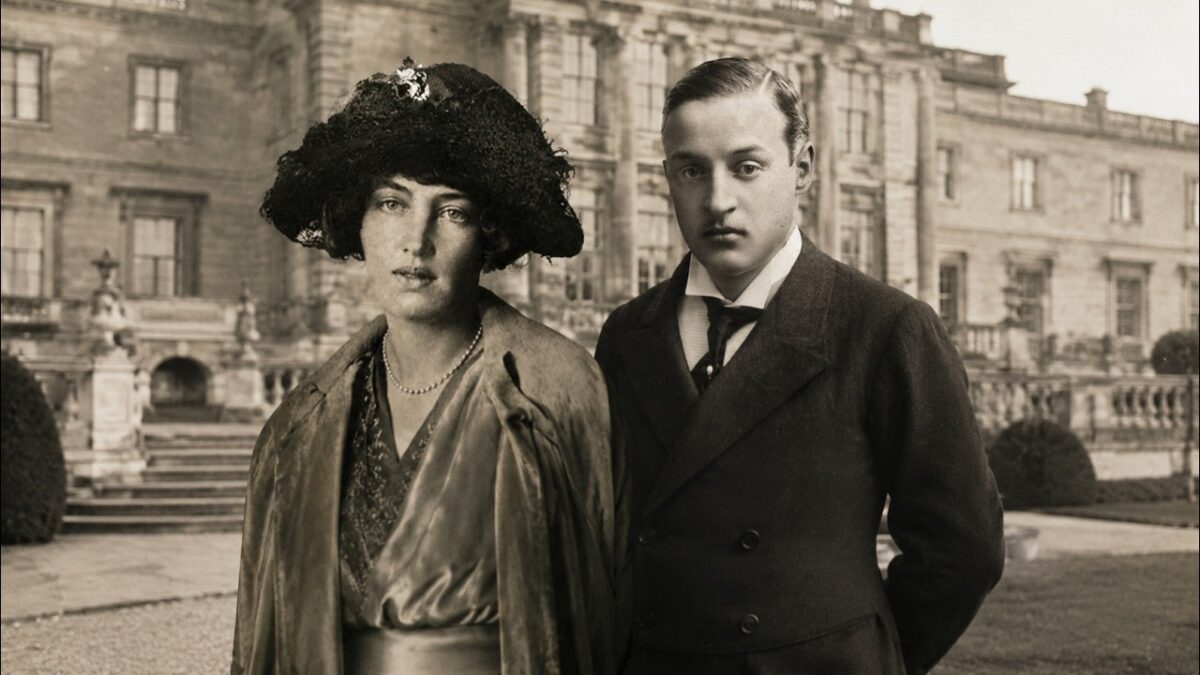
If you walk into Blenhan Palace today, two enormous eyes look down on you from the ceiling, pale, blue green, watchful. The visitors pass beneath them by the thousand on their way to the room where Winston Churchill was born, and almost no one is ever told whose eyes they are. They belong to a woman the palace tried to forget.
She was once the most admired beauty in Europe. P adored her. Baldini painted her.
A future king begged to marry her. And she wanted only one thing in the whole world, to be the Duchess of Malbra, mistress of this house. The same house that had already broken Canuelo Vanderbilt.
She chased that wish for 26 years. She ruined her own face, reaching for perfection. And when she finally won, when the title and the palace were at last hers, the Duke turned off the lights and had her carried out into the dark.
She would die half a century later, alone and forgotten in a locked hospital ward. But her eyes are still up there, still watching, still asking to be seen. This is the story of Gladis Deacon, the woman who got everything she wished for.
Ladies and gentlemen, welcome. For those of you who are new here, at Crown Files, we tell the stories of the women who lived beside power, the duchesses and the aeryses, the wives kept in the quiet margins of the official histories, the women who paid a very private price for very public lives. Tonight’s story belongs among the strangest of them all.
It begins with a house you may already know, Blenham Palace in the green heart of Oxfordshire. The only house in all of England, neither a royal residence nor a cathedral that is permitted to call itself a palace. the birthplace of Winston Churchill.
A house so vast and so heavy with history that it has quietly broken more than one woman who tried to live inside it. You may remember the first of them, Consuelo Vanderbilt, the young American heirs whose mother forced her weeping to marry the 9inth Duke of Malbor and to pour the Vanderbilt fortune into these cold and beautiful stones. That marriage was a sorrow from the very first day.
In time, it ended in separation and at last in divorce. But within months of losing one American wife, the Duke had already found another. Her name was Glattis Deacon.
And in many ways, hers is the stranger story, and I have always thought the sadder one. She was, by the account of nearly everyone who ever met her, one of the most beautiful and brilliant women of her age. She was born in Paris in 1881 into great wealth and into a scandal we will come to soon enough.
She grew up among the dazzling names of the Bell Epoch, the painters, the poets, the princes who drifted through the great salons of Paris and Rome. Marcel P wrote that he had never seen a girl with such beauty, such magnificent intelligence, such goodness and charm. The sculptor Rodam befriended her.
The painter Baldini set her upon his canvas. A future king of Prussia begged to marry her. Winston Churchill himself would one day call her simply a strange glittering being.
She had the whole world at her feet and she wanted only one thing from it. She’s wanted it since she was a girl of 14. She wanted to be the Duchess of Marra, the mistress of this enormous house.
Not for love in the beginning, for the title, for the place, for the proof of it. It would take her 26 years to get it. And here is the part that has always stayed with me.
What this woman did to herself along the way in the name of beauty and what was done to her once she finally arrived is a story that the palace itself for a very long time preferred not to tell. Even today, visitors walk in through the grand entrance and pass directly beneath her every single day of the year without ever once being told her name. Those eyes are still there.
And tonight we are going to tell you whose they are. Tonight we tell the story of Gladis Deacon, the woman who got everything she wished for. And our story begins where hers in a strange way still remains.
High on a painted ceiling at Benham, looking down on a world that has forgotten her. Let us begin. If you visit Blenhan Palace today, you will walk in beneath them without knowing.
You will come up the long approach past the lake and the great gates, and you will step into the shadow of the north portico, the grand stone entrance to the house. And if by chance you happen to look up, you will see them. Two enormous eyes painted on the ceiling high above your head.
Pale blue green, watchful. They follow the line of the stone as if the ceiling itself were dreaming. Most visitors never look up at all.
They walk straight on into the stateooms toward the room where Winston Churchill was born. The guides, for the most part, do not stop them. For a very long time, the guides were not encouraged to explain those eyes to anyone.
They belong to a woman. They were painted there in the late summer of 1928 by an artist named Colin Gil at the express command of the woman herself. She was at that moment the Duchess of Malbra.
She had wanted to leave her mark upon this house, and so she had her own eyes set into its ceiling, where they would gaze down upon every guest who ever crossed the threshold long after she herself was gone. She could not have known how exact that wish would turn out to be, because the woman would be driven out of this house within 5 years. She would die half a century later alone and nearly forgotten in the locked ward of a mental hospital.
And these eyes painted on a ceiling she would never be allowed to stand beneath again would become almost the only trace of her that the palace allowed to remain. So before we go any further, let us answer the question the guides so rarely do. Whose eyes are they? To understand that, we have to leave Blenhan behind for a while.
We have to go back, back across the channel, back across 30 years, to a world that no longer exists. To the salons of Paris and Rome at the turn of the 20th century, to that brief gilded span of years, the French would later call the bell epoch, the beautiful age, when Europe’s aristocracy still believed the party would never end. And there in those rooms, we find her at the height of her powers.
Young, radiant, the single most talked about young woman in Europe. Her name was Gladis Deacon. She was American by blood, though she had been born in Paris, and she moved through European society as though she had been made for it.
She spoke several languages, and she spoke them brilliantly. She had read more and thought more deeply than almost any man who tried to court her. She could hold a table of poets and diplomats spellbound for an entire evening and then puncture the whole performance with a single devastating remark.
People did not quite know what to do with her. They only knew that they could not look away. The poet Marcel P, a man not easily impressed by anyone, was among the first to fall.
He wrote of her that he had never in his life seen a girl with such beauty, such magnificent intelligence, such goodness and charm. From P that was no small thing. He spent his life dissecting the vanities of exactly this world, and here he was, undone, like everyone else.
He was not alone. The great sculptor August Roda sought her out and befriended her. The painter Claude Monet welcomed her.
The Italian portraitist Giovani Baldini who painted all the famous beauties of the age set her upon his canvas. The young sculptor Jacob Epstein would model her head in stone. The art historian Bernard Baronson, one of the sharpest minds in Europe, considered asking her to marry him.
To be painted, sculpted, written about, and pursued by such men all at once was to be something more than fashionable. It was to be a kind of living work of art. And the admiration did not stop at artists.
According to her biographer, a young prince of the German imperial house, the crown prince of Prussia, heir to the Kaiser himself, became so taken with her on a visit that he is said to have given her a ring. The gift caused alarm in Berlin, the Kaiser, the story goes, demanded that the ring be returned. A young American woman, it seemed, had wandered close enough to the throne of Germany to make an emperor nervous.
This was the world Gladis Deacon commanded. Princes and painters, poets and politicians. Years later, Winston Churchill, who knew her well and was not given to sentiment about glamorous women, would search for the right words to describe her and settle on these.
He called her simply a strange glittering being. Glittering. It is exactly the right word.
And so in time is strange because here is the thing about Gladis Deacon that the salons of Paris did not yet understand. Underneath the brilliance, underneath the charm that disarmed even P, there was something restless, something that could turn cold without warning. She could be tender and thoughtful one moment, and casually, carelessly cruel the next.
She gathered the most remarkable people of her age around her, and yet she seemed always to be searching past them for something she could not name. Those who knew her best would spend the rest of their lives asking the same questions. Why was she so captivating to men and women alike? Was she entirely sane, or was there even then some fracture running quietly beneath the surface? And what exactly did this woman who had everything want so badly that nothing in front of her would do? We know the answer to that last question.
She told people herself. She wanted a house. She wanted a title.
She wanted to be the Duchess of Morbra to be mistress of Blenhan Palace, the great house in England she had fixed upon as a girl. She had decided this for herself at the age of 14. with the strange single-minded certainty that would define her whole life.
It did not matter to her that the Duke she had chosen was at that point already married to a weeping American heirs named Consuelo Vanderbilt. Gladis simply looked at the future and decided it belonged to her. It would take her 26 years to make that future come true.
And along the way, in the pursuit of a beauty she feared was not quite perfect enough, she would do something to herself that no one who adored her could undo. Something that would in the end take the very face that P had praised and Baldini had painted and quietly destroy it. But that is still to come.
For now, hold on to the image of her at her dazzling best, adored, untouchable, the brightest star in the brightest room. Because every fall is measured from a height. And to understand how far Glattis Deacon would one day fall, you must first see how high she once stood.
To understand that, to understand the restlessness underneath the glitter and the wound it grew from, we have to go back even further still, past Paris, past the salons, to a single night on the French Riviera when Gladis was just a child of 10 or 11 years old, to a hotel suite in Can and a sound that no little girl should ever have to hear. Because before Glattis Deacon was the most admired woman in Europe, she was a frightened daughter in a family coming violently apart. To understand the woman, you have to begin with the family.
And the family was American, though you would never have guessed it from the way they lived. Gladis was born in Paris in February of 1881, the eldest surviving daughter of two wealthy Americans abroad. Her father was Edward Parker Deacon of an old and respectable Boston family.
Her mother was Florence Baldwin, the daughter of an American admiral, a beauty in her own right, restless and charming, with an appetite for the pleasures of European society that her husband could neither match nor control. There were four daughters in all and a baby son who did not survive infancy. On paper, it was a life of every privilege.
In truth, it was a marriage already poisoning itself from the inside. For the deacons did not really live anywhere. They drifted Paris, Rome, the Riviera, the fashionable resorts of the season.
A handsome American family forever between hotels. And as they drifted, the marriage curdled. Edward was jealous and increasingly certain that his wife was unfaithful.
Florence, for her part, had grown tired of a husband whose suspicion followed her into every room.
By the time Glattis was old enough to understand the tension in the air, the household had become a quiet battlefield, and she and her sisters with a ground it was fought over. Then on a winter night in 1892, the battle stopped being quiet. The family was at Can on the French Riviera staying at the hotel Splendid.
Edward Deacon had become convinced correctly as it happened that his wife had taken a French lover, a man named Emil Abbe. On the night of the 18th of February, his suspicion turned to certainty, and his certainty turned to violence. He forced his way into his wife’s rooms.
He found Abbe there and he shot him dead. Gladis was a child of 10 or 11 years old. Her sisters were younger still.
They were in the hotel that night somewhere among those rooms. As the shots rang out and the household fell into chaos, as the police arrived, as their father was taken away, as their mother’s secret spilled out of the private dark and into the newspapers of two continents. We should be careful here.
It would be easy and cheap to dwell on the horror of that night for its own sake. The newspapers of 1892 did exactly that, and they did it gleefully. What matters for our story is not the spectacle.
It is the wound. Because whatever a child of 10 understands or fails to understand about jealousy and betrayal and a body on the floor of a hotel suite, she does not walk away from a night like that unmarked. No one does.
What followed did not heal it, it deepened it. Edward Deacon was arrested and tried in France, where the courts of the day tended to look with a certain sympathy on a husband driven to violence by a faithless wife. He was convicted, but of a lesser charge and served a relatively short term in prison.
And in the meantime, the family did not draw together in its grief. It tore itself apart over the children. Gladis spent the years that followed being passed back and forth like a contested inheritance.
She was placed for a time in a convent school outside Paris. When her father was released, custody of the older girls was given to him, and he took them across the Atlantic to America, far from their mother. Their mother, in turn, was not content to let them go.
There were reconciliations that failed, separations that hardened, and at least one occasion on which one parent simply took the children from the other. The girls were, in the most literal sense, fought over and carried off. Their childhood became a long argument between two adults who had stopped loving each other and started using their daughters as weapons.
And the man at the center of it all, the father, did not recover. In the years after the killing, Edward Deacon’s mind began to fail him. The jealousy that had ended a man’s life curdled into something darker and more permanent.
He spent his final years confined, and he died in an asylum in 1901, his reason gone. Hold that fact for a moment. It will matter later.
The father died, his mind broken, behind the walls of an institution. It is a sentence we will have caused to write again about his daughter 3/4 of a century on. So this was the soil in which Gladis Deacon grew.
Not the gilded salons we met her in last. Those came later, and they were, in a sense, a performance built on top of all this. Underneath was a girl who had learned before she was 12 several lessons that no child should have to learn so early.
That love could end in gunfire. That the people who were supposed to keep you safe would instead bargain over you. That beauty, her mother’s beauty, could set terrible things in motion.
And that a person could simply be taken away in an instant and not come back. It is not difficult to draw a line from that childhood to the woman she became. The restlessness that ran beneath the glitter, the need to be adored by everyone in the room, and the inability to be satisfied by any of it.
The way she could be warm and then suddenly mysteriously cold, as though some part of her had decided long ago, and for good reason never to be fully at anyone’s mercy again. and above all the strange and fixed determination formed in those same wandering years to seize for herself one thing in the world that could never be taken away. A title, a great house, a place that was hers by law and could not be argued over by anyone.
She would spend her life looking for safety in the wrong places, in titles, in admiration, in the eyes of men who loved what she was rather than who she was. And she would spend it too in the company of a fear that would in the end undo her completely. Because there was one thing this brilliant, wounded, much admired young woman could not bear.
She could not bear the thought that her beauty, the one currency the world had taught her was reliable, might one day prove imperfect, might fade, might fail her the way everything else in her childhood had failed her. And so at the very height of her loveliness, with all of Europe at her feet and a future king begging for her hand, Glattis Deacon made a decision. A small decision at first, a private one, a few injections to make a beautiful face just a little more perfect.
It would be the worst decision of her life. Her childhood had taught her that almost nothing could be relied upon. Not love, not safety, not the people who were supposed to provide them.
But there was one thing the world kept telling her it could rely on over and over in every room she entered. Her face. And what a face it was.
We have already heard the testimony. P undone by it. Baldini reaching for his brushes.
Roda Monet Baronson a future king of Prussia. A whole generation of the most discerning men in Europe. all agreeing on the same point.
Glattis Deacon was beautiful in a way that stopped conversations. She had a clear classical profile, pale blue green eyes, and a stillness to her features that made people compare her to a statue or to the marble heads of antiquity. Sculptors wanted to carve her precisely because she already looked carved.
For a young woman who had learned to distrust everything else, this was intoxicating. Her beauty opened every door. It drew the admiration she craved.
It gave her power in a world that gave women very little. It was, she must have felt, the one thing that was truly and reliably hers. And that perhaps is exactly why she could not leave it alone.
Because Glattis did not see what everyone else saw. Where the world saw perfection, she saw a flaw. She had decided that her nose, that classical, much praised nose, was not quite straight enough, not quite the flawless Grecian line of the ancient statue she so admired.
To anyone else, it was invisible. To her, it was unbearable. The one reliable thing she possessed was not in her own eyes perfect.
And for a woman built the way Glattis was built, not perfect was very close to not safe. So at the age of 22, at the very summit of her loveliness, she made a decision that the medicine of her age was nowhere near ready to understand. This was the dawn of cosmetic surgery.
Long before it was a science, long before anyone grasped its dangers. The fashionable solution of the moment was a substance that seemed almost miraculous. Soft paraffin wax warmed until it flowed, then injected beneath the skin to smooth a line or build up a contour.
It was new. It was glamorous. and it was, as a great many women of that era would discover to their ruin, catastrophic.
Glattis had the wax injected into the bridge of her nose to perfect the profile she thought imperfect. At first, perhaps it did what she wished, but warm wax does not stay where it is put. It does not bind to the body the way the doctors of 1903 imagined it would.
Over the months and years that followed, slowly and without mercy, the wax began to move. It softened in the heat. It sank under its own weight.
It traveled down from the bridge of her nose, settling into the lower part of her face, into her cheeks, her jaw, her chin, where it hardened into heavy, immovable lumps beneath the skin. There was no undoing it. There was no procedure in that era to take it back out.
The damage simply was and it went on slowly getting worse for the rest of her life. The clear classical profile that P had praised and Baldini had painted began year by year to thicken and to sag and to distort. The marble statue was cracking from the inside.
Think for a moment about the particular cruelty of that. Not a sudden disfigurement, not an accident in an instant, but a slow one. A wound that arrived in installments over decades in the mirror a little more each year.
For a woman whose entire sense of safety was bound up in her beauty, it was the precise shape of her deepest fear made real by her own hand. She had reached out to make herself perfect forever. Instead, she had set in motion the steady lifelong destruction of the one thing she had trusted.
And here is perhaps the strangest detail of all, the one that tells you something essential about Gladis Deacon. She did not retreat. Not then.
For years afterward, as the damage advanced, she went on moving through the great rooms of Europe as if daring the world to notice. She still held her court of poets and princes. She still wore her beauty like armor, even as it failed.
There was a defiance in it that is hard not to admire, even as it breaks your heart. The full bitter measure of that defiance would come years later after she had finally become a duchess, long after the wax had done its work. She agreed to appear in an American magazine advertisement for a brand of face cream.
There she is in the photograph, the Duchess of Marra posed in her wedding gown, lending her famous name to a promise of flawless skin. These creams, the advertisement has her say, keep my complexion so vigorous and healthy. Read that again and feel how it lands.
The most painted, most admired face of the bell pock, a face she herself had quietly ruined, now being used to sell the dream of perfect beauty to ordinary women. She was selling the very thing she had lost and lost in the chase for the very perfection the advertisement promised. It is one of the saddest small ironies in her entire story.
And she walked into it, it seems, with her chin up. That was Glattus Deacon, wounded as a child, adored as a young woman, and now carrying beneath the surface of her own face a slow catastrophe of her own making. the perfect emblem of everything that drove her.
The reaching for perfection, the refusal to be satisfied, the terrible cost of it. You might think with all of this that the world would have turned away from her, that the suitors would fade, the doors would close, the glittering life would dim. For a while it did not.
For a while she remained one of the most sought after women in Europe. lumps and all by the sheer force of her wit and her presence and the legend she had become. And through all of it, through the childhood, the scandal, the slow ruin of her face, one fixed idea burned on inside her, exactly as bright as it had been when she was 14 years old.
She still meant to be the Duchess of Morbra. She had chosen her house. she had chosen her duke.
The fact that he was married to another woman had never troubled her for a moment. And now, with the patience of someone who had decided the future already belonged to her, she set about the long, strange work of making it true. It would take her the better part of three decades.
It would require the slow unraveling of another woman’s marriage. And when at last she stood inside Blenhan Palace as its mistress, when she finally had the title she had wanted since she was a girl, she would discover the crulest truth of her entire life. She had spent 26 years getting exactly what she wished for, and it was going to destroy her.
She decided at 14. Now we watch her spend a lifetime making it come true. It is worth pausing on how strange this was.
Most girls who dream of a duke are dreaming of romance. Gladis was not. She had fixed upon a specific man holding a specific title living in a specific house, Charles Spencer Churchill, the 9inth Duke of Malbor, known to everyone as Sunny.
and she had fixed upon him at the precise moment he was preparing to marry somebody else. That somebody else was Consuelo Vanderbilt. You may remember her.
Consuel was the young American railroad heirs whose mother had forced her into the marriage in tears to buy the family a British title and to pour the Vanderbilt millions into Blenham’s crumbling stones. It was a wretched union from the start. The Duke had told Consuelo, more or less on their honeymoon, that he had married her only to save his house.
They were miserable together for years, and into that misery walked Glattis Deacon. At first, astonishingly, she came as a friend. In the late 1890s, the Duke invited her to stay at Benham, and Gladis and Consuelo became close.
Two clever American women in the same cold English palace. But Glattis had not forgotten her girlhood vow. As Consuel’s marriage decayed, Glattis was there, brilliant and patient, and impossible to ignore, gradually becoming something more to the Duke than his unhappy wife had ever been.
In time, she became his mistress. The friendship on her side had always had a purpose. Consuel and the Duke separated, and at last, in 1921, they divorced.
And Glattis, who had waited and maneuvered and never once let go of the idea she had seized at 14, finally won.
Later that year in Paris, she married the ninth Duke of Morbra. She was 40 years old. She had pursued this one outcome for 26 years, and she had it.
For a brief moment, it must have seemed worth every year of the wait. She was the Duchess of Malbor, now, Mistress of Blennim Palace. Her circle was the cream of the age, Littton Strait, Lady Oteline Morell, her new husband’s cousin, Winston Churchill among them.
She set about making the great house her own with the same fierce will she brought to everything. She laid out gardens. She summoned artists.
And she did the thing we began with in a late summer of 1928. She had the painter Colin Gil brought to Blenham. And she had her own eyes, those pale blue green, much painted eyes set into the ceiling of the grand portico, where every visitor would forever pass beneath them.
Out in the gardens on the water terraces, she had two stone sphinxes carved, each one bearing her own face. She was pressing herself into the very fabric of the house, making herself permanent, making herself at last into something that could not be taken away. It is almost unbearable knowing what came next because the marriage that was supposed to be her safe harbor turned with terrible speed into the same kind of cold war she had grown up inside.
Sunonny was not an easy man, vain, fretful, and increasingly devout, having converted to Catholicism in a way that put a wall between them. Gladis was not an easy woman, brilliant, mocking, and by now carrying decades of accumulated wounds beneath that ruined, still defiant face. They had wanted very different things.
He had wanted in his way a conventional duchess. She had wanted the title more than she had ever wanted the man. Once she had it, there was nothing left to chase, and the marriage had nothing to stand on.
It curdled. They quarreled in public and in private, and Gladis denied the children she had hoped for. There were, it is recorded, three miscarriages in the space of four years, closing the door on motherhood for good, filled the enormous echoing house with something else instead.
Dogs. Blenham spananiels, the breed named for the house itself. She bred them and she let them run everywhere through the stateaterooms and across the priceless floors until the palace rire of them and the Duke was driven to distraction.
It was perhaps her way of answering his coldness. If he would not give her a life inside these walls, she would fill them on her own terms and let him live with the result. The stories from those last Benham years grow stranger and sadder.
The most famous of them has Glattis at the dinner table in the great formal dining room with a revolver laid out beside her place setting. As the story is told by her biographer, one of the guests, eyeing the gun nervously, finally asked her what on earth it was for. Gladis is said to have answered lightly without missing a beat.
Oh, I don’t know. I might just see a rat I want to shoot. It is a brilliant line.
It is also, when you sit with it, a frightening one. A woman keeping a loaded weapon at her own dinner table in her own home and turning it into a joke. By some accounts, she kept a revolver in her bedroom as well to keep her husband from coming in.
Whatever the precise truth of each anecdote, the shape of them all is the same. The marriage had become something to defend herself against. The safe harbor had become a siege.
This was where 26 years of wishing had led. She had the house. She had the title.
She had carved her own eyes into the ceiling and her own face into the garden stone, certain that this finally was hers forever. And inside those walls she had made permanent. She was lonelier and angrier and more besieged than she had ever been in all her wandering years.
She had gotten exactly what she wished for, and it was about to be taken from her, completely, deliberately, and with a coldness that even Gladis Deacon, who had seen a great deal of cruelty in her life, could not have quite expected. Because Sunonny Morbra had decided that he wanted her out of his house, and he had thought of a very particular way to make her go. He did not divorce her.
He did not confront her. He did something quieter and colder and far more humiliating than either. By the early 1930s, the Duke of Morbra had simply had enough of the quarrels, of the dogs, of the strange, brilliant, increasingly erratic woman his second wife had become.
He wanted her gone from Blenhan. But Glattis was not a woman who could be argued out of a house. She had spent 26 years winning.
She had every legal right to be there. She was the duchess. The eyes on the ceiling were hers.
The sphinxes in the garden wore her face. She was not going to leave because he asked her to. So Sunny Morbra did not ask.
In 1933, he had the gas and the electricity to blenim cut off. Picture what that means. Not a single dramatic confrontation, but a slow, deliberate strangling of comfort.
The vast house, the second largest in all of England, a house so enormous it could swallow whole the homes of ordinary people, going dark room by room, the heating dying in the English autumn, the lights failing in those long corridors. He was not driving her out with shouting or with lawyers. He was making it impossible to live there at all and waiting for the cold and the dark to do the rest.
When Gladis retreated to their house in London, he reached out and did the same thing there. The power went off in the London house, too. There was nowhere left inside his world that he would allow her to be warm.
And then finally, she was removed, evicted. The Duchess of Morbra, Mistress of Blenhan, put out of the palace she had carved herself into. By some accounts, it took real effort to get her out.
She did not go gently from the place she had wanted her whole life, but she went. The doors closed behind her, and the house she had pressed her own face into, in stone and in paint, expecting to belong to it forever, kept her eyes and lost the woman. Sit with the symmetry of that for a moment, because it is the dark heart of this whole story.
Glattis Deacon had spent her life terrified of being taken away, of being discarded, of being left with nothing she could call permanently her own. As a child, she had been carried back and forth between waring parents. As a woman, she had reached for a title precisely because a title could not be taken from you.
And here, at the end of it all, she was being put out into the dark by a husband who could not even be bothered to face her, turned out of the one place she had believed with her whole stubborn heart would be hers until she died. The eyes stayed on the ceiling. The woman went out the door.
There is one final twist of the knife, and it is so strange that a novelist would hesitate to invent it. The Malbras were by now moving toward a formal divorce, the final severing, the public undoing of everything Gladis had spent 26 years building. It never came because in 1934, the year after he turned out the lights on her, Sunonny Mulra died quite suddenly.
And so Glattis was not divorced after all. She was widowed. She remained by law and by title the Daaja Duchess of Morbra to the very end of her life.
She kept the name she had ruined another woman’s marriage to obtain. She kept the title she had chased since she was 14. She simply was not allowed to keep the house or the husband or the life.
She got to hold the crown and nothing underneath it. Even her victory when it finally and fully arrived arrived hollow. What do you do when you have spent your entire life pursuing one thing and you catch it and it turns to ash in your hands? If you are Glattis Deacon, you disappear.
She did not fight for rehabilitation. She did not try to win back her place in society. The woman who had once held all of Europe spellbound, who had been painted by Baldini and adored by P, who had made an emperor nervous and a poet weep, simply walked out of the world that had once worshiped her.
She withdrew to a farmhouse in the Northamptonshire countryside, far from London, far from Benham, far from anyone who had known her at her dazzling height. And there the most admired woman of the bleach began the long quiet business of being forgotten. The friends fell away.
The invitations stopped. The face that had launched a thousand compliments was now a face most people preferred not to see, sunk and lumpen with the wax of an old vanity. She lived more and more by night.
She filled the farmhouse with cats the way she had once filled Blenhan with dogs, surrounding herself with creatures who would not flinch at her face, who wanted nothing from her but warmth. The brilliant conversation went unheard. The remarkable mind went unread.
Year by year in that dark farmhouse, Gladis Deacon receded out of living memory and into the footnotes. A strange anecdote half remembered at dinner parties, a curiosity, a name attached to a pair of eyes on a ceiling that nobody could quite explain. The palace, for its part, was happy to let her vanish.
The eyes stayed. The story did not. In time, the guides who walked visitors through Blenhan were not encouraged to mention her at all.
The Duchess, who had carved herself into the house, was being carefully, quietly edited out of it, until it was very nearly as though she had never lived there at all. Nearly, but not quite. Because decades later, in the most unlikely of places, a young man who had grown curious about a pair of mysterious painted eyes was going to go looking for the woman behind them.
He was going to find her, very old, very strange, her famous face hidden behind a cloth in a place that should sound horribly familiar to us by now. the same kind of place where her father’s broken mind had finally given out all those years before. For a while, the world let her stay in the farmhouse with her cats.
Then, in 1962, even that was taken from her. She was an old woman now, well into her 80s, living alone and by night, and entirely on her own strange terms. Those around her decided she could no longer be left to it.
And so against her will, Glattis Deacon was removed once more, carried out of the last place that was hers, the way she had been carried as a child, the way she had been carried out of Benham. This time they took her to a hospital in Northampton, to a geriatric ward, and there they kept her. It is the sentence we have been waiting and dreading to write.
The Daraja Duchess of Malbor P’s beauty, Baldini’s sitter, the woman who had made an emperor anxious, would spend the last 15 years of her life in the locked ward of a mental hospital. in very nearly the same way and to very nearly the same end as the father whose violence had broken her childhood 70 years before. The wheel had come all the way around.
The girl who had run from a broken man in an asylum became an old woman ending her own days inside one. And there she might have disappeared entirely. a nameless old patient, a pair of unexplained eyes on a ceiling two counties away, and no one left who could connect the two except for a young man named Hugo Vickers.
He was in the mid 1970s a young writer at the very start of his career, and he had become quietly obsessed. He had been to Blenhan. He had seen the eyes on the portico ceiling and the sphinxes in the garden, and he had wanted to know whose they were.
The trail had led him improbably, to a psychiatric hospital in Northampton, and to the astonishing discovery that the woman behind those eyes was still alive, just barely, very old and very strange, and almost entirely forgotten by the world that had once hung on her every word. He went to see her and then he went back again and again over the course of two years patiently earning the trust of a woman who had every reason left in the world to trust no one. There is one image from those visits that stays with me above all the others.
When Vicers first came to her, the old duchess kept a cloth draped over the lower half of her face, hiding the ruin the wax had made all those decades ago, of the profile she had once thought not quite perfect enough. And at some point, slowly, she lifted it. She drew the cloth aside.
And there, set in that wrecked and ancient face, undimemed by any of it, were the eyes. The same pale blue green extraordinary eyes that Baldini had painted, that P had praised, that she had ordered set into the ceiling of a palace half a century before. After everything, the wax, the years, the cruelty, the forgetting, the eyes were still there.
He asked her once the question that had started his whole search. He asked her in effect where Glattis Deacon had gone, the dazzling girl from the salons of Paris, the beauty, the duchess, the brightest star of a vanished age. Where was she now? The old woman considered it for a moment and then she answered him slowly.
“Gladis Deacon,” she said.
“She never existed.”
She died in that hospital in 1977 at the age of 96. She had outlived her beauty, her husband, her world, and very nearly her own name. Two years later, the young man who had found her published the story of her life and pulled her at the last possible moment back out of the footnotes she had so very nearly vanished into for good.
So, let us return one final time to where we began. Blenham Palace is still there. Of course, the visitors still come in their thousands every year.
They still walk in beneath the north portico on their way to the stateaterooms and the room where Churchill was born. And the eyes are still on the ceiling exactly where she put them, pale and watchful and patient, looking down on a world that walks past underneath without ever looking up. Most people never notice them at all.
The ones who do and who ask are often told very little. For most of a century, the house she carved herself into preferred to forget her. But you know the answer now.
You know whose eyes those are. You know about the frightened child in the hotel at Can and the most beautiful woman in Europe and the syringe of wax and the 26-year pursuit and the lights going out at Benham and the cats and the cloth and the locked ward in Northampton. You know what it cost her to reach for a perfect permanent unassalable life and how completely that reaching undid her.
She wanted to make herself into something that could never be taken away. In the end, the only part of her that the world could not quite erase was a pair of painted eyes on a ceiling looking down, still asking after all this time to be seen. She was wrong when she answered that young man.
She did exist. She existed enormously. And tonight, at least in this small way, she has not been forgotten.
Her name was Gladis Deacon. Thank you for spending this time with us. If her story moved you, you may find that the other women we have gathered here, the duchesses and the heirses who lived beside power and paid for it, will stay with you in the same quiet way.
They are waiting whenever you wish to meet them. Until then, take care of yourselves and look up now and then.








